Fort de Viraysse: A French Alpine Artillery Position
Site at a Glance
- Rating
- 4.7
- Popularity
- Very Low
- Country
- France
- Primary era
- Modern
- Eras represented
- Modern
- Civilizations
- French
- Site type
- Military
- Remains
- Fort
On this page9 sections
History
Fort de Viraysse is a French alpine artillery position on the Tête de Viraysse in Val-d’Oronaye, built between 1885 and 1889 in the Séré de Rivières system. It formed part of the fortified place of Tournoux and was intended to block the Ubayette Valley and the route from the Col de Larche toward the Ubaye Valley and Tournoux. At an altitude of 2,772 metres, it became the highest work in France’s nineteenth-century fortification system.
Construction and border defense
The position was built as France responded to Italy’s expansion of its Alpine forces and fortifications after Italy joined the Triple Alliance in 1882. The Triple Alliance was a military agreement linking Italy with Germany and Austria-Hungary. Viraysse was one of several detached batteries established on the heights above Fort de Tournoux, giving French artillery control over routes approaching from the southeast.
Its guns were intended to cover several approaches. Two positions faced the Ubayette Valley, four covered the Col de Larche, and two faced the passes of Monges and Sautron. The original number of 95 mm guns is uncertain, although six were installed when France mobilised in August 1914. The battery was disarmed in 1915. Enlargement works carried out between 1890 and 1894 added three vaulted casemates, protected chambers used for shelter and accommodation, to improve winter living conditions. A separate barracks complex was constructed below the battery between 1887 and 1890.
Interwar reorganization
In 1929, the Commission for the Defence of the Borders decided to establish the Larche defensive barrier farther down the valley. This system included the artillery works of Saint-Ours Haut and Roche-la-Croix. Viraysse was then incorporated into the forward-post line of the Meyronnes district, within the Ubaye sector of the fortified sector of the Dauphiné. The Alpine Line was the southeastern part of France’s interwar frontier defenses, associated with the wider Maginot system. Older positions such as Viraysse could be retained as forward posts or observation sites within this network.
The Meyronnes district was entrusted to the 83rd Alpine Chasseur Battalion, a French mountain-infantry unit trained for operations in difficult Alpine terrain. In its later role, Viraysse was armed with four 150 mm T modèle 1917 Fabry mortars, served by a detachment of the 11th Battery of the 162nd Position Artillery Regiment. It also functioned as artillery observation post O 8, with observation extending toward Italy.
Combat in 1940 and later ownership
During the Italian invasion of France in June 1940, Viraysse directed or supported French fire against Italian movements through the Col de Larche and the passes of Sautron and Monges. Italian heavy artillery shelled the position on 20 June. On 21 June, Italian infantry approached through the mountain passes but was repulsed by French artillery and the turret of Roche-la-Croix.
Viraysse was bombarded and surrounded on 22 June. Italian forces attacked on the evening of 23 June, and the position defended itself with grenades. The Italian-French armistice was signed on 24 June and came into force at 12:35 a.m. on 25 June. French batteries continued firing until the armistice became effective. The battery and its barracks became private property in 2005.
Remains
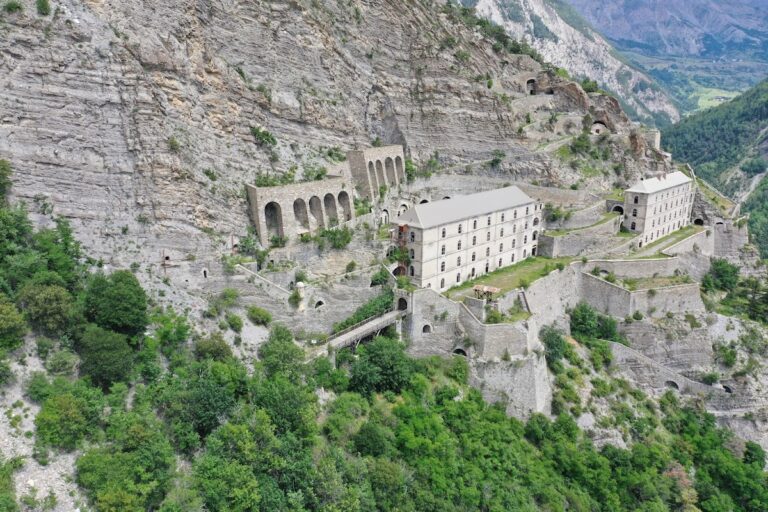
Fort de Viraysse occupies the summit of the Tête de Viraysse beside the Col de Mallemort, at 2,772 metres. It is a small enclosed artillery work built in masonry in the Séré de Rivières manner. Its defensive enceinte, an enclosing wall or perimeter, surrounds the battery, while small projecting bastions protected the perimeter. The route to the position was cut into the mountainside in hairpin bends, rising through the Col de Mallemort at 2,559 metres and the Col de Viraysse at 2,721 metres.
Summit artillery works
Enclosed battery
The main battery retains its defensive grilles and the arrangement of its gun positions. The positions were directed toward the Ubayette Valley, the Col de Larche, and the passes of Monges and Sautron. The artillery chambers and accommodation spaces included vaulted casemates, which were enlarged between 1890 and 1894. The main work survives in an altered and partially ruined condition.
Subsidiary battery
A subsidiary battery lies below the main position. It consists of four solid traverses, raised masses used to separate gun positions and protect them from side fire or explosions, with a gun platform between each traverse. Together, these elements formed a separate artillery arrangement below the summit work.
Defensive barracks
The barracks stand about 550 metres northwest of the battery, in a depression roughly 150 metres north of the Col de Mallemort, at an altitude of 2,503 metres. They form a large rectangular or quadrilateral enclosure around an interior courtyard. Projecting corner buildings provided flanking fire along the four outer fronts, while the bastions contain loopholes at foot level. Many of these openings were built in concrete, despite the predominance of stone in the complex.
The barracks are roofless and ruinous, with extensive deterioration across the complex. Surviving interior features include panelling in one ruined building, original shutters and window fittings, fine stables, and several Goux structures, small prefabricated sanitary buildings used in military compounds. A small Goux structure remains in the courtyard. The barracks also retain an unusually well-preserved cast-iron François-Vaillant stove, a military cooking range, cooking pots, another stove whose upper part has been removed, and several fine joinery elements.
Nearby sites