Château de Saveille: A Fortified Château in France



Site at a Glance
- Rating
- 4.6
- Popularity
- Low
- Country
- France
- Primary era
- Medieval
- External website
- Open
- Eras represented
- Medieval, Early Modern, Modern
- Civilizations
- French
- Site type
- Military
- Remains
- Castle
On this page8 sections
History
Château de Saveille is a fortified château in Paizay-Naudouin, France, with construction dating from the fourteenth century and a character that combines medieval defenses with Renaissance decoration. It stands within the historic region of Angoumois and later became associated with the Reformed communities of the area.
The lords of Saveille
The lands of Saveille were held by the Barrière family during the Middle Ages. Marguerite de Chasteigner married Pierre Barrière, a knight and lord of Saveille in Angoumois. Pierre, the son of Guillaume Barrière, rendered homage in 1333 for his tithes, acknowledging the obligations owed to his superior lord. Their granddaughter Jeanne, lady of Saveille, later married Jean de Montalembert.
The fortified seat and its jurisdiction
In 1508, Jacques de La Rochefaton, lord of Saveille, received the rights of châtellenie, a territorial lordship administered from a fortified seat, from his suzerain of Ruffec. The grant included high, middle, and low justice, meaning different levels of judicial authority, as well as permission to construct a fortified château on his land. In return, La Rochefaton paid 9,000 gold écus.
A Calvinist stronghold
After 1534, the La Rochefaton family adopted the Reformed religion, the Protestant tradition associated with the Reformation. The Touchimbert family later developed Saveille as a Calvinist stronghold, with its own Protestant temple. In 1685, members of the family presented the grievances of the Huguenots, the French adherents of the Reformed faith, to King Louis XIV.
Later ownership
By the 1860s, the château belonged to the Count of Bourdeilles, who had married Léonie, one of the four daughters of the Count of Neuilly, on 16 May 1832. The Disnematin de Salles family owned it from 1888 to 1917, followed by the Ligondés from 1917 to 1948. The Mas Latrie family are the current owners. Château de Saveille has been listed as a French historic monument since 2005.
Remains
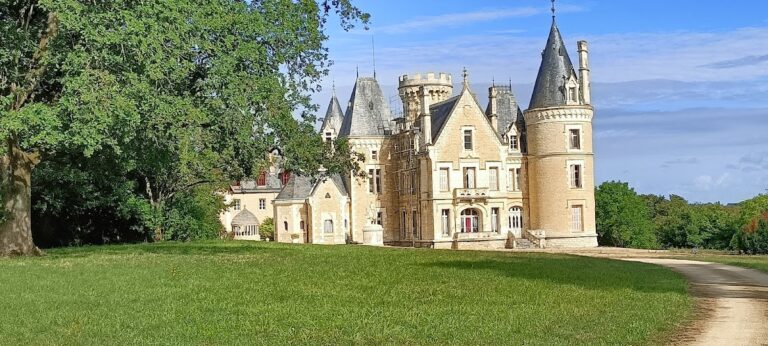
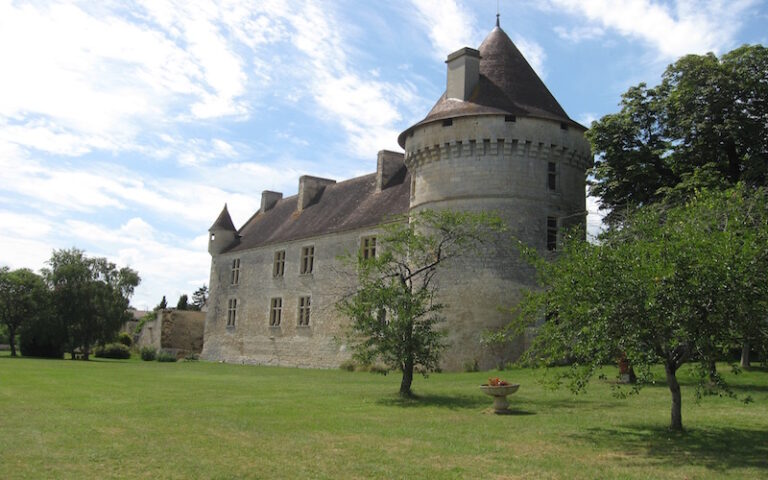
Château de Saveille occupies the center of a square enclosed by moats. Its L-shaped plan, steeply pitched roofs, and two large round towers give the building the appearance of a medieval fortified castle, while its decorative treatment also reflects the Renaissance, the European movement that revived classical forms between the fourteenth and sixteenth centuries.
Fortified château
A large round tower capped by a pepper-pot roof stands at each end of the building. A pepper-pot roof is a small, steeply conical roof often placed over a turret. These towers form part of the château’s fortified architectural character, while the surviving arrangement within the moated square expresses the organization of the site as a fortified residence.
South wing
The south wing was rebuilt in the nineteenth century in the Neoclassical style, which renewed the use of ancient Greek and Roman forms. Its reconstruction forms a later architectural phase within the L-shaped building, alongside the medieval-looking towers and the Renaissance decoration.