Anta 1 do Vale da Laje: A Prehistoric Burial Monument in Portugal
Site at a Glance
- Popularity
- Very Low
- Country
- Portugal
- Primary era
- Stone Age
- Eras represented
- Stone Age
- Civilizations
- Unclassified
- Site type
- Burial
- Remains
- Tomb
On this page12 sections
History
Anta 1 do Vale da Laje is a prehistoric dolmen, or stone burial monument, in the parish of Serra e Junceira, in the municipality of Tomar, Portugal. It is regarded as the oldest known dolmen north of the Tagus River. The monument belongs broadly to the Neolithic, a prehistoric period associated with farming and polished-stone tools, although its precise construction date is unknown.
Neolithic construction and later use
The tomb is thought to have formed part of a group of five dolmens. The other four have disappeared, and the numeral in its name distinguishes the surviving monument. A building phase was followed by more intensive use during the later Neolithic, which may have continued into the early Copper Age, a period of increasing copper use.
About 6,500 years ago, a new stone circle was constructed around the monument. After a period when the tomb fell out of use, it became a burial place again during the Bronze Age, when bronze was widely used. This later funerary use did not substantially alter the structure. About 90 people were buried at the site over roughly 3,000 years.
Excavation and modern protection
The monument was discovered in 1990 and has been excavated repeatedly since the early 1990s. Work in 1992 recovered 2,246 pottery pieces, many of them highly fragmented. Residue analysis found fats from ruminant and non-ruminant animals, as well as dairy fats. This provides the first direct indication of milk and dairy-product consumption in Portugal during the late fourth or early third millennium BCE.
Restoration took place in 2014. A Portuguese-British team excavated the site in 2017, with further work continuing through 2020. The 2017 excavation was coordinated by archaeologists Luiz Oosterbeek and Chris Scarre, with participation from the Instituto Terra e Memória in Mação. House construction had reached the site fence while the monument lacked formal protection. After the excavations, a classification process began on 16 July 2021.
Remains
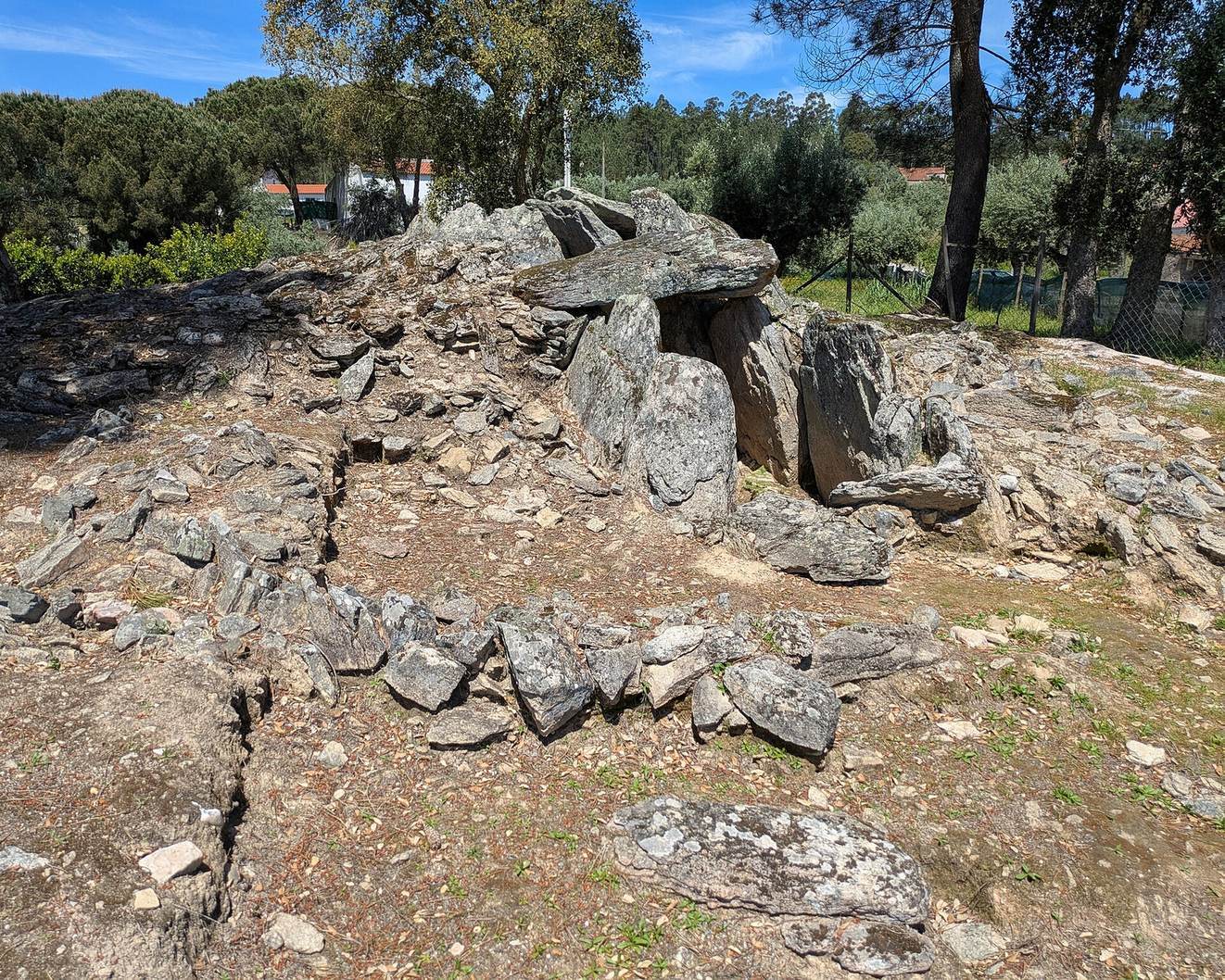
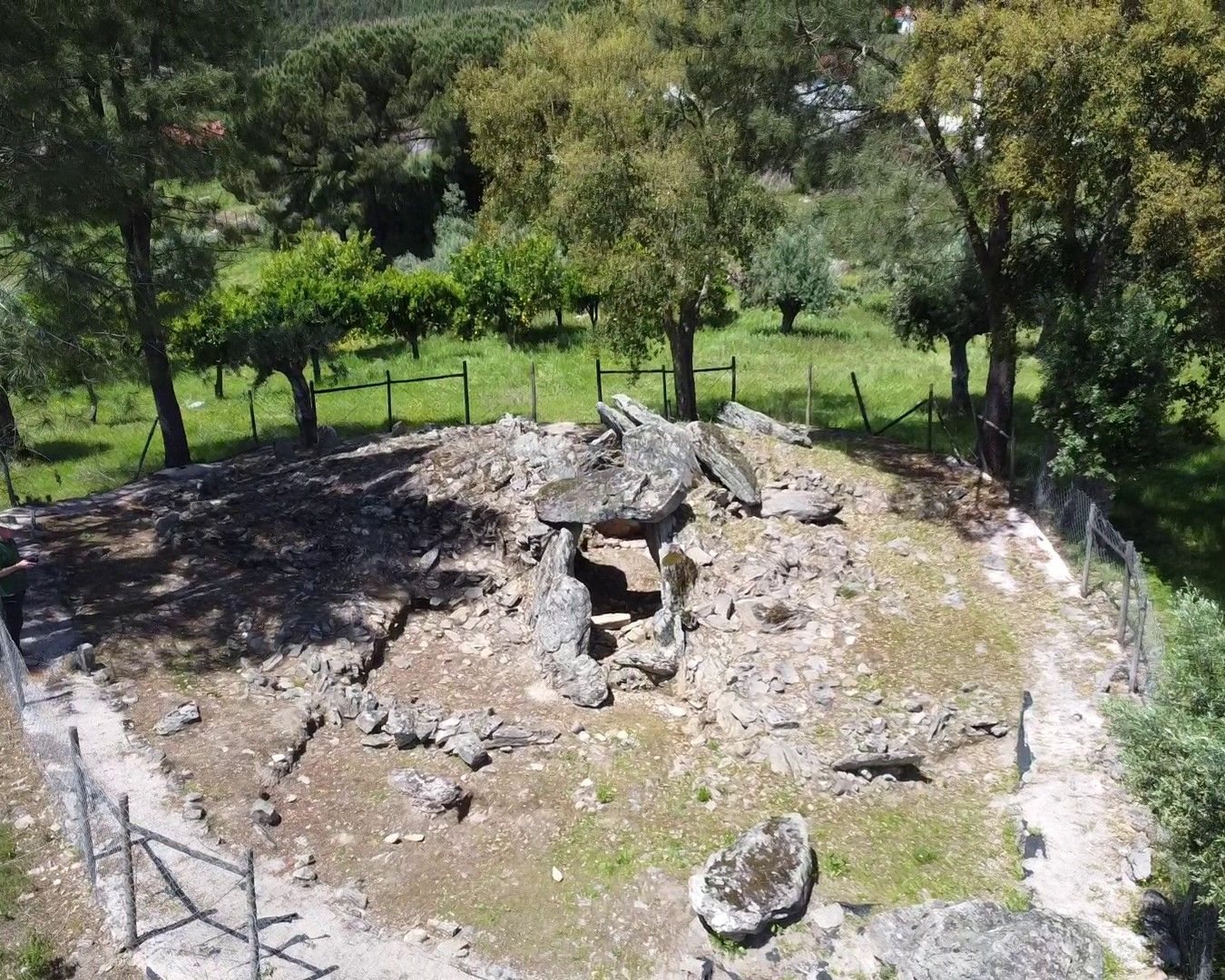
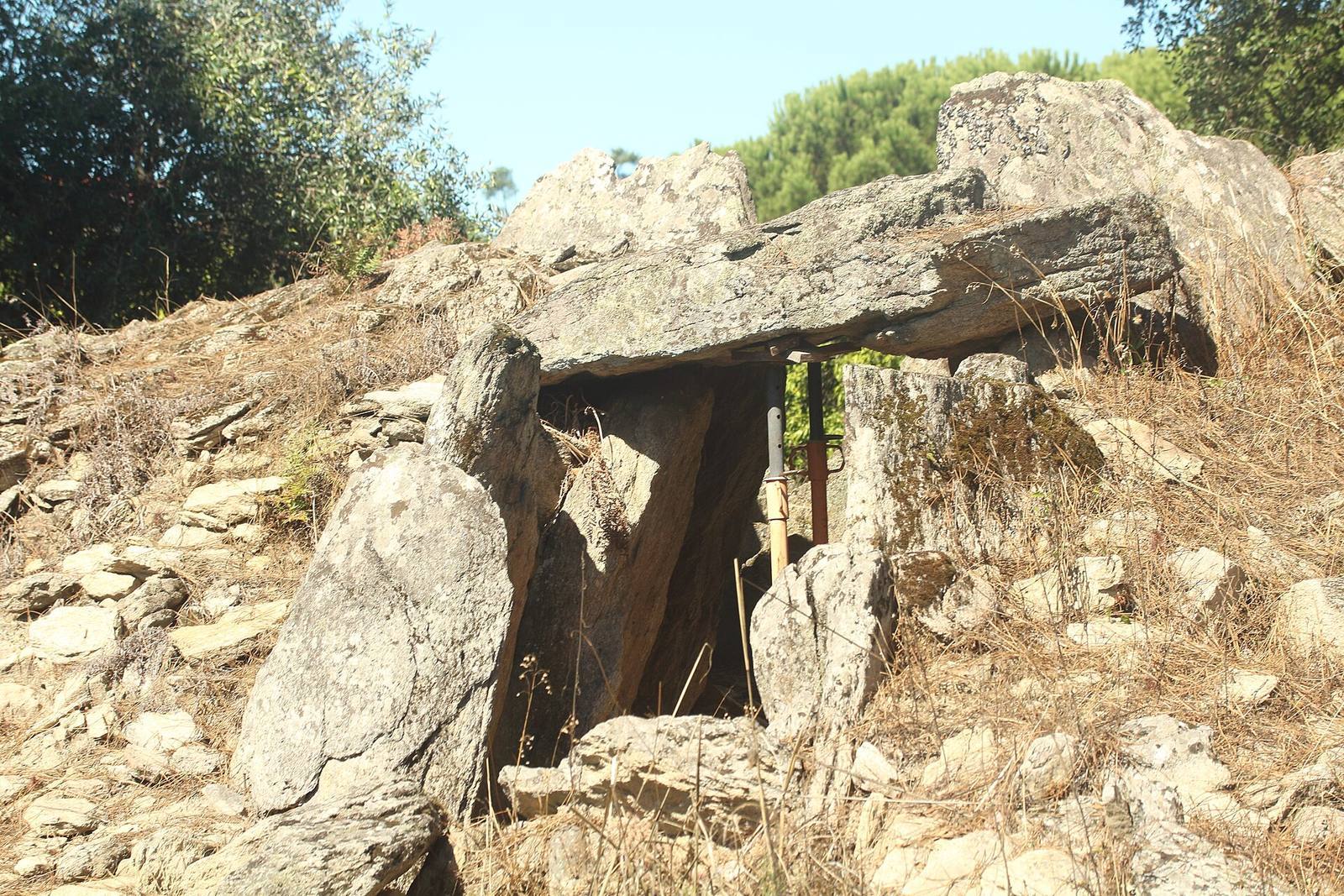
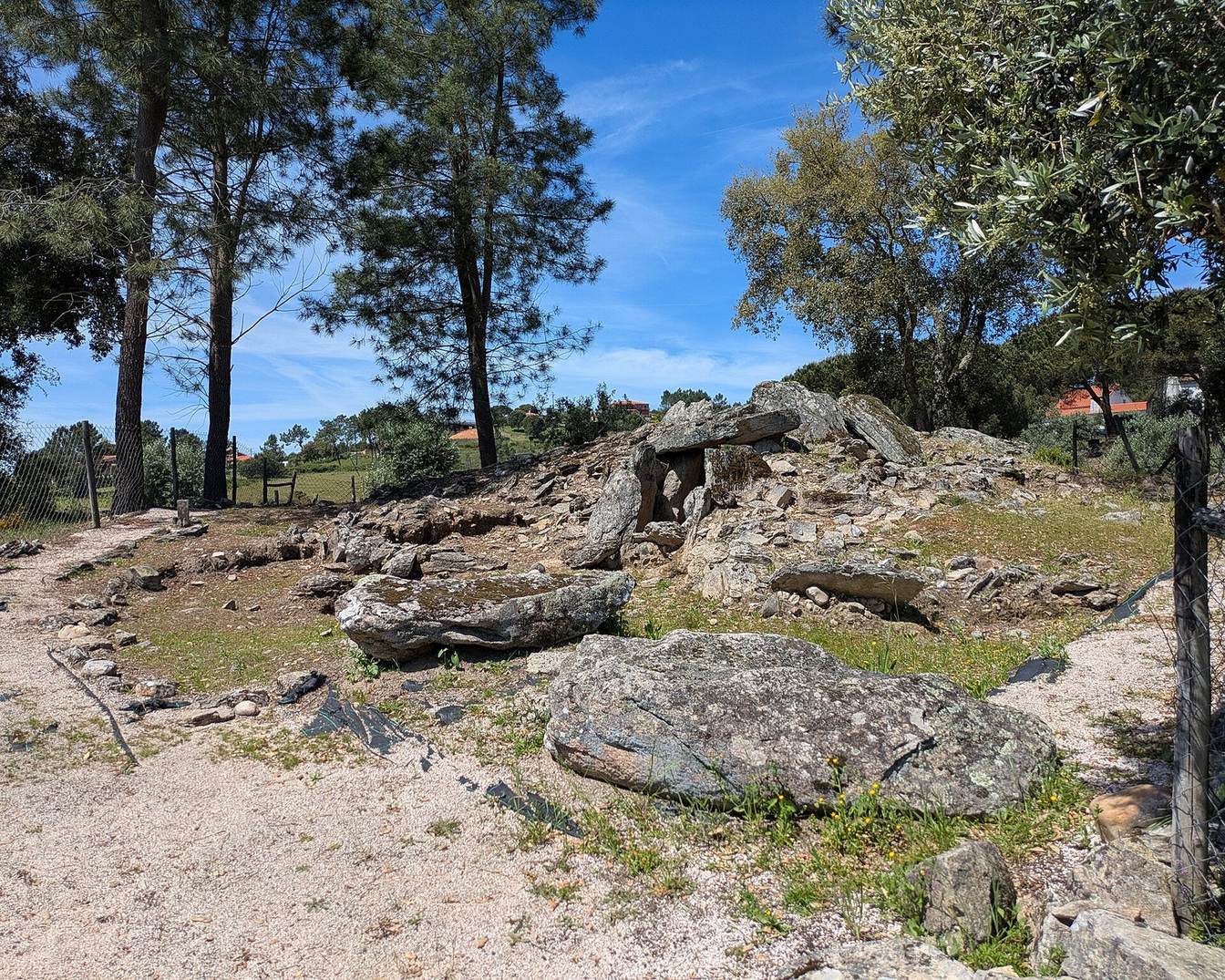
Set on a hill at about 160 metres above sea level beside an artificial dam, the dolmen lies approximately 10 kilometres southeast of Tomar. It is 5.8 metres long and built from stone. Its layout centers on a five-sided burial chamber, reached by a short entrance corridor, with a stone ring and earthen mound forming part of the original structure.
The burial structure
Chamber and corridor
Five large upright stones, each more than 2.5 metres high, form the pentagonal chamber. The stones are gneiss, a banded rock, taken from an outcrop about 100 metres away. A short, narrow corridor approaches the chamber slightly off-centre from the east. Several upright stones flank the passage. Two large roof slabs once covered it, but only one remains.
Stone ring and mound
Slabs originally encircled the tomb in a ring about 5 metres across. Ramps made from smaller stones extended from the ring, and an oval earthen mound, 9 to 10 metres in diameter, covered the structure. In front of the tomb, a platform of fine stones supported a small circular altar; its purpose is unknown.
Surrounding stone features
A later circle around the monument consists of small slabs interspersed with large quartz and quartzite pebbles. Some of the pebbles came from the nearby Zêzere riverbed. They may have reflected sunlight, making the monument easier to see from a distance.
Excavated layers and finds
Layers
Excavation identified four archaeological layers. The two middle layers correspond to the monument’s construction and its period of most intensive use. The disturbed upper layer contains remains dating from the Copper Age to recent times.
Objects
Finds include decorated plaques made of schist, bell-shaped pottery, a pendant, microliths (small stone tools), a polished axe, arrowheads, and other objects. Many recovered items can be seen at the Centro de Pré-História do Instituto Politécnico de Tomar.
Pottery
The pottery includes conical and hemispherical dishes, dishes with angled profiles, shallow plates, bowls of varied shapes, handled jars often fitted with necks, and closed rounded pots. Some bowls may have been used for cooking, while jars were probably used to store or carry goods. The rounded pots may have served as lamps.