Sulz Manor House: A Neoclassical Residence and Spa in Austria
Site at a Glance
- Popularity
- Medium
- Country
- Austria
- Primary era
- Modern
- Eras represented
- Modern
- Civilizations
- Austrian Empire, Habsburg, Hungarian
- Site type
- Domestic
- Remains
- Manor House
On this page8 sections
History
Sulz Manor House, also known as Kastell Sulz, is a neoclassical residence in Gerersdorf-Sulz, Burgenland, Austria, built around 1800 by Judith Countess Festetics von Tolna as a manorial home. In Hungarian usage, kastell referred to an aristocratic residence and did not necessarily mean a fortified castle. The house soon became the center of a spa and bathing complex.
Residence and spa development
Judith’s husband, Georg Count Festetics von Tolna, had begun developing Hévíz as a spa in 1795. About five kilometres north of his main residence at Keszthely, Hévíz was part of the family’s broader interest in bathing, which also took shape at Sulz.
The mineral spring at Sulz was already known when it was tapped anew in 1815. In 1816 or 1817, Judith had a bathing facility and guesthouse built for commercial use. Workers filled the marshy ground and redirected groundwater to prepare the site.
Changing ownership and the end of bathing
After Judith died in 1829, her heirs leased the bath in 1831 and sold it in 1833. Despite commercial success and increasing visitor numbers, the property changed hands repeatedly. In 1837 Alois Tárnok bought it and resold it a few months later to Count Karl Zichy von Zieh and Väszonkö, the lord lieutenant, or chief official, of Vas County and an imperial-and-royal chamberlain, a court officer in the Habsburg monarchy. Tárnok became estate manager and probably arranged for a pharmacist to carry out the first known analysis of Sulz’s water in 1838.
Baron Adolf Greminger bought the profitable bath as an investment in 1846. Political upheaval during the revolutions of 1848–1849 disrupted social life and reduced visitor numbers. The bath closed and was sold in 1850.
Mineral-water business and preservation
The spa grounds, with the house at their center, passed through several more owners. In 1904 Samuel Unger, a Vienna mineral-water merchant, bought the property. Because the bath was difficult to reach by rail, he ended bathing operations and focused on selling the mineral water. Later efforts to restart bathing did not shift the business away from water sales. The house remained part of the spa complex until World War II, although bathing had ended decades earlier.
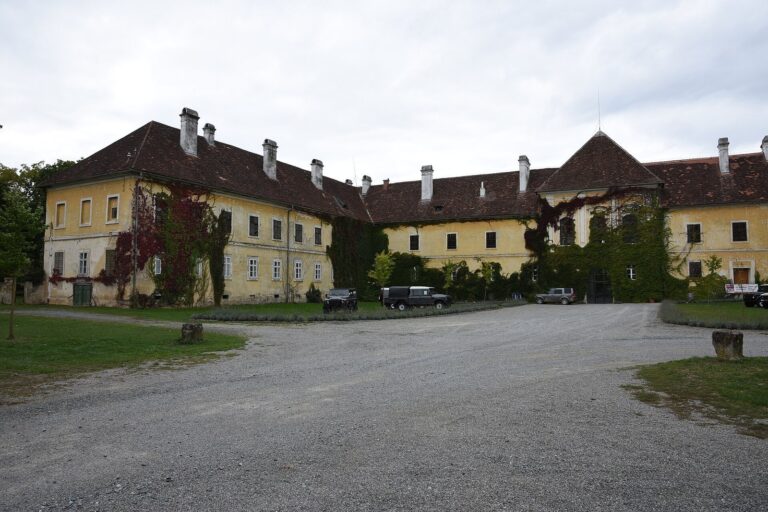
The house and mineral-water business subsequently changed hands again, and the building deteriorated. Güssinger-Vitaquellen-Mineralwasser AG used it as a workshop, and demolition nearly followed in the 1970s. The Kastell Association acquired the building in 1980 and carried out work over the following decades to slow its decay. Physician Sigurd Hochfellner bought it in 2018. The building is privately owned and protected as a monument.
Remains
The residence and its setting
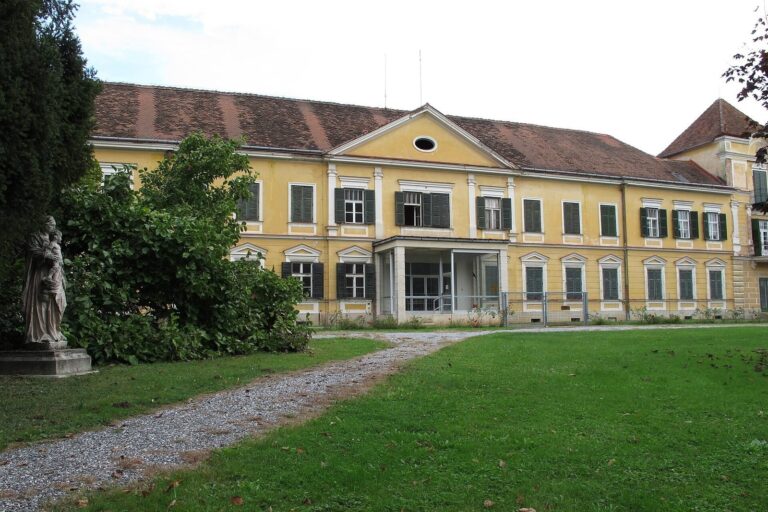
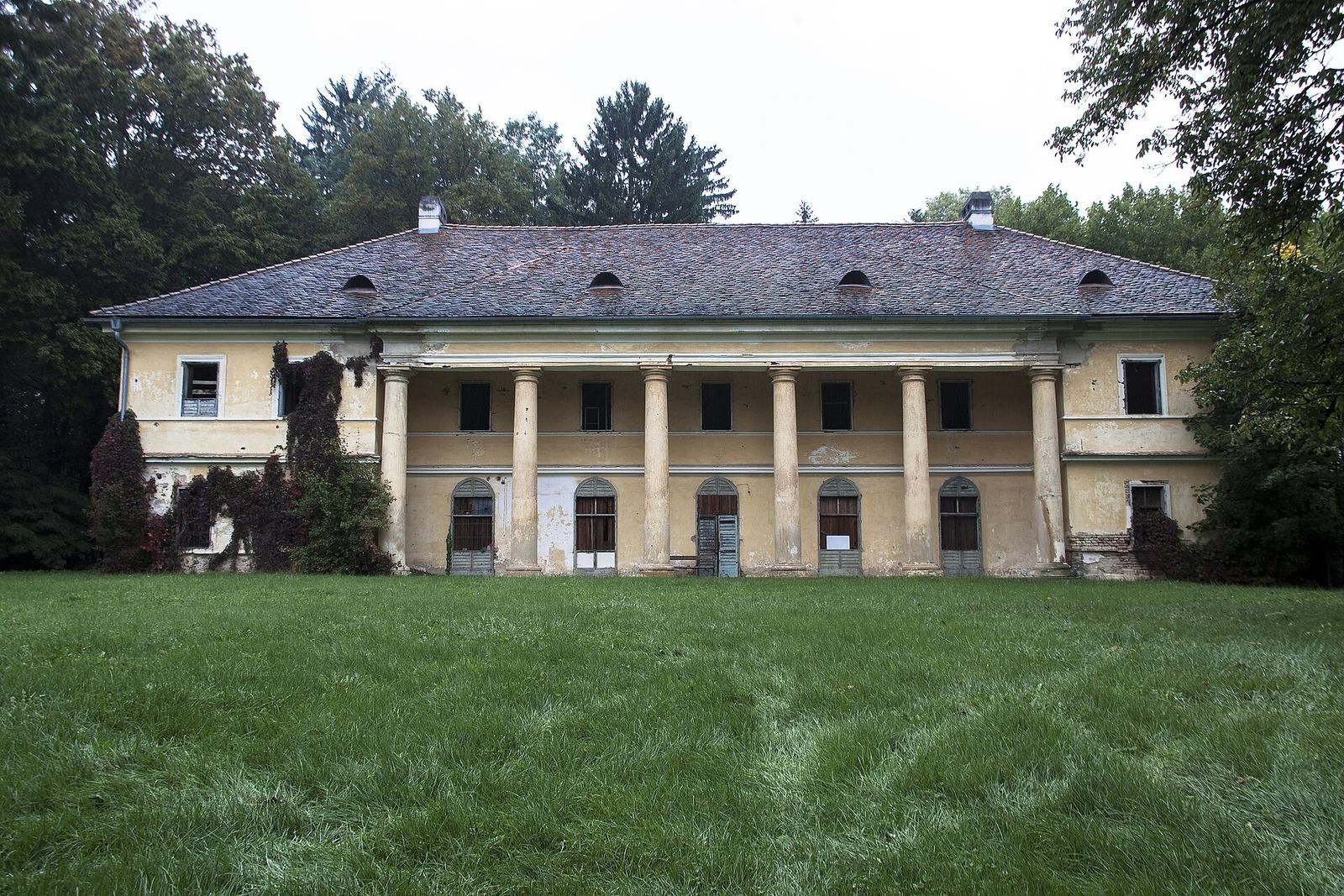
The ruinous two-storey house stands within a green area of about 4.2 hectares south of Sulz’s built-up area. Wooded slopes descend toward it from the west and north, steeply in places. Sulzer Straße (L188) runs along the grounds’ southern edge; across the road lies the former Güssinger Beverages & Mineralwater GmbH site, with the protected Vitaquelle spring house directly opposite the house.
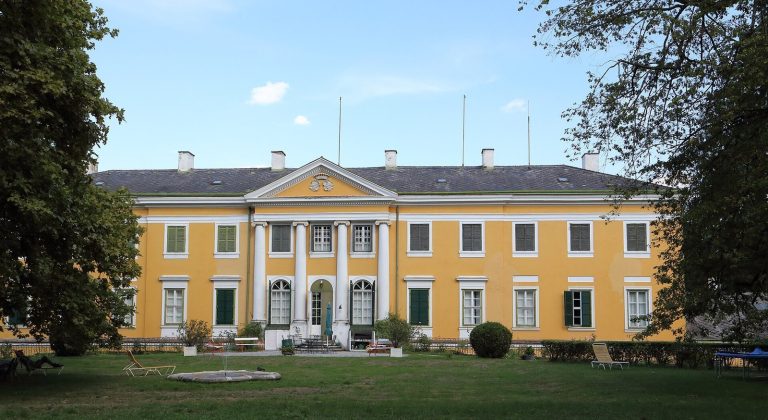
The neoclassical residence has a hipped roof and a prominent columned front facing south. Its recessed main section is arranged in five vertical bays and fronts a covered arcade supported by six round columns. The columns have Doric capitals, the upper parts of columns in the classical Doric order. A single-storey covered arcade with five bays and square columns extends from the east side to a pavilion. The pavilion has a square roof lantern and a pyramidal roof, and originally provided access to the bathing facilities.
Bathing facilities and water supply
The spa grounds included a bathing facility and guesthouse, with a stone wellhouse built over the main spring. Three pump wells supplied water through wooden pipes. Two stood near the residence, one to the east and one to the south; another spring was near the gardener’s house. The wells served both drinking and bathing, and the mineral-water wells had wooden or stone wellhouses. The main spring supplied about 30 buckets of water a day.
Finds from the spring
Work on the spring in 1815 brought Roman gold coins and a statue of a nymph to light. These finds are archaeological evidence associated with the site.