Angevin Castle: A Medieval Coastal Fortress in Italy


Site at a Glance
- Rating
- 4.6
- Popularity
- Very Low
- Country
- Italy
- Primary era
- Early Modern
- Eras represented
- Medieval, Early Modern
- Civilizations
- Kingdom of Naples, Spanish
- Site type
- Military
- Remains
- Castle
On this page6 sections
History
Angevin Castle is a medieval coastal fortress in Mola di Bari, Italy, built by Angevin rulers between 1278 and 1281. Ordered by Charles I of Anjou during the rebuilding of Mola, it formed part of a coastal defense system intended to protect the Adriatic shore from pirate raids.
Angevin foundation
Construction was supervised by Pierre d’Angicourt, known as the “King of Carpenters,” and Jean da Toul. The castle’s position on the shoreline gave it a defensive role within the medieval settlement and connected its history to the development of Mola under Angevin rule. Charles I was a French prince who became king of Sicily and Naples, and his government supported coastal fortification in the region.
Feudal control and Venetian attack
During the fifteenth and sixteenth centuries, the castle passed among several feudal lords. It resisted repeated attacks and was never captured. In 1508, however, a Venetian siege damaged the fortress and partly destroyed it.
Charles V ordered its reconstruction and reinforcement in 1530. The changes responded to the spread of firearms. The earlier defenses had been effective against catapults but were vulnerable to artillery, whose gunpowder projectiles required stronger and more sloping fortifications. Charles V, the Habsburg emperor, promoted military changes during the conflicts of the sixteenth century that encouraged this modernization.
Vaaz ownership and later history
In 1613, the merchant Michel Vaaz acquired the castle. It remained with the Vaaz family for more than two centuries before being sold to the Italian Ministry of Defence in 1849. The interior spaces were repeatedly rebuilt and altered over time and are now used for conferences. Angevin Castle is recognized as Italian national heritage.
Remains
Fortress and coastal defenses
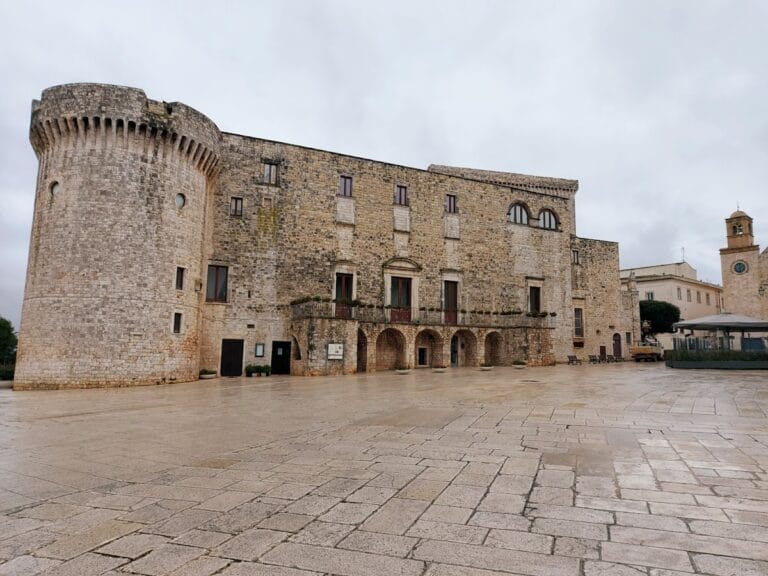
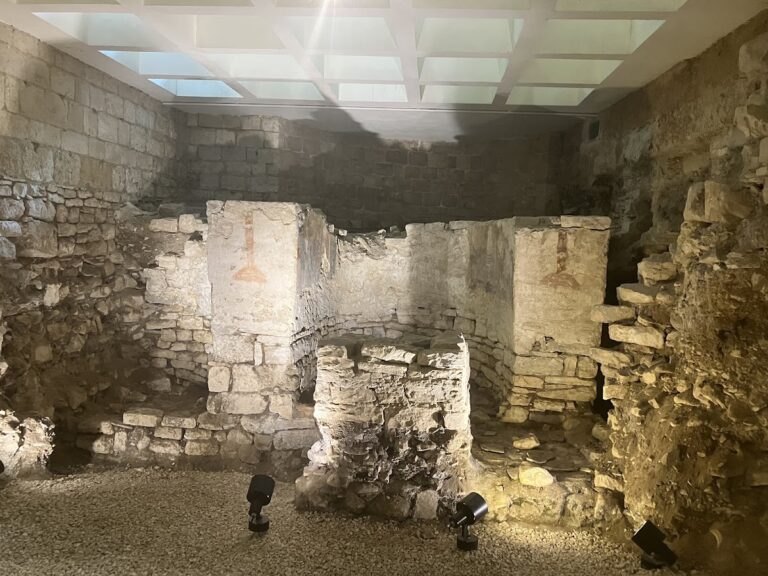
The restored fortress stands on the Adriatic shoreline at approximately seven metres above sea level. It has the angular form of a star fort, a design with projecting points that allowed defenders to cover the surrounding walls with crossfire. The structure is built of rubble masonry, with powerful sloping walls designed to withstand firearm attacks.
The surviving fortifications include numerous portcullises, heavy latticed gates that could be lowered vertically across fortified entrances. A moat formerly surrounded the castle and connected with the sea, while a bridge linked the fortress to the town walls. Behind the castle, Piazza XX Settembre contains the Van Westerhout Theatre and the Church of Saint Nicholas, Mola di Bari’s principal church.
Nearby sites