Cathedral Basilica of the Assumption of Mary: Cathedral of Conversano, Italy


Site at a Glance
- Rating
- 4.6
- Popularity
- Low
- Country
- Italy
- Primary era
- Medieval
- External website
- Open
- Eras represented
- Medieval
- Civilizations
- Kingdom of Naples, Norman
- Site type
- Religious
- Remains
- Cathedral
On this page9 sections
History
The Cathedral Basilica of the Assumption of Mary is the Roman Catholic cathedral of Conversano, Italy, and the seat of the Diocese of Conversano-Monopoli. Dedicated to the Assumption of the Virgin Mary, it originated probably in the late eleventh century, when a cathedral was rebuilt on the site of an earlier church. That earlier building may itself have adapted a pre-Christian religious structure. The present cathedral belongs broadly to the eleventh and twelfth centuries and follows the Apulian Romanesque tradition of southeastern Italy.
Medieval cathedral
The cathedral was renovated between 1358 and 1379, while its original forms were retained. In 1359, Bishop Antonio d’Itri promoted the completion of the sculptural decoration, particularly on the facade. This medieval phase helped establish the building’s architectural and decorative character before later changes transformed its interior.
The cathedral also acquired important religious associations during the later Middle Ages. A relic of Flavian of Constantinople, regarded as a co-patron of Conversano, was brought to the church from Giulianova between 1483 and 1494. The building’s patronal icon, the Madonna della Fonte, is a painting dated approximately to the thirteenth century.
Tradition of the Madonna della Fonte
Tradition holds that the Madonna della Fonte reached Conversano in 487 with Simplicio, identified as the city’s first bishop. He was said to have rescued the painting from a church fire in Africa during conflicts with followers of Arianism, a Christian movement whose teaching about the relationship between the Father and the Son was later rejected as heretical by orthodox Christianity.
According to the same tradition, the vessel carrying the icon made two unsuccessful attempts to land at Polignano. It eventually reached the coast at Cozze, then a hamlet of Conversano. This arrival was interpreted as a sign that Conversano was the icon’s intended destination, linking the painting to the city’s religious identity.
Baroque transformation and twentieth-century reconstruction
During the Baroque period, the interior was radically altered. Stucco covered the walls, the ceiling was lowered and painted with sacred images and arabesque motifs, and additional altars changed the arrangement of the side aisles. These interventions gave the interior a different appearance from the Romanesque structure that had survived on the exterior.
In 1877, the local architect Sante Simone proposed restoring the cathedral’s original Romanesque character. The proposal met strong local opposition, but its approach was effectively implemented after a fire in 1911 destroyed almost all of the interior furnishings. A few furnishings were saved from the flames, while the facade and apsidal section were the principal parts recovered. Bishops Antonio Lamberti and Domenico Lancellotti promoted the reconstruction, which was completed in 1926 when the cathedral reopened for worship.
In June 1997, Pope John Paul II elevated the cathedral to the status of a minor basilica, a special Catholic liturgical and ecclesiastical designation granted by the pope. The building is also designated an Italian national monument.
Remains
Setting and overall plan
The cathedral stands on Conversano’s acropolis, well within the ancient megalithic walls. All four sides are separated from the surrounding buildings. Its present architectural character follows Apulian Romanesque models, with a T-shaped, or tau-cross-shaped, plan and apses facing east.
The entrance does not open onto the principal square. Instead, it faces a separate open space toward Corte Altavilla, the former seat of the Counts of Conversano. This arrangement reflects the cathedral’s westward orientation, which differed from the orientation of the castle around which the principal square developed. A groove on the side facing the square served as a unit of measurement for the local market.
Facade and portals
The gabled facade has a slightly stepped profile, with hanging blind arches beneath the cornice. Pilasters divide it into three sections. In the upper part, a fifteenth-century rose window has twelve rays and a double frame, while two smaller oculi flank it.
Three portals open onto the facade. The central portal carries rich sculptural decoration, including two stylophore lions. A stylophore is a sculpted figure that symbolically supports an architectural element. Here, the lions support a projecting porch crowned by a tympanum.
Naves, apses, and surviving furnishings
The interior is arranged as three naves with upper galleries, or matronea, which are tribunes opening into the church space. These galleries correspond to three semicircular apses in the presbytery. A fifteenth-century fresco associated with the Pisan school covers the entire left apse.
Blind arches open along the sides of the naves. Their decorations include a fifteenth-century wooden crucifix and the icon of Maria Santissima della Fonte. Both survived the 1911 fire, unlike most of the interior furnishings, and remain among the objects that connect the present interior with the cathedral’s earlier history.
Bell tower and organ
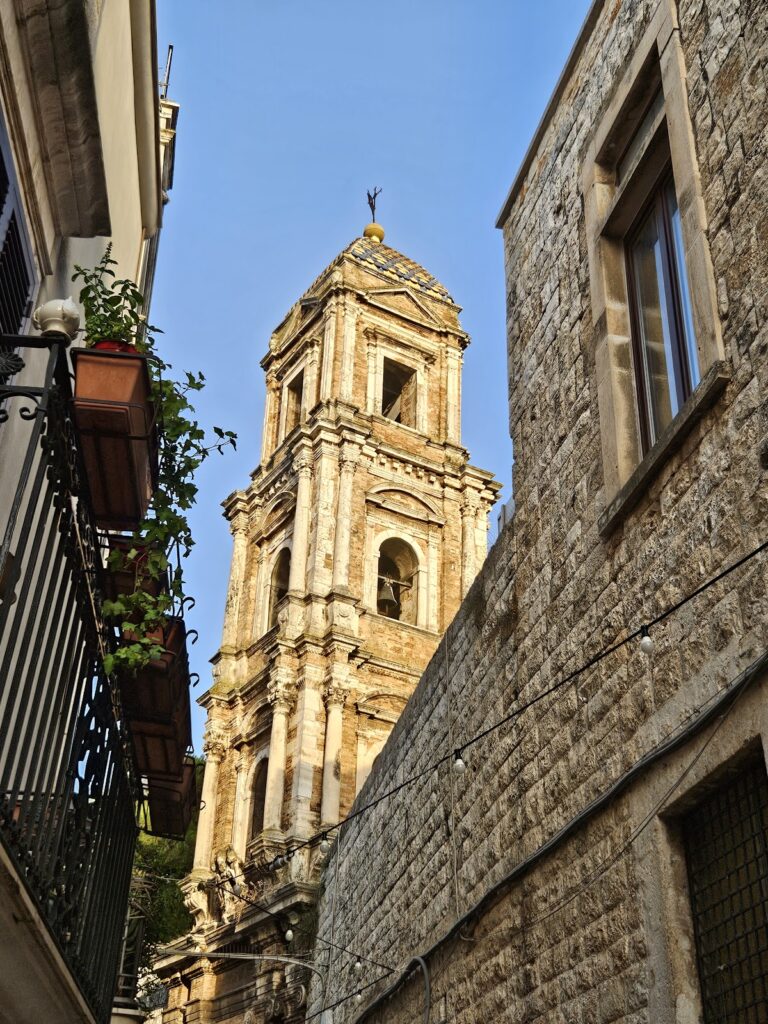
The original bell tower was halted halfway through construction by a notarial act issued by the abbesses of the monastery of San Benedetto. The present bell tower was built later, and its clock was added subsequently after the required consent and authorizations.
The cathedral’s pipe organ was built in 1935 by Balbiani Vegezzi Bossi of Milan. It stands on a stone loft in the transept, while its console is at floor level. The arrangement reflects a later intervention in which the pipes were moved from their original case.
The instrument has two chromatic keyboards of 58 keys each and a concave pedalboard with 30 pedals. The first manual contains Principale 8′, Bordone 8′, Ottava 4′, and a five-rank Ripieno. The second manual, enclosed in an expressive case, contains Eufonio 8′, Flauto 4′, and Voce Celeste. The pedal division contains Subasso 16′ and Basso 8′.
Its mechanism uses electric transmission, with two lantern bellows at the rear, a curtain valve, and a Daminato electric blower. The controls include fixed combinations, couplers for the pedal and manuals, Ripieno and Tutti controls, and swell and crescendo pedals.
Nearby sites