Aquinum: An Ancient Roman City in Italy


Site at a Glance
- Rating
- 4.6
- Popularity
- Very Low
- Country
- Italy
- Primary era
- Classical
- External website
- Open
- Eras represented
- Classical, Medieval
- Civilizations
- Kingdom of Sicily, Roman
- Site type
- City
On this page17 sections
History
Aquinum is an ancient city in Italy, located in the territory of Castrocielo and Aquino in the Province of Frosinone. Its origins reach back to prehistoric settlement, while its development as a major urban center began under the Volsci and continued after Roman conquest in the fourth century BC. Positioned on the Via Latina, the Roman road linking Rome with southern Italy, Aquinum became a commercial and productive center and later one of the principal settlements between Rome and Capua.
Volscian origins and Roman expansion
The foundation date of Aquinum is uncertain. The surrounding territory was inhabited from the Neolithic period, and the settlement became Volscian during the fourth century BC. The Volsci were an ancient Italic people who occupied parts of southern Latium before Roman expansion. Tradition attributes the foundation of Aquinum to them and recalls their defense of the settlement against the Samnites, another Italic people and a major regional rival of Rome.
Rome conquered Aquinum during the fourth century BC. Around 300 BC, the city was made a municipium, a Roman town whose inhabitants held civic rights under varying conditions. It was a municipium by the time of Cicero and became a colonia in 39 BC, during the Triumvirate, the three-man government established after the assassination of Julius Caesar. Aquinum is also traditionally said to have received the title urbs in 211 BC, a designation previously reserved for Rome. After nearby Fregellae was destroyed in 125 BC, Aquinum’s strategic importance increased, and it became the most important center between Rome and Capua.
The imperial city
Aquinum continued as a municipium during the imperial period, possibly until the third century. It possessed the right to mint its own coins under Roman authority, and bronze issues bearing a rising rooster are associated with the city. Its population may have reached about 40,000.
The city is traditionally regarded as the birthplace of Juvenal, the Roman satirical poet. One villa in the archaeological area has been proposed as his possible birthplace, although the attribution remains uncertain. Aquinum has also been associated, with similarly uncertain attribution, with Pescennius Niger, a Roman military commander proclaimed emperor during the civil wars of AD 193 and 194.
Christian institutions and Lombard conquest
An episcopal see, the jurisdiction and administrative center of a bishop, existed at Aquinum by approximately 450 or at least by the fifth century. After the death of Bishop Jovinus around 593, the see remained vacant. The Lombards, a Germanic people who established a kingdom in Italy after the weakening of Roman imperial rule, conquered Aquinum in 577.
The inhabitants later moved eastward to a settlement between two lakes. The lakes were subsequently drained, although three lakes remained near the urban center until the sixteenth century. Aquinum’s ecclesiastical organization changed over time. Its diocese was united with Pontecorvo in 1742 and incorporated into the Diocese of Sora in 1818. In 2014, the parishes of Montecassino Abbey were added, and the diocese took its present name, the Diocese of Sora-Cassino-Aquino-Pontecorvo.
The County of Aquino
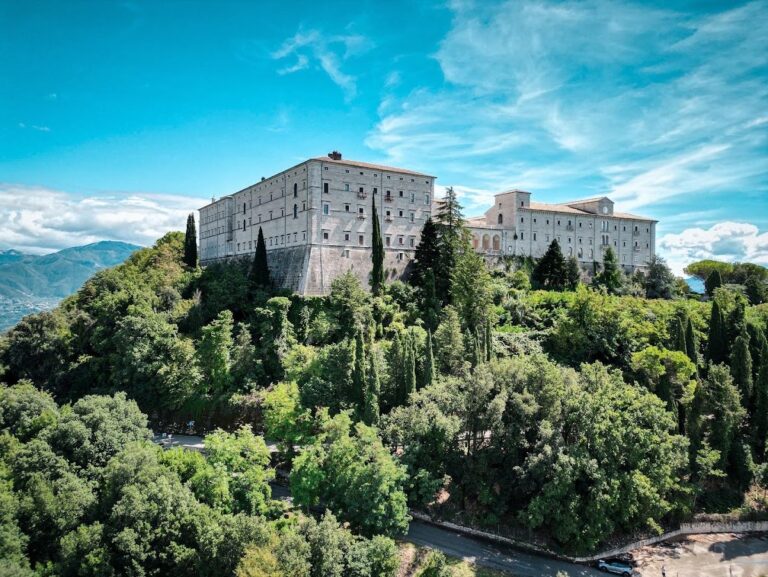
The County of Aquino was established in the twelfth century within the Norman Kingdom of Sicily. The counts controlled territory between Fregellae and Cassino and competed with the abbots of Montecassino. Aquinum may have been destroyed again in 1252 by the army of King Conrad IV, although voluntary submission to him is also recorded. The castle of the count survived this episode.
In 1461, Onorato Caetani, lord of Sermoneta, operated a mint at Aquino to support the military cause of John of Anjou, a claimant to the throne of Naples. During the late fifteenth century, Aquino passed by marriage to the Catalan D’Avalos family. In 1583 it was sold to Giacomo Boncompagni, the legitimized son of Pope Gregory XIII and Duke of Sora. King Ferdinand IV of Bourbon purchased it in 1796 for the Kingdom of Naples.
Modern political changes and archaeological work
Aquino became part of the Kingdom of Italy in 1861. In 1927, it was transferred from the former province of Terra di Lavoro to the newly established Province of Frosinone.
Archaeological excavation of ancient Aquinum has taken place annually since the beginning of the twenty-first century. The excavated area remains only partly exposed. The medieval church of Santa Maria della Libera was built over the earlier temple of Hercules Liberator, a Roman cult form invoking Hercules as a liberator or protector. Its plain interior reflects nineteenth-century restoration, a treatment retained after wartime damage in 1944.
The church of Santi Costanzo e Tommaso d’Aquino serves as the co-cathedral of the Diocese of Sora-Cassino-Aquino-Pontecorvo and has held the honorific title of minor basilica since 1974. Thomas Aquinas was not born at Aquino. He was born at Roccasecca, about eight kilometers to the north, in the castle of a collateral branch of the Aquino family.
Remains
The archaeological area of Aquinum lies west of the medieval town, largely within agricultural land in the territory of Castrocielo, while the wider site extends across the municipalities of Aquino and Castrocielo. The ancient urban area was partly enclosed by Augustan-period walls made from large limestone blocks. Within and around this boundary, surviving remains include roads, monumental buildings, religious structures, residential villas, and a Roman honorific arch.
Ancient urban structures
Walls and Porta Capuana
Portions of the Augustan walls survive in large limestone blocks. The Porta Capuana, also called Porta San Lorenzo, stands directly over the Via Latina and is almost completely preserved. The ancient road passed through this gate as it crossed the city.
Temples and public buildings
The ancient city contains the remains of two temples, a Roman basilica, a theatre, an amphitheatre, and a large public bathing complex. In Roman urban architecture, a basilica was generally a substantial public hall. The baths are among the largest in Italy, and recent investigations have excavated substantial sections of the complex.
Villas and mosaics
Several Roman villas occupy the archaeological area. One has been proposed as the possible birthplace of Juvenal, although this identification is uncertain. Excavated areas, including the public baths, have yielded mosaics showing an elephant, a rhinoceros, and marine creatures. A latrine contains a separate mosaic with comic-erotic imagery.
Arco di Marcantonio
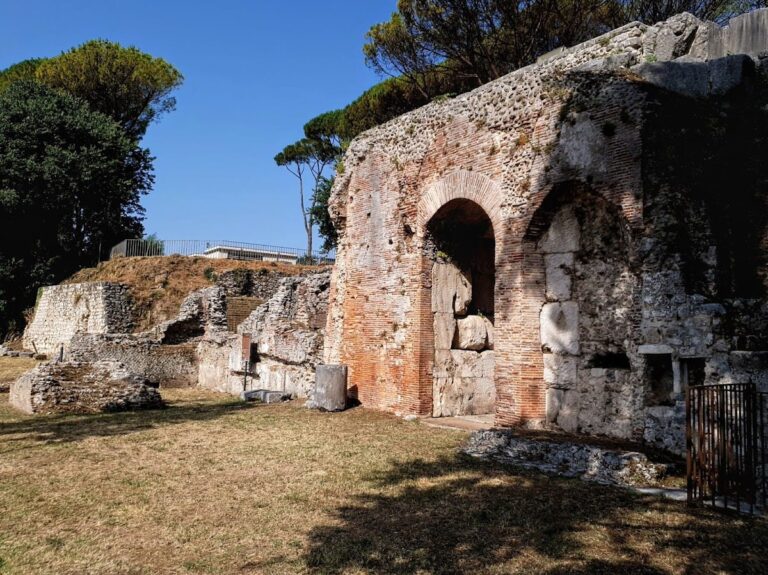
The structure known as the Arco di Marcantonio is a Roman honorific arch south of the ancient city, near Santa Maria della Libera. It dates from the second half of the first century BC or, more broadly, the first century BC. Its composite capitals survive, while the upper part is incomplete. The popular connection with Mark Antony depends on a vague reference in Cicero’s Second Philippic and is not certain.
Santa Maria della Libera
Santa Maria della Libera is a ninth-century Romanesque church erected over the remains of the temple of Hercules Liberator. Older Roman building elements were reused in the medieval structure. These architectural spolia, meaning older elements incorporated into a later building, include a three-arched portico and a portal formed from Roman pieces bearing floral reliefs.
The portal lunette, a semicircular space above a doorway, contains a mosaic of the Madonna and Child between two female founders associated with the D’Aquino family. The women are represented in coffins. Several Roman inscriptions are built into the church, while other inscriptions found in the surrounding area attest to the importance of the ancient settlement. The church interior is undecorated as a result of its nineteenth-century restoration, and the building is now roofless.
Medieval town and castle
Churches and former cathedrals
The medieval settlement contains the co-cathedral of Saints Constantius and Thomas Aquinas, the church of San Pietro Vetere, the church of San Marco, and the Church of the Sacred Heart. Other ecclesiastical sites include the former or earlier cathedrals of Santa Maria degli Angeli on the Roman road, San Costanzo in the Vallone historic-natural park, a third cathedral near the tower of Saint Thomas Aquinas, and a fourth cathedral dedicated to Saints Constantius and Thomas Aquinas.
Castle of the Counts of Aquino
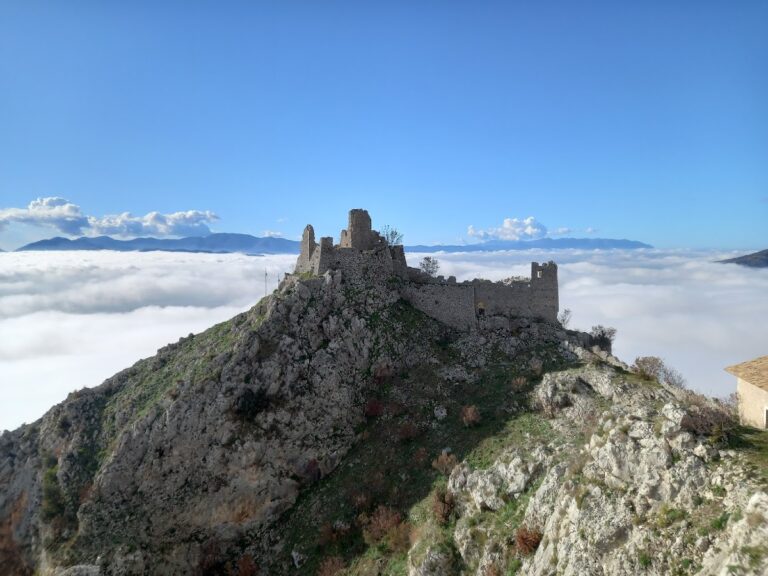
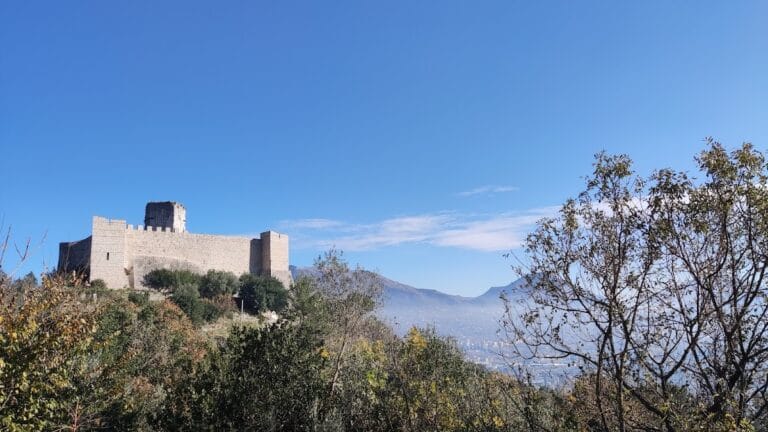
The castle of the Counts of Aquino was built above a low rocky slope southwest of the medieval town. After wartime destruction, its surviving elements include a tall square keep with an upper wall-walk, a defended passage along the top of a wall. The principal building, known as the Casa di San Tommaso, has two substantial upper-storey bifora windows, each divided into two lights by a central support. Smaller buildings and a round tower near the Forme d’Aquino stream also survive.
A ruined tower associated with Saint Gregory the Great remains part of the castle area. The name Casa di San Tommaso refers to Thomas Aquinas, whose actual birthplace was the castle at Roccasecca rather than this building.
Civic museum
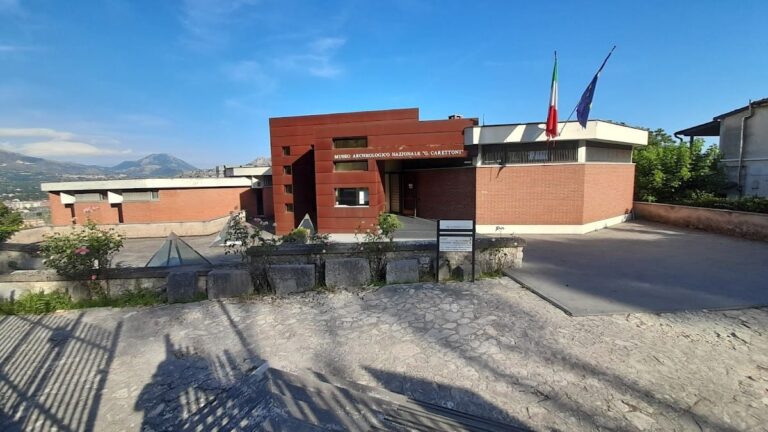
At the western edge of the town, a modern purpose-built civic museum contains material from Roman Aquinum. Its collections include architectural elements, sarcophagi, stone inscriptions, and craft objects. The final room presents the lives of Thomas Aquinas and Saint Constantius of Aquino, the town’s patron saint and a Christian bishop associated with the settlement.