Abbey of Monte Cassino: A Benedictine Monastic Centre in Italy


Site at a Glance
- Rating
- 4.7
- Popularity
- High
- Country
- Italy
- Primary era
- Early Modern
- External website
- Open
- Eras represented
- Classical, Medieval, Early Modern
- Civilizations
- Kingdom of Naples, Lombard, Roman, Spanish
- Site type
- Religious
- Remains
- Monastery
On this page18 sections
History
The Abbey of Monte Cassino is a Benedictine monastery in Italy, standing on the summit of Monte Cassino above the town of Cassino in Lazio. Benedict of Nursia founded it around AD 529–530 on a site associated with the Roman settlement of Casinum, and the complex later acquired a dominant Neapolitan Baroque character. From its foundation, Monte Cassino became the principal house of the Benedictine movement and one of the most influential religious and intellectual centres in medieval Europe.
Roman and Early Christian Foundations
The rocky summit had already served as a fortified centre. The Volsci established a citadel there before the Romans defeated them in 312 BC and developed Casinum as a Roman settlement. The Romans later built a temple dedicated to Apollo, a major deity associated with prophecy, healing, music, and the arts. An amphitheatre, theatre, mausoleum, and other remains in the surrounding area reflect the continuing Roman presence.
According to Pope Gregory I, also known as Gregory the Great, Benedict destroyed the pagan image and altar when he established the monastery. He adapted the temple for Christian worship, creating an oratory dedicated to Saint Martin of Tours, a fourth-century bishop and missionary in Gaul. A second oratory dedicated to Saint John the Baptist was established where the Apollo altar had stood. These acts placed the new monastery within an earlier sacred and political landscape.
Benedictine Foundation
Benedict remained at Monte Cassino until his death. Here he composed the Rule of Saint Benedict, a sixth-century guide to monastic discipline, communal prayer, work, study, and care of the sick. The rule became the principal foundation of Western Benedictine monasticism. Benedict was traditionally buried in the oratory of Saint John with his sister Scholastica, who is venerated in the same religious tradition.
The community also established a hospital. Its charitable treatment of the sick was regarded as an early model for hospitals in medieval Europe, adding medical care to the monastery’s religious and educational functions.
Destruction and Restoration in the Early Middle Ages
A Lombard attack around 577 destroyed the monastery. The surviving monks withdrew to Rome, taking Benedict’s remains with them according to historical tradition. A later tradition claimed that the relics of Benedict and Scholastica were transferred to monasteries in Gaul. The resulting dispute between Monte Cassino and French religious institutions over the relics’ authenticity continued for generations.
Petronax of Brescia re-established the monastic community around 717–718 at the instigation of Pope Gregory II, with support from Lombard and ecclesiastical authorities. The community was placed directly under the pope. Monte Cassino then became an influential model for other Benedictine foundations and developed connections with both the Lombard and Carolingian worlds.
Carloman, the son of Charles Martel, spent his later years at the monastery, while Charlemagne visited in 787 and granted it privileges. Paul the Deacon wrote his history of the Lombards while he was a monk at Monte Cassino, and the monastery influenced the foundation and organization of Fulda.
In 744, a donation by Gisulf II of Benevento created the secular territory known as the Terra Sancti Benedicti, or Land of Saint Benedict. Governed by the abbot and subject only to the pope, this territory made Monte Cassino the centre of a strategically important state between Benevento and the Byzantine coastal city-states.
Another catastrophe came in 883, when Saracen forces sacked and burned the monastery and killed Abbot Bertharius. The monks withdrew first to Teano and later to Capua. Reconstruction began around 949 under the direction of Pope Agapetus II. Cluniac reform practices were introduced during the years of exile, although their subsequent development at Monte Cassino remained limited.
Cultural and Political High Point
The eleventh and twelfth centuries brought the abbey’s greatest cultural and political influence. In 1057, Pope Victor II recognized the abbot of Monte Cassino as having precedence over all other abbots. Three monks later became popes: Stephen IX, Victor III, and Gelasius II. The abbey also produced bishops and cardinals and exercised authority through its territorial state.
Abbot Desiderius, who governed from 1058 to 1087 and later became Pope Victor III, directed a monumental rebuilding of the monastery. Artists from southern Italy and Constantinople were employed, while the library and scriptorium, the monastic workshop for producing manuscripts, were expanded. Monte Cassino became a centre of theology, history, medicine, education, and manuscript production. Greek and Arabic medical works were translated there, contributing to the development of the medical school at nearby Salerno.
Pope Alexander II consecrated the rebuilt abbey church in 1071. The monastery’s historical writing included the chronicles associated with Leo of Ostia, Amatus of Monte Cassino, and Peter the Deacon. Erchempert had earlier produced an important history of the southern Italian Lombards. The abbey preserved ancient works, illuminated manuscripts, early vernacular documents, and medical texts, while Beneventan script, a medieval script used especially for Latin manuscripts in southern Italy, flourished in its writing culture.
Decline, Rebuilding, and Suppression
Monte Cassino entered a period of decline in the thirteenth century. In 1239, Emperor Frederick II stationed troops there during his conflict with the papacy and expelled the monks. In 1294, the abbey was incorporated into the Celestines, a Benedictine reform congregation founded by Pietro da Morrone, later Pope Celestine V. Pope John XXII raised the abbey and its territory to the status of a diocese in 1321, but Pope Urban V abolished that arrangement in 1367. The abbey was placed in commendam, meaning that its administration was assigned to an external holder, in 1454, and became subject to the Abbey of Santa Giustina in Padua in 1504.
An earthquake in 1349 almost completely destroyed the monastery. Reconstruction and later additions introduced Renaissance and Baroque elements, shaping the monumental complex that survived until the Second World War. French Revolutionary forces sacked Monte Cassino in 1799. The Italian government dissolved the abbey in 1866, after which the complex became a national monument and the monks remained as custodians of its cultural and religious treasures.
War, Destruction, and Reconstruction
During the Battle of Monte Cassino, fought from January to May 1944 as the Allies attempted to break through the German Gustav Line, the abbey stood near a major defensive position in central Italy. Its height and location made the hill strategically important, and civilians took refuge in the monastery. German military authorities initially excluded the abbey from their defensive positions and declared a neutral zone around it. On 15 February 1944, however, Allied forces bombed the complex after mistakenly believing that German troops were inside the buildings.
The bombardment almost completely destroyed the abbey. German forces entered and occupied the ruins afterward, using them as defensive cover. Large numbers of civilians sheltering in the monastery were killed. Estimates of the deaths range from about 230 to 250, while another estimate gives 427. The bombing also created serious diplomatic tension between the Holy See and the Western Allies because German troops were not present inside the abbey when the attack began.
Before the destruction, Abbot Gregorio Diamare and Lieutenant Colonel Julius Schlegel arranged the evacuation of the archive, valuable manuscripts, artworks, and building plans to Rome and the Vatican. Their preservation made the postwar reconstruction possible. Work began after the war and continued from 1948 to 1956, following the principle of rebuilding the complex where it had stood and as it had been. Pope Paul VI consecrated the rebuilt basilica on 24 October 1964.
Recent Ecclesiastical History
In 2013, the Cassinese Benedictine Congregation was incorporated into the Sublacensian Congregation, creating the Sublacensian-Cassinese Congregation, to which Monte Cassino has belonged since then. The abbey remained a territorial abbey, whose abbot formerly exercised episcopal jurisdiction over a defined territory, until Pope Francis applied the provisions of Ecclesia Catholica on 23 October 2014. Its 53 parishes, secular clergy, and seminarians were transferred to the Diocese of Sora-Cassino-Aquino-Pontecorvo. The abbey retained jurisdiction over the monastery, the abbey church, and their immediate surroundings.
Donato Ogliari became territorial abbot in 2014 and later served as apostolic administrator while also becoming abbot of Saint Paul Outside the Walls in Rome. Pope Francis appointed Antonio Luca Fallica as abbot in January 2023, and Fallica began the office in March of that year. In 2015, the monastic community consisted of thirteen monks.
Remains
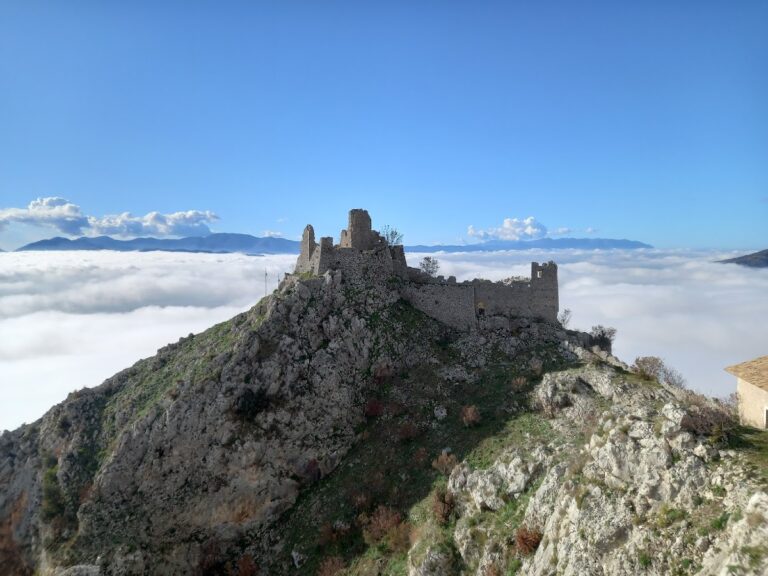
The monastery occupies the summit of a rocky hill approximately 516–520 metres above sea level. Its surviving complex combines Roman, medieval, Renaissance, Baroque, and postwar reconstructed elements, with Neapolitan Baroque providing its dominant architectural character. The courtyards and church occupy the summit above Cassino, while the cloisters organize the principal surviving buildings around open spaces.
Early Sacred Areas and Entrance Cloister
Entrance Cloister
The entrance, or Southern, Cloister occupies the area traditionally identified with the Roman temple of Apollo. Benedict adapted that earlier sacred building into the oratory of Saint Martin. Archaeological work in 1953 uncovered foundations associated with the chapel. A bronze sculpture by Attilio Selva, The Death of Saint Benedict, dated 1952, stands in the cloister garden. Its portico contains the mosaic Christ between the Madonna and Saint Martin, designed by Brother Vignarelli.
Saint Martin and Saint John Oratories
The Saint Martin oratory measured approximately 12 metres long by 8 metres wide. The Saint John oratory, built at the summit where the Apollo altar had stood, measured about 15.25 metres long by 8 metres wide. Archaeological investigations after the 1944 destruction identified remains of both oratories, including later additions from the eighth and eleventh centuries and foundations predating the Christian buildings.
Renaissance Cloisters
Bramante Cloister
The Bramante Cloister, also called the Saint Anne Cloister, is a Renaissance courtyard built in 1595. Its octagonal central cistern, a tank for storing water, is surrounded by Corinthian columns supporting an entablature, the horizontal architectural structure carried by columns. Balconies overlook the Liri valley and the cemetery below. At the foot of the staircase stand statues of Saint Benedict and Saint Scholastica. The Saint Benedict statue is an original work from 1736 by Brother Campi of Carrara, while the Saint Scholastica statue is a copy of the destroyed original.
Benefactors’ Cloister
The Benefactors’ Cloister, also known as the Northern Cloister, was built in 1513, probably to a design by Antonio da Sangallo the Younger. Rows of statues represent popes, rulers, and patrons associated with the abbey over the centuries, with the statues produced from 1666 onward. The upper cloister contains eighteenth-century statues of Pope Urban V and Pope Clement XI set in grey-marble niches. The cloister before the church follows a pure Renaissance style and takes its name from its commemorative statues.
Abbey Church
The abbey church was completely destroyed by the 1944 bombing and reconstructed from the original seventeenth- and eighteenth-century plans. Much of the earlier marble was reused in the rebuilt floors, wall panelling, and inlaid decoration. The former frescoes and painted canvases on the vaults and walls were permanently lost. The facade follows the architectural structure of the adjoining cloister, and its tympanum, the enclosed field within a pediment or arch, bears the arms of Monte Cassino and its abbots: a lion standing on its hind legs and a tower between two cypresses.
The tomb of Saint Benedict lies behind the altar. The church contains three organs, including the principal organ built in 1953 by Vincenzo Mascioni. It has 88 stops, four manuals, and a pedalboard housed in a historic case. The rebuilt church therefore combines preserved materials and plans with postwar furnishings and reconstruction.
Medieval and Later Decoration
The medieval church rebuilt under Desiderius between 1066 and 1071 used stone brought from Rome. Byzantine mosaicists and other craftsmen from Constantinople decorated the apse, the usually semicircular end of a church, together with the arch, vestibule, and other areas. Their work employed gold, silver, bronze, iron, glass, ivory, wood, plaster, and stone.
Most of this medieval decorative program was later lost. The former paintings in the atrium included scenes from the Old and New Testaments, and their accompanying titles survive. Two fragments depicting greyhounds from the Byzantine mosaics are known to survive in the Monte Cassino Museum. The seventeenth-century monastery included paintings by Luca Giordano, Francesco Solimena, Francesco de Mura, Paolo de Matteis, and Sebastiano Conca. In the 1980s, a later cycle of frescoes was commissioned from Pietro Annigoni with the participation of several pupils.
Library and Evacuated Collections
The abbey library preserves Codex Cassinese 512, a manuscript containing the Cassinese Glosses, an anonymous commentary on Dante’s Divine Comedy, as well as the Cassinese legal documents known as the placiti. In 1865, the monks printed an edition of the manuscript to commemorate the six-hundredth anniversary of Dante’s birth.
In December 1943, approximately 1,400 irreplaceable manuscripts, chiefly patristic and historical works, were evacuated for safekeeping along with documents concerning the abbey’s history. The wartime transfers also included collections from the Keats-Shelley Memorial House in Rome, while some material from the Capodimonte Museum was among the other objects moved for protection. The survival of these materials preserves an important part of Monte Cassino’s literary and institutional history alongside the reconstructed buildings.