Munster Abbey, Ancienne abbaye bénédictine Saint-Grégoire: A Former Benedictine Monastery in France
Site at a Glance
- Rating
- 4
- Popularity
- Very Low
- Country
- France
- Primary era
- Early Modern
- External website
- Open
- Eras represented
- Medieval, Early Modern
- Civilizations
- French, Holy Roman Empire
- Site type
- Religious
- Remains
- Monastery
On this page17 sections
History
Munster Abbey, also known as the Ancienne abbaye bénédictine Saint-Grégoire, is a former Benedictine monastery in Munster, France, founded around 660 in the Munster valley at the meeting of the Petite Fecht and Grande Fecht. Its foundation formed part of the effort to restore Christianity in a region where it had declined after the end of the Western Roman Empire. A possible earlier settlement around 633 remains uncertain, as does the later tradition that Irish or Anglo-Saxon followers of Gregory the Great founded the monastery.
Foundation and Carolingian expansion
The monastery probably received early support from Childeric II, a seventh-century Merovingian king of Austrasia, who made a major donation in 675. Further grants from Louis the Pious in 823 and Lothair in 843 strengthened the institution. Louis the Pious also granted the abbey immunity and the right to choose its own abbot. These privileges placed the monastery in a stronger position within the political and religious order of the Carolingian period.
From a small foundation, the abbey expanded considerably during the ninth century. By the end of that period it controlled much of the Munster valley, villages on the Alsatian plain, and possessions in the Breisgau, Jura, Lorraine, and other areas. Its original territory probably covered the Petite Fecht valley and the northern part of the Grande Fecht valley. Around 823, its cultivable land may have covered between 2,000 and 4,000 hectares.
The abbey also exercised religious authority beyond the valley. From the ninth century it influenced the churches of Colmar and, in the early eleventh century, held the right to appoint parish priests there. This position weakened after Colmar became a collegiate church in 1234. Following the Treaty of Meerssen in 870, the abbey entered the possessions of Louis the German. It later came under Count Eberhard and, before 1146, under the supervision of the Bishop of Basel. In the process it lost its status as an imperial abbey and part of its domain.
Medieval rivalry and territorial contraction
The abbey became the object of repeated competition among the bishops of Basel and Strasbourg and the emperors of the Holy Roman Empire. An imperial abbey was a monastery subject directly to the emperor rather than to a territorial prince, allowing its abbot to exercise territorial authority. During the twelfth and thirteenth centuries, famine, floods, severe weather, territorial losses, and fires weakened the institution. It burned twice in 1183, on 15 March and 1 December.
In 1235, Emperor Frederick II restored the abbey’s status as an imperial abbey after acquiring the remaining two-thirds of its avouerie, the secular office responsible for protecting and administering an ecclesiastical institution. He entrusted the whole of that authority to the town of Munster. During the Great Interregnum, however, the Geroldseck family occupied the abbey’s lands through the Bishop of Strasbourg and built the unauthorized Schwartzenberg castle there.
After the Geroldsecks were defeated at Hausbergen in 1262, control passed again to the Bishop of Basel and then to Rudolf of Habsburg, a thirteenth-century German king and Holy Roman Emperor who sought to recover imperial possessions alienated during the interregnum. By then, the abbey had lost much of its regional influence. Munster itself became a free imperial city in 1287, further reducing the monastery’s political position. By the end of the thirteenth century, its possessions outside Alsace had been lost, along with parts of its Alsatian holdings, while local lords and officials divided its remaining territory in the valley.
Reform and renewed difficulties
Abbot Marcquart, appointed in 1329, attempted to restore the abbey’s position. Pope Benedict XII confirmed its privileges and protections in a bull dated 7 January 1336. Around 1339, Marcquart introduced regulations addressing private property held by monks, residence outside the convent, and growing lay control over the abbey’s possessions. The Bishop of Basel ratified these measures in 1348.
A further fire on 16 August 1348 caused extensive damage within the monastery. The surviving written evidence and archaeological remains do not establish that rebuilding followed immediately. The abbey continued to possess broad economic and judicial rights over its domain, including hunting, forestry, fishing, wine-sale privileges, tithes, corvée labour, rents, and monopolies over milling and baking. It also exercised low justice and policing powers. The abbot appointed one-third of the town council and nominated important officials, including the Schultheiss, who administered the abbey’s domain.
Sixteenth-century decline and the Reformation
The abbey declined further during the sixteenth century. After the plague of 1539, only two monks remained. Abbot Petermann d’Aponex was imprisoned after the inhabitants of Munster invaded the abbey. The monastery was later left without monks, while Joachim Bremming, appointed abbot by the Bishop of Basel, was arrested after mismanaging the institution.
In 1568, the emperor appointed Henri de Jestetten. His attempt to restore the abbey’s rights led to armed conflict in Munster, which was settled by a treaty negotiated by Lazare de Schwendi in 1575. The inhabitants and parish of Munster had become Protestant during the Reformation, while the abbey remained Roman Catholic. The agreement confirmed the inhabitants’ freedom of confession and required the monastic community to pay the town’s pastor. The monastery also suffered severe damage during the Thirty Years’ War, the prolonged European conflict that affected much of Central Europe between 1618 and 1648.
Repopulation, intellectual life, and dissolution
After Alsace came under French sovereignty, the abbey joined the Congregation of Saint-Vanne and Saint-Hydulphe in 1659. This reforming Benedictine federation repopulated the monastery and encouraged the rebuilding of its deteriorated buildings. During the eighteenth century, Munster Abbey became an important regional intellectual centre. Dom Augustin Calmet, a Benedictine scholar and theologian, served as subprior from 1704, and the Benedictine abbot Charles Marchant was among the scholars associated with the institution.
The abbey was dissolved during the French Revolution in 1790 and 1791. Its lands and rights were confiscated and sold, and the buildings were briefly used for one of the first textile factories in Alsace. Approximately 8,000 books were transferred to Colmar, while the abbey church was demolished in 1802. The surviving remains were listed as French historic monuments in 1990, with a further protection entry recorded in 1992. After a long period of neglect from the 1990s, the remains became the subject of a heritage-development project in the early 2020s.
Remains
Abbey enclosure and medieval churches
The former abbey occupied a substantial enclosure in the centre of present-day Munster. In its eighteenth-century arrangement, the church and cemetery stood to the north. A long north-south building ended at the southwest in the prior’s house, while a formal French garden and orangery lay to the east. Buildings formed a southern row, and a large meadow extended towards the present site of the Couvent des Manufactures Hartmann.
Early church
The earliest identified church remains date from the first half of the tenth century. This pre-Romanesque building measured about 10.50 metres wide and 15 metres long. It had a single nave, separated from the choir by a chancel, the part reserved for the clergy and the liturgical focus of the church. Its floor carried a surface layer coloured red with tile aggregate.
Romanesque church
A new Romanesque church replaced the earlier building in the middle or second half of the twelfth century. It had a three-aisled nave, a substantial western massif, and a tower over the crossing. Some materials were obtained locally, while the worked sandstone probably came from the mountains around Schratzmaennele and Grand Hohnack, about 5 kilometres to the north. A fire recorded in 1182 falls within the period of this rebuilding, although archaeological investigation does not establish a direct connection between the fire and the construction work.
Cloister
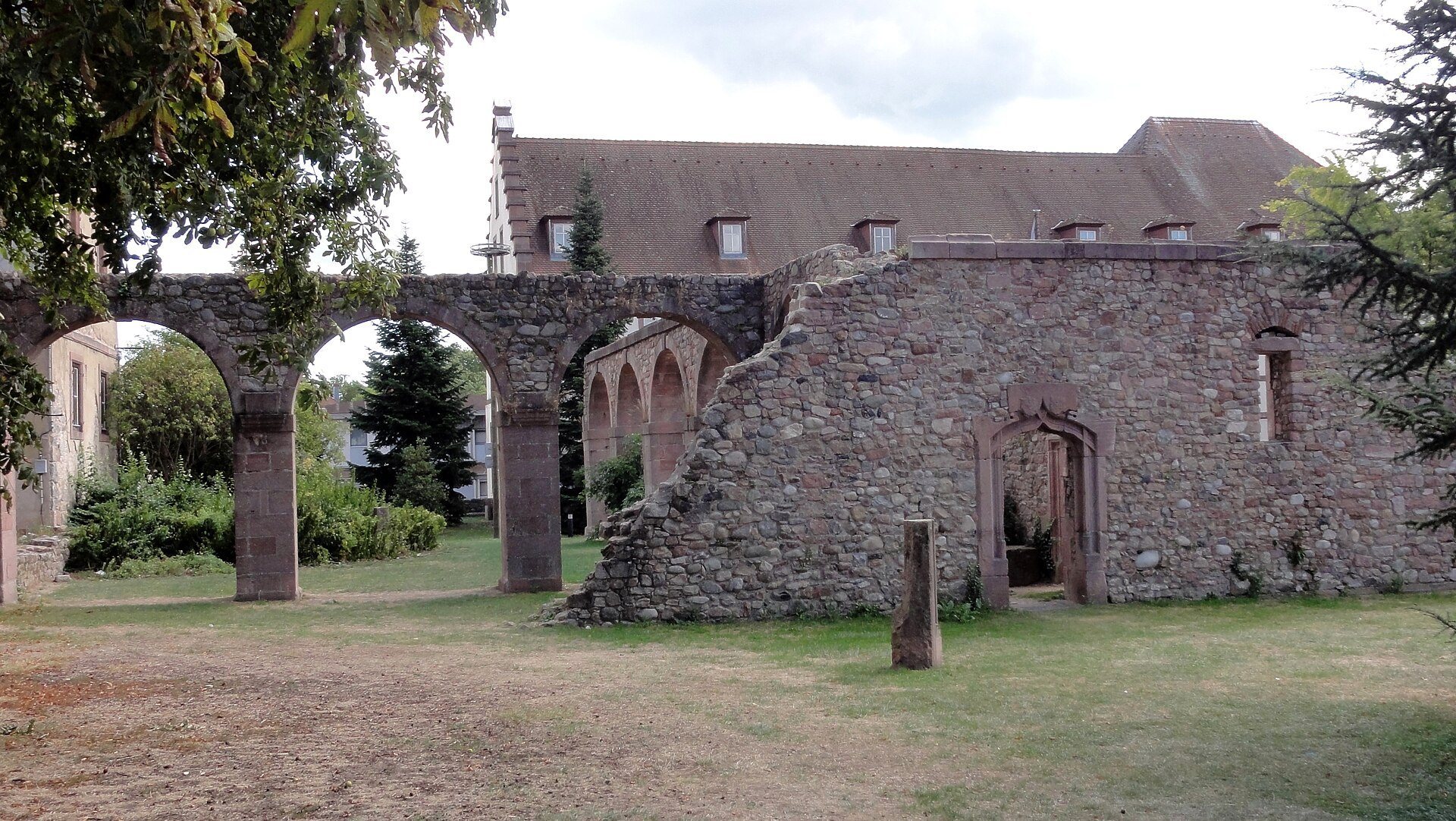
The first identified cloister was contemporary with the Romanesque church. A cloister is a covered walkway arranged around an open courtyard and connecting the principal buildings of a monastery. At Munster it adjoined the church on the south and opened towards the refectory and cellar. Archaeological evidence identifies no building on its western side. A later fire on 16 August 1348 caused extensive damage within the monastery, but neither the written evidence nor the excavations demonstrate immediate rebuilding.
Eighteenth-century buildings and surviving fabric
Abbatial residence
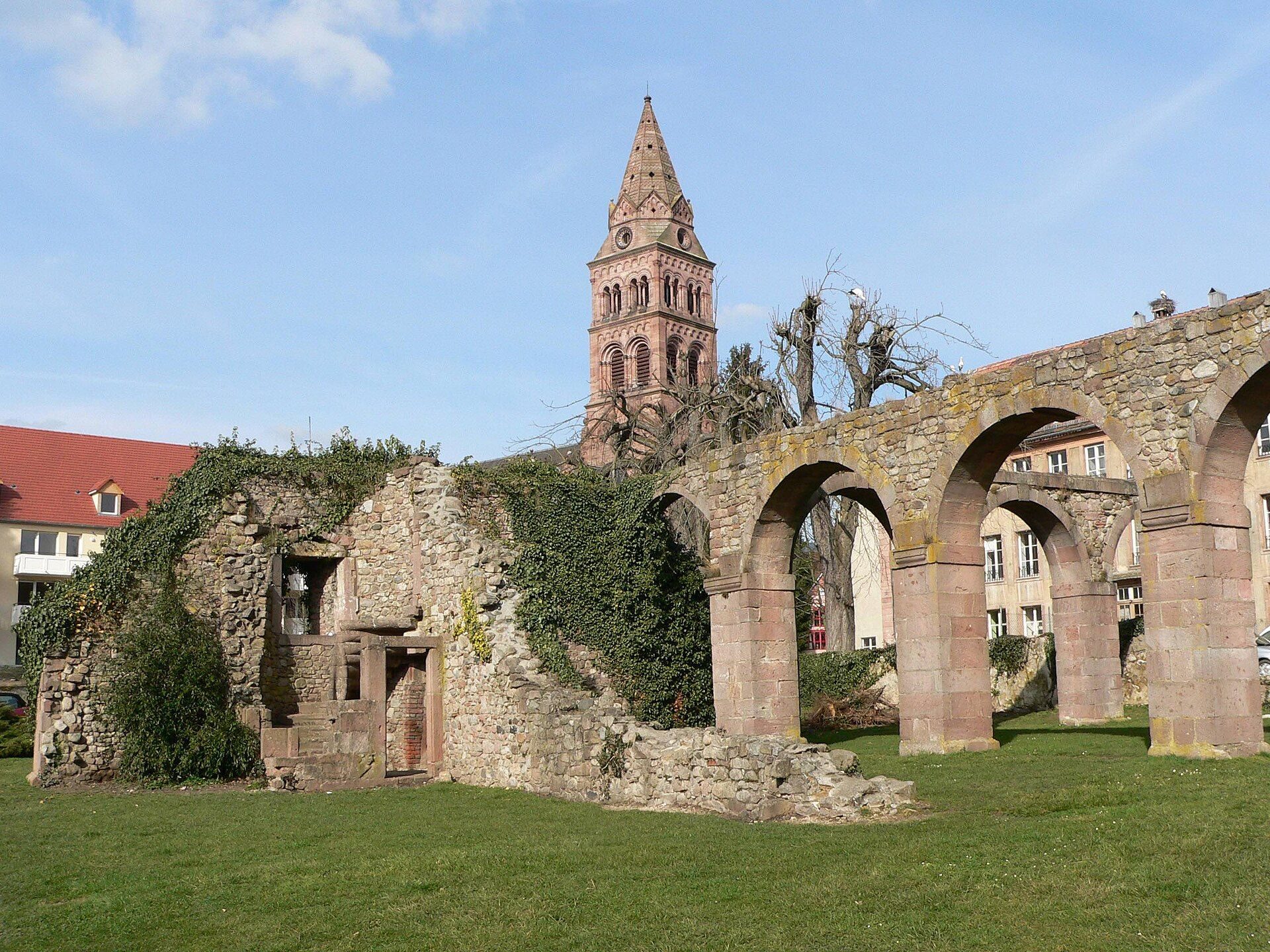
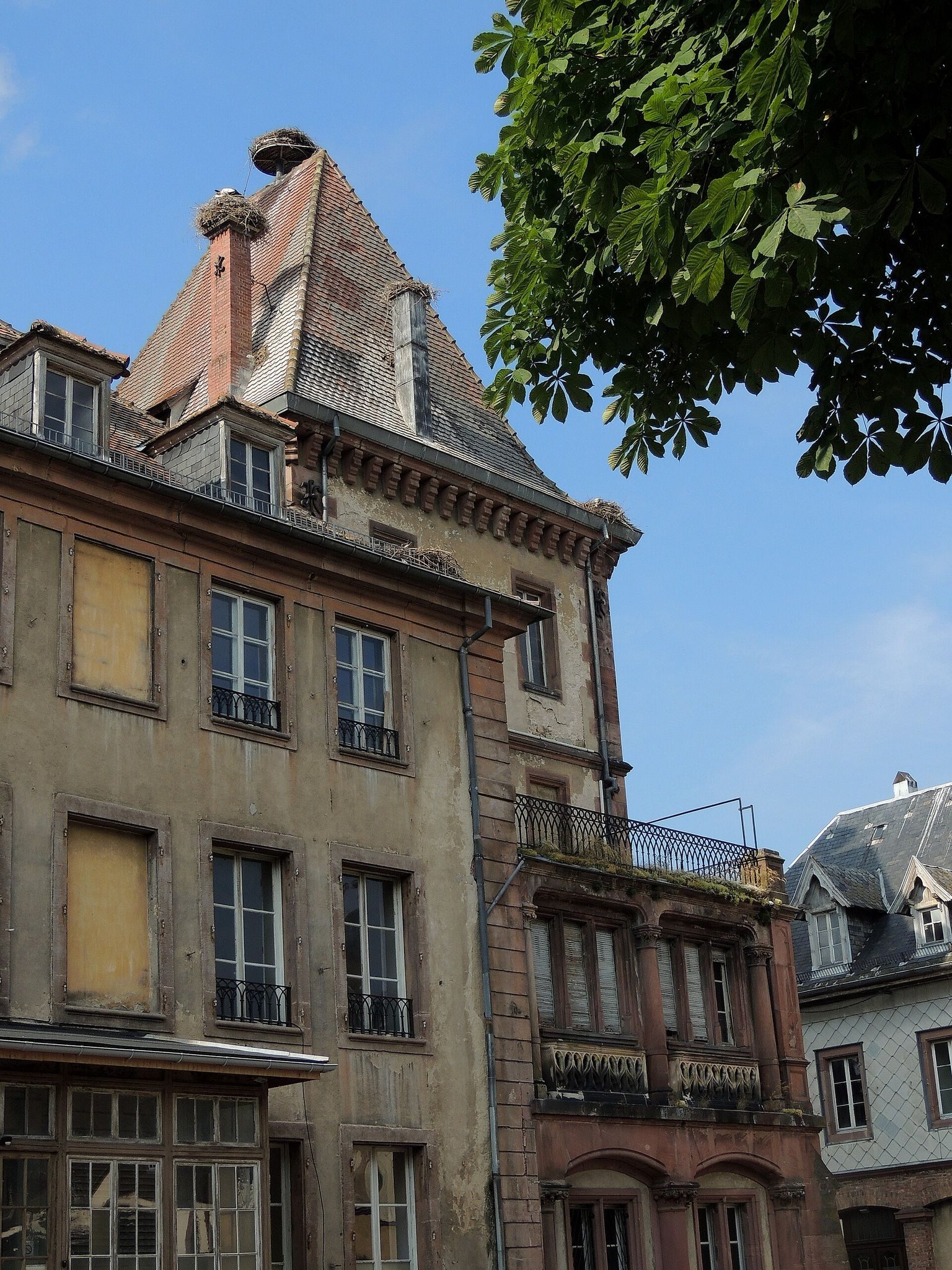
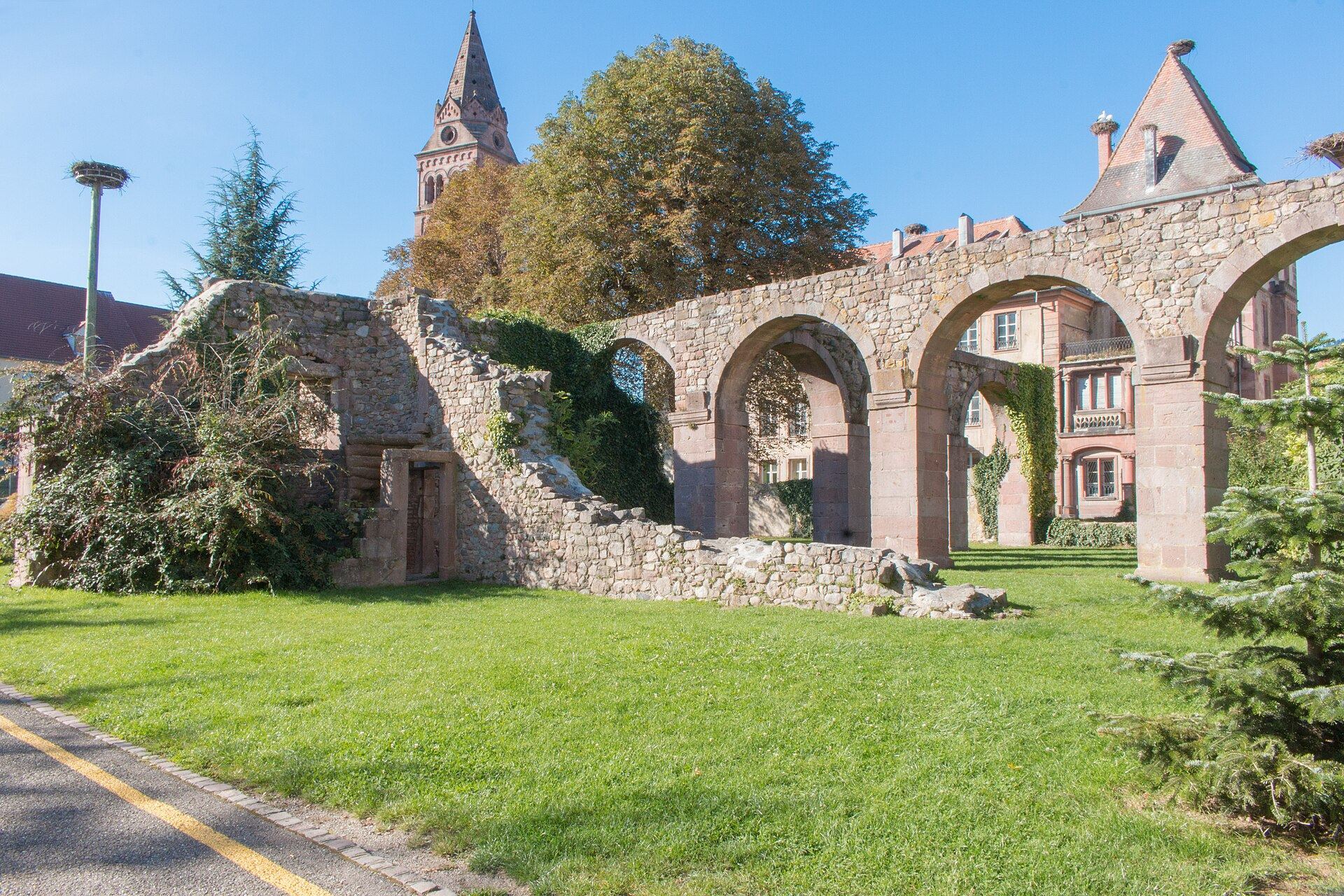
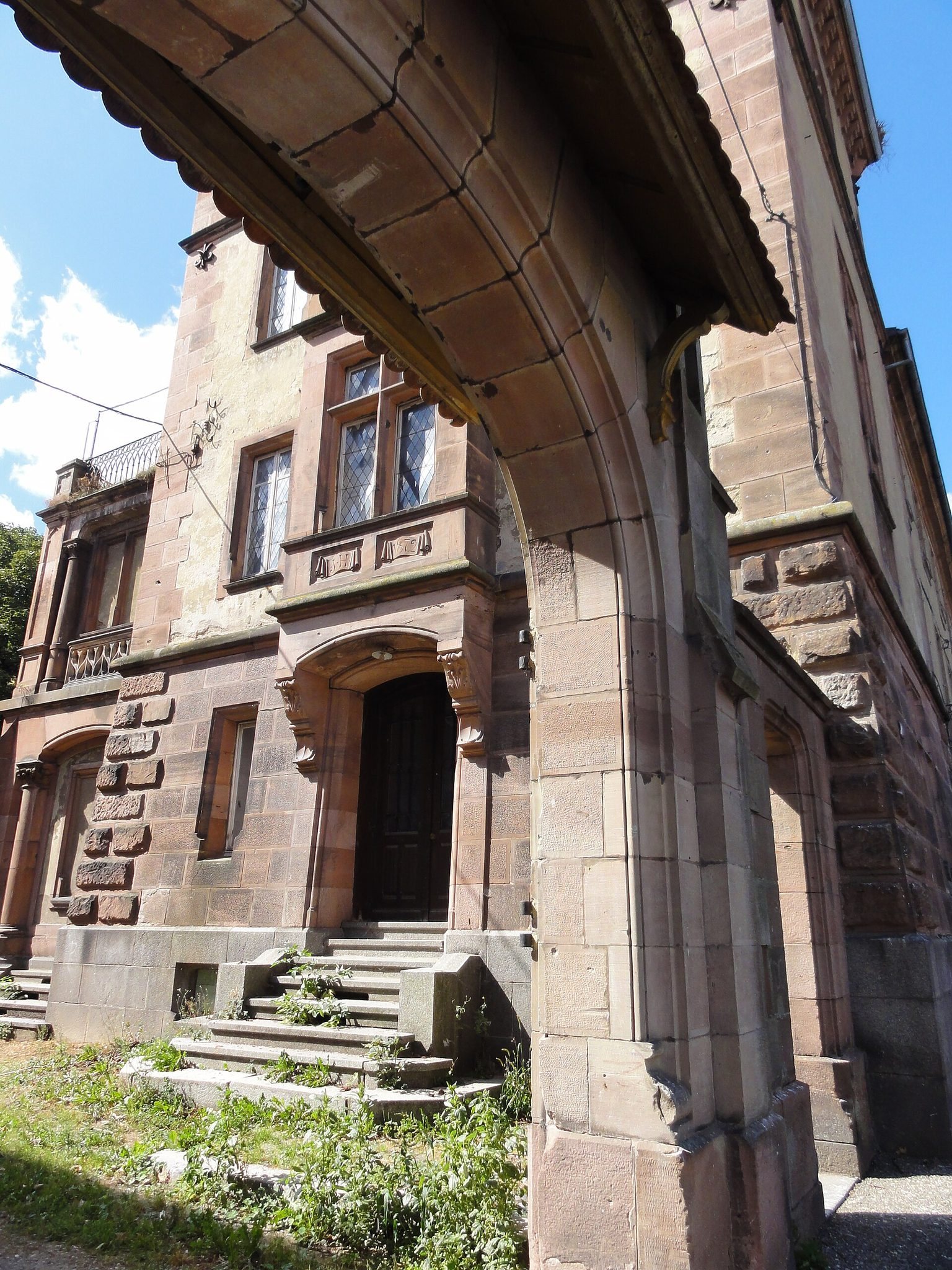
The abbatial residence was completed between 1786 and 1789. It is among the principal surviving parts of the former complex, together with sections of the cloister. The abbey church was demolished in 1802, and bombardments during the First World War destroyed most of the other remaining buildings.
Prior’s house and enclosure
The former prior’s house later became the intercommunal media library. Other parts of the eighteenth-century enclosure are now covered by streets and buildings. The surviving residence and cloister fragments therefore represent only part of the former monastic layout, whose church, gardens, work areas, and open land once occupied much of the central enclosure.
Library, treasury, and collections
Library and manuscripts
At the end of the eighteenth century, the abbey library held approximately 8,500 volumes. Its surviving holdings show particular interest in Greek and Hebrew studies, theology, and scientific works. Forty-three manuscripts are known, including tenth-century fragments of a Bible, Bede’s De natura rerum, and Lucan’s Bellum civile. Sixteen manuscripts date from the tenth to the thirteenth centuries, and six are illuminated. More than half of the known manuscripts are now held in the municipal library of Colmar.
Treasury and medal collection
The abbey treasury was traditionally said to have contained a crown, sceptre, and sword attributed to King Dagobert. The crown disappeared during the Revolution, while the sceptre and sword had already left the treasury by the early eighteenth century. The historical basis of this tradition remains uncertain.
The monastery also possessed an eighteenth-century cabinet of medals. In 1779 alone, Abbot Benoît Aubertin acquired more than 1,000 ancient coins. The collection disappeared during the Revolution, and its final fate is unknown. In 1672, the abbey temporarily sheltered relics of Saint Clare, the Italian religious founder associated with the Poor Clares, after French troops entered Lorraine. The monastery is also associated with the origin of Munster cheese, a cow’s-milk cheese named after the town.