Rozafa Fortress: The Historic Citadel of Shkodër, Albania


Site at a Glance
- Rating
- 4.6
- Popularity
- Medium
- Country
- Albania
- Primary era
- Medieval
- Eras represented
- Classical, Medieval
- Civilizations
- Illyrian, Ottoman, Venetian
- Site type
- Military
- Remains
- Citadel
On this page9 sections
History
Rozafa Fortress, also known as Shkodër Fortress, is a fortified citadel in Albania overlooking the city of Shkodër. Built on a hill settled from the Early Bronze Age, it developed from the Illyrian city of Scodra, with fortification walls dating to the fourth or third century BCE. The hill’s position above the Buna and Drin rivers made it an important stronghold in the western Balkans.
The Illyrian Citadel
Scodra emerged as a city by the sixth or fifth century BCE and became the capital of the Labeates, an Illyrian political group. The Illyrians were Indo-European-speaking peoples who occupied much of the western Balkans in antiquity. The citadel also held an important position under the Ardiaei, another Illyrian political group, particularly during the reign of King Gentius.
During the Third Illyrian War, Gentius gathered his forces at Scodra as the Roman army commanded by Lucius Anicius Gallus advanced against him. Gentius withdrew into the city after the Roman attack. When he became trapped, he sent the tribal leaders Teuticus and Bellus to negotiate. He surrendered on the third day of a truce, was taken into Roman custody, and was sent to Rome. Roman forces later captured his wife Etuta, his brother Caravantius, and his sons Scerdilaidas and Pleuratus at Meteon, north of Lake Shkodër. The Illyrian kingdom fell in 168 BCE.
Successive Rulers and Sieges
After the fall of the Illyrian kingdom, the fortress passed through Byzantine, Duklja, Bulgarian, Serbian, Venetian, Ottoman, Montenegrin, and Albanian phases of control. Most of the fortifications visible today are Venetian in origin. The site was involved in the siege of Shkodër in 1478–1479 and again in the siege of 1912–1913, reflecting its continuing military importance across different periods.
A Catholic church built within the fortress in the thirteenth century is identified by scholars as St. Stephen’s Cathedral. After the Ottoman Empire captured Shkodër in the fifteenth century, the former cathedral was converted into the Fatih Sultan Mehmet Mosque. The mosque takes its name from Mehmed II, the Ottoman sultan known as “the Conqueror.” The fortress and its surroundings now form an Archaeological Park of Albania, a managed heritage area in which archaeological remains and their landscape are preserved together.
Rozafa in Tradition
The name Rozafa has several proposed explanations. One connects it with Resafa, a place associated with the death of Saint Sergius, an early Christian martyr venerated in the region around Shkodër. Other interpretations link the name with an Arabic caliphal capital associated with the reign of the Umayyad caliph Hisham, or with the Akkadian term Rasaappa, understood as “governor’s house” and associated with settlements that had administrative functions.
An Albanian oral tradition tells of three brothers whose foundation walls repeatedly collapsed. They agreed that the wife who brought them food should be immured in the foundations. Rozafa, the wife of the youngest brother, accepted the sacrifice and asked that openings remain for her right eye, hand, foot, and breast so she could continue caring for her infant son. Marin Barleti, an Albanian humanist and historian of the late fifteenth and early sixteenth centuries, recorded the tradition as early as 1505 in De obsidione Scodrensi.
A related Serbian epic, The Building of Skadar, was published by Vuk Karadžić in 1815 after he recorded a folk song from the Herzegovinian storyteller Old Rashko. In that version, the brothers are Vukašin, Uglješa, and Gojko of the Mrnjavčević family. The folklorist Alan Dundes considered the name Gojko an invention of the ballad.
The story has been interpreted through themes of maternal sacrifice and immurement, or the sealing of a person within a structure, and has also been connected with the worship of an earth-mother goddess in Albanian folk belief. Local practice associated Rozafa’s milk with the fortress walls. Women scraped limestone deposits from the site, mixed them with water, and drank or applied the mixture to their breasts in a remedy intended to increase milk supply and pass Rozafa’s character and patriotism to their children.
Remains
Hilltop Fortifications
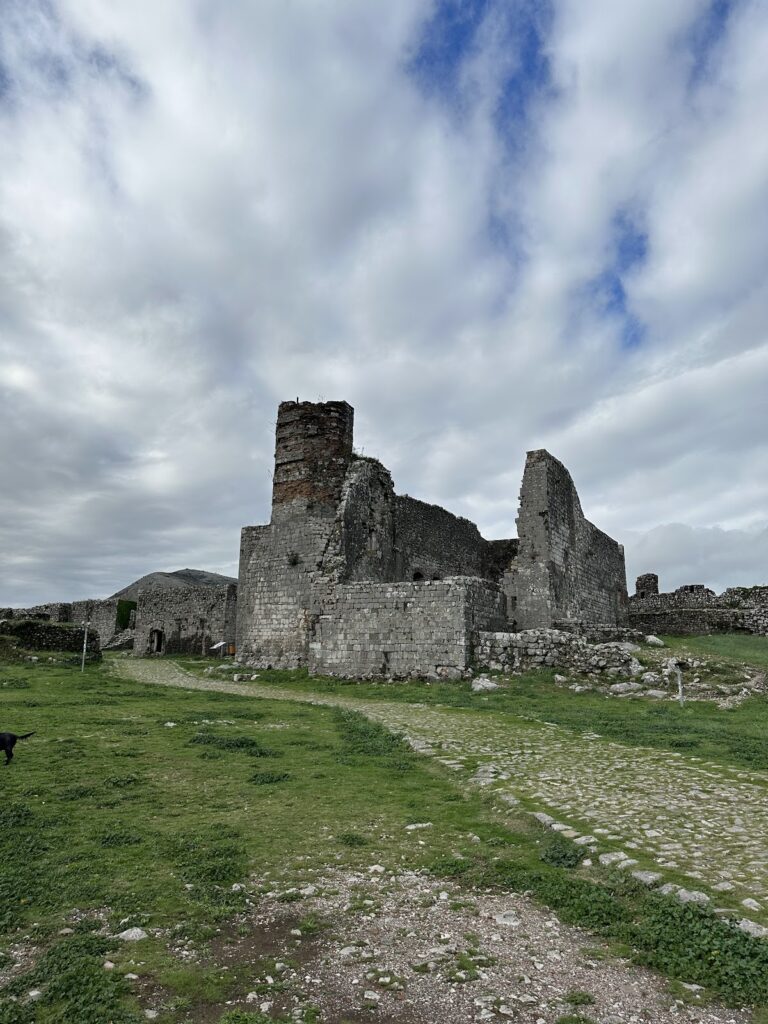
The fortress occupies a rocky hill approximately 130 metres above sea level, surrounded by the Buna and Drin rivers. Its earliest defensive walls date to the fourth or third century BCE and formed the citadel of Scodra. The surviving walls are predominantly Venetian and were built mainly from limestone and brick, preserving the physical evidence of the fortress’s later medieval and early modern development.
Former Cathedral and Mosque
Within the fortress are the ruins of the thirteenth-century Venetian Catholic church identified as St. Stephen’s Cathedral. The complex was later converted into the Fatih Sultan Mehmet Mosque after the Ottoman capture of Shkodër. Its remains include the former church-mosque structure and an associated minaret, linking the site’s Christian and Ottoman religious phases in a single architectural group.
Museum and Historical Collections
Several buildings and ruins survive inside the fortified enclosure. A former barracks houses a small museum devoted to the history of the fortress. Its collections include ancient Illyrian coins and other remains of Illyrian culture, together with objects and paintings connected with the Ottoman conquest of the Balkans. Busts of Skanderbeg, the Albanian nobleman and military leader who resisted Ottoman expansion, and other local heroes are also displayed there.
Gateway and Rozafa Monument
The original Illyrian gateway contains limestone deposits associated in local belief with Rozafa’s milk. Native milkweeds growing at the site produce a milk-like sap when their stalks are broken, reinforcing the association between the landscape and the legend. A monument depicting Rozafa with her child stands within the fortress, giving the oral tradition a physical presence among the surviving remains.
Nearby sites