Aliaga Castle: A Medieval Fortress and Hospitaller Commandery in Spain


Site at a Glance
- Rating
- 4.8
- Popularity
- Very Low
- Country
- Spain
- Primary era
- Medieval
- Eras represented
- Medieval
- Civilizations
- Unclassified
- Site type
- Military
- Remains
- Castle
On this page10 sections
History
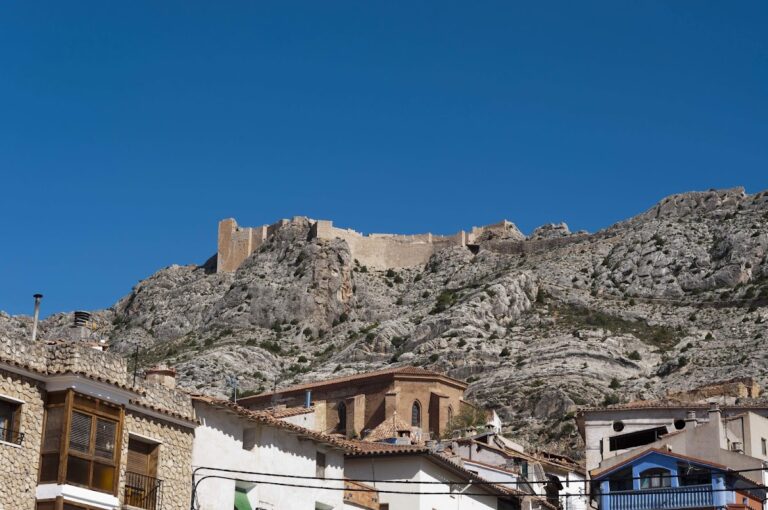
Aliaga Castle is a medieval fortress in Aliaga, Spain, of Muslim origin and dating from the twelfth century. Known also as the Encomienda Castle, it later became the seat of a commandery, an administrative and economic district governed by a military-religious order.
Muslim and Aragonese rule
In 1118, Alfonso I of Aragon conquered the castle and granted it to Lope Johanes of Tarazona, together with the fortresses of Pitarque, Jarque, Galve, Alcalá de la Selva, and Apelia. Alfonso I and his successor Alfonso II were kings of Aragon whose campaigns incorporated Muslim-held territories into the expanding Christian kingdom. After Alfonso I died in 1134, Aragonese forces withdrew, and Aliaga and its castle returned to Almoravid control that same year. The Almoravids were a Berber Muslim dynasty that ruled parts of North Africa and the Iberian Peninsula during the eleventh and twelfth centuries.
The definitive Christian conquest took place under Alfonso II. By 1162, the castle had been granted to the Order of the Hospital of Saint John of Jerusalem, also known as the Hospitallers, a military-religious order that held land, operated fortresses, and administered commanderies. From at least 1180, Aliaga served as the seat of a commandery whose subordinate castles included Pitarque, Fortanete, Villarroya de los Pinares, and Sollavientos.
Late medieval and nineteenth-century conflict
In 1462, during the Navarrese Civil War, the lord of Híjar occupied the castle while supporting Charles of Viana against his father, John II, king of Aragon and Navarre. After reconciling with John II, he received the countship of Aliaga and Castellote. In 1487, the lords of Híjar were granted the title of Dukes of Aliaga.
The wider Maestrazgo region and its surroundings became a major area of activity during the First Carlist War, a nineteenth-century Spanish civil war between supporters of the Carlist claim to the throne and forces supporting Isabella II. After the Carlist commander Ramón Cabrera established himself in the region, its fortresses, including Aliaga Castle, were strengthened. In 1840, General Leopoldo O’Donnell led liberal forces in a siege of Aliaga. The legitimist garrison, commanded by Francisco Macarulla, surrendered on 16 April after artillery fire had severely damaged the stronghold.
The bombardment caused serious damage, and the castle continued to deteriorate because repairs were not undertaken. Its violent destruction has led to the expectation that future excavations may reveal archaeologically important remains.
Ownership and protection
In 1972, Spain’s State Heritage authorities auctioned the entire complex, which a private individual acquired for 120,000 pesetas. The owner’s descendants sold it to Aliaga Town Council in 2022 for 50,000 euros, returning the castle to public ownership. Aliaga Castle was declared an Asset of Cultural Interest in 2006. The town council has sought to promote its rehabilitation, with the proposed work requiring assistance from the Spanish state and the Government of Aragon.
Remains
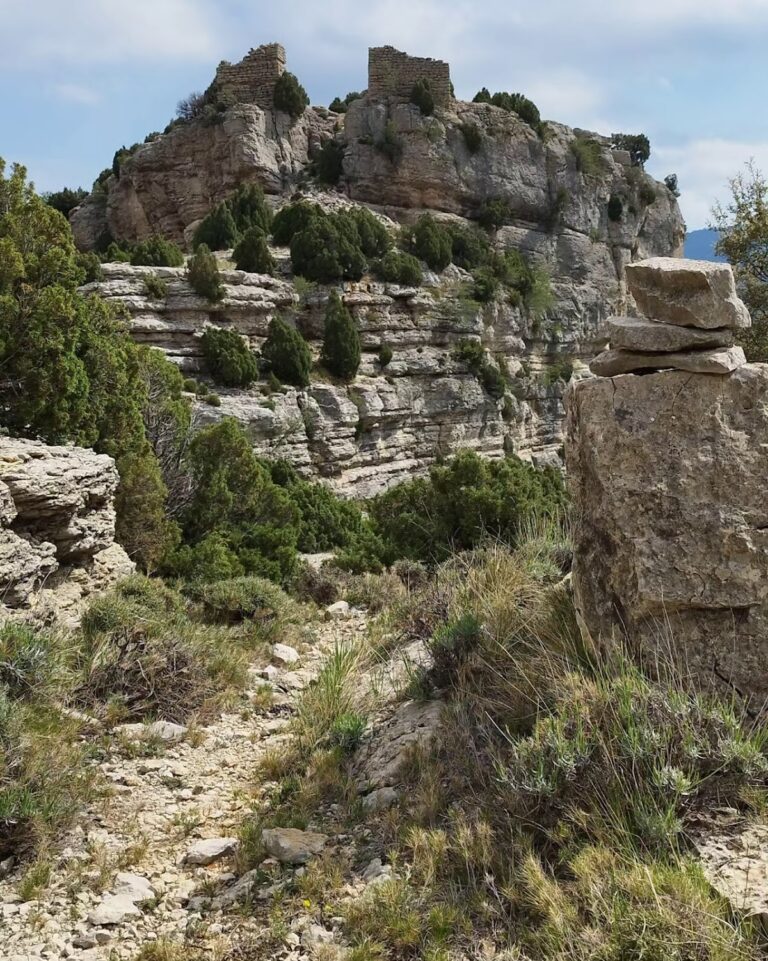
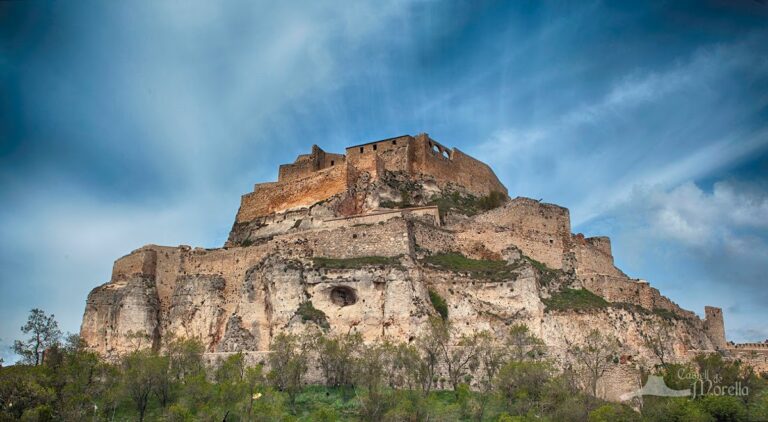
The fortress occupies approximately 4,000 square metres on a rocky outcrop. Its irregular plan comprises three walled enclosures arranged as terraces along the slope, using the natural difference in elevation. Traditional regional materials associated with Arab architecture shape the complex, especially rammed earth, in which damp earth is compacted inside formwork to create solid walls, and rubble masonry made from irregular stones set with a binding material.
Terraced defensive enclosures
Upper enclosure and keep
The original upper enclosure occupies the highest part of the rocky outcrop. It contains the keep, whose base survives. The remains are reached by a metal staircase, and their position preserves the enclosure’s relationship to the highest ground within the fortress.
Second enclosure
The second walled enclosure is represented by two small sections of curtain wall. These surviving wall fragments form part of the castle’s stepped defensive arrangement between the upper enclosure and the lower outer defenses.
Outer enclosure
The outer enclosure is the best-preserved of the three. It consists of a relatively low wall measuring approximately 100 by 50 metres and reinforced by several closely spaced semicircular towers, each about 3 metres in diameter. Together, the wall and towers define the broadest defensive terrace of the complex.
Southeast tower
On the southeast flank of the outer enclosure are the remains of a large rectangular tower measuring approximately 8 by 7 metres. Built of rammed earth, it adds a distinct block-shaped structure to the semicircular tower defenses of the outer wall.
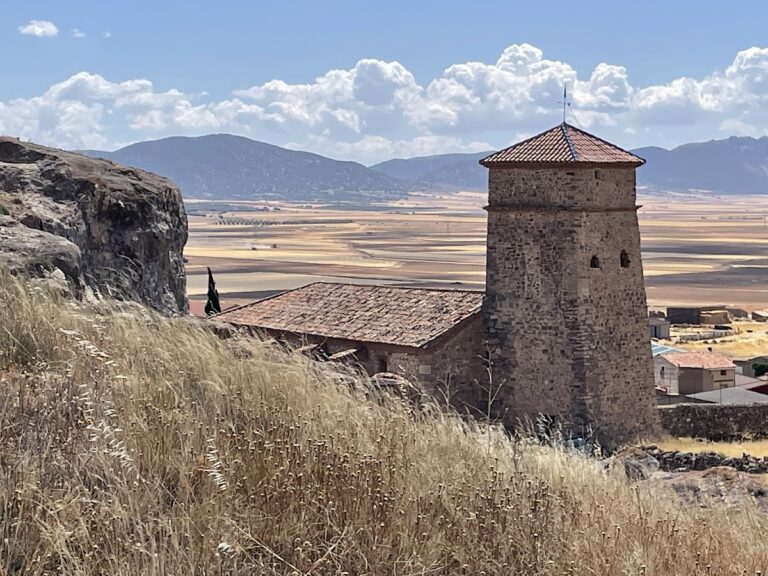
Aliaga Castle is now in a state of partial ruin, and one of its towers is considered at serious risk of collapse.
Nearby sites