Aladzha Monastery: A Medieval Orthodox Rock Monastery in Bulgaria


Site at a Glance
- Rating
- 4.6
- Popularity
- Medium
- Country
- Bulgaria
- Primary era
- Medieval
- External website
- Open
- Eras represented
- Classical, Medieval
- Civilizations
- Byzantine, Second Bulgarian Empire
- Site type
- Religious
- Remains
- Monastery
On this page13 sections
History
Aladzha Monastery is a medieval Orthodox rock monastery in Bulgaria, near Varna, developed by Christian hermits in natural limestone caves. The caves were occupied from the fourth century, while the monastery assumed its definitive form during the twelfth or thirteenth centuries as a rock-based monastic community.
Early Christian Occupation
The caves belong to a wider Christian landscape in northeastern Bulgaria. Aladzha was probably connected with the region’s many rock monasteries associated with Hesychasm, an Orthodox ascetic and mystical teaching that spread through Byzantium and Bulgaria between the twelfth and fourteenth centuries. The relationship between the medieval monastery, the nearby catacombs, an early Christian basilica, a small fortification, and settlements remains uncertain. Together, however, they may represent an early Christian center in the Black Sea region. The medieval monastery may also have continued an older local Christian tradition, possibly linked to centers mentioned in the writings of Constantine Porphyrogenitus, a tenth-century Byzantine emperor and writer.
The monastery’s original Christian name is unknown because no medieval written reference to it has been found. A tradition noted in the late nineteenth century connected the site with “Holy Savior,” a title for Christ the Savior. Bulgarian Christians have called it “Holy Trinity” since 1960. The name Aladzha comes from a Turkish-derived word meaning “colorful” or “variegated,” probably referring to the brightly painted frescoes that contrasted with the pale limestone. It first appeared in published literature in 1832, in Viktor Tepljakov’s Letters from Bulgaria.
Destruction and Afterlife
Following the Ottoman conquest of Bulgaria in the late fourteenth century, the monastery was destroyed. It was abandoned as a monastery by the late fifteenth or early sixteenth century, although hermits continued to occupy the caves until the eighteenth century. The site is now an inactive monastery in ruins and functions as a branch of the Varna Historical and Archaeological Museum. It remains affiliated with the Bulgarian Orthodox Church and the Varna and Veliki Preslav Diocese.
Archaeological Investigation and Protection
Systematic archaeological research began in the late nineteenth century under Karel and Herman Shkorpil, Czech-born Bulgarian archaeologists. An archaeological society and museum founded by them in Varna during the early twentieth century took responsibility for the monastery’s care and conservation. At their initiative, Aladzha Monastery was declared a national antiquity in 1912 and a cultural monument of national significance in 1957. A dispute between the municipality and the state over the monastery’s properties ended in 1924.
Remains
Aladzha Monastery occupies natural caves cut into a steep limestone or karst cliff nearly 40 metres high, close to the upper edge of the Franga Plateau. The monastic spaces are arranged on two levels within a forest-rich setting. The caves formed in limestone deposits laid down on the floor of the ancient Sarmatian Sea, which covered much of southeastern Europe approximately 12 million years ago.
Monastic Cave Complex
Monastery Church
The main monastery church, dedicated to the Holy Trinity, is situated in the western part of the first level beside the staircase leading through the complex. A small altar niche is cut into the middle of its eastern wall. The church forms part of a wider group of spaces that includes two chapels, a church used for funeral rites, a crypt, a kitchen, a refectory, 20 monastic cells, and other service areas.
Second-Level Chapel
A small chapel occupies the second level. Its altar area retains badly damaged wall paintings, and fragments of a fresco cycle survive on the walls and ceiling. The ceiling includes portions of an Ascension of the Lord fresco dated to the thirteenth or fourteenth century. A fresco is a wall painting made on plaster. Time and repeated visitation have damaged the surviving paintings, while some lost or deteriorated scenes are known through watercolors made in the early twentieth century.
Burial and Domestic Spaces
The cave complex also contains a church used for funeral rites, a crypt, monastic cells, a kitchen, and a refectory. A crypt is a chamber used for burial or other subterranean religious purposes. These spaces are integrated into the two-level arrangement of the cliff rather than standing as separate buildings.
Aladzha Catacombs
Rock-Cut Chambers
The Aladzha catacombs form a separate group of caves approximately 800 metres northwest of the monastery. They extend through three levels. The best-preserved second level contains a large room of uncertain function, possibly a crypt, and a smaller room with five burial chambers. Early Christian crosses carved into the stone appear in both principal rooms. Some crosses include Alpha and Omega, the first and last letters of the Greek alphabet, which in Christian symbolism represent the beginning and the end and are associated with Christ’s eternity.
Another entrance to a burial room opens from the outer platform of the second level, although rock that slid from the cliff blocks it. The lower and upper levels are less well preserved. The lower level probably contained a church and monastic cells, while the upper level probably held a chapel. The burial chambers and carved crosses indicate the religious use of the caves.
Archaeological Finds
The catacombs yielded ceramic fragments, coins of Justinian I, parts of a metal censer, and other objects. Justinian I was the Byzantine emperor who ruled from 527 to 565, so coins from his reign help place activity in the catacombs during the sixth century. A censer is a vessel used to burn incense during worship. The burial chambers, crosses, and associated finds point to occupation of the caves between the fourth and sixth centuries.
Early Christian Features Nearby
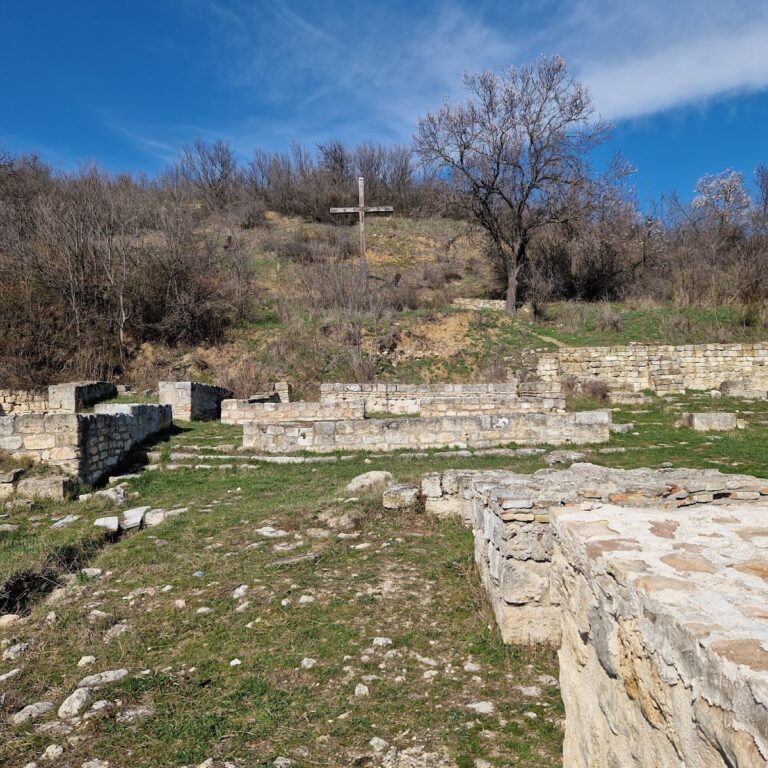
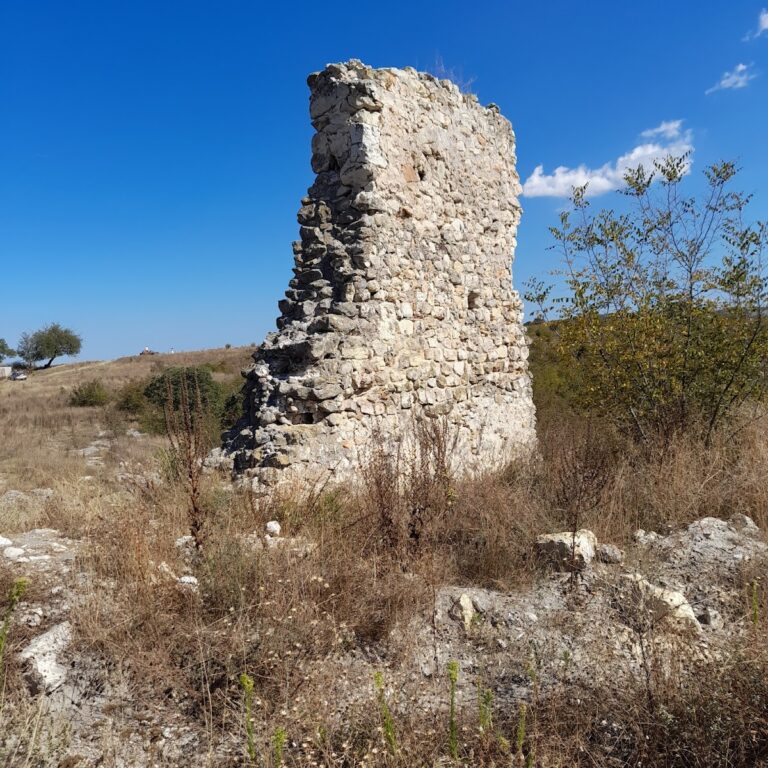
Near the monastery are remains of a small early Christian basilica, a fortification, and several settlements from approximately the same general period. The basilica has three naves and dates to the fifth or sixth century. These nearby remains form part of the wider archaeological setting in which the earlier Christian occupation of the caves and the later medieval monastery developed.
Nearby sites