Museum of Mosaics Devnya: A Roman Villa Museum in Bulgaria


Site at a Glance
- Rating
- 4.3
- Popularity
- Low
- Country
- Bulgaria
- Primary era
- Classical
- Eras represented
- Classical
- Civilizations
- Byzantine, Roman
- Site type
- Domestic
- Remains
- Villa
On this page12 sections
History
The Museum of Mosaics Devnya in Devnya, Bulgaria, preserves the House of Antiope, a Roman villa built in the late third or early fourth century AD at Marcianopolis, the ancient city that preceded modern Devnya. The museum was established in 1976 after archaeological work uncovered the villa and its mosaic floors. Marcianopolis was an important Roman and early Byzantine urban centre in the eastern Balkans, and the museum complex preserves part of its ancient remains.
Foundation of Marcianopolis
Marcianopolis was founded beside the Devnya River in AD 106 by the Roman emperor Trajan, who ruled from AD 98 to 117. The city probably took its name from Trajan’s sister, Ulpia Marciana. The sixth-century historian Jordanes preserved a legend that a golden vessel returned by the river led to the choice of the site. A more practical explanation connects the foundation with the area’s high-quality limestone resources.
The city reached particular prosperity under the Severan dynasty, the Roman imperial house that ruled from AD 193 to 235. Marcianopolis was largely completed by the end of the third century and became the seat of a bishopric in the fourth century. Repeated attacks by barbarian groups, Huns, Goths, and finally the Avars brought its urban history to an end. The city was abandoned after Avar attacks in AD 614–615.
The House of Antiope
The villa was constructed on the site of earlier buildings destroyed during Gothic raids in AD 250–251. Its building phase may belong to the reign of Constantine the Great, the emperor who ruled from AD 306 to 337 during the period when Christianity became increasingly prominent in the Roman Empire. The House of Antiope remained in use through repairs and rebuilding until the seventh century, when continuing Avar and Slavic attacks led to its abandonment.
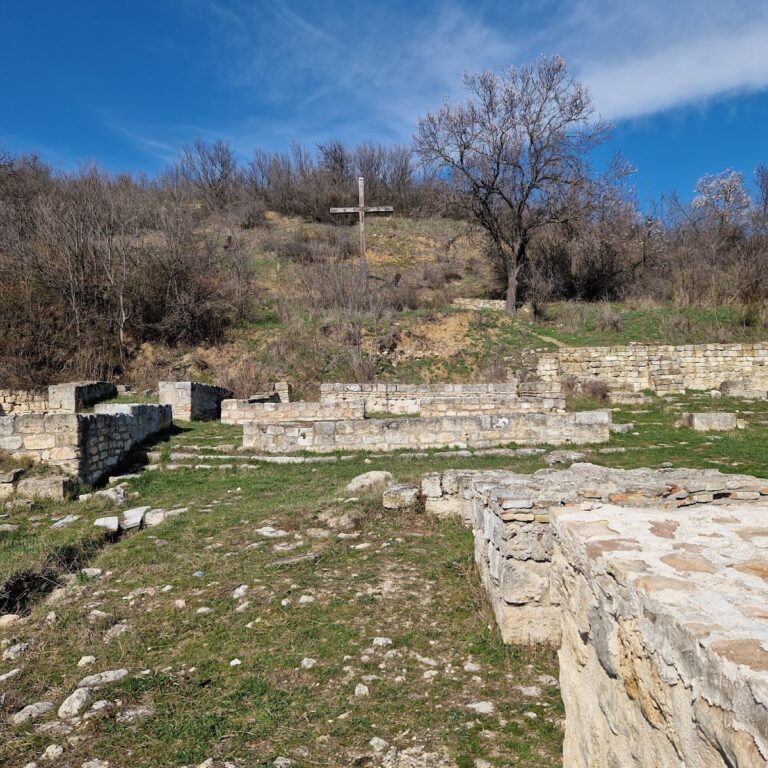
Archaeological investigations took place during five intermittent excavation seasons. They revealed the villa together with several surrounding ancient walls, creating a substantial part of the preserved ruins of Marcianopolis. The modern museum building was designed by architect Kamen Goranov. Curator Anastas Angelov later criticized its construction, arguing that about 90 percent of the building’s weight rested on the Roman ruins. By 2008, visible cracks threatened the structure, which was also sinking because of groundwater.
Remains
Villa Layout
House of Antiope
The House of Antiope is an almost square villa measuring about 37.15 by 37.75 metres, with approximately 1,400 square metres of interior space. Its 21 residential, working, and storage rooms were arranged around an atrium, the interior courtyard of a Roman house. The atrium measured 11.11 by 5.87 metres, had a floor of stone slabs, and contained a stone-lined well 0.76 metres across at its centre. A peristyle, or columned gallery, surrounded the courtyard on three sides and covered 92.63 square metres.
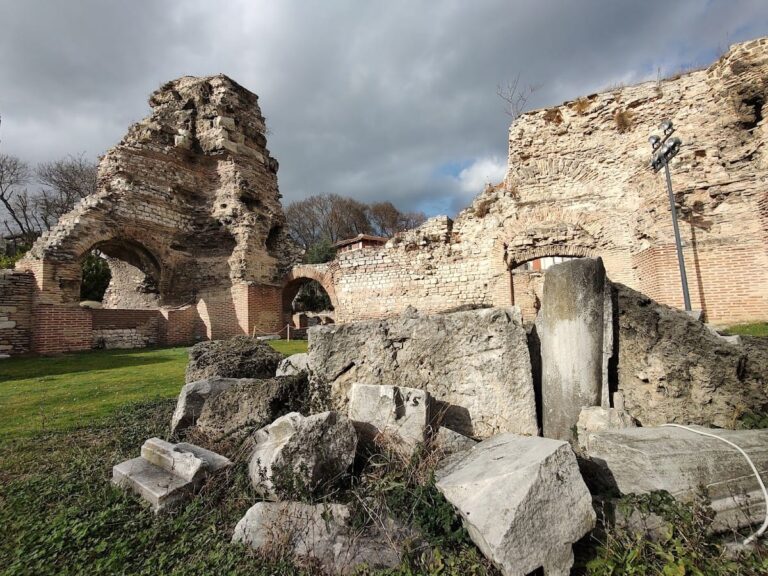
The museum building occupies the western part of the villa, while the eastern wing and atrium remain uncovered. A well-preserved Roman street runs beneath the building, which stands within a small park. Many of the villa walls carried frescoes and stucco. The portico and five other rooms contained elaborate mosaic floors. Archaeological objects associated with the villa and the lives of its inhabitants are also displayed in the museum.
Mosaic Floors
Medusa Mosaic
The best-known mosaic covers the floor of the tablinum, the owner’s office, which measures 8 by 8 metres. It shows the gorgon Medusa surrounded by a circular geometric shield identified as the shield of Athena. Medusa’s face turns slightly to the right while her eyes look to the left, and tesserae in different shades create a sense of volume. The image served as a protective talisman against evil forces rather than merely representing a frightening monster.
Zeus and Antiope
A mosaic in the cubiculum, or private bedchamber, measures 5.60 by 4.40 metres and depicts Zeus and Antiope. Zeus appears as a young satyr abducting Antiope, while two Ancient Greek inscriptions identify the figures as “satyr” and “Antiope.” The scene is considered one of the few contemporaneous representations of this episode in early Byzantine art.
Ganymede Mosaic
The oecus, the villa’s largest formal room, carried a mosaic showing Ganymede being taken to Mount Olympus by Zeus in the form of an eagle. This is described as the only mosaic with this subject in Bulgaria.
Four Seasons Mosaic
The mosaic from the women’s apartments measures 8.6 by 7.8 metres. Although badly damaged, it retains images of animals, geometric motifs, and personifications of the four seasons. Autumn is the best-preserved seasonal figure and appears as a young woman wearing a gold dress.
Pannonian Volutes Mosaic
The Pannonian Volutes mosaic consists of repeated geometric patterns in four colours. It was found in another ruined building in eastern Marcianopolis, probably an early Christian basilica, and was later transferred to the museum. Its name refers to the repeated volutes, spiral or scroll-like ornamental forms.
Three mosaics remain in their original locations, while the others were moved for conservation and restoration. Their designs were made with two Roman techniques. Opus tessellatum uses small tesserae arranged in regular horizontal or vertical lines, while opus vermiculatum places them along the contours of figures and forms. The tesserae are made from marble, clay, limestone, and coloured glass in 16 colour varieties. The villa’s mosaic programme remains exclusively pagan in character, featuring Greek and Roman mythological figures, exotic animals and birds, floral motifs, and geometric designs despite the spread of Christianity during Constantine’s reign.