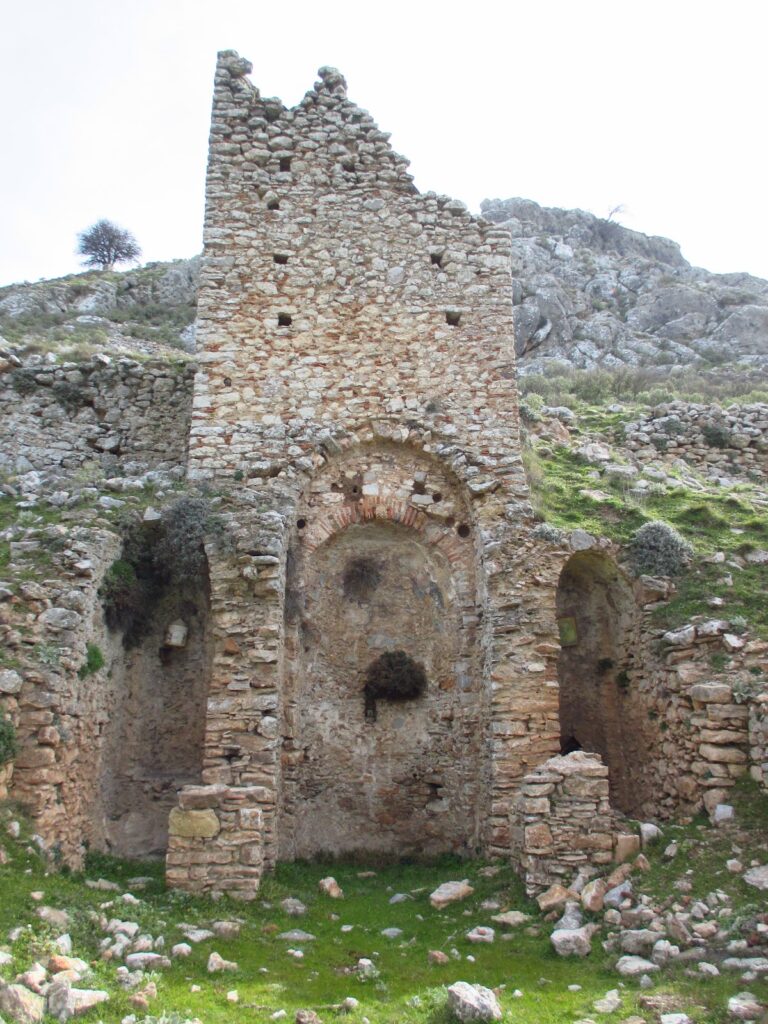
Monastery of Malevi: A Greek Orthodox Monastic Center in Greece


Site at a Glance
- Rating
- 4.9
- Popularity
- Medium
- Country
- Greece
- Primary era
- Unclassified
- External website
- Open
- Eras represented
- Unclassified
- Civilizations
- Unclassified
- Site type
- Religious
- Remains
- Monastery
On this page8 sections
History
The Monastery of Malevi is a Greek Orthodox monastery in Greece, dedicated to the Dormition of the Theotokos, the Eastern Orthodox feast commemorating the death and assumption of Mary, the mother of Jesus. Tradition places its foundation around 717, during the eighth century, at a site called Kanaloi. The monastery is ecclesiastically subordinate to the Holy Metropolis of Mantineia and Kynouria.
Early traditions and relocations
The first monastery was traditionally established in a protected position to avoid raids by brigands. According to the tradition, an exceptionally severe winter caused the monks there to starve to death. In the tenth century, a shepherd reportedly found the monastery’s icon of the Virgin Mary among bushes, renewing interest in the religious community.
The monastery was relocated for the first time in 1320, according to a chrysobull issued by Emperor Andronikos II Palaiologos. A chrysobull was an official Byzantine imperial charter, often authenticated with a gold seal. A few years later, the monastery’s miraculous, myrrh-streaming icon was covered with silver. The icon is possibly attributed to Luke the Evangelist, whom Orthodox tradition associates with some early images of the Virgin Mary.
Ottoman-period activity
Malevi was active in the early seventeenth century. In 1609, Turkish authorities permitted the rebuilding of a ruined church at Platanos. A second relocation followed in 1616 under Abbot Joseph Karatza, as stated by a founding inscription.
Saint Neilos the Myrovlitis, whose secular name was Nikolaos Terzakis, later lived as a monk at Malevi. He died in 1651 and subsequently withdrew to Mount Athos, the autonomous monastic community in northern Greece and a major center of Eastern Orthodox monasticism.
War, destruction, and reconstruction
On 8 May 1786, Turkish forces burned the monastery in retaliation for their defeat by the klephts of Zacharias and by the klephts of Agios Petros, including Thanasis Karampelas and Antonakis Alevizos. Klephts were armed irregular fighters who operated in Ottoman-ruled Greece and later contributed to the Greek revolutionary movement.
During the Greek War of Independence, Abbot Kallinikos Tsiamouris belonged to the Filiki Etaireia, a secret revolutionary society founded in 1814 that helped prepare the uprising. As a physician, he provided substantial assistance to many fighters and to Dimitrios Ypsilantis, a Greek military leader and revolutionary. Ibrahim Pasha, an Ottoman military commander, destroyed the monastery in 1826.
During the German occupation, German forces bombed Malevi because a hospital assisting the rebels of Mount Parnon was operating there. The monastery became a women’s monastery in 1949. Fourteen nuns lived there according to the 2011 census.
Community and religious observance
Malevi was established as a separate settlement in 1940 within the former community of Agios Petros. It now belongs to the Community of Agios Petros, together with Agios Petros and Xirokampi, in the Municipality of North Kynouria. The name Malevi derives from Malevos, the local name for a summit of Mount Parnon.
The monastery celebrates the Apodosis of the Dormition of the Theotokos on 23 August. The Apodosis is the concluding observance of an Orthodox feast, and this celebration is traditionally known as the “Nine Days of the Virgin.” The principal observance begins on 22 August with a solemn Great Vespers service and attracts worshippers from throughout Greece.
Remains
Monastic complex on Mount Parnon
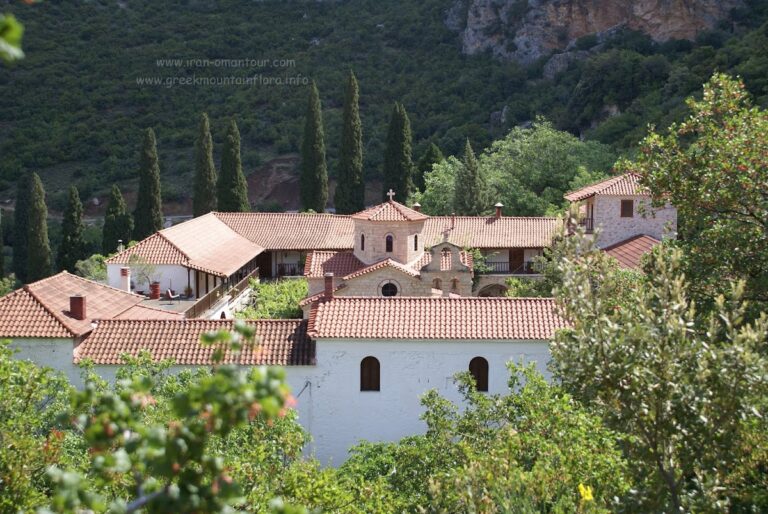
The monastery stands on the slopes of Mount Parnon at approximately 900 metres above sea level. Its central church, the katholikon, is a domed cross-in-square building. A katholikon is the principal church of an Orthodox monastery, while a cross-in-square church incorporates a central dome into a square structural plan. The interior of the katholikon has recently been decorated with religious paintings.
A recently built Byzantine-style church dedicated to the Virgin Mary occupies the upper part of the courtyard. Newly built and renovated monastic cells and auxiliary buildings surround the katholikon. The complex also contains chapels dedicated to Saint Neilos, Saint Nektarios, and Saint George.
Dependent religious establishment
Malevi has a metochion dedicated to Saint Charalambos in the village of Korakovouni. A metochion is a dependent monastery, estate, or religious establishment belonging to a larger monastery.