Al-Sayeda Nafeesah Mosque: A Historic Mosque and Mausoleum in Cairo


Site at a Glance
- Rating
- 4.8
- Popularity
- High
- Country
- Egypt
- Primary era
- Early Modern
- Eras represented
- Medieval, Early Modern, Modern
- Civilizations
- Fatimid, Ottoman
- Site type
- Religious
- Remains
- Tomb
On this page9 sections
History
Al-Sayeda Nafeesah Mosque is an Islamic mosque and mausoleum in Cairo, Egypt, incorporating the shrine of Sayyida Nafisa, a revered descendant of the Prophet Muhammad and an Islamic saint and scholar. The present complex was rebuilt during the Ottoman period, while the shrine developed from a much older burial place in the historic necropolis of al-Qarafa.
Sayyida Nafisa and the First Shrine
Sayyida Nafisa was a great-granddaughter of Hasan, one of the Prophet Muhammad’s two grandsons. She emigrated from the Hejaz to Egypt and settled in Fustat, where her piety, learning, and reported miracles attracted widespread respect. Religious tradition holds that she completed the pilgrimage to Mecca thirty times and memorized the Qur’an.
One tradition says that, shortly before her death in 824, she repeatedly recited the Qur’an while seated in her grave. Local people then persuaded her husband to bury her in al-Fustat rather than take her body back to Medina, because of the baraka, or sacred blessing and grace, associated with her. She was probably first buried in her own house, which tradition places beneath the present shrine.
A mausoleum was built there at a later date. The fourteenth-century historian al-Maqrizi attributed its first construction to Ubaydallah ibn al-Sari, who served as Abbasid governor of Egypt from 821 to 827. The site therefore developed from a domestic burial place into a shrine associated with the family of the Prophet.
Fatimid Expansion and Religious Importance
The shrine’s importance increased during the Fatimid period, when this part of al-Qarafa became a cemetery landscape containing commemorative mosques and mausoleums for figures revered across the Islamic community. Badr al-Jamali is associated with the restoration of a gate or door in 1089.
In 1138, the Fatimid caliph al-Hafiz initiated another restoration. This work included the renewal of the dome over the tomb and the marble lining of the mihrab, the prayer niche that indicates the direction of Mecca. A marble architectural inscription also identifies the Fatimid caliph al-Mustansir in the building’s history. A portable wooden mihrab connected with al-Hafiz was probably commissioned in either 1137–1138 or 1146–1147.
Mamluk Administration and Ottoman Rebuilding
Under Mamluk rule, the management of the mosque and mausoleum passed to the Abbasid caliphs in Cairo. The Mamluks were the military ruling elite who governed Egypt after the Fatimids and before the Ottoman conquest, while the Abbasid caliphs retained a mainly ceremonial position under the sultanate. Their family relationship to Ali and Fatima gave the shrine a symbolic connection with the Prophet’s household, known as the Ahl al-Bayt.
The transfer occurred during the reign of the Mamluk sultan al-Nasir Muhammad and may have begun around 1362 under the Abbasid caliph al-Mutawakkil I. Control was briefly removed around 1364–1365 and later restored. Abbasid administration and visits continued until the Ottoman conquest of Cairo in 1517. Visitors made funerary donations in exchange for blessings associated with the Abbasid authorities or with Nafisa herself.
The present mosque and shrine were rebuilt during the Ottoman period under Abd al-Rahman Katkhuda, an influential Egyptian official and patron of architectural works. The complex was restored again in 1897 under Khedive Abbas II, who ruled Egypt from 1892 to 1914, after damage caused by fire. Extensions followed in the late 1980s and again in the late 1990s, partly to support increasing religious teaching activities.
Modern Alterations and Continuing Use
Al-Sayeda Nafeesah Mosque and the surrounding necropolis form part of Historic Cairo, which UNESCO inscribed as a World Heritage Site in 1979. The shrine also lies along al-Khalifa Street, a concentration of mausoleums associated with members of the Prophet’s family and other Islamic figures. It forms an early stop on the Ahl al-Bayt route, which begins at the shrine of Zayn al-Abidin and ends at the shrine of Sayyida Zaynab.
A new zarih, an ornamental enclosure placed around a tomb, was inaugurated during a visit by the leader of the Dawoodi Bohra community in June 2021. A renovation sponsored by the Indian Bohra community was completed in late summer 2023. The project altered the interior, and President Abdel Fattah El-Sisi visited to mark its completion. The mosque remains an active place of worship.
Remains
Layout and Shrine
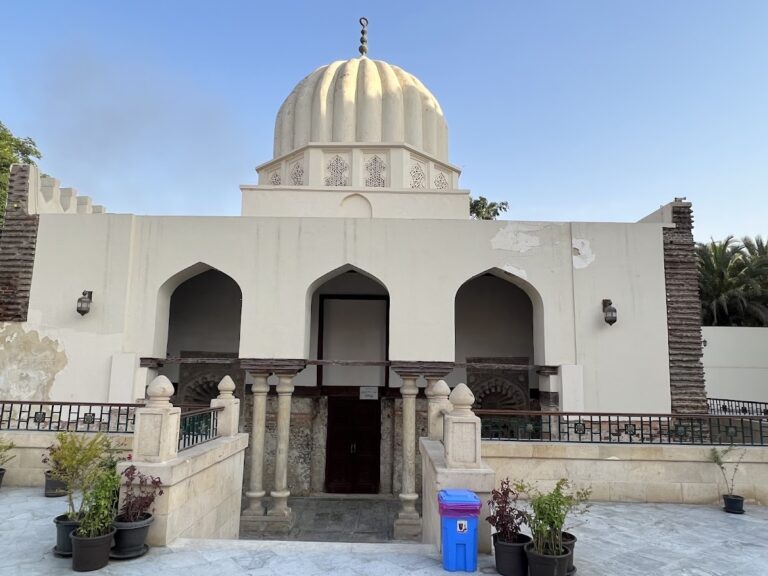
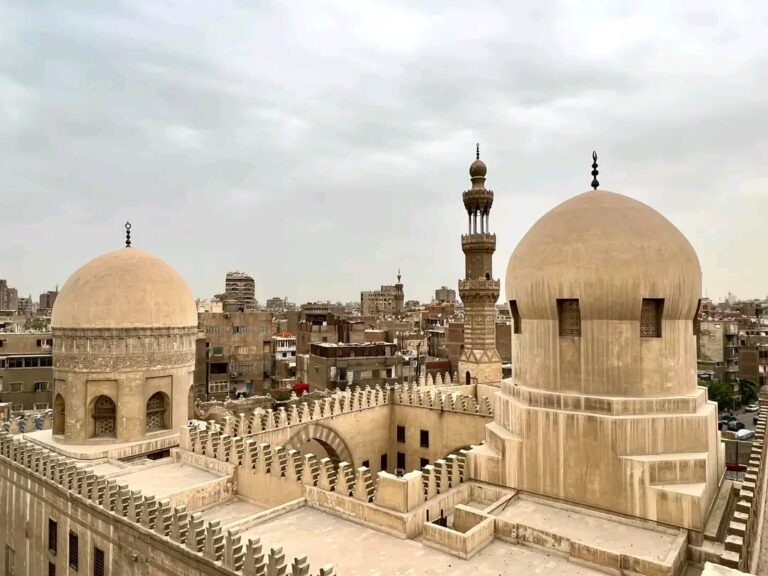
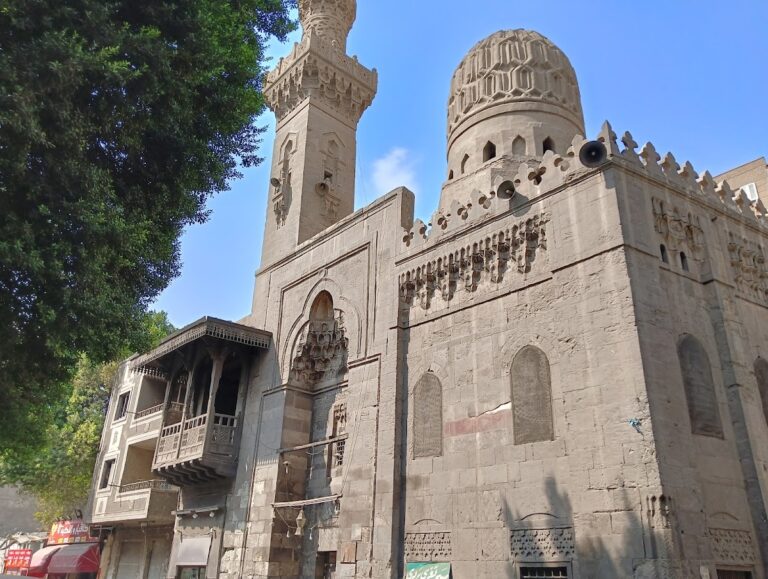
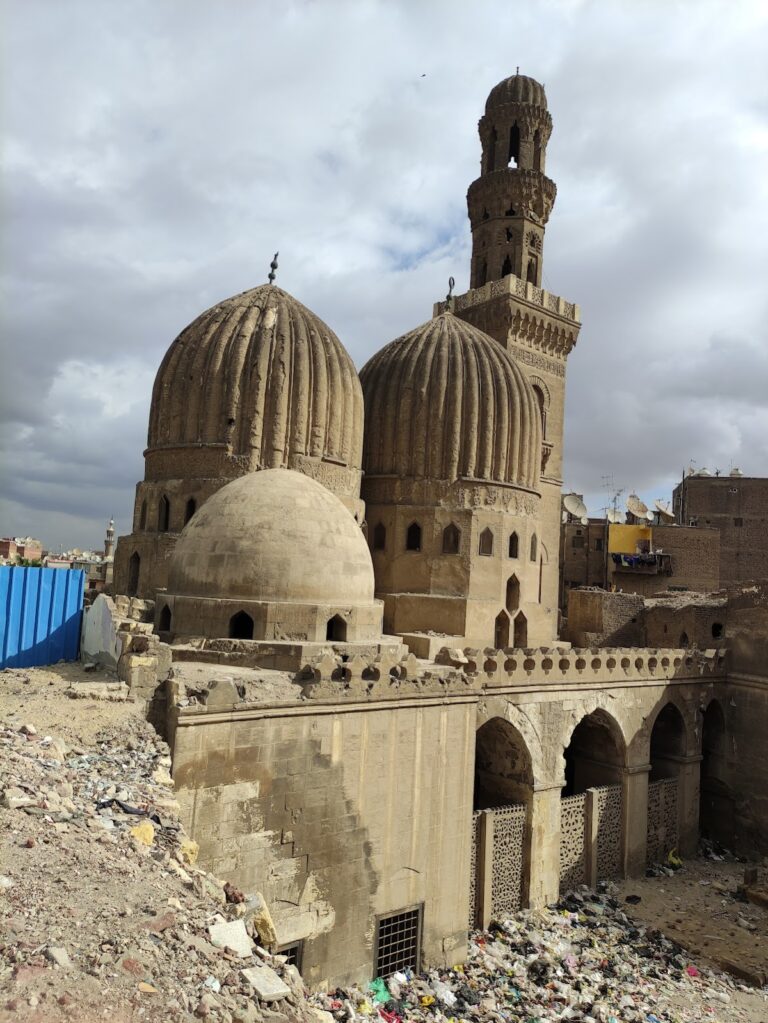
The complex combines a mosque with a funerary shrine containing Sayyida Nafisa’s tomb. Its principal surviving elements include a dome over the mausoleum and one or two minarets, with the number varying between descriptions of the building. The shrine occupies the location traditionally identified with Nafisa’s former house.
Separate entrances serve men and women. Inside, a passage leads toward the tomb and contains painted panels expressing devotion to the Prophet’s family, together with verses of poetry praising them. The mausoleum is enclosed by copper work that was renovated during the tenure of Abbas I, who ruled Egypt from 1848 to 1854. Its entrance was renewed and faced with marble.
Fatimid Architectural Elements
A decorative cresting survives on the north wall of the funerary complex. It consists of a chain-like sequence of inverted Y-shaped forms and is considered likely to date from the restoration associated with Badr al-Jamali in 1089. The feature preserves a visible element from the period when the shrine gained greater importance under Fatimid rule.
The restoration initiated by al-Hafiz in 1138 renewed the tomb dome and added marble lining to the mihrab. A portable wooden mihrab associated with the mosque is preserved at the Museum of Islamic Art in Cairo and is one of the few surviving Fatimid-period elements linked with the complex. It takes the form of a niche beneath a pointed arch. Polygonal shapes and a six-pointed star decorate its outer face, while carved foliate arabesque fills the spaces between them. The deeply carved central niche contains further foliate arabesque and a less prominent pattern of eight-pointed stars.
Later Interior and Cemetery Setting
The interior was altered during the renovation completed in late summer 2023. Earlier Mamluk-style interior decoration was replaced or covered with Asian-style marble, and sections of the interior facade were moved to the mausoleum of Ibn Ata Allah al-Iskandari, an Egyptian Sufi scholar and religious author.
The mosque stands within the wider al-Qarafa cemetery landscape, where nearby mausoleums include those of Sayyida Sakinah bint Husayn, Sayyida Ruqayya bint Ali, Sayyid Muhammad ibn Jafar al-Sadiq, and Sayyida Atikah. This surrounding group of shrines developed particularly during the Fatimid period, when commemorative buildings were established for religious figures revered by the wider Islamic community.