Aillevans Dolmen Group: Three Prehistoric Tombs in France
Site at a Glance
- Popularity
- Very Low
- Country
- France
- Primary era
- Stone Age
- Eras represented
- Stone Age, Bronze Age
- Civilizations
- Unclassified
- Site type
- Burial
- Remains
- Necropolis
On this page15 sections
History
The Aillevans dolmen group comprises three prehistoric stone tombs in Aillevans, France. They are broadly associated with the Late Neolithic and Bronze Age, although their precise chronology remains uncertain. Similarities in their construction and burial practices suggest that one settled community built them. The group has also been attributed to the Horgen culture, a prehistoric culture of central Europe.
Neolithic and Bronze Age use
Dolmen 1 developed through five phases of construction, alteration, or reuse. During its first three phases, at least 23 people were buried there. In a later building phase, the original mound was incorporated into a larger structure, and builders added postholes, meaning holes for upright timber supports, and paving. A timber building with a two-sided sloping roof may have stood above the tomb, possibly reflecting its reuse as a sanctuary.
Dolmen 2 appears to have remained in use through successive burials. Earlier human remains were moved against the chamber walls to make room for later interments. Its use probably began only after Dolmen 1 had been reused.
Later history
Dolmen 1 seems to have been abandoned in the Early Bronze Age and was damaged by frost and runoff. During the Late Bronze Age, people altered its interior, digging into the mound to extract clay and forming basins to collect cremated remains. After the Bronze Age, vegetation covered the mound. It gradually became a heap of stones cleared from surrounding land, a use that continued into the twentieth century.
Viellescazes excavated all three dolmens in 1954. J.-P. Milotte, A. Thévenin, and R. Antoine returned to the group in 1960, and Dolmen 1 was excavated again in 1973. Earlier digging had disturbed its archaeological layers, so most of the material recovered in 1973 came from sifting earth discarded during previous work. Dolmen 1 has been protected as a French historic monument since 2 March 1979.
Remains
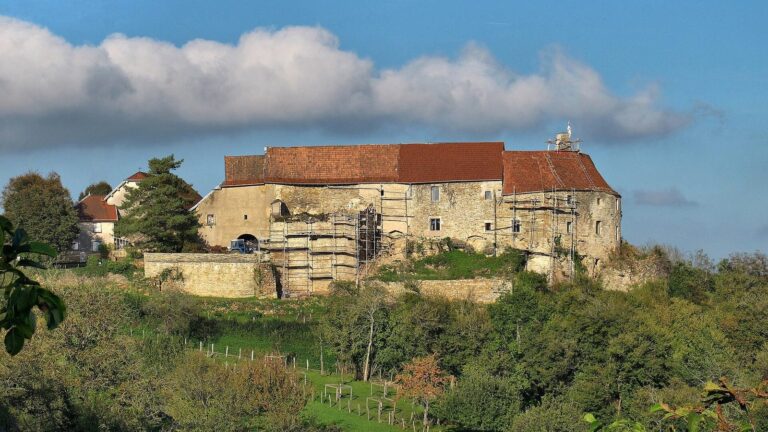
The three limestone monuments occupy a wooded hill at about 300 metres above sea level, on the right bank of the Ognon. Dolmen 1 lies about 600 metres from Dolmen 3, while Dolmen 2 is about 280 metres from Dolmen 3. The group is classed as the Aillevans type, with projecting side arms beside the chamber entrance. The surrounding structures take the form of circular earth mounds or trapezoidal stone-built mounds, with the stonework laid without mortar.
Dolmen 1
Original chamber
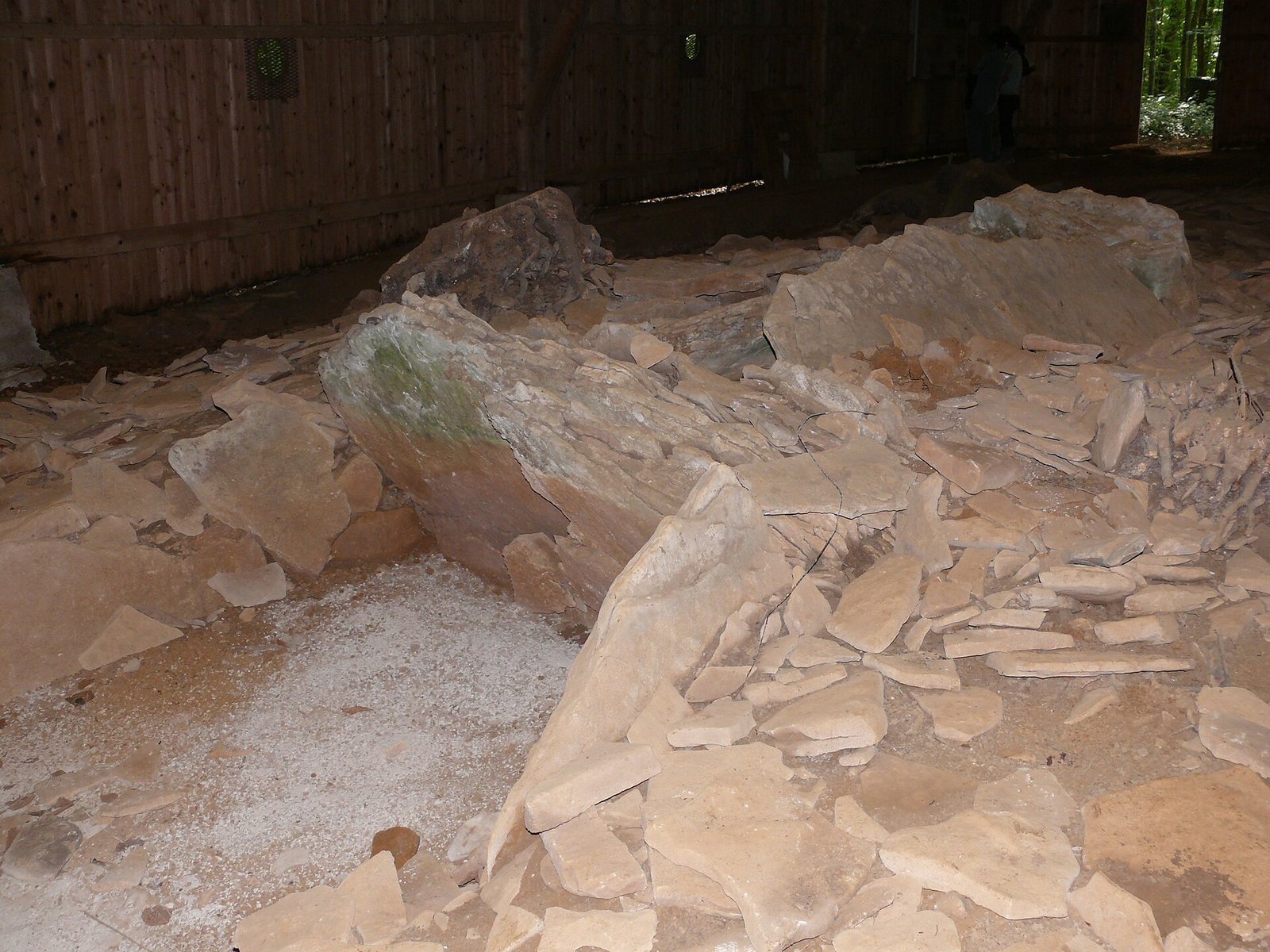
The tomb originally stood within a circular mound about 3 metres in radius. It is aligned east to west and opens eastward. Its entrance vestibule measures 2 metres across and 1 metre long, with limestone upright slabs on its north and south sides. The slabs were set in pits 0.8 metres deep and secured with clay.
Four slabs enclose the rectangular burial chamber, which measures 1.9 by 1.7 metres. Its east and west slabs are 1.70 and 2.15 metres long, 0.30 to 0.40 metres thick, and set 1.80 metres deep. The north and south slabs measure between 1.33 and 1.85 metres long, stand 1.30 metres high, and are 0.13 to 0.15 metres thick. They sit only 0.20 metres deep, packed with small limestone slabs. Some stones bear peck marks, and the chamber floor was cut down about 0.35 metres.
Expanded mound and later features
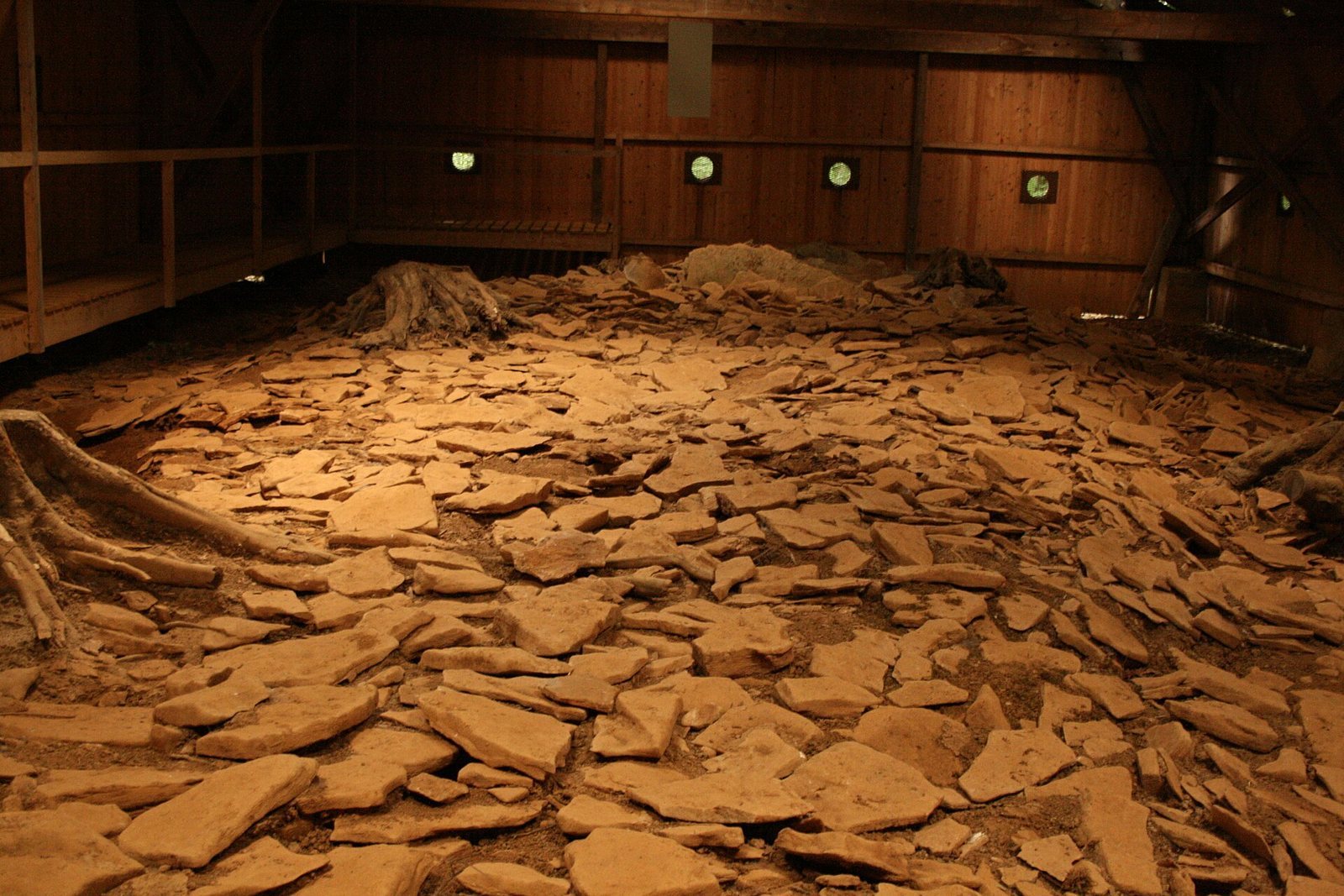
The enlarged mound is trapezoidal, about 18 to 19 metres long and 4 to 9 metres wide. Upright limestone slabs form its long sides, set into a straight trench 0.40 metres deep and 0.60 metres wide. Six postholes lie around the tomb, and paving surrounds it. The probable timber building and sloping roof would have left the side arms and entrance uncovered. In the Late Bronze Age, a clay-extraction pit and basins were cut into the mound; the basins served to collect cremated remains. A shelter now covers Dolmen 1.
Finds
Materials from Dolmen 1 include two quartzite hammerstones and flakes, five sandstone blocks that may have been used as pecking tools, and flint blades, blade fragments, flakes, arrowheads, and a dagger. The pottery dates mainly to the Late Bronze Age.
Dolmen 2
Chamber and mound
The chamber is roughly square and about 2 metres across, with four upright slabs. Its east and west slabs measure 2.30 and 2.50 metres long and 0.25 to 0.30 metres thick; they were set in a trench 1.80 metres deep. The north and south slabs measure 1.65 and 1.80 metres long and 0.20 and 0.25 metres thick, respectively, and were set only 0.25 metres deep. Small walls of unmortared stone close the chamber’s eastern corners. The floor was dug down about 0.60 metres.
Clay covered by four to six layers of paving forms a trapezoidal mound about 15 to 17 metres long. Its eastern end is 2 metres wide at the base, with the entrance centred in it.
Burial evidence
Excavations yielded an estimated 3,500 to 4,000 human teeth. Counts of bone fragments suggest about 50 burials, including 33 adults and eight children. Some 200 to 300 teeth from boar or pig may represent food offerings.
Objects
Funerary objects include five flint tools, three copper or bronze items, and fragments from three pottery vessels. The flint pieces comprise four arrowheads, including piercing and cutting forms, and a notched dagger that was probably attached to a handle. Two poorly fired vessels have S-shaped profiles, grey interiors, and red exteriors. A round-bottomed beaker has a black interior, a beige outer coating, and crushed calcite mixed into its clay. The metal objects are a large cast bead, a hammered bead for threading, and a small awl pointed at both ends.
Dolmen 3
Structure and condition
Dolmen 3 resembles the other monuments in its general design, but its chamber was not dug into the ground. Paving around it extends for at least 18 metres. The monument is in very poor condition, with broken supporting slabs.
Finds
Material found in the paving includes a few highly fragmented human bones that are difficult to identify, along with bones from a pig-family animal and a sheep or goat. Pottery finds comprise one sherd from a rough, poorly fired brown-black vessel tempered with coarse limestone, and four other fragments.