Acueducto de los Milagros: Roman Aqueduct of Mérida


Site at a Glance
- Rating
- 4.7
- Popularity
- Medium
- Country
- Spain
- Primary era
- Classical
- External website
- Open
- Eras represented
- Classical
- Civilizations
- Roman
- Site type
- Infrastructure
- Remains
- Aqueduct
On this page7 sections
History
The Acueducto de los Milagros is a Roman aqueduct in Spain, at Mérida, built to supply Emerita Augusta, the city that became the capital of the Roman province of Lusitania. Its construction is generally placed in the Julio-Claudian or Flavian period of the first century AD, although its exact date and sequence of building phases remain uncertain. The aqueduct continued to serve the city for several centuries.
Roman water supply
Emerita Augusta already had three earlier aqueducts when the Acueducto de los Milagros was constructed. The system traditionally began at the Proserpina reservoir and carried water towards the western side of the city. Later discoveries extended the known route beyond the reservoir, while evidence that the reservoir itself was not built during the Roman period has challenged the traditional understanding of the aqueduct’s water source and course.
Dating and rebuilding
A thermoluminescence analysis, a method for estimating when fired material was last heated, dated one brick from the prominent section near the city to approximately AD 290. Engineer Isaac Moreno Gallo has interpreted this section as a rebuilding carried out during the reign of Emperor Diocletian, who ruled from AD 284 to 305. In this view, the rebuilt arcades replaced a siphon system, which conveyed water under pressure across lower ground, after that system had disappeared.
Another study, from the Autonomous University of Madrid, proposed a fourth- or fifth-century construction date and interpreted the aqueduct as Visigothic, with Byzantine influence. That conclusion was rejected by figures including Mérida mayor Antonio Rodríguez Osuna. The aqueduct’s date and construction history therefore remain contested rather than settled by a single chronology.
Decline and heritage protection
After the fall of the Roman Empire, the aqueduct fell into decay and survived as ruins. Its traditional name, “Aqueduct of the Miracles,” is linked to the wonder inspired by the survival of its structures across so many centuries, as if preserved by a divine miracle. The monument became a Spanish National Monument in 1912 and is protected as a monument of cultural interest. Since 1993, it has formed part of the Archaeological Ensemble of Mérida, a UNESCO World Heritage Site recognized under criteria (iii) and (iv).
Remains
The surviving aqueduct combines a mainly underground watercourse with an elevated crossing built from alternating granite and red brick. Most of the conduit ran through a subterranean gallery cut into living rock, following the natural contours on a slight gradient. It emerged above ground in short arched sections where streams interrupted the route, before reaching the broad valley of the Albarregas River near the city.
Conduit and urban terminal
The water intake, traditionally called the caput aquae, or head of the aqueduct, was placed at the Proserpina reservoir. From there, the conduit followed a sinuous course of approximately 10 or 11 kilometres. It entered Mérida at the highest point of Calvario Hill. Within the city walls, a nymphaeum, a monumental fountain or water shrine, provided the aqueduct’s architectural terminal. This structure has traditionally been identified as the castellum aquae, the point where aqueduct water entered the urban distribution network, although that facility was probably situated nearby rather than inside the nymphaeum itself.
Albarregas arcades
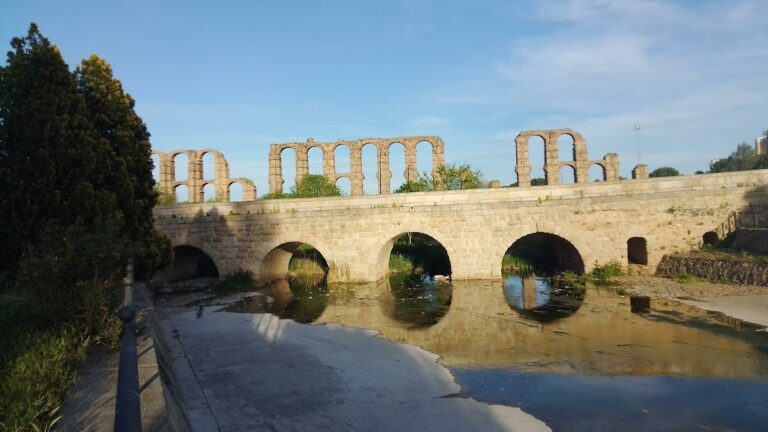
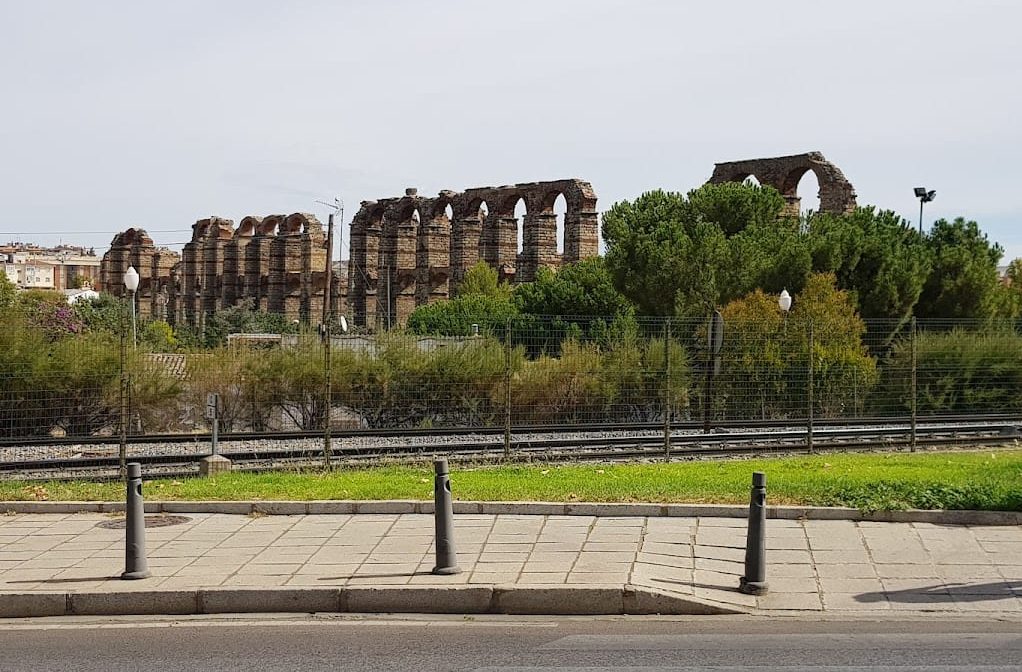
The best-known remains cross the Albarregas River on superimposed arcades. The elevated section extends for approximately 830 metres and rises about 25 metres at the deepest part of the valley. The aqueduct as a whole is also recorded as approximately 827 metres long. Its strong pillars contain a core of opus caementicium, or Roman concrete, faced by five courses of granite ashlar alternating with five courses of red fired brick. The resulting grey-and-red pattern is characteristic of the monument and of Mérida.
Arches at several levels connect the pillars. Most are constructed in brick, while the arch over the river channel has carefully worked granite wedge-shaped stones. Seventy-three pillars survive in varying states of deterioration. A small Roman bridge called the Puente de Albarregas runs parallel to the arcades in their immediate vicinity.