Basilica of Saint Eulalia of Mérida: A Christian Pilgrimage Church in Spain


Site at a Glance
- Rating
- 4.3
- Popularity
- Medium
- Country
- Spain
- Primary era
- Medieval
- External website
- Open
- Eras represented
- Classical, Medieval, Early Modern
- Civilizations
- Kingdom of León, Roman, Visigothic
- Site type
- Religious
- Remains
- Basilica
On this page14 sections
History
The Basilica of Saint Eulalia of Mérida is a Catholic church in Spain, dedicated to Saint Eulalia of Mérida and associated with the Archdiocese of Mérida-Badajoz. Its origins reach back to the fourth century, when the first church was built in Hispania after the Peace of Constantine, the change in imperial policy that ended official persecution of Christianity and enabled Christian church construction within the Roman Empire. The site became an important center in the emergence of Christianity on the Iberian Peninsula.
The fourth-century martyrial church
The original church was a martyrial basilica, a church built to commemorate a martyr near the place associated with burial or remembrance. It was erected in memory of Saint Eulalia, whose martyrdom became known across the Roman Empire. Her cult made the church a pilgrimage destination in the early Middle Ages for visitors from western Europe and North Africa, while churches dedicated to her were founded elsewhere, particularly in western Europe, with relics associated with the saint.
Bishops and archbishops of Mérida enriched the church over time. The poet Aurelius Prudentius praised its marble, mosaic pavements, and gilded coffered ceilings, but these features did not survive the later history of the site. The church suffered heavy damage during the Muslim invasion, and the early complex was subsequently transformed through further rebuilding.
Visigothic and medieval rebuilding
A Visigothic basilica was erected in the fifth century around Saint Eulalia’s late Roman funerary monument. The present church follows the same general plan and was begun around 1230, after Alfonso IX of León reconquered Mérida. Builders reused materials from the earlier structures. The Order of Santiago, a medieval military-religious order combining religious commitments with military and institutional duties, adopted the church as its chapter church.
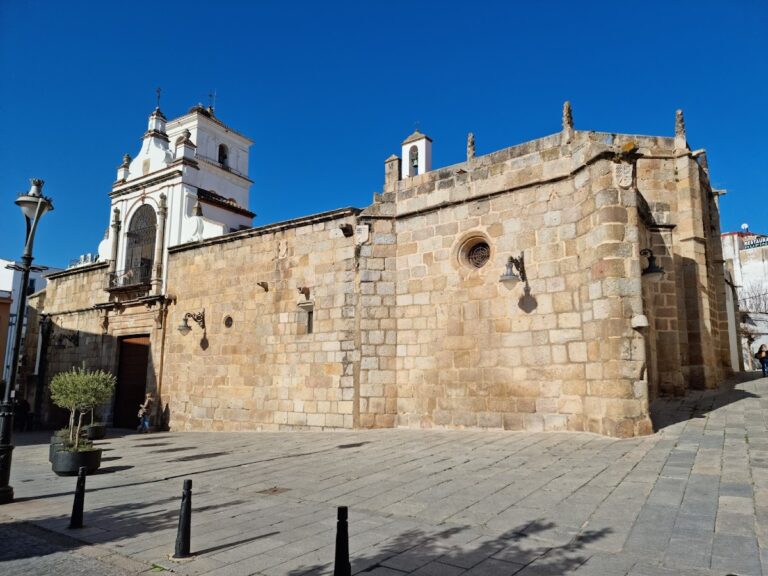
The building was Romanesque in origin, although later work gave it a strongly Baroque appearance. It was embellished and renovated during the seventeenth century. Until the end of the nineteenth century, the basilica formed part of the Patrimonium Petri, the property and institutional patrimony of the Holy See.
Modern recognition and ecclesiastical status
The basilica was declared a Spanish national monument in 1912 and is now protected as a monument of cultural interest. Since 1993, it has formed part of the Archaeological Ensemble of Mérida, which is inscribed on the UNESCO World Heritage List under identification number 664, specifically 664-009.
Although the church had long been popularly called a basilica, Pope Francis formally granted it the title of minor basilica. The document confirming the title is dated 23 September 2014, and the decision was announced during a homily on 10 December 2014, Saint Eulalia’s feast day and the feast day of Mérida’s patron saint.
Remains
The basilica stands outside the walls of ancient Mérida, above Saint Eulalia’s funerary mound and near the place traditionally associated with her execution. Excavations beneath the church began in 1990 and exposed an underground complex containing Roman and Visigothic remains. The excavated crypt is open to the public and provides the physical setting for understanding the successive buildings on the site.
Roman and early Christian remains
Roman houses and the Christian cemetery
The earliest remains are Roman houses dating from the first to the third centuries AD. After this area was abandoned, a Christian necropolis, or organized cemetery, was established there in the fourth century. It included a tumulus building commemorating Saint Eulalia, and this structure became the nucleus of the large basilica erected in the fifth century.
Saint Eulalia’s funerary monument
The crypt preserves remains of the late Roman funerary mound, or martyrial mausoleum, associated with Saint Eulalia. The mound formed the base and focal point of the Visigothic basilica built over and around it. The upper front portion of that Visigothic church survived later invasions and demolitions, and it still closes the apse behind the main altar.
The basilica and its interior
Plan and surviving early fabric
The present church has a basilican plan with three naves ending in three semicircular apses. Remains of the early Christian and Visigothic basilicas survive at the altar end. The side chapels beside the high altar and the southern doorway of the facade are prominent Romanesque elements, a style relatively uncommon in Extremadura. Their forms also show the beginnings of Gothic influence.
Columns and wooden ceiling
A wooden artesonado, a decorated coffered ceiling made from geometric recessed panels, covers the vaults. The capitals and columns include pieces transferred from the earlier Visigothic church, preserving material links between the present building and its predecessor.
The Hornito and devotional features
The votive chapel
The Hornito is a preserved structure in the basilica’s atrium, opposite the main entrance. It is a votive chapel associated with the cult of Saint Eulalia. Tradition places it at the site of her martyrdom, while its practical function was to allow pilgrims to pray before the saint at any hour without entering the basilica.
Reused Roman material
The Hornito incorporates reused remains from a Roman temple dedicated to Mars. One piece carries the Latin inscription “MARTI SACRVM VETTILLA PACVLI,” meaning “Consecrated to Mars. Vettilla, wife of Paculo.” The interior of the basilica also contains an image of Saint Eulalia and a statue of Our Lady of the Greater Sorrow.