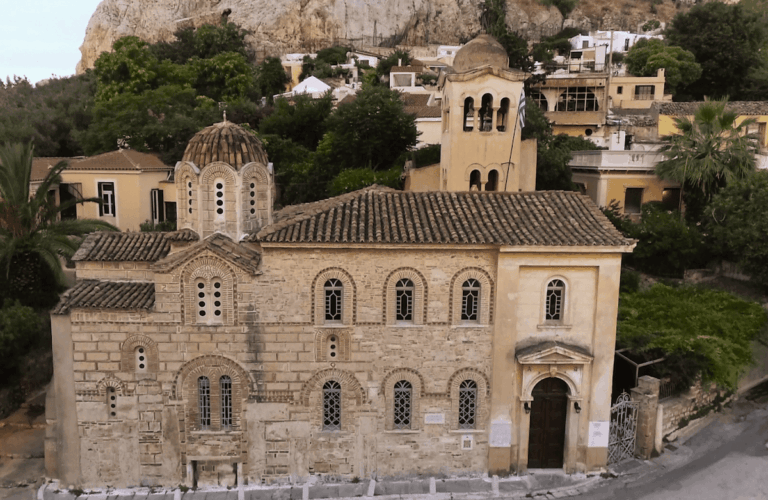
Fethiye Mosque, Athens: An Ottoman Religious Building and Exhibition Space


Site at a Glance
- Rating
- 4.4
- Popularity
- Low
- Country
- Greece
- Primary era
- Early Modern
- External website
- Open
- Eras represented
- Medieval, Early Modern
- Civilizations
- Byzantine, Ottoman
- Site type
- Religious
- Remains
- Mosque
On this page9 sections
History
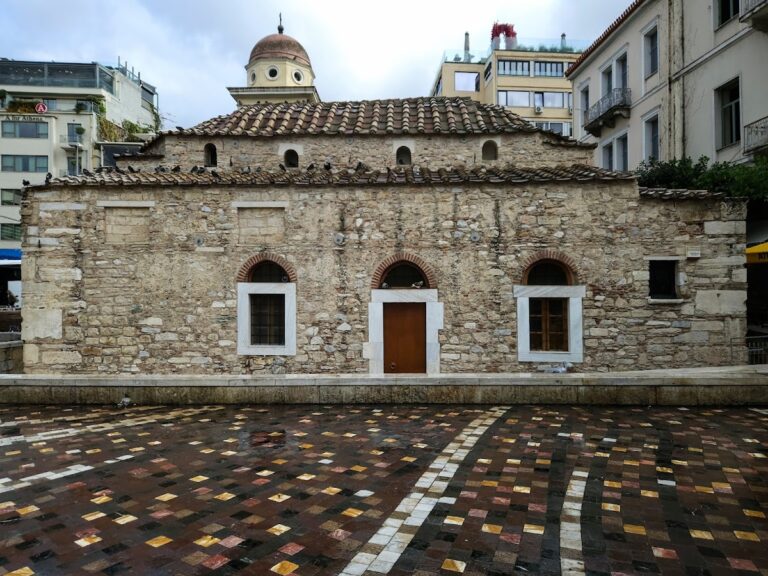
Fethiye Mosque, Athens, is an Ottoman religious building in Greece, constructed in the seventeenth century in the classical Ottoman architectural tradition. It stands at the center of the Roman Agora on the site of an eighth- or ninth-century Byzantine basilica dedicated to the Virgin Mary.
Byzantine and Early Ottoman Phases
After the Ottoman capture of Athens on 4 June 1456 from the Florentine duke Francesco II Acciaiuoli, the basilica was probably converted into a mosque. This change may have taken place before Sultan Mehmed II, known as Mehmed the Conqueror, visited Athens in August 1458. Mehmed had captured Constantinople in 1453 and expanded Ottoman rule into southeastern Europe. His visit was long regarded as evidence that he founded the mosque, but that interpretation is no longer generally accepted.
The building is not recorded under its present name before 1676. Evliya Çelebi, who visited Athens in 1667, described an older mosque called Eski Camii, meaning Old Mosque, on the same site. The present building was erected between 1668 and 1670, replacing that earlier mosque.
Seventeenth-Century Reconstruction
The reconstruction of 1669–1670 is associated with the Ottoman architectural historian Machiel Kiel and later research with the Ottoman annexation of Crete at the end of the Cretan War. The Cretan War was the conflict through which the Ottoman Empire completed its conquest of Crete. This explanation, rather than a foundation by Mehmed II, is now generally accepted.
Because the mosque stood beside the grain market in the Roman Agora, it became popularly known as the Mosque of the Wheat Market. Its religious use was interrupted during the Venetian occupation of Athens from October 1687 to May 1688, when the building was converted into a Catholic church dedicated to Dionysius the Areopagite.
Greek State and Military Uses
The building was considered as a possible seat of the Assembly of the newly independent Greek state. It was taken out of religious use in 1824 and then used by the Philomuse Society of Athens, a Greek educational and cultural association active during the early years of the independent state. The minaret was probably demolished after this change of use.
From 1834, Fethiye Mosque successively served as a barracks, a prison, and a military bakery for the Athens garrison. It remained a military bakery until 1935. By no later than 1890, flour storage areas and ovens had been installed against its exterior walls.
Archaeological Storehouse and Restoration
In 1937, the Metaxas regime proposed creating a museum of modern Athens history in the building, but the plan was abandoned during the Second World War. From the mid-twentieth century until the early 2010s, the former mosque served as an archaeological storehouse for antiquities and historical remains found in the Roman Agora and on the Acropolis.
Restoration under the auspices of Anastasios Orlandos removed later annexes and plaster covering. The Ministry of Culture announced the removal of the stored antiquities and the restoration of the building in 2010. The Central Archaeological Council, Greece’s principal advisory body for archaeological heritage, approved the campaign in 2013, and the work concluded in 2017. Since then, the building has functioned as an exhibition space rather than a place of worship. It is administered by the Greek Ministry of Culture and protected as part of a Greek archaeological site.
Remains
Centralized Prayer Hall
The mosque has a quadrilobate, or tetraconch, plan, a centralized layout with four projecting or semicircular parts around a central space. Its square prayer hall is arranged around four columns and a central dome. Four lateral semidomes and four smaller domes at the corners create a symmetrical four-leaf-clover form.
The four columns carry arches that support the central dome. On the eastern side, a simply designed mihrab, the prayer niche marking the direction of Mecca, identifies the hall’s religious orientation. The interior is plastered and largely plain, although limited red and blue floral motifs survive above the mihrab and beside the eastern window in the north wall.
Entrance Porch
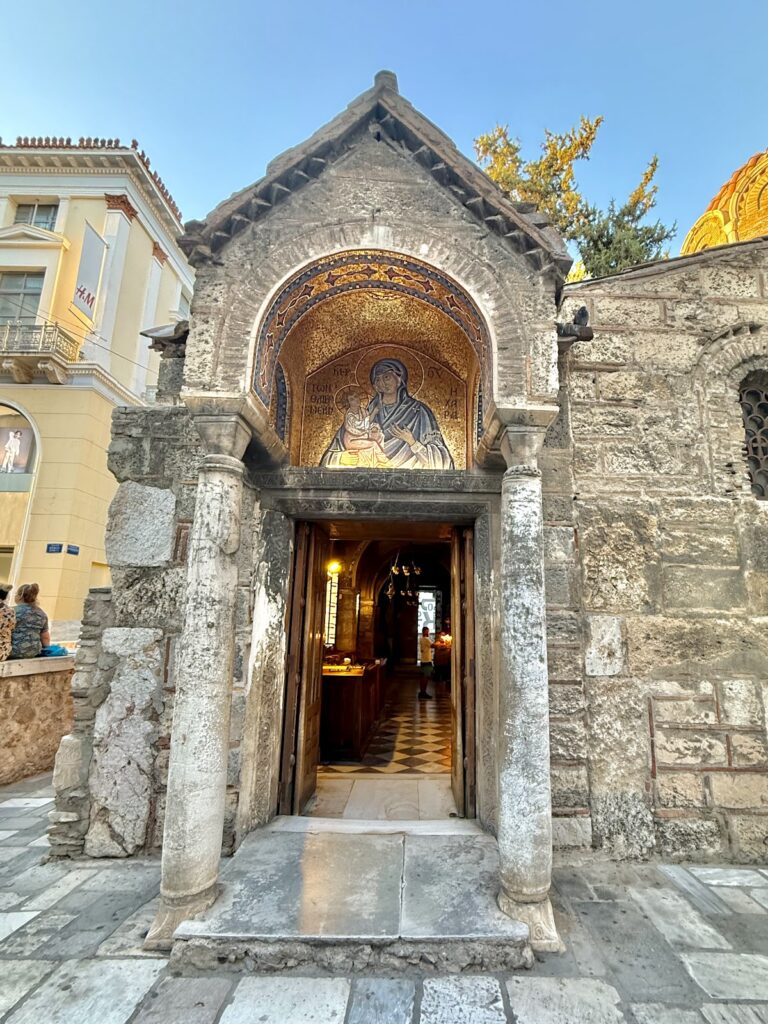
The entrance is on the west, through a marble-paved porch covered by five small domes. Five arches rest on four reused columns and two stone corner pillars, with traces of color remaining on the arches. A muqarnas niche, a tiered ornament resembling stalactites, stands on each side of the entrance and separates the two porch windows.
Marble frames around the entrance and windows carry inscriptions, with the oldest dating from 1669–1670. Ancient architectural elements were reused extensively in the building’s construction, linking its seventeenth-century fabric with the earlier structures of Athens.
Earlier Foundations and Minaret
The present mosque has a different orientation from the Byzantine basilica beneath it, allowing part of the earlier church’s foundations to remain visible. The surviving base of a spiral staircase stands at the southwest. The minaret probably belonged to the earlier mosque because its orientation differs from that of the present building.
Fethiye Mosque is located in the Aerides district at the center of the Roman Agora, approximately 100 meters from the former Dzisdirakis Mosque. Its surviving structure therefore preserves evidence of several periods of change, from the Byzantine basilica and earlier Ottoman mosque to the seventeenth-century rebuilding and its later adaptations.
Nearby sites