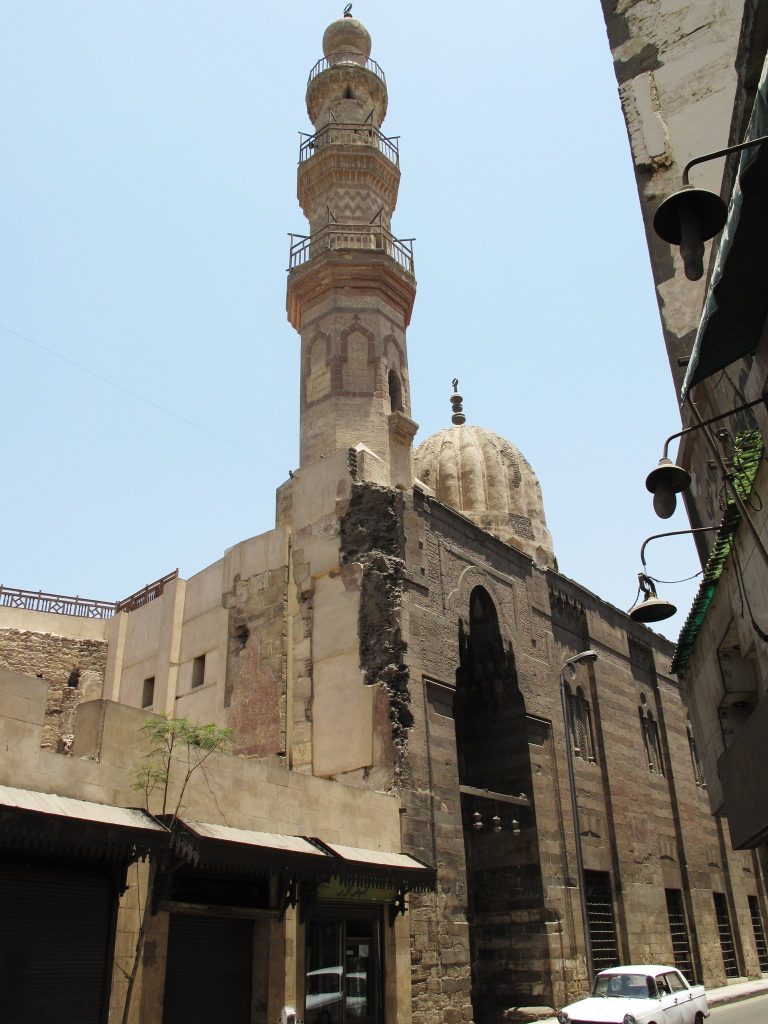
Abu al-‘Ila Mosque: A Late Mamluk Religious Monument in Cairo


Site at a Glance
- Rating
- 4.6
- Popularity
- Medium
- Country
- Egypt
- Primary era
- Medieval
- Eras represented
- Medieval
- Civilizations
- Mamluk
- Site type
- Religious
- Remains
- Mosque
On this page10 sections
History
Abu al-‘Ila Mosque is a Sunni mosque in Bulaq, Cairo, Egypt, built around 1485 during the late Mamluk period by the merchant Nur al-Din ‘Ali ibn Qanish al-Burullusi. It was dedicated to the Sufi religious leader Husayn Abu ‘Ali, whose name gave the mosque its commonly used title.
Foundation in the late Mamluk period
Husayn Abu ‘Ali lived in the fifteenth century in a retreat and religious lodge near the Nile. After attracting many followers, he asked Nur al-Din ‘Ali ibn Qanish al-Burullusi to renew the place where he worshipped. The merchant fulfilled this request by establishing the mosque and attaching a mausoleum, a structure built over or beside a tomb, for the shaykh.
Abu al-‘Ila was buried in the mausoleum after his death in 1486. The mosque therefore served both as a place of worship and as a memorial associated with a respected Sufi figure. Its foundation belongs to a period when the Mamluk sultanate ruled Egypt and religious architecture was marked by elaborate decoration and richly ornamented mosques.
Repairs and later alterations
The building was repaired during several periods and underwent major modifications between 1915 and 1920. These changes left only parts of the original Mamluk structure intact, while the surviving elements continue to identify the mosque as a notable monument of Bulaq Abu al-‘Ila.
Several scholars were also buried within the mosque. They included Shaykh Ahmad al-Ka’ki, who died in 1545; Shaykh ‘Ubayd; Shaykh ‘Ali Haksha, who died in 1854; and Shaykh Mustafa al-Bulaqi, who died in 1846.
Religious importance
The mosque remains an important religious site because of Abu al-‘Ila’s tomb. Local Muslims continue to visit it seeking his baraka, understood in Sufi practice as sacred blessing or spiritual beneficence, as well as his intercession. This continuing religious association forms an important part of the mosque’s identity alongside its architectural value as a Mamluk monument.
Remains
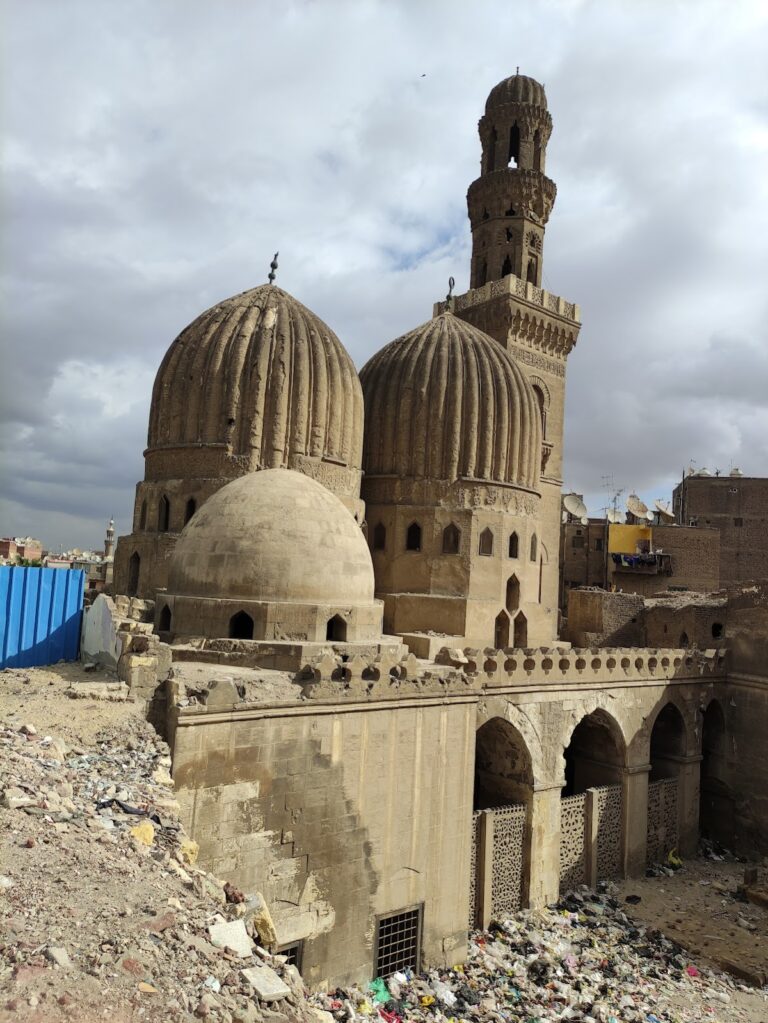
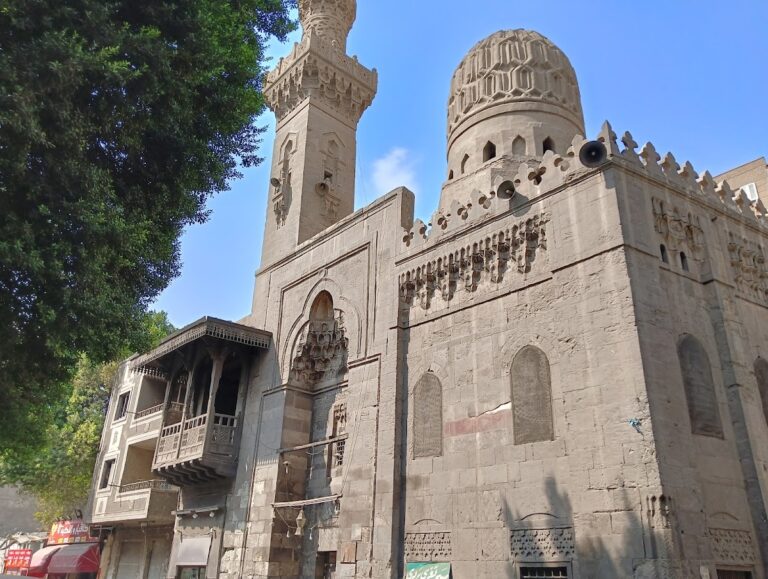
The surviving complex preserves parts of a building probably arranged as a four-iwan madrasa plan. An iwan is a vaulted hall or recessed space opening onto a courtyard, while a madrasa is an Islamic educational institution traditionally associated with religious study. Four such spaces were likely placed around a central court. The remaining historic fabric includes the mausoleum, minaret, entrance, part of the eastern wall, sections of the northern facade, the northern door, dome, and minbar.
Surviving architectural structure
Mausoleum and dome
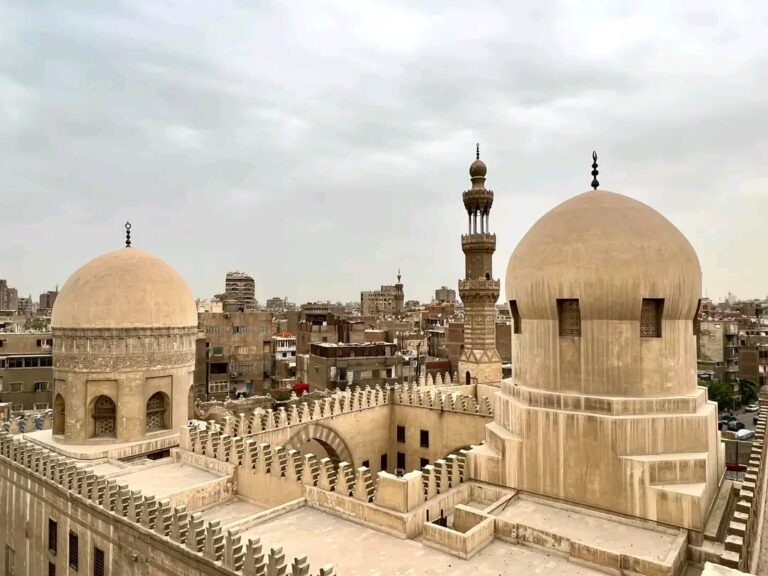
The mausoleum forms one of the principal surviving elements of the mosque and is associated with the tomb of Husayn Abu ‘Ali. The exterior dome is built of stone. Interior walls and domes carry colored Islamic inscriptions, preserving part of the decorative program connected with the building’s religious function.
Minaret and entrances
The mosque retains a single minaret, together with its main stone entrance and northern door. The main entrance bears the Quranic inscription, “Whatever good you do, God knows it.” Sections of the northern facade and part of the eastern wall also survive, helping define the remaining outline of the historic structure.
Columns, ceiling, and floor
The building rests on 23 white-marble columns. Its floor is made of Indian teakwood, and the decorated ceiling is covered with gold leaf. These materials form part of the surviving interior treatment, alongside the colored inscriptions on the walls and domes.
Minbar
The surviving minbar, the raised pulpit from which the sermon is delivered, is regarded as an outstanding example of woodworking from the Circassian Mamluk period. Its panels are inlaid with ivory and another decorative inlay material. The sides and doors are divided by distinctive ornament, especially around the large circular element. An inscription at the entrance names its maker as Ali ibn Tannin and associates the work with the shrine of Husayn Abu ‘Ali.