Abbazia di Santa Maria Assunta: A Medieval Abbey in Italy


Site at a Glance
- Rating
- 4.6
- Popularity
- Medium
- Country
- Italy
- Primary era
- Medieval
- External website
- Open
- Eras represented
- Medieval, Early Modern
- Civilizations
- Holy Roman Empire, Lombard
- Site type
- Religious
- Remains
- Monastery
On this page15 sections
History
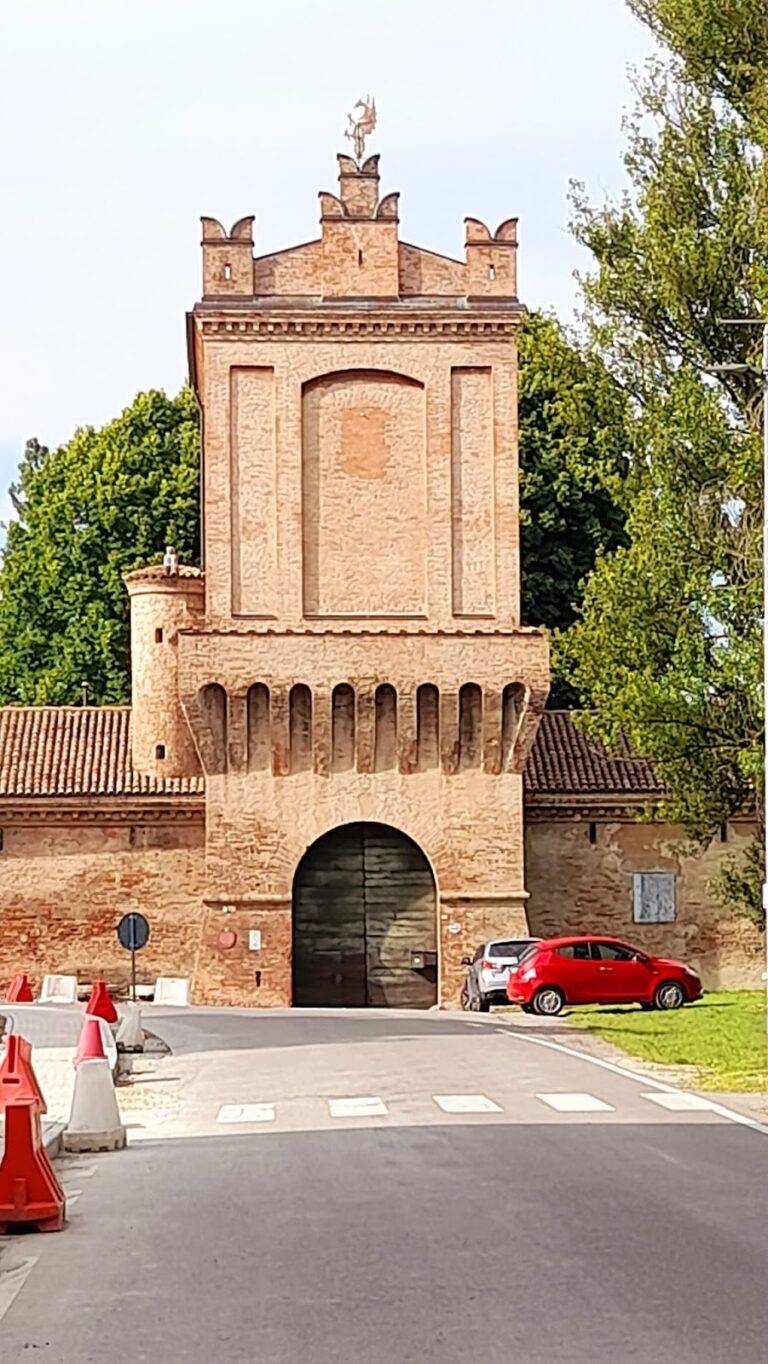
Abbazia di Santa Maria Assunta, also known as the Abbey of Monteveglio, is a medieval Roman Catholic church and former monastery in Italy, on a hill above Monteveglio, about 25 kilometres west of Bologna. Its present church was built mainly in the eleventh and twelfth centuries in the Romanesque style by the Canons Regular of San Frediano of Lucca. The complex now belongs to the Brothers of Saint Francis and lies within the Parco Regionale dell’Abbazia di Monteveglio.
Roman and early Christian origins
Roman settlement in the surrounding area followed the construction of the Via Aemilia in 187 BC. Villas stood around the present abbey during the first century AD, and a Roman temple may have occupied the hilltop. Marble fragments reused in the religious complex may come from that earlier building.
The earliest certain reference to a Christian church at Monteveglio dates to 973. A document concerning a transfer between Albert, bishop of Bologna, and Uberto, bishop of Parma, mentioned a church with a baptistery. The site may have had a church as early as the fifth century, during the period when Byzantine and Lombard powers shaped northern Italy, but that earlier date remains uncertain. Parts of the crypt and apse also suggest that a church and monastery may have existed before the ninth century.
Canossan foundation and medieval authority
In 1015, Sigifred II of Canossa became bishop of Parma and abbot of Nonantola, while Monteveglio became a fief of the House of Attoni. The abbey was established between the eleventh and twelfth centuries, probably with the patronage of Matilda of Canossa, the Italian noblewoman and territorial ruler whose lands and religious patronage were closely tied to northern Italy’s church and imperial politics.
Tradition connects the foundation with Monteveglio’s survival of the siege conducted by the forces of Henry IV in 1092. Henry IV was the Holy Roman Emperor involved in the wider late-eleventh-century conflict between imperial and papal authority, a struggle in which Matilda was an important opponent of imperial power. Between 1092 and 1100, the Canons Regular of San Frediano arrived at Monteveglio and undertook the construction of the church.
In 1198, the inhabitants of Monteveglio signed an act of submission to Bologna in the abbey’s cloister. The abbey’s authority later declined as the nearby defensive castle became less important. Its medieval sphere nevertheless included the Abbey of Saint Fabian, the Monastery of Saint Apollinaris at Serravalle, the monastery at Fagnano, and two hospitals. For almost three centuries, it also administered Bologna’s Hospital of Santa Maria della Carità. Bologna’s Church of Saint Apollinaris at Porta Nuova belonged to the abbey until its demolition in 1256.
Lateran administration and renewed prosperity
After 1455, the Canons Regular of San Frediano were replaced by the Lateran Canons of San Giovanni in Monte of Bologna, an Augustinian community of clerics who followed a rule of communal religious life. Their arrival began a new period of prosperity. The monastery was enlarged, the church received new furnishings and decoration, and a bell tower was built in the fifteenth century.
In 1468, the abbey stood at the height of its influence and had 65 churches under its authority. Its parish territory expanded, and the title of its superior changed from archpriest to prior and then to abbot. The abbot possessed the privilege of wearing episcopal insignia until 1796, and again from 1934 to 1977 under a special papal privilege.
On 25 March 1527, during the abbacy of Ludovico Landriani, the abbey was besieged by landsknechts serving Charles V as they marched toward Rome. Landsknechts were German-speaking mercenary infantry widely used in European warfare during the late fifteenth and sixteenth centuries. Tradition holds that a sudden snowstorm and flooding of the Ghiaia stream caused the troops to abandon the siege. A thanksgiving procession connected with the event continues to bring a candle to the church, with the observance placed on the first Sunday of June by one tradition and on 25 March by another.
Suppression and modern religious use
Napoleon’s reforms suppressed the monastery in 1796, ending its institutional existence. In May 1799, the archpriest Father Guiducci hosted the poet Ugo Foscolo, who was recovering incognito at Monteveglio before being arrested as an alleged Austrian spy.
Architect Giuseppe Rivani directed a major restoration from 1925 to 1934. The work reconstructed the church’s original architecture and removed later additions. During the 1960s, the complex housed La Piccola Famiglia dell’Annunziata, a community founded in 1961 by Father Giuseppe Dossetti. In 2022, the abbey housed the Brothers of Saint Francis. Monteveglio is also associated with the Piccola Cassia, an ancient route linking Nonantola and San Giovanni in Persiceto with the Via Cassia near Lucca and Pistoia.
Remains
The surviving complex consists of a west-facing Romanesque brick church set on an east-west axis, the monastery buildings, a fifteenth-century cloister, and portions of an earlier cloister. Inside the church, the spaces are arranged vertically, with the congregation’s three-nave area above a raised presbytery and a crypt below it.
Church structure and interior
Congregational area
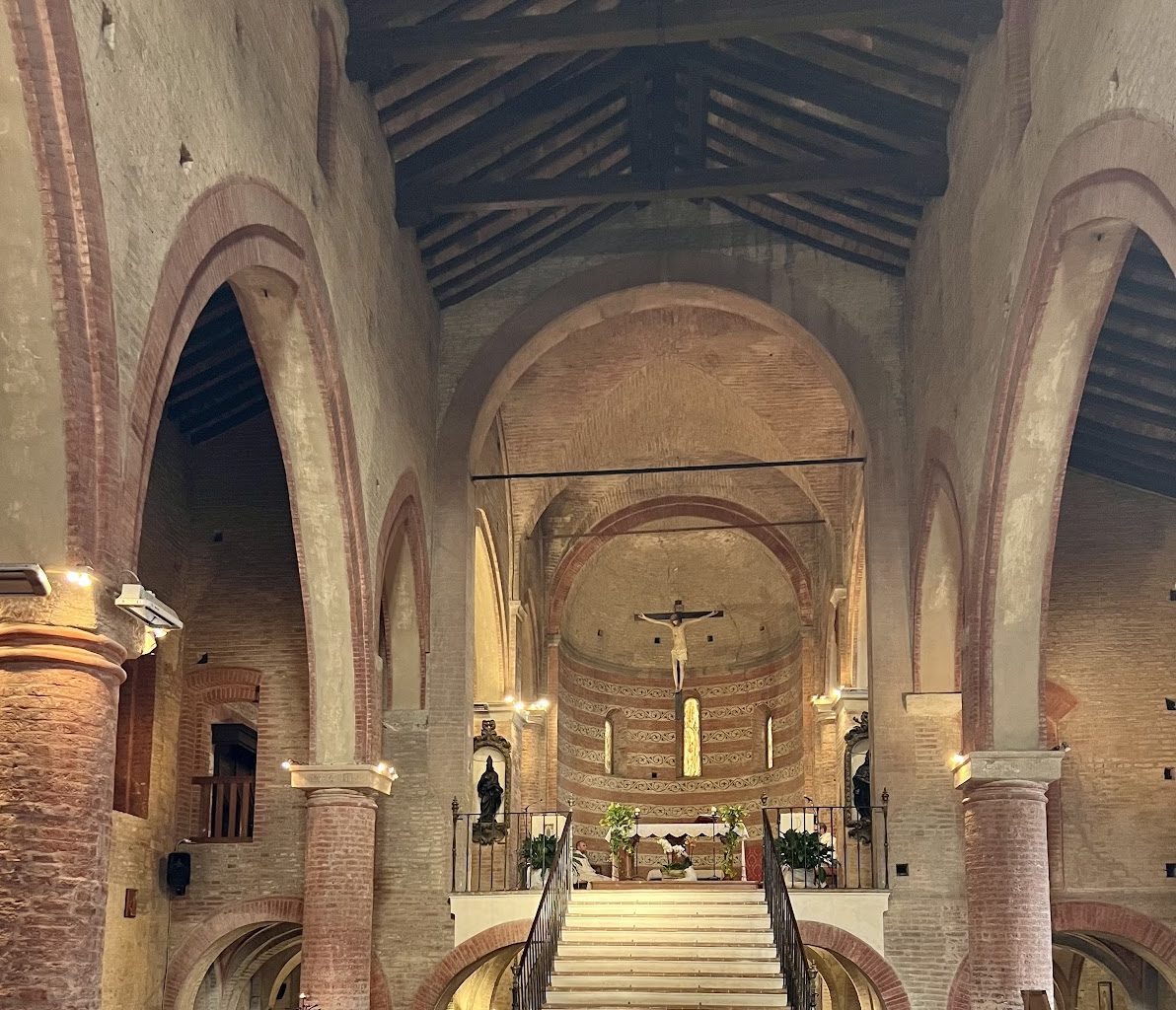
The main body of the church has three naves divided by columns and pointed arches influenced by Arab artistic forms. The west facade contains the principal entrance, while another entrance opens through the south wall. A marble memorial tablet to Matilda of Canossa stands in the right nave. Two capitals near the upper end of the central nave bear engraved decoration from the period of the Lateran Canons. A seventeenth-century engraved tomb slab set into the central nave floor closes access to the canons’ cemetery beneath the church.
Presbytery and altar
Baroque stairs lead from the central nave to the raised presbytery above the crypt. Single-light windows fitted with alabaster slabs illuminate the space, which ends in three apses. The altar is made of red Verona marble and rests on five columns. An eighteenth-century organ stands to its right, while a memorial tablet concerning the 1527 siege is set into the left wall. A walnut choir structure stands beside the presbytery.
Crypt
The crypt is divided into four bays by piers and cylindrical columns. Differences in the column bases and capitals preserve evidence of alterations over several centuries. Three smaller apses contain sarcophagus-shaped altars. The flat slab of the central altar is an authentic Roman funerary slab, and another tomb slab from the Lateran period lies in the floor before it.
The three smaller apses retain single-light alabaster windows. A Lombard-period baptismal font stands in the right aisle, and one capital also dates from the Lombard period. These elements connect the lower church with the earlier religious history of the site.
Bell tower and decoration
The fifteenth-century bell tower rises from the northern apse and has no independent foundations. The church’s painted decoration includes sixteenth-century frescoes in the crypt and restrained fifteenth- and sixteenth-century paintings in the vaults and apses, where the imagery retains a strongly medieval character. The presbytery has red bands and black ornamental motifs, some dating from the thirteenth century and others remade during the latest restoration.
A fifteenth-century polychrome wooden crucifix hangs above the altar. The church also contains a copy of Lorenzo Costa’s painting of the Assumption, while the original is preserved in Bologna’s Pinacoteca Nazionale.
Monastery and cloisters
Sacristy
The sacristy forms part of the monastery and connects with both the crypt and the presbytery. Its furnishings include a large cupboard dated 1487, inlaid with figures of fountains, churches, castles, flowers, and a heart on a chalice. A fifteenth-century carved-wood lectern bears the arms of the abbey and Monteveglio Castle, and a brightly coloured column clock also survives there.
The sacristy preserves a late-fifteenth-century tempera painting on canvas of the Madonna and Child, known as the Madonna della Rondine. An unknown artist created the painting, which originally came from the oratory of the Santa Maria della Rondine confraternity.
Fifteenth-century cloister
At the centre of the monastery is a fifteenth-century quadrangular cloister with arcades, two brick wells, and wrought-iron arches. Covered walkways on two levels surround the courtyard, with six arches along each north-south side and seven along each east-west side. Ancient painted panels on the ground floor recall the monastery’s history.
The upper level contains the cells used by the canons until the end of the eighteenth century. These rooms were restored with wooden ceilings in the fifteenth-century Bolognese style, alongside the loggia. An eighteenth-century masonry well with a characteristic roof stands in the garden.
Surviving Romanesque portico
On the north side of the abbey, eight intact arches form the surviving portico of the original Romanesque cloister. Its capitals vary in style, preserving different phases of the cloister’s construction and alteration. The portico is the remaining part of a structure whose other sides were demolished during the first half of the nineteenth century.
Nearby sites