Torcello Cathedral: A Byzantine Basilica in the Venetian Lagoon


Site at a Glance
- Rating
- 4.4
- Popularity
- Medium
- Country
- Italy
- Primary era
- Medieval
- Eras represented
- Medieval
- Civilizations
- Byzantine, Venetian
- Site type
- Religious
- Remains
- Cathedral
On this page18 sections
History
Torcello Cathedral, formally the Basilica of Santa Maria Assunta, is a Byzantine-founded church on Torcello in the northern Venetian Lagoon of Italy. Established in 639 in the late Paleochristian basilical tradition, it became the cathedral of the diocese transferred from the Roman city of Altinum and later acquired one of northern Italy’s most important medieval mosaic cycles.
Foundation and early development
The church was founded on the orders of Isaac, exarch of Ravenna, a senior Byzantine imperial governor, during the reign of the emperor Heraclius. The bishop Paulus had taken refuge at Turricellum, the early name for Torcello, during the Lombard invasion. He brought the treasury and relics of the bishopric of Altinum, an ancient Roman city in the northern Venetian region, to the lagoon settlement.
A stone foundation inscription names Isaac as the official who ordered the church’s construction, Maurice as the military commander who built it from its foundations, and Maurus as the bishop who consecrated it. Made during Heraclius’s reign, the inscription is regarded as the earliest document of Venetian history.
Torcello later developed into one of the wealthiest and most prosperous centers of the early Venetian lagoon. The church was enlarged in 826 and underwent a major renovation in 864 under Bishop Adeodatus II. In 1008, Bishop Orso Orseolo, son of Doge Pietro II Orseolo, rebuilt and rededicated it to Santa Maria Assunta, or Saint Mary of the Assumption. This rebuilding raised the nave, added windows to the west wall, and created the arcades that separate the nave from the aisles and support the clerestory.
Medieval cathedral and later changes
Between the second half of the eleventh and the second half of the twelfth century, the cathedral received an extensive mosaic cycle made principally by Venetian and Byzantine mosaicists. Venetian artists working from Byzantine models produced much of the earlier decoration, while Byzantine workshops later repaired or recomposed damaged sections in the mature Comnenian style, the refined artistic language associated with the imperial Comnenian period.
The town of Torcello declined during the fifteenth century. The island became isolated and partly abandoned, although the church continued to function as a place of worship. The cathedral remained the seat of the bishop until the Diocese of Torcello was suppressed in 1818. It then became a parish church under the Patriarchate of Venice. The parish institution was suppressed in 1986, and the basilica was incorporated into the parish of Burano. Torcello had also been treated as a titular see, a bishopric retained in name without ordinary territorial administration, since 1969. The church is a minor basilica and sanctuary.
The cathedral and its mosaics underwent repeated restoration. Work followed the earthquake of 1117 during the second half of the twelfth century, and further interventions took place around 1423–1430, in 1732–1739, 1753–1759, and 1849–1853, with partial correction in 1896. Other restoration dates include 1418, 1693, 1826, and 1894. Work carried out between 1972 and 1985 addressed the building and its decoration, with a further mosaic review planned for 2018–2019. Nineteenth-century repairs changed the quality of several mosaic sections, and some badly damaged heads were replaced.
The summit of the separate bell tower was lost in 1640 and was not rebuilt to its former height. The tower was restored in 1826. Torcello Cathedral forms part of the UNESCO World Heritage property “Venice and its Lagoon,” inscribed in 1987.
Relics and traditions
The cathedral preserves the skull of Saint Cecilia as a relic. A nearby small oratory is traditionally associated with the site of an earlier church dedicated to Saint Mark. According to this tradition, Rustico da Torcello and Buono da Malamocco brought the relics of Saint Mark the Evangelist from Arab-occupied Alexandria to Venice in 828.
Remains
Religious complex and exterior
Cathedral and narthex
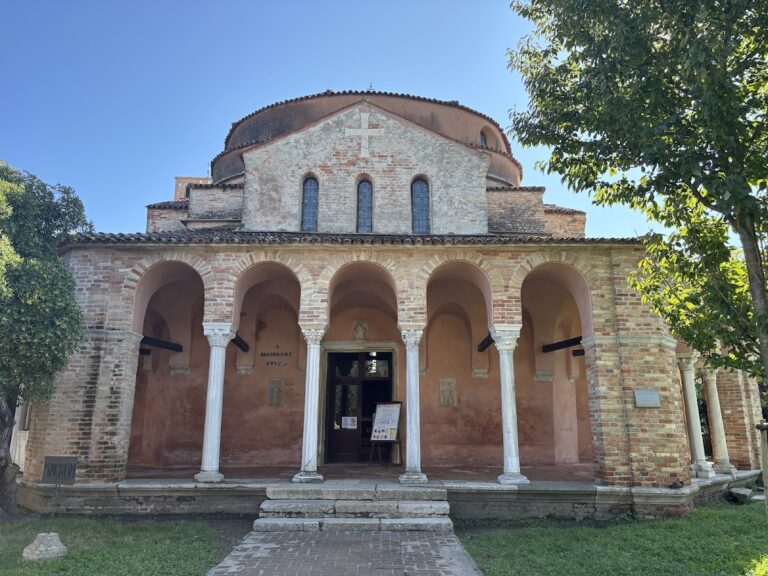
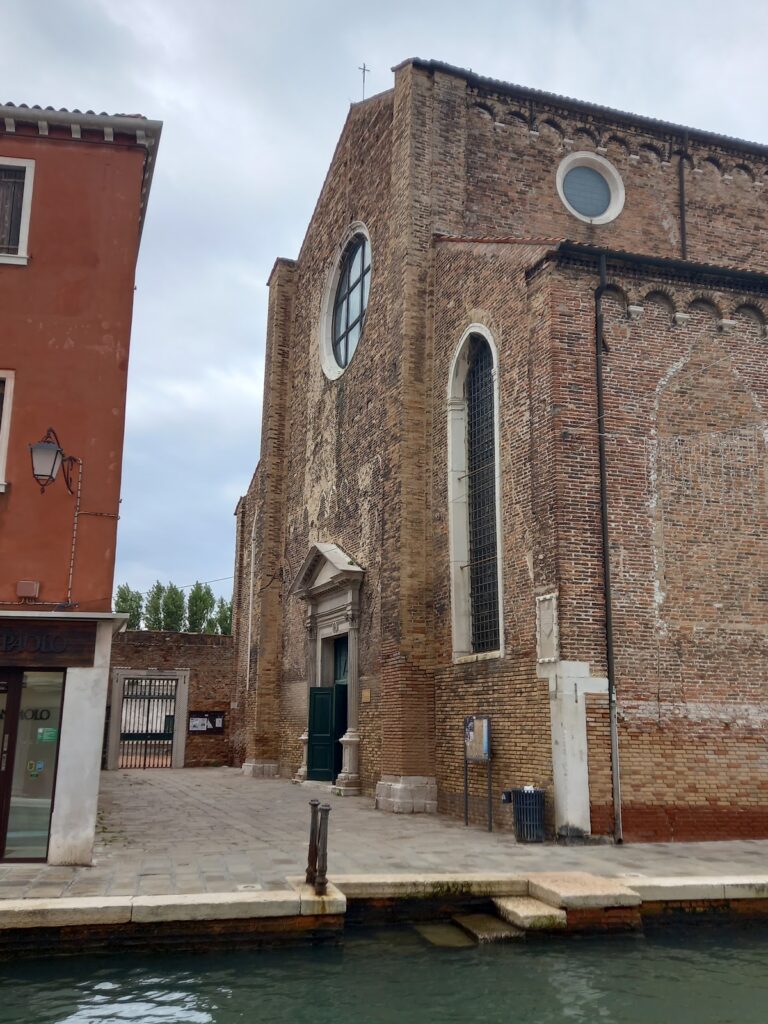
The basilica stands near the remains of Torcello’s ancient civic square, with Santa Fosca and the foundations of a vanished baptistery dedicated to Saint John forming a single religious complex. A bishop’s palace was formerly connected with the group. The cathedral follows a late Paleochristian basilical plan, organized around a central nave, two aisles, an eastern apse, and an entrance narthex.
The narthex dates from the eleventh century and was enlarged and altered in the thirteenth century. Its gallery connects with and surrounds the neighboring church of Santa Fosca, while the frontal portico was enlarged in the fourteenth century. The baptistery was formerly incorporated into the narthex. Traces survive in the present façade, including part of its structure.
Façade and portal
The façade is divided by twelve pilasters or semi-columns joined at the top by round arches. Its central marble portal has jambs dating from around 1000. The church’s earliest fabric was altered extensively over time, although the central apse wall and part of the baptistery are identified among the surviving elements of the seventh-century building.
Santa Fosca and bell tower
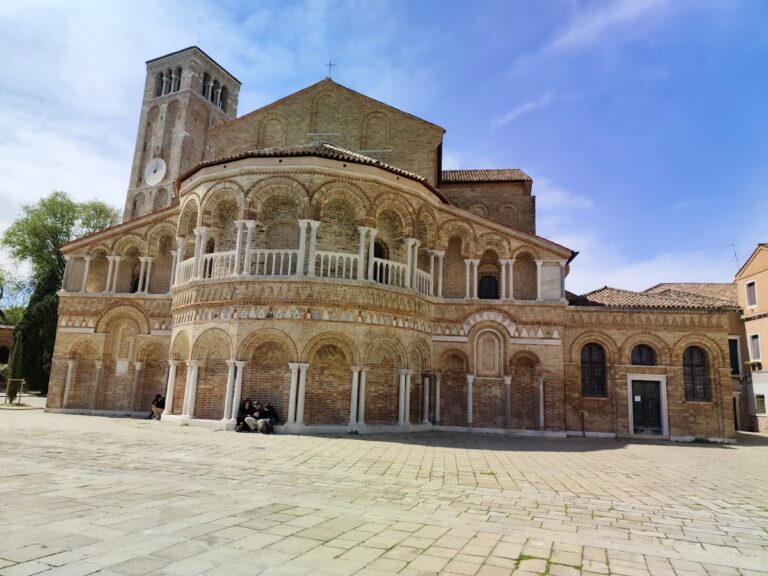
The adjacent martyrion of Santa Fosca survives as part of the wider religious complex. A martyrion is a Christian memorial structure associated with a martyr or sacred relic. The separate bell tower stands nearby in the meadow. Its shaft is divided by pilasters, and its bell chamber has four-light openings. It contains three bells forming an ascending E-flat-3 peal.
Interior and liturgical furnishings
Nave, aisles, and apse
The interior has a central nave and two aisles divided by eighteen Greek-marble columns with Corinthian capitals. The marble pavement is arranged with interlaced circles, curving scrolls, and lozenge, triangular, rectangular, circular, and square forms in pearl-toned and white, red, green, and yellow marble.
The two side apses, the synthronon in the central apse, and the crypt beneath it belong to the 864 renovation. A synthronon is a stepped semicircular seating structure for clergy, with the bishop’s seat at its center. The central apse also preserves earlier and later layers of decoration, including fragments of figures painted during the first half of the eleventh century.
Presbytery and iconostasis
An iconostasis, also called a templon in Byzantine contexts, separates the presbytery from the nave. Its upper section consists of slender marble columns with Byzantine capitals. The lower section carries bas-reliefs of peacocks and lions together with painted wooden panels showing the Virgin and Child and the twelve Apostles.
The panels date to around 1430 and are attributed to the late Gothic painter Zanino di Pietro. Three are deteriorated. On the reverse of the iconostasis is a 1591–1592 canvas version of the same subjects by Marco Vecellio, installed there in 2009.
Altar, throne, and inscriptions
The high altar stands at the center of the apse. It was reconstructed in 1923 using original parts and contains the relics of Saint Heliodorus, identified as the first bishop of Altinum. A marble episcopal throne stands against the apse wall on a raised podium.
The foundation inscription beside the altar names the officials and bishop associated with the church’s establishment. Two principal inscriptions in the central apse describe Christ as both God and man and close to the penitent, and present Mary as the “star of the sea” and the means of salvation. Further inscriptions appear in the right apse and beside the praying Virgin in the Last Judgment.
Mosaic decoration
Apse and triumphal arch
The surviving mosaic decoration includes the central apse basin and semi-cylinder, the triumphal arch, the basin and vault of the right apse, and the counter-façade. The central apse contains a gold-ground Hodegetria, an image of the Virgin presenting Christ as the guide to salvation, above the Apostles standing on a flowering meadow.
The Apostles follow the Latin sequence, with James the Less and Thaddeus taking the places of Mark and Luke. The Virgin wears a deep dark-blue maphorion and is attributed to a Byzantine workshop of the second half of the twelfth century. The Apostles are generally dated to the late eleventh century and are largely attributed to Venetian mosaicists working from Byzantine models.
The Annunciation on the triumphal arch has the dynamic lines of mature Comnenian art and is associated with the same general workshop as the Hodegetria. The arch formerly displayed an Ascension in which Christ, enclosed in a mandorla, was carried heavenward by angels. Fragments of Christ and two angels survive. Twelfth-century sections replaced comparable eleventh-century subjects that had deteriorated.
Right apse
The right apse contains an enthroned Christ Pantocrator, meaning Christ as the all-ruling sovereign, beside two angels. Below are four Church Doctors, Ambrose, Augustine, Martin of Tours, and Gregory Thaumaturgus. The vault shows the Lamb of God within a roundel, four vegetal garlands extending along the diagonals, and four supporting angels, two of them truncated at the bust by the rectangular form of the vault.
Bands of flowers and fruit represent the four rivers of Paradise. They include a symbolic bestiary with a lion, peacock, bull, eagle, and white-plumaged birds. The imagery combines Byzantine and Italian workmanship and incorporates a motif of Ravennate origin. Its early-Christian appearance once led to a proposed ninth-century date, but it is interpreted instead as a Comnenian revival of early-Christian themes.
Counter-façade and Universal Judgment
The counter-façade is covered by a Venetian-Byzantine mosaic of the Universal Judgment, one of the most monumental mosaics in the Veneto. Six registers organize the composition. The upper registers present the Crucifixion, the Anastasis, or Christ’s descent into and liberation of the dead from Hell, and Christ enthroned as judge. The lower registers show the Last Judgment, the weighing of souls, Paradise, and Hell.
The Crucifixion includes Mary and John the Evangelist. In the Anastasis, the risen Christ tramples the devil and the gates of Hell while Adam, Eve, David, Solomon, and the souls released from Limbo accompany him. Much of the surrounding angelic procession is modern restoration.
The Judgment scene places Christ within a mandorla, accompanied by the Virgin, John the Baptist or another intercessory figure, the twelve Apostles, and angels. A river of apocalyptic fire issues from the scene. Nearby are the empty throne of the Hetoimasia, the preparation of the throne awaiting Christ at the Last Judgment, angels sounding resurrection trumpets, the dead rising from earth and sea, the sea goddess Thetis, and an angel rolling up the starry sky.
The Psychostasis, or weighing of souls, shows the archangel Michael balancing a soul against two demons armed with hooks. Paradise includes the gate of Eden guarded by angels or a cherub, Michael and Peter with the keys of the kingdom, and groups of the saved, including martyrs, bishops, monks, and women such as Mary of Egypt.
Hell contains rulers, prelates, bishops, monks, and other figures tormented by demons in association with Satan and the Antichrist. The lowest scenes contrast Paradise and Hell through images of Abraham holding a blessed figure possibly identified as Lazarus, saved souls, the garden of Paradise, and punishments associated with the seven deadly sins. The damned include the rich man Epulon, the lustful, gluttons biting their hands, the wrathful immersed in icy water, the envious represented by skulls and snakes, the avaricious adorned with jewels, and the slothful represented by scattered bones and skulls. Some identifications remain uncertain, including the figures identified as John the Baptist or the Good Thief, Abraham or another patriarch, and Lazarus or another blessed figure.
A lunette above the main portal contains the bust of a praying Virgin with outstretched arms. The gold background of the Last Judgment expresses the idea of theophany, in which nothing occurs without the presence of God.
Phases of the mosaic cycle
The first major phase of the mosaic decoration, chiefly from the late eleventh century, includes the right-apse Pantocrator, the Apostles in the central apse, the Church Doctors, the right-apse vault, and much of the counter-façade. In the central apse, these mosaics may have replaced or covered frescoed figures of Apostles or bishops of Altinum and Torcello painted in the first half of the eleventh century. Fragments of those earlier paintings survive in the lower central apse.
The central-apse decoration was revised after the construction of the synthronon and other alterations. Some mosaics were damaged, possibly in the earthquake of 1117, and Byzantine workshops repaired them during the second half of the twelfth century. A mosaic head removed from the church was donated to the Louvre in 1892 by Édouard Gerspach.