San Pietro Martire: A Parish Church on Murano


Site at a Glance
- Rating
- 4.5
- Popularity
- Low
- Country
- Italy
- Primary era
- Early Modern
- External website
- Open
- Eras represented
- Medieval, Early Modern
- Civilizations
- Venetian
- Site type
- Religious
- Remains
- Church
On this page16 sections
History
San Pietro Martire is a Roman Catholic parish church on Murano, Italy, founded in the fourteenth century with a Dominican convent and now belonging to the Patriarchate of Venice. The original building was erected between 1348 and 1363 at the initiative of the Venetian patrician Marco Michiel. It was first dedicated to Saint John the Baptist and consecrated on 17 September 1417. The church later took the name of Saint Peter Martyr, the thirteenth-century Dominican friar and martyr Peter of Verona, whose cult gave the rebuilt church its dedication.
Foundation and rebuilding
The foundation joined parish worship with the presence of the Dominican Order, a Catholic religious order associated with preaching and theological study. A fire completely destroyed the church in 1474. It was rebuilt and enlarged, reopening in 1511 under the dedication San Pietro Martire. The rebuilding period also brought important artistic commissions, including a work ordered from Fra Bartolomeo in 1508. His painting of God the Father in Glory between Saints Mary Magdalene and Catherine of Siena was never delivered to the Dominicans of Murano and is now preserved in the Museo Nazionale di Villa Guinigi in Lucca.
The church continued to develop after its reconstruction. Baroque altars were added in the side aisles, while the nearby convent remained connected to the church until the changes imposed during the Napoleonic period.
Suppression and parish restoration
Napoleonic suppression measures affecting Venetian churches and monasteries closed San Pietro Martire and its Dominican convent in 1806. The convent was occupied by the military, and its artworks were transferred to the Gallerie dell’Accademia. After parts of the convent were demolished, the remaining buildings served successively as a primary school, an artistic-glass workshop, and a post office.
The church reopened for worship in 1813. On 27 October of that year, its status as a parish church was formally transferred from Santo Stefano di Murano, which had fallen into ruins. The new parish was initially dedicated to Saints Peter and Paul, but the dedication returned to San Pietro Martire in 1839. After the suppression or demolition of other religious institutions on Murano and neighboring islands, their artworks and furnishings were brought to the church. Material from the demolished Scuola of San Giovanni dei Battuti, a Venetian charitable or religious confraternity, also entered its collections.
Restoration and continuing use
Restoration between 1922 and 1928 altered the physical and historical understanding of the building. In 1924, a portico from the demolished Santa Chiara monastery was transferred to the church. The work also exposed the original timber roof structure and revealed frescoes of saints above the columns. In the nineteenth century, remains identified as those of the Holy Innocents were moved from Santo Stefano after its demolition in 1835 and placed in a sarcophagus in the Ballarin Chapel.
San Pietro Martire remains one of Murano’s two functioning parish churches. Its parish museum preserves liturgical and artistic material gathered from churches and monasteries suppressed during the Napoleonic period, together with objects from the former San Giovanni dei Battuti confraternity. Paintings by Paolo Veronese underwent conservation in recent years and were exhibited at the Gallerie dell’Accademia in 2017 and at the Frick Gallery in New York in early 2018.
Remains
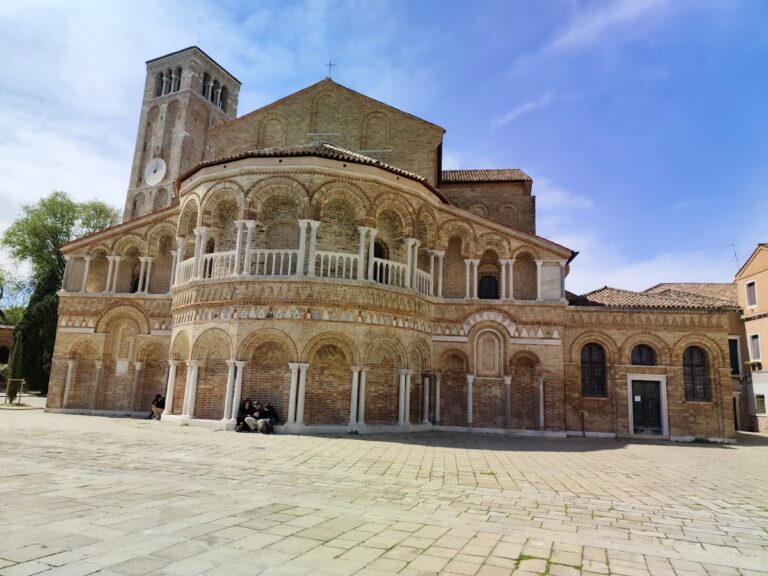
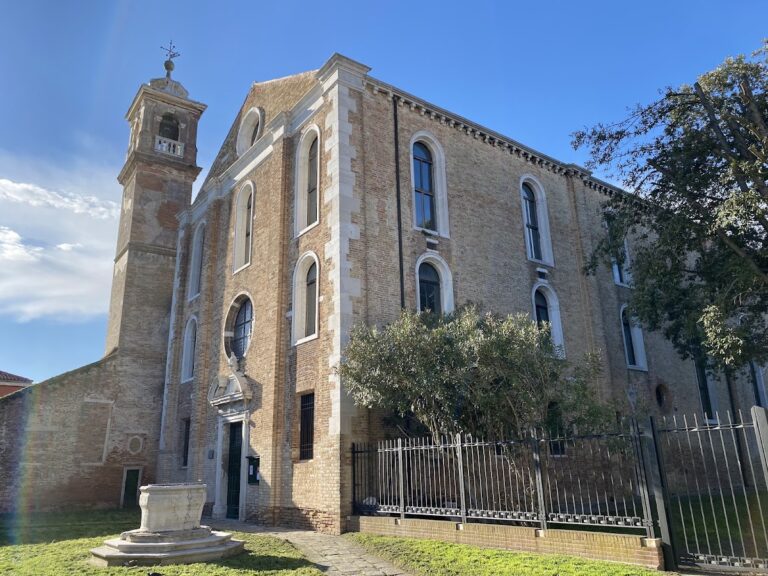
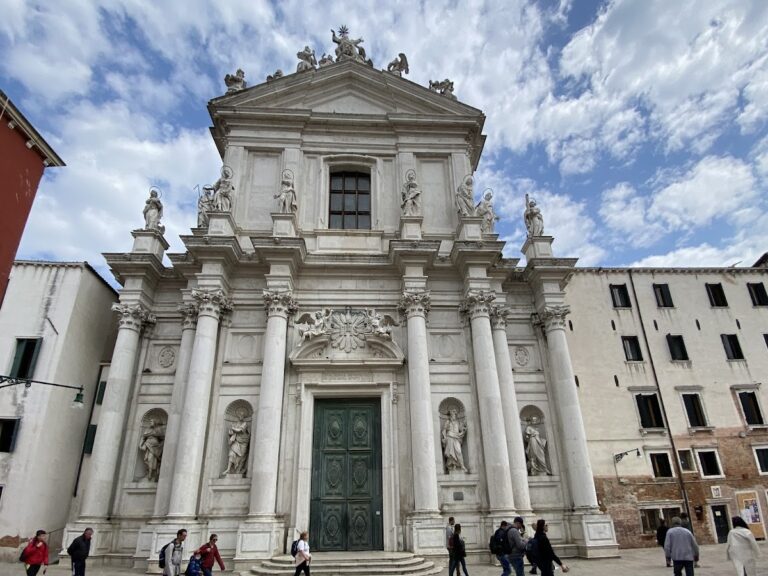
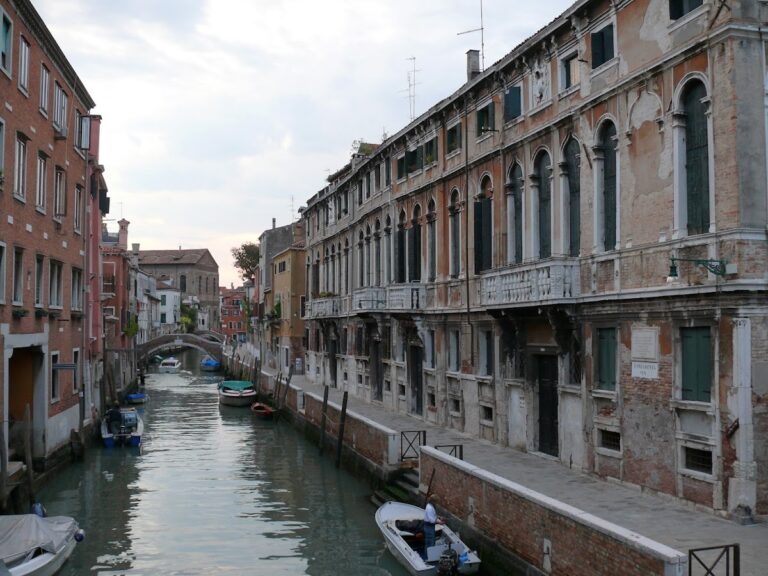
San Pietro Martire stands parallel to the Rio dei Vetrai, an important waterway on Murano, with its facade opening onto a small square. The church is built of exposed, unplastered brick. Its exterior combines pointed-arch windows and pilaster divisions with a large circular rose window above a valuable sixteenth-century Renaissance portal. Along the side walls, pilasters or wall strips are joined beneath the cornice by repeated small arches. A Gothic-style portico with arcades and columns extends along the church’s left, or western, side. This structure is a surviving section of the cloister from the nearby Santa Chiara monastery.
Exterior and bell tower
Facade and portico
The facade presents the building’s brick construction together with its layered medieval and Renaissance elements. Pointed-arch windows and the rose window organize the upper elevation, while the sixteenth-century portal forms the principal entrance feature. The portico beside the western side preserves arcades and columns from the Santa Chiara cloister, transferred during the restoration of 1922 to 1928.
Campanile
A prominent campanile, or bell tower, stands to the left of the church. It dates from 1498 to 1502 and belongs to the period of the building’s late fifteenth- and early sixteenth-century reconstruction.
Nave and presbytery
Basilican interior
The interior follows a basilican plan, a longitudinal layout with a central nave and lower side aisles. Two rows of massive columns divide the three naves. The timber framework of the roof remains exposed, and each nave ends in a semicircular apse. Above the columns of the central nave, frescoes show Dominican saints in white habits and black mantles. The figures include Thomas Aquinas, Vincent Ferrer, Jordan of Saxony, Dominic, Catherine of Siena, and Albert the Great, with inscriptions describing their virtues.
Presbytery
The spacious presbytery, the liturgical area around the main altar, is covered by a barrel vault and flanked by two small chapels. Its paintings include Bartolomeo Letterini’s Wedding at Cana and Multiplication of the Loaves and Fishes, together with Giuseppe Porta’s Deposition from the Cross. Six altars occupy the side naves, three on each side.
Paintings in the nave
The right nave contains The Baptism of Christ, attributed by many scholars to Jacopo Tintoretto. It came from the high altar of the demolished San Giovanni dei Battuti on Murano. Two works by Giovanni Bellini are also preserved in the church: Assumption of the Virgin and Eight Saints, dated 1510 to 1513, and the Barbarigo Altarpiece, dated 1488.
The Barbarigo Altarpiece shows the Virgin and Child, two musical angels, Saint Augustine, Saint Mark, and Doge Agostino Barbarigo. It was transferred from Santa Maria degli Angeli. The painting had originally been in the Doge’s Palace, where doges traditionally commissioned such works, and was reframed and moved to the high altar of Santa Maria degli Angeli in 1501 at Barbarigo’s request because two of his daughters were nuns there.
Other paintings include Palma the Younger’s image of Saints Nicholas, Charles Borromeo, and Lucy, transferred from the demolished church of Santi Biagio e Cataldo on Giudecca. Giovanni Agostino da Lodi’s Madonna and Child with Saints came from the demolished San Cristoforo delle Pace. The church also contains Paolo Veronese’s Saint Jerome in the Desert, transferred from Santa Maria degli Angeli, and Saint Agatha in Prison Visited by Saint Peter and an Angel. Another work by Giovanni Agostino da Lodi, also known as Pseudo-Boccaccino, shows the Madonna enthroned between Saint John the Baptist, Saint George, and two bishops.
Presbytery chapels
Ballarin Chapel
On the right side of the presbytery is the Ballarin Chapel, dedicated to Saints Joseph and Mary. It was commissioned by Giorgio Ballarin, a prominent Murano glassmaker, for himself, his family, and his descendants. He was buried there in 1506. The chapel contains the tomb monument of Giovanni Battista Ballarin, grand chancellor of the Republic of Venice, who died on 29 September 1666, and the tomb of his son Domenico Ballarin, also a grand chancellor, who died on 2 November 1698. The tomb of Alessandro Ballarin, a diplomatic and Senate secretary who died in the early eighteenth century, is also associated with the chapel.
The chapel formerly held a Giovanni Bellini altarpiece measuring 2 by 3 metres and depicting the martyrdom of Dominican fathers, with Milan visible in the distance. That painting is now in the National Gallery in London. The chapel also contains the sarcophagus associated with the remains identified as those of the Holy Innocents, transferred from Santo Stefano in the nineteenth century.
Chapel of the Blessed Sacrament
The chapel on the left side of the presbytery is identified as the Chapel of the Blessed Sacrament. Its Lombard-style altar contains a relief of the Ecce Homo dated 1495. The altar was transferred from the destroyed church of Santo Stefano in Murano.
Sacristy and parish museum
The sacristy houses the Parish Museum, whose collections include chalices and other liturgical vessels, silver objects dating from the twelfth to the nineteenth century, and paintings and tapestries dating from the fourteenth to the nineteenth century. The museum also preserves material transferred from suppressed churches and monasteries and from the demolished San Giovanni dei Battuti confraternity.
Among its furnishings are carved wooden retables by Pietro Morando, ornamental structures associated with altars, decorated with scenes from the life of Saint John the Baptist. The museum also preserves Giovanni Agostino da Lodi’s Barcaioli Altarpiece, dating to around 1500, and Francesco da Santacroce’s Madonna and Child between Saints Jerome and Zacharias, dated 1507.
Wooden dossals by Pietro Morando, made between 1652 and 1666, have sculpted telamons, human figures used as supporting architectural elements, and scenes from the life of Saint John the Baptist. They were originally associated with San Giovanni dei Battuti, moved to Santo Stefano after that confraternity was suppressed, and adapted for the sacristy in the nineteenth century.