Fort Treporti: A Nineteenth-Century Coastal Artillery Fortification in Italy


Site at a Glance
- Rating
- 3.8
- Popularity
- Very Low
- Country
- Italy
- Primary era
- Modern
- Eras represented
- Modern
- Civilizations
- German, Habsburg, Italian
- Site type
- Military
- Remains
- Fort
On this page7 sections
History
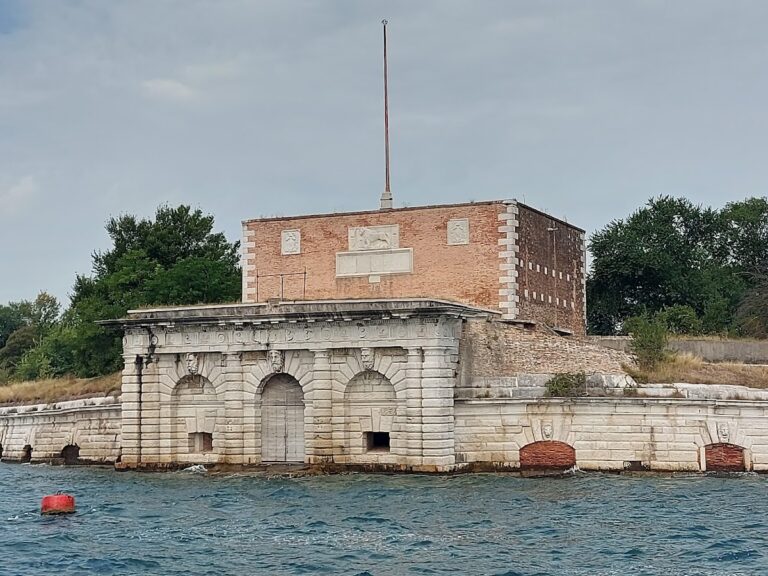
Fort Treporti, also known as Forte Vecchio, is a nineteenth-century coastal artillery fortification in Italy at Punta Sabbioni, built under Habsburg Austrian administration between 1845 and 1851. Its purpose was to defend one of the water approaches to Venice, and it stood at the end of the coastal strip between the sea and the lagoon before the Punta Sabbioni breakwater was built in 1882 and the surrounding land was reclaimed.
Austrian construction and military use
Construction began in 1845 during the second Austrian rule, the period of Habsburg administration that followed the end of Napoleonic rule in the Venetian territories. The fort was completed in 1851 as part of a defensive complex with two levels, a gun battery, and a moat. In 1900, while an Austrian garrison still occupied the site, a powder magazine was added for the protected storage of gunpowder and other explosive military supplies.
Italian and German alterations
During the Italian garrison period in 1915, range-finding towers were constructed. These military observation structures helped determine the distance and direction of artillery targets. In 1945, under a German garrison, two small storage buildings were added to the fortification.
Postwar transformation
After the Second World War, Fort Treporti ceased to serve a military function. It became shelter for displaced persons, refugees, and civilians without homes, and some families continue to live there, with genealogical connections to the first inhabitants. Since 1996, the Meta Forte association, later renamed Forte Vecchio, has promoted the fort through artistic production. The site is regarded as one of the best-preserved fortifications in the northern Venetian Lagoon and forms part of the Via dei Forti, a museum route linking the fortifications of the Cavallino-Treporti area.
Remains
Fort Treporti occupies more than 26,000 square metres. Its surviving plan is lunette-shaped, with a curved front and a large inner courtyard. The built area covers approximately 3,800 square metres, while about 10,400 square metres consists of open ground and 12,400 square metres is occupied by the surrounding moat. The moat is connected to the lagoon. Earthworks once protected the courtyard, but they have since been levelled.
Main fortification
The fort is constructed from red brick and pale Istrian stone, a limestone traditionally quarried in Istria and widely used in Venetian construction. Its general arrangement includes a first and second level, a gun battery, and the artificial moat. The fort is now in a state of abandonment, although some families partially inhabit it.
Later military structures
The range-finding towers added in 1915 are made of plastered brick with iron finishes. The two small storage buildings constructed in 1945 have brick masonry walls and roofs supported by wooden beams. Together, these later additions remain associated with the fort’s changing military use during the twentieth century.
Nearby sites