Church of Santa Maria e San Donato: A Romanesque Basilica on Murano


Site at a Glance
- Rating
- 4.5
- Popularity
- Medium
- Country
- Italy
- Primary era
- Medieval
- External website
- Open
- Eras represented
- Medieval, Early Modern, Modern
- Civilizations
- Italian, Venetian
- Site type
- Religious
- Remains
- Basilica
On this page14 sections
History
The Church of Santa Maria e San Donato is a Roman Catholic church on Murano in Italy. Founded during the seventh century, probably around its middle, it is a Romanesque basilica dedicated to the Virgin Mary, Saint Donatus of Evorea, and Saint Cyprian. It became Murano’s mother church, later served as the cathedral of the bishops of Torcello and Murano, and now holds the title of minor basilica.
Foundation and the mother church of Murano
The church arose during the first major phase of settlement on Murano and was originally dedicated to the Assumption of the Virgin Mary. All the island’s other churches depended on it, while an octagonal baptistery in front of the facade served the island’s newborns. In 999, its parish priest, Michele Monetario, made a formal undertaking to the bishop of Torcello, providing an early written reference to the church.
A different tradition links the foundation of the church, then called Santa Mariae plebis Murianensis, to Otto I, the tenth-century Holy Roman Emperor. According to this account, Otto made a vow after surviving a storm on the Adriatic. The tradition preserves a religious explanation for the church’s beginnings, while its early medieval role is also reflected in its position as the principal parish church of Murano.
Rebuilding and the cult of Saint Donatus
The church was restored in the ninth century and completely rebuilt in the twelfth. Its present medieval form was completed around 1140 to 1141, a date preserved in the mosaic pavement. In 1125, Doge Domenico Michiel led the naval campaign associated with the Venetian conquest of Cephalonia. He brought the relics of Saint Donatus of Evorea to Murano, where they were placed in the mother church of Santa Maria Assunta.
The transfer gave the church its additional dedication to Saint Donatus and strengthened its position as a center of his cult. Donatus, a fourth-century Christian bishop associated with healing miracles, eventually became Murano’s patron saint. Tradition also says that Michiel brought the bones of a dragon killed by the saint. Large bones displayed behind the altar continue to be linked with this story, although they are probably whale ribs.
Cathedral period and later alterations
In 1692, Bishop Marco Giustiniani transferred the episcopal seat of Torcello to Murano. The church then served as the cathedral of the bishops of Torcello and Murano. Giustiniani initiated a Baroque remodelling that altered the arcades, columns, choir screen, ambons, pavement, windows, and exterior mosaic decoration. The presbytery was raised in 1695 to accommodate his tomb, affecting the medieval pavement.
The baptistery in front of the facade was demolished in June 1719. Its destruction also led to the movement of the Roman funerary altar that had served as an immersion baptismal font. The church remained associated with the commemoration of Saint Lawrence Giustiniani, while the relics of Saint Gerard Sagredo added another important devotional focus. Sagredo was a Christian bishop and martyr associated with Hungary, and his feast and translation were already commemorated in liturgical texts by the thirteenth century, although the transfer of his relics to the church is variously dated to 1333 or 1400.
Restoration and continuing religious use
By the nineteenth century, the building had become structurally unsafe, probably because the eighteenth-century changes increased its weight and weakened parts of the structure. Restoration campaigns between 1868 and 1873 reconstructed the side walls and altered the upper windows and apse. Later work sought to recover a more medieval appearance from interventions considered too extensive.
Protection of the mosaic pavement became an urgent concern from 1966. The church closed in 1973, and between 1973 and 1979 the pavement was dismantled, stored, protected from humidity and flooding by a new subfloor, and reinstalled. Missing tesserae were replaced to clarify the designs, while larger gaps were repaired with marble paving. Patriarch of Venice Marco Cé inaugurated the completed restoration in December 1979. Archaeological material found beneath the pavement included remains of the earlier church, especially a carved ninth-century sarcophagus containing bones. It was reused as a receptacle for the body of Saint Gerard Sagredo and as the base of an altar.
Further pavement repairs took place between 2012 and 2015, particularly in the left and central aisles. High water continued to threaten the mosaic, and the exceptional flooding of November 2019 caused additional detachment of tesserae. The church remains a parish church within Murano’s pastoral collaboration with San Pietro Martire. The Patriarch of Venice also holds the title of perpetual commendatory abbot, and the basilica forms part of the UNESCO World Heritage property covering Venice and its Lagoon.
Remains
Plan, exterior, and bell tower
The basilica is a three-aisled Romanesque building on a Latin-cross plan. Six bays organize the interior, while a high, slightly projecting transept is about 8.40 metres wide. The central nave follows a spacing of about 4.80 metres between columns. The side aisles measure twice this interval, the nave four times it, and the transept three times it. Dark red exposed brick forms the principal building material, and the detached bell tower stands separately from the church.
Eastern apse
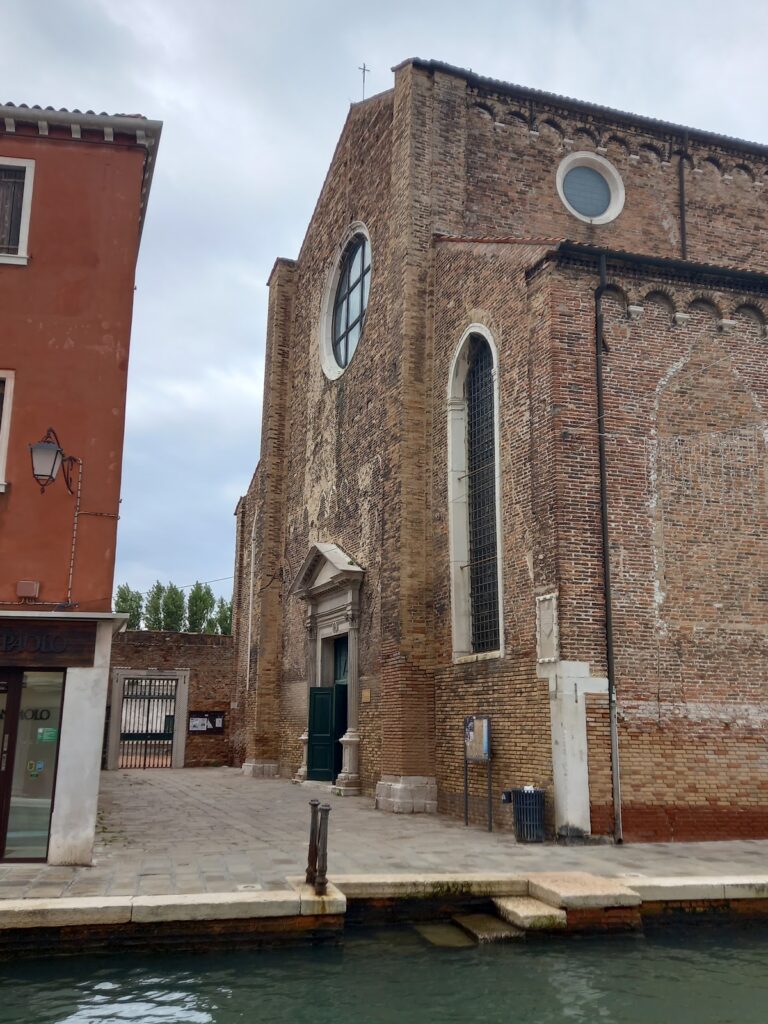
The eastern apse faces a canal and forms the building’s principal outward-facing elevation for people approaching from the water. Its polygonal form has two decorative levels. Seven concave niches occupy the lower level, while the upper level creates a false gallery with seven niches and paired columns arranged in two orders. Round arches, projecting supports, zigzag friezes, marble ornament, and the contrast between red brick and white stone give the apse a lightened appearance. Blind arcades, balustrades, carved capitals, and relief fragments reused from earlier churches enrich the decoration. Some elements are attributed to the ninth century and show Byzantine influence, while the side elevations around the transept display stronger western forms.
Western facade and campanile
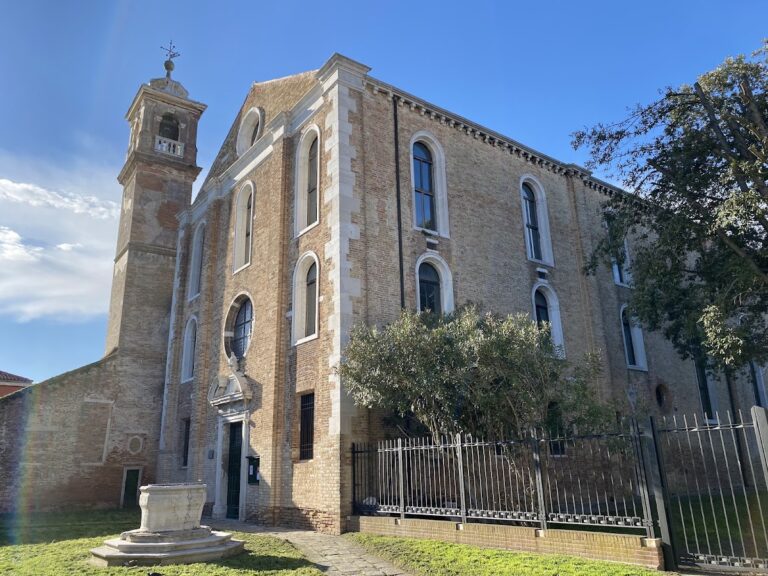
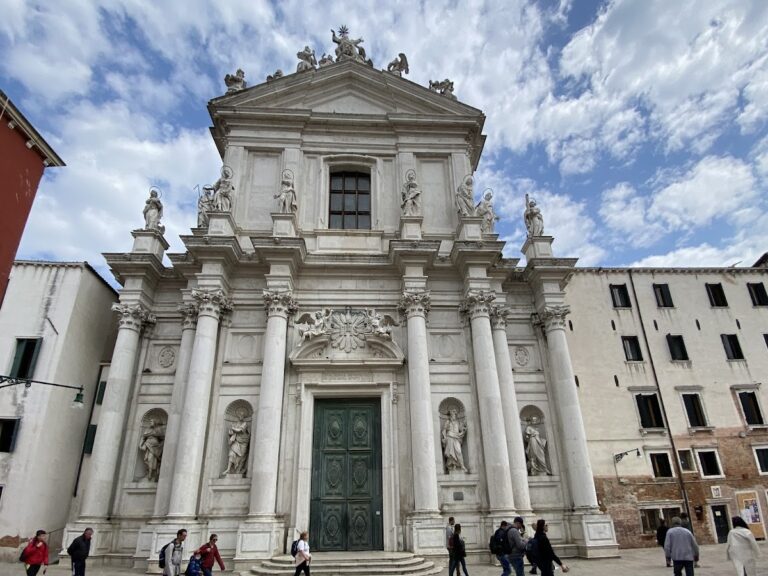
The west facade is divided into three parts. Small single-lancet windows pierce the sloping side sections, and a small biforium, or two-light window, occupies the central upper section. Above the portal is a fourteenth-century relief of Saint Donatus with a devotee. Two second-century Roman pillars from Altino frame the entrance. Their funerary decoration is incorporated into the bases of the arches that once connected the church with the demolished baptistery.
The detached campanile, or bell tower, is a square Romanesque structure of three tiers, generally dated to the twelfth or thirteenth century. Lesenes divide its stages, and the bell chamber has three-light windows and hanging arches. The tower is approximately 50 metres high. A later upper extension was demolished after lightning strikes made it unsafe. At its foot stands the 1927 Monument to the Fallen, which incorporates a monumental marble sculpture by Napoleone Martinuzzi.
Interior and apse decoration
Five Greek-marble columns on each side divide the interior into a central nave and two aisles. Their Corinthian capitals carry acanthus leaves and support slightly raised semicircular arches. The date of the capitals remains disputed: the last capitals on either side may predate the sixth century, while another interpretation assigns all of them to the twelfth-century rebuilding. A timber truss roof covers the aisles, transept, and presbytery.
Presbytery and high altar
The high altar was designed by Antonio Gaspari according to seventeenth-century principles of Eucharistic adoration. Its tall, four-column polychrome structure includes an aedicule for the solemn display of the Eucharist, with a sarcophagus beneath containing the body of Saint Donatus. Statues of Saint Lawrence Giustiniani and Saint Eliodorus, bishop of Altino and patron of the diocese of Torcello, stand on the altar. The present Eucharistic table incorporates a mid-fourteenth-century former high-altarpiece with six saints around the Dormition of the Virgin and thirteen small compartments showing half-length figures. The work is attributed to an anonymous pupil of Paolo Veneziano.
Apse mosaic and frescoes
The semi-dome of the apse contains a twelfth-century mosaic of the praying Virgin Mary against a gold ground. She stands on a footstool with open hands held against her chest and wears a deep-blue mantle and maphorion, the mantle traditionally shown covering the Virgin in Byzantine art. The elongated forms and linear folds of the drapery reflect the developing independence of Venetian mosaic art, while the composition remains closely related to the Virgin mosaic at Santa Maria Assunta on Torcello and to the Byzantine artistic language used by workshops in Venice and at San Marco.
Four Evangelists appear in frescoes dated to 1404 and attributed to Nicolò di Pietro. An eighteenth-century stucco relief of the Assumption occupies the center below them. A Latin inscription around the apse praises the Virgin as the redeemer of those ruined by Eve, while another inscription along the apse arch concerns the Incarnation, Christ’s removal of sin, and the testimony of disciples and prophets. A former Annunciation mosaic on the exterior of the triumphal arch was destroyed during later restoration, leaving only a trace of the Virgin’s foot.
Mosaic pavement
The mosaic pavement was made in September 1141, according to its central inscription, and covers more than 500 square metres. It combines small tesserae with slabs of porphyry, serpentine, marble, other stones, and precious stones. Opus tessellatum, mosaic work made from small pieces, creates much of the figural and bestiary imagery. Opus sectile, formed from larger stone or marble pieces cut into geometric shapes, produces triangles, squares, hexagons, and octagons. Panels vary in size, meeting directly in some places and separated elsewhere by marble borders.
Peacocks, griffins, an eagle holding a lamb, dragons, birds with prey, marine waves, Solomon’s knots, geometric patterns, and crickets associated with the domestic hearth fill the pavement. Its imagery expresses Christian theological ideas through form and symbol. Squares represent the limited human dimension, circles the divine and the absence of beginning and end, and octagons resurrection and baptism. Two cocks carrying a fox upside down signify wisdom’s triumph over cunning, while peacocks feeding on the Eucharist in a chalice symbolize divine grace. The left aisle represents the way of the Church, the central aisle the way of salvation, and the right aisle the way of baptism.
Relics, chapels, and later furnishings
The urn containing Saint Gerard Sagredo’s body stands in the right transept. The chapel of Saint Philomena was rebuilt against the north side of the church between 1866 and 1873 after its former structure outside the south aisle was demolished. Its walls incorporate a fourth-century Roman sarcophagus front, an eighth-century Lombard pluteus, or carved screen panel, and a ninth-century sarcophagus front. In 1995, the body of Blessed Daniel of Ungrispach was placed in the chapel. Daniel, a wealthy fur merchant born at Cormons in 1344, died at Murano in 1411 and was later venerated as blessed after his body was found intact when his tomb was reopened.
An ancient Roman funerary altar from Altino, belonging to the Acilia family, now stands in the right transept. It had formerly served as the immersion font in the demolished baptistery. A rectangular panel above the third column on the left contains the Lion of Saint Mark, the arms of Murano, the arms of podesta Carlo Quirini, and the wooden cask known as the Saint Alban cask. The cask was embedded in the church in 1543 during conflicts between Murano and Burano. Its inscription records Quirini’s dedication and the traditional claim that it miraculously refilled with wine.
A wooden, polychrome, and gilded image of Saint Donatus dated to 1310 was once displayed in the left aisle and is now preserved at the Diocesan Museum at Santa Apollonia. The saint appears in episcopal vestments, holding a crozier with the Agnus Dei and a Gospel book. Donato Memo, podesta of Murano, and his wife kneel at his feet. The inscription identifying the bishop is among the earliest written testimonies of Venetian vernacular, and the work is attributed to Bartolomeo di Ca’ Nason.
Behind the high altar, four large bones hang from wires and are traditionally identified as the dragon bones associated with Saint Donatus. The saint’s relics remain in the marble sarcophagus beneath a reclining effigy of the bishop. The basilica also contains a mechanically operated main organ made by Domenico Malvestio in 1894, originally for a Venetian synagogue. It stands in the left side of the transept and was restored by Pasquale Ferrari in 2015. Its keyboard has 56 notes and its pedalboard 27. A separate positive chest organ, made by Paul Ott in 1968, has a 51-note keyboard.
Nearby sites