Spaso-Preobrazhensky Cathedral: A White-Stone Church of Pereslavl-Zalessky


Site at a Glance
- Rating
- 4.8
- Popularity
- Medium
- Country
- Russia
- Primary era
- Medieval
- External website
- Open
- Eras represented
- Medieval
- Civilizations
- Unclassified
- Site type
- Religious
- Remains
- Church
On this page8 sections
History
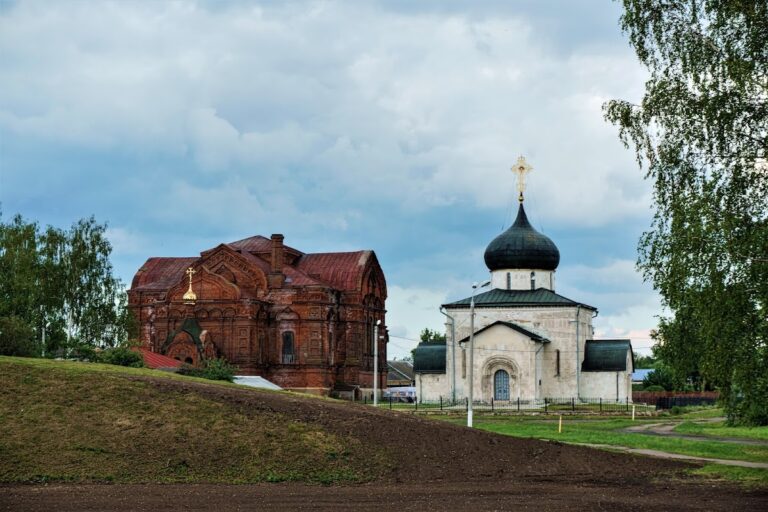
Spaso-Preobrazhensky Cathedral is an Orthodox cathedral in Pereslavl-Zalessky, Russia, founded by Prince Yuri Dolgoruky in 1152 and completed under his son, Andrei Bogolyubsky, in 1157. Built in the pre-Mongol period, the era before the Mongol invasions of the thirteenth century, it is one of the earliest white-stone monuments of northeastern Rus. The cathedral stands within the town’s kremlin and is the only one of the five earliest white-stone churches of northeastern Rus to survive in almost complete form.
Princely church and burial place
During the thirteenth and fourteenth centuries, the cathedral served as the court church of the princes of Pereslavl and as their dynastic burial church. Prince Dmitry Alexandrovich, Prince Ivan Dmitrievich, and other aristocrats associated with Pereslavl were buried there. The church also played a role in the religious life of the ruling family. Many Pereslavl princes were baptized in the cathedral, including Alexander Nevsky, a thirteenth-century prince of Novgorod and Vladimir who later became a major Russian historical and religious figure. His baptism is dated to around 1220–1221, although the exact year is uncertain.
The cathedral’s walls preserve inscriptions connected with the political world of medieval Rus. One twelfth-century graffiti inscription records the murder of Andrei Bogolyubsky and lists the men who took part in the assassination. It is regarded as the oldest dated written monument of northeastern Rus. Other graffiti were made during the cathedral’s construction, before the facades were whitewashed, and include autographs by Ignat and Lazor as well as a sequence of abbreviated weekday names.
Medieval inscriptions and later interpretation
The graffiti also preserve evidence about the people named in the assassination inscription. Analysis of one text gives the conspirator Yakim’s patronymic as Kutskovich, making a Novgorodian origin for his father, Kuchka, probable. The patronymic of another conspirator, Efrem, has been connected with the Arabic name Mu’izz, suggesting that he may have descended from a Muslim. A rare personal name found among the cathedral inscriptions also occurs in another major Old Russian inscription.
A 2020 investigation identified a rare drawing of a running man lifting a fantastic creature. It has been interpreted either as an image of a distant mythical being or as an allegory of the struggle between good and evil. The cathedral was frescoed in the second half of the twelfth century. In 1862, the local historian and architect N. A. Artleben discovered compositions of the Last Judgment, a Christian image of humanity’s final judgment, and the Virgin Enthroned, a formal representation of Mary seated as queen.
Closure, excavation, and museum use
During restoration in 1893–1894, the ancient frescoes were removed in small fragments and placed disorderly in an unheated shed. In 1895, the Archaeological Commission judged them unworthy of further preservation, and most fragments were later transferred to the State Historical Museum in Moscow. Nineteenth-century frescoes considered to have little artistic value were scraped away. A surviving fragment of medieval painting, showing the half-length figure of the Apostle Simon, is now preserved in that museum.
The cathedral was closed during the 1930s and ceased to function as a church. Excavations directed by N. N. Voronin in 1939 and restoration work undertaken by Alexei Chinyakov in the 1940s examined the building’s foundations, floor, wall paintings, burials, and medieval graffiti. Excavations beneath the cathedral in 1939 uncovered a decorated sarcophagus lid from the grave of Ivan Dmitrievich. Further archaeological work in 2020 revealed a white-stone sarcophagus dating to the second half of the thirteenth century and burials outside the cathedral.
On 2 September 1945, a museum dedicated to Alexander Nevsky was established in the building. That museum later closed, and the cathedral is now occupied by a branch of the Pereslavl museum-reserve. It functions as a museum rather than an active church and remains a federally protected cultural-heritage monument of Russia.
Remains
Form and construction
Spaso-Preobrazhensky Cathedral is a quadrangular, single-domed, cross-domed church. In this arrangement, a central dome is carried by structural arms organized in the shape of a cross. Four internal pillars support the building, and three apses, semicircular sanctuary projections, extend from its eastern side. The cathedral was formerly about 22 metres high. Its walls are approximately 1 to 1.30 metres thick and were built from carefully dressed white-stone blocks laid in a semi-rubble technique, with small fragments placed between the larger blocks and the courses joined almost dry.
The building rests on a strip foundation of large fieldstones set in lime. About 1.2 metres deep, it reaches a dense clay layer and is wider than the walls, projecting about 1 metre to the north and 1.5 metres to the east. The foundation descends vertically to about 0.8 metres before narrowing. Archaeological investigations have also identified crossed strip foundations characteristic of pre-Mongol monuments from the first half of the twelfth century. The cathedral now stands approximately 90 centimetres deeper in the ground than it did in the pre-Mongol period, with two additional courses of white-stone plinth below the present drip-course.
Exterior decoration and entrance
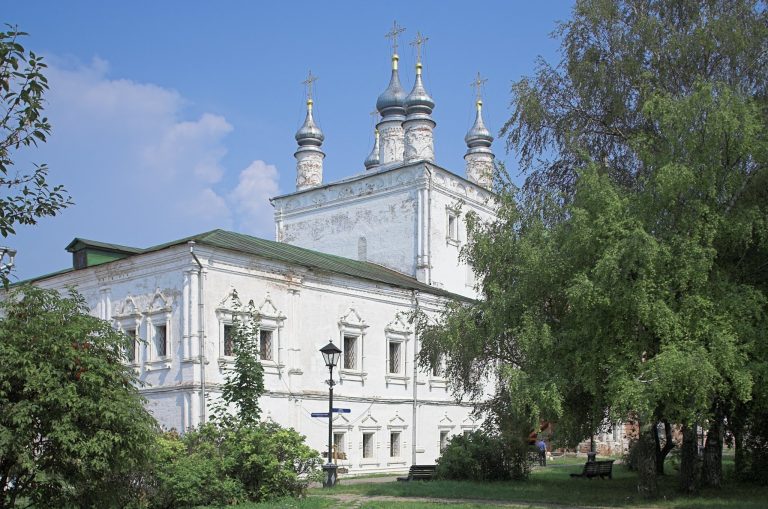
The exterior has restrained decoration. Flat pilasters divide the facades into three sections. The drum, the structure supporting the dome, carries a simple border, a saw-tooth brick ornament, and a crenellated band. The apses have blind arcading, saw-tooth ornament, and carved semi-roll moulding. The upper facades end in three zakomars, curved gable-like sections characteristic of medieval East Slavic church architecture.
The cathedral has a single dome, described as helmet-shaped or onion-shaped. The roof and dome are painted green, while the remaining exterior walls are white. The windows are semicircular, and the entrance has a modest portal. Archaeological research has identified the entrance to the choir gallery in the second tier of the western bay of the north wall. Its original arrangement may have involved a wooden stair tower, rather than the stone stair towers used in many other pre-Mongol churches of northeastern Rus.
Floors, paintings, and surviving objects
Excavations inside the church uncovered yellow, green, and brown glazed floor tiles. More elaborate white tiles with blue ornament probably decorated the choir gallery. Archaeologists in 2020 recovered additional fragments of wall painting, clay floor tiles, and areas of yellow and green glaze. The interior walls are now white, while the surviving fragment depicting the Apostle Simon is preserved in the State Historical Museum in Moscow.
The cathedral’s early-fifteenth-century icon of the Transfiguration, the Gospel episode in which Jesus is revealed in divine glory before three disciples, is attributed to Theophanes the Greek. The icon is now held by the Tretyakov Gallery in Moscow, the principal museum of Russian art. Together with the surviving foundations, floor evidence, burials, paintings, and inscriptions, these displaced and preserved works help define the cathedral’s medieval artistic and historical record.