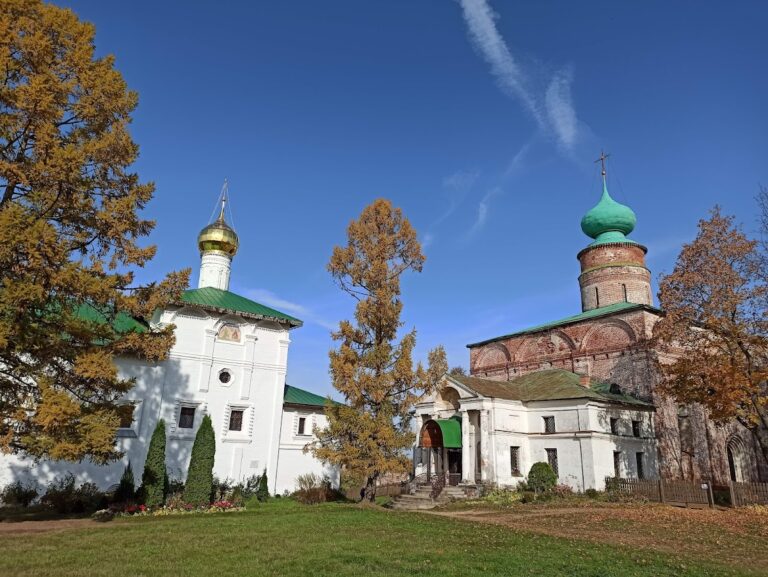
Nikitsky Monastery (Pereslavl-Zalessky): A Historic Russian Orthodox Monastery


Site at a Glance
- Rating
- 4.8
- Popularity
- Medium
- Country
- Russia
- Primary era
- Early Modern
- External website
- Open
- Eras represented
- Early Modern, Modern
- Civilizations
- Russian
- Site type
- Religious
- Remains
- Fortified Monastery
On this page17 sections
History
Nikitsky Monastery (Pereslavl-Zalessky) is a Russian Orthodox male monastery in Russia, dedicated to Saint Nicetas the Goth, a Christian martyr traditionally dated to 372. Regarded as one of the oldest monasteries in Russia, it developed beside Lake Pleshcheyevo during the early medieval Christianization of the region and later became a fortified religious and landed center.
Origins and Early Tradition
The monastery’s foundation date is uncertain. Local tradition places its beginnings in 1010, when Prince Boris Vladimirovich and Bishop Ilarion established churches beside Lake Pleshcheyevo as Christianity spread through formerly pagan lands. One of these churches may have developed into the monastery. Another proposed date places its construction around the turn of the eleventh and twelfth centuries, while the monastery itself is dated to before 1186. It may have received the status of a lavra, a major Orthodox monastic center, in that year.
Written monuments from the period before the Mongol invasions do not mention the monastery. Its early history is closely associated with Nikita the Stylite, also called Nikita of Pereslavl. A stylite was an ascetic who practiced devotion on or beside a pillar. The date of Nikita’s life at the monastery remains disputed: his medieval life places his ascetic activity in the late twelfth century, while another chronology places it during the Mongol-Tatar period.
A fifteenth-century monastic life of Nikita, later enlarged with accounts of miracles after his death, describes healings linked to him. Among those associated with his intercession were Mikhail Vsevolodovich, a son of the Prince of Chernigov, and Ivan, a son of Ivan the Terrible. The tradition surrounding Mikhail’s healing later led to the construction of a commemorative chapel, whose present building dates from 1702.
Growth in the Fifteenth and Sixteenth Centuries
At the turn of the fifteenth and sixteenth centuries, the monastery housed Daniil of Pereslavl, who later founded the Trinity-Danilov Monastery. Until the sixteenth century, the community supported itself through its own labor. Around 1515 to 1521, the Pereslavl deacon Eustathius built a wooden church dedicated to Nikita the Stylite after he was healed at the saint’s relics. The church no longer survives. In 1521, Prince Dmitry Ioannovich of Uglich granted the monastery a village near Uglich.
In 1528, Grand Prince Vasily III of Moscow ordered the construction of a stone Nikitsky Cathedral on the site of an earlier stone church dedicated to Saint Nicetas the Goth. Saint Nicetas the Goth was an early Christian martyr associated with the fourth century and is distinct from the later local ascetic Nikita the Stylite, although both became central to the monastery’s religious identity.
The monastery flourished under Abbot Vassian and attracted the attention of Ivan the Terrible, the English name for Ivan IV, grand prince of Moscow and the first Moscow ruler formally crowned tsar. Ivan developed the monastery as a reserve fortress in case Alexandrov Sloboda became unsafe, made repeated pilgrimages there with his family, endowed it with estates, and introduced communal monastic life. He also attended the consecration of the new cathedral.
Siege, Destruction, and Romanov Reconstruction
The monastery withstood a Polish siege in 1609. Two years later, Lithuanian forces commanded by Jan Piotr Sapieha captured and burned it after a two-week siege, killing many of its defenders. Abbot Misail, who had led the defense, was forced to wander after the destruction.
Reconstruction followed with assistance from the Romanov dynasty, which ruled Russia from 1613 to 1917. Tsar Michael I, Tsar Alexis, and Patriarch Filaret Nikitich made substantial donations. Under Alexis, the walls and towers were renewed with minor alterations in 1643 to 1645. Part of this work was financed by Patriarch Joseph, while the Annunciation Church and its associated refectory complex were built during the same period.
In 1668, Tsar Alexis authorized fishermen to catch fish in Lake Pleshcheyevo for the monastery’s needs, using one seine. Peter I confirmed the privilege in February 1698. Tradition also holds that Peter stayed at the monastery while using the nearby lake for his amusement fleet.
Landholding, Devotion, and Later Imperial Rule
During the medieval period, the monastery became a major feudal landholder. In 1754 it was recorded as owning 2,000 serfs, with estates including Gorodishche, Knyazhevo, Konyutskoye, Korovino, Krasnoye, Kriushkino, Luchinskoye, Nikitskaya Sloboda, Plechchevo, Polovetskoye, Skomorokhovo, Troitskaya Sloboda, Faleleevo, Filimonovo, Filippovskoye, and Yagrenevo.
In the eighteenth century, the monastery served as a place of exile for clergy from Pereslavl who had committed offenses. Its religious importance continued during the eighteenth and nineteenth centuries, when pilgrims were shown the pillar associated with Nikita, his ancient chains, and his stone cap. Church authorities removed the cap to Moscow in 1735.
Six annual processions connected the monastery with Pereslavl and the surrounding devotional landscape. Two traveled from the city to the monastery, on June 6 for Saint Nikita and on August 3 in remembrance of the city’s deliverance from the cholera epidemic of 1848. Three processions took place around the monastery, on the Monday of Holy Week, February 15, and September 28. Another went to Saint Nikita’s well on the ninth Sunday after Easter.
Nationalization, Decline, and Revival
The monastery’s property was nationalized in 1918, and the monastic community was formally dissolved in 1923. Valuable objects were transferred to museums. The buildings were successively used as a rest home for scientific workers, a school, housing, municipal services, a women’s penal colony, a labor camp from 1948 to 1953, and a military base from 1953 to 1959.
The historic iconostasis of Nikitsky Cathedral was burned in 1933. Some conservation work took place after the Second World War, but deterioration continued. The cathedral was restored during the 1960s and 1970s under the architect I. B. Purishev. After decades of neglect, its central dome collapsed on Saint Elijah’s Day in 1984.
The monastery reopened in December 1993, and extensive restoration of its buildings and grounds followed under Bishop Anatoly Aksyonov, who served as its superior until 1999. Archimandrite Dimitry Khamtsov has been its superior since 1999, and the monastic community has occupied the site again since 1993. Further restoration of Nikitsky Cathedral took place in 2013, including work on its interior paintings and the installation of a new iconostasis. The monastery is an active Orthodox institution and a cultural-heritage monument of federal significance in the Russian Federation.
Remains
Nikitsky Monastery stands on the northern outskirts of Pereslavl-Zalessky beside Lake Pleshcheyevo. Its walled compound combines stone and wooden construction in a Byzantine-Russian architectural tradition. The complex is associated with Nikitskaya Sloboda, which historically served the monastery’s needs, and with the former settlement of Kleshchin, whose ruins were donated to the monastery after Pereslavl-Zalessky was reestablished.
Cathedral and Memorial Structures
Nikitsky Cathedral
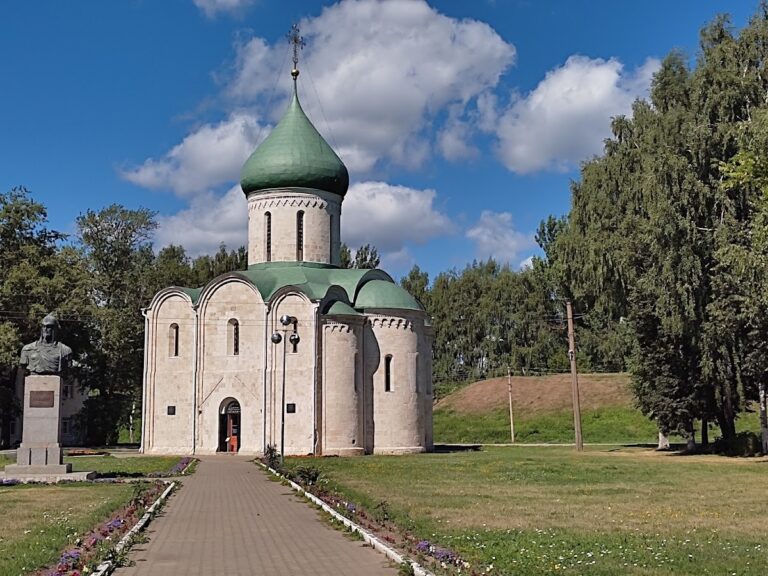
Nikitsky Cathedral is a five-domed church built between 1561 and 1564. The earlier stone church commissioned under Vasily III became its southern chapel, dedicated to Nikita the Stylite. The sixteenth-century cathedral remains a central part of the complex, although its central dome collapsed in 1984. Restoration in the 1960s and 1970s, followed by further work in the early twenty-first century, returned the building to use as part of the restored monastery.
Ivan the Terrible gave the cathedral a large bronze church chandelier, while his wife, Anastasia Romanovna, donated an image of Nikita the Stylite embroidered by her own hand. The cathedral’s historic iconostasis was destroyed by fire in 1933. A replacement was being installed during the restoration recorded in 2013, alongside work on the interior paintings.
Chapel over Nikita’s Pillar
A chapel over the pillar associated with Saint Nikita was built in the eighteenth century and is dated to 1768. The pillar, Nikita’s iron chains, and his stone cap formed a devotional memorial shown to pilgrims. The stone cap was taken to Moscow in 1735, while the monastery preserves the saint’s relics and remains associated with the chains displayed in his cult.
Chernigov Chapel
The Chernigov Chapel was built in 1702 in or beside the wooded cemetery separating the monastery from the town. It commemorates the healing of the prince of Chernigov associated with Nikita the Stylite. The chapel is described as the last example of Pereslavl architecture from the Old Russian period.
Refectory and Bell Towers
Annunciation Church and Refectory
The Annunciation Church and its two-storey refectory chamber were built between 1643 and 1645 and remain part of the monastery. The refectory later received a chapel dedicated to Saint Nicholas the Wonderworker, added in 1768. Together, these buildings represent the major seventeenth-century rebuilding that followed the monastery’s destruction in 1611.
Bell Towers
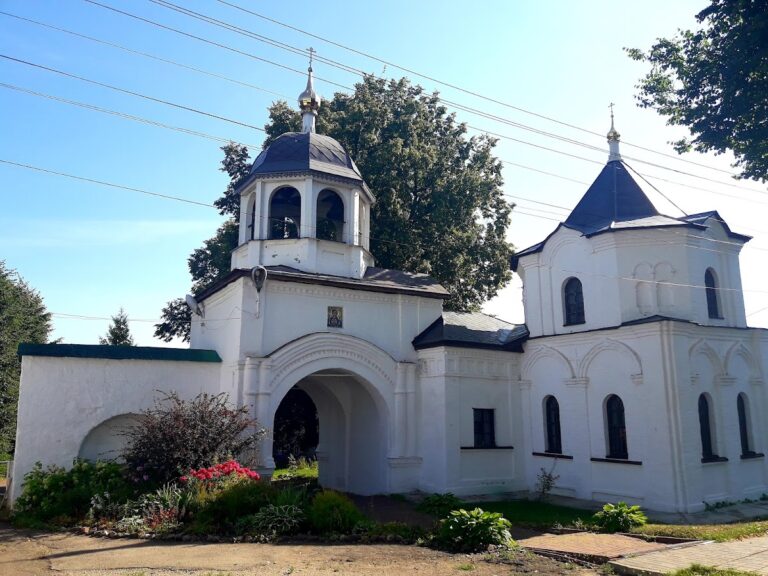
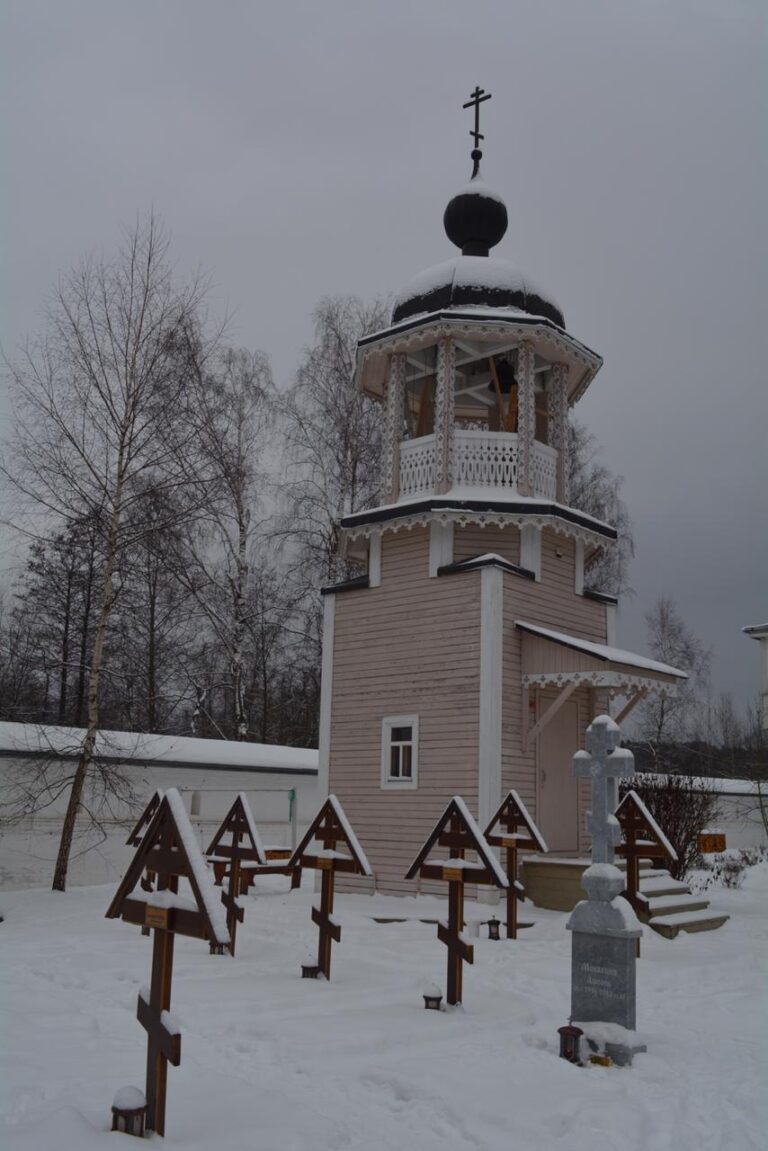
A tent-roofed bell tower associated with the Annunciation complex dates from 1668. A separate high gate bell tower was built in 1818, replacing an earlier gate church dedicated to the Archangel Michael. The later tower is described as Neoclassical.
Fortifications and Service Buildings
Walls and Towers
The monastery’s fortress walls and towers were built in the 1560s and renewed between 1643 and 1645 with minor changes. They survive in rebuilt form as a chain of defensive structures around the compound, reflecting the monastery’s development as a reserve fortress under Ivan the Terrible and its later reconstruction after the Lithuanian assault.
Monks’ and Service Buildings
Service buildings were constructed during the eighteenth century, and a monks’ building was added in 1876. These structures form part of the surviving combination of religious, residential, and functional buildings within the walled complex.
Two Lithuanian cannons left after the 1611 siege survive in the Pereslavl Museum rather than at the monastery. Their connection with the siege preserves a material reminder of the conflict that destroyed the complex and preceded its Romanov-era rebuilding.
Nearby sites