Kremlin of Pereslavl-Zalessky: A Medieval Fortress in Russia
Site at a Glance
- Country
- Russia
- Primary era
- Medieval
- Eras represented
- Medieval, Early Modern
- Civilizations
- Russian
- Site type
- Military
- Remains
- Citadel
On this page13 sections
History
The Kremlin of Pereslavl-Zalessky is a medieval Rus fortress in Russia, established at its present site in 1152 by Prince Yuri Dolgoruky. In the twelfth and thirteenth centuries, it was the second most powerful fortress in the Vladimir-Suzdal lands, after the Vladimir Kremlin. It took its name from a city in southern Rus, while the form Pereslavl became established over time.
Foundation and medieval defenses
The fortress succeeded a fortified town on the shore of Lake Pleshcheyevo, north of the present site, which was occupied from the ninth to the twelfth century. In 1152, Yuri moved the fortress to a more spacious position at the mouth of the Trubezh River. In 1194, during the rule of his son Vsevolod the Big Nest, the timber walls and towers were rebuilt.
Horde forces captured and plundered the fortress repeatedly. After taking Vladimir in 1238, Tatar forces seized Pereslavl. They attacked again in 1252, after a nearby battle between Nevryu’s forces and Prince Andrey Yaroslavich’s retinue; Andrey later fled to Novgorod. In 1282 and 1293, Prince Andrey Gorodetsky brought Horde forces against the city during his conflict with his brother, Grand Prince Dmitry Alexandrovich. The walls and towers were restored after each destructive capture.
In 1304, forces from Tver, led by the boyar Akinf, besieged the city for three days but withdrew after Moscow troops arrived. The timber defenses were renewed in 1369 under Prince Dmitry Donskoy. In spring 1372, Lithuanian forces led by Prince Keistut besieged the Kremlin but failed to take it. They burned nearby settlements instead, causing considerable damage across the district. Horde forces plundered the fortress again in 1382 under Tokhtamysh and in 1408 under Edigu, the last Tatar attack on it. Its walls were renewed in 1536.
Wars and later changes
During the Time of Troubles, a period of political crisis and conflict in Russia in the late sixteenth and early seventeenth centuries, Polish-Lithuanian forces under Alexander Lisovsky captured the fortress in 1608. After the Battle of Kalyazin, the townspeople broke with False Dmitry II, a claimant to the Russian throne. Jan Piotr Sapieha retaliated by storming and plundering the city. On 1 September 1609, a Russian-Swedish advance force led by Semyon Golovin and Christer Somme destroyed the garrison in a night assault as forces under Mikhail Skopin-Shuisky liberated the city.
Sapieha’s forces failed to capture the city in 1611. In 1618, an eight-day siege by the Lisovchiki, irregular troops associated with Alexander Lisovsky, also ended in failure. The assault was led by Colonel Stanislav Chaplinsky and was the last military test of the Kremlin’s fortifications. The defenses were renewed in 1631.
The Sretensky Novodevichy Monastery, a convent, was founded within the Kremlin in 1659. Its final timber walls were built in 1666 with twelve watchtowers. By 1759, the walls had become dilapidated and were no longer needed, so they were dismantled. The monastery was suppressed during the eighteenth century. Since 2019, the Kremlin and its surviving Transfiguration Cathedral have been on Russia’s tentative list of candidate sites for UNESCO World Heritage inscription. The Kremlin is also a federal-level cultural heritage site in Russia.
Remains
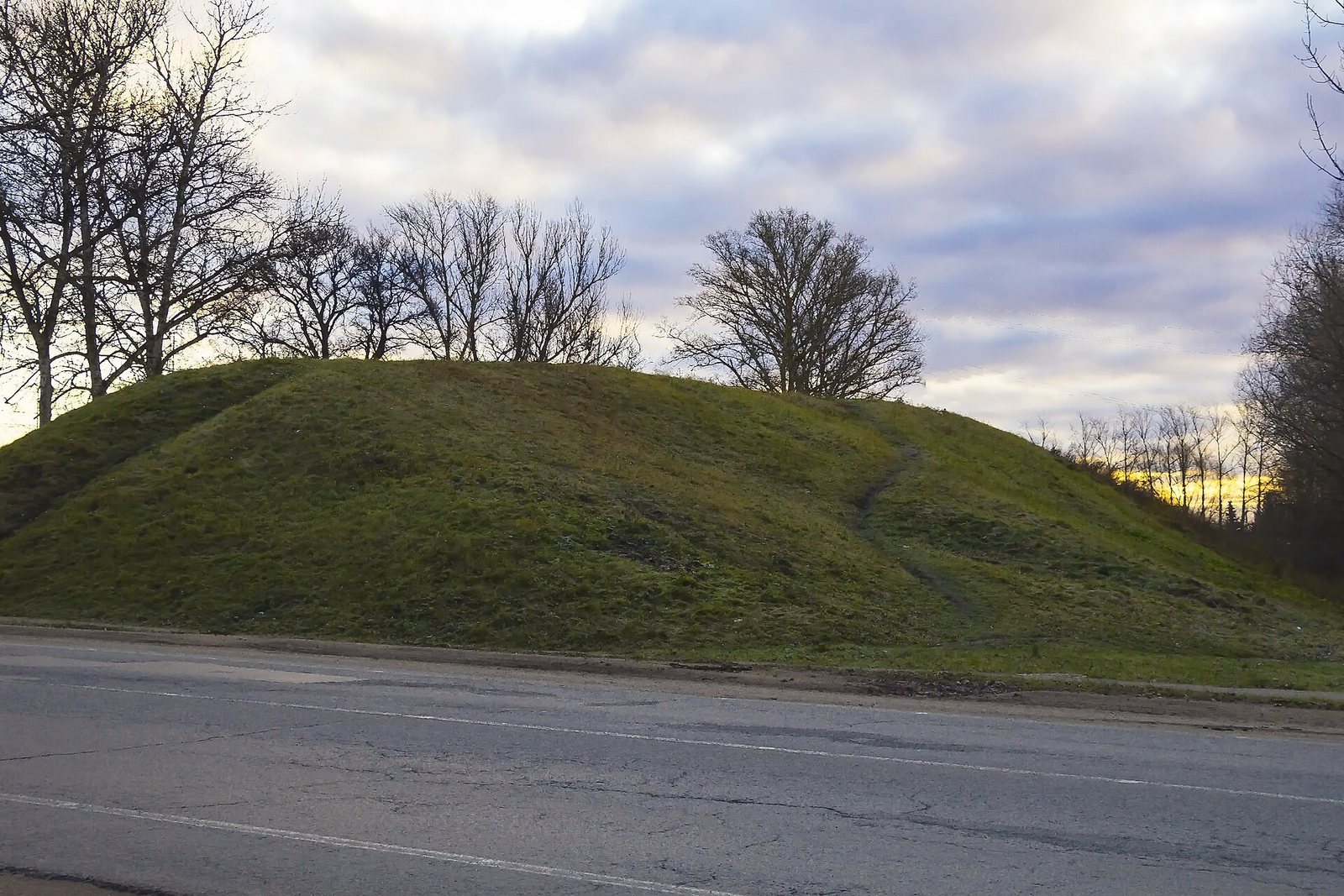
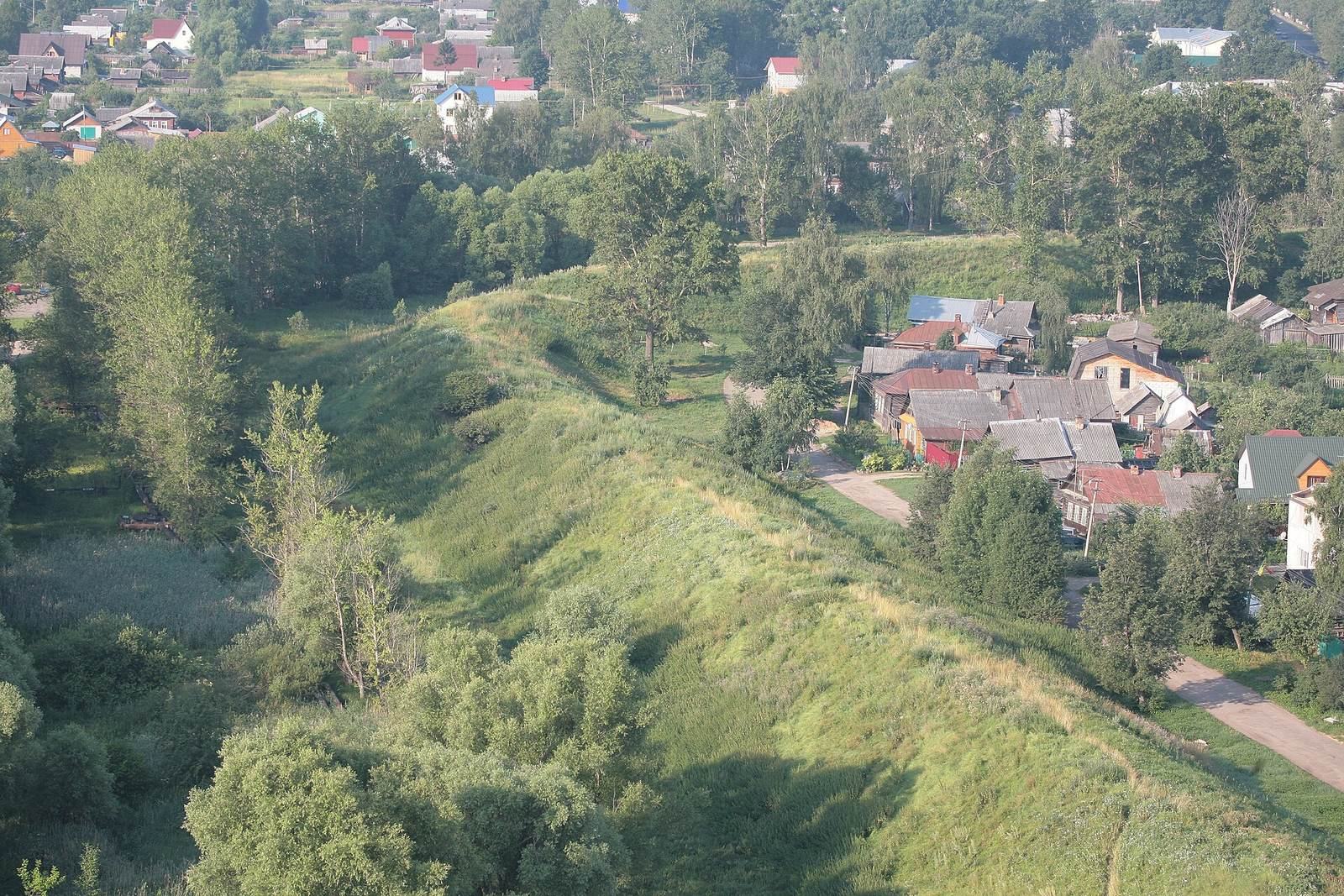
The Kremlin occupies the central historic part of the city, with a pear-shaped plan enclosed by a well-preserved ring of earthworks. The ramparts extend about 2,541 metres. Today they rise 10 to 12 metres, measure about 30 metres across at their base, and are 6 metres wide along the top. They are among the best-preserved earthworks of their kind in Russia.
Fortifications and waterways
Earthworks
Oak and aspen logs formed the foundations of the ramparts, arranged in three layers. Each section was divided by an inner wall into two compartments and filled with earth; the logs were joined by ends that projected beyond the structure. Double timber walls with towers once stood along the top of the ramparts.
Water defenses
The Trubezh River, the now-buried Murmazh stream, and the Grobley ditch helped surround the fortress with water. A pond is all that remains of the ditch. On the landward side, a ditch provided another line of defense. Some sections held water, while others were reinforced with sharpened stakes and obstacles.
Timber walls and towers
A description from 1691 gives the oak timber wall a length of 2,541 metres and notes a covered defensive walkway projecting from it beneath a plank roof. The wall had three gate towers, named Spasskaya, Nikolskaya, and Rozhdestvenskaya, as well as nine towers without a passage through the wall. The towers had four, six, or eight sides. Bridges stood at the gate towers, and a gallery with a protective wall probably ran along the defenses. A concealed underground passage led from Taynitskaya Tower to the Trubezh River to supply water. Spassky Gate stood on the north side, and Nativity Gate was to the southwest.
Religious and civic buildings
Transfiguration Cathedral and princely chambers
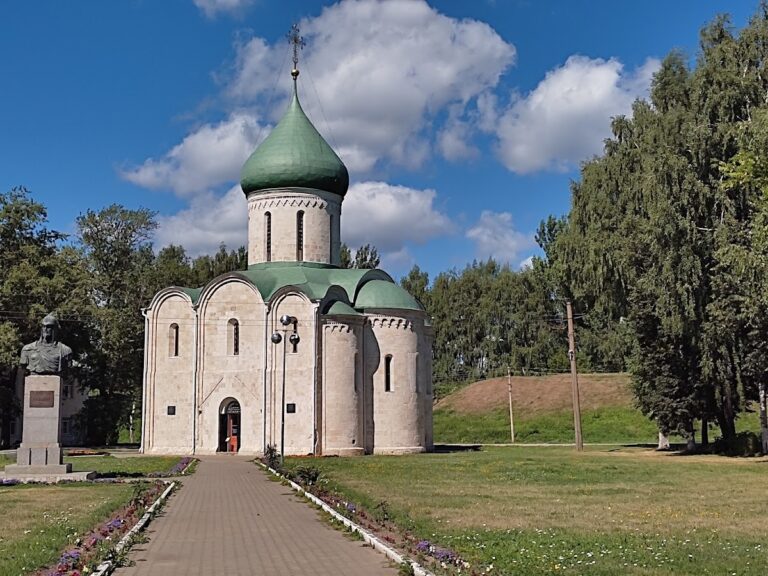
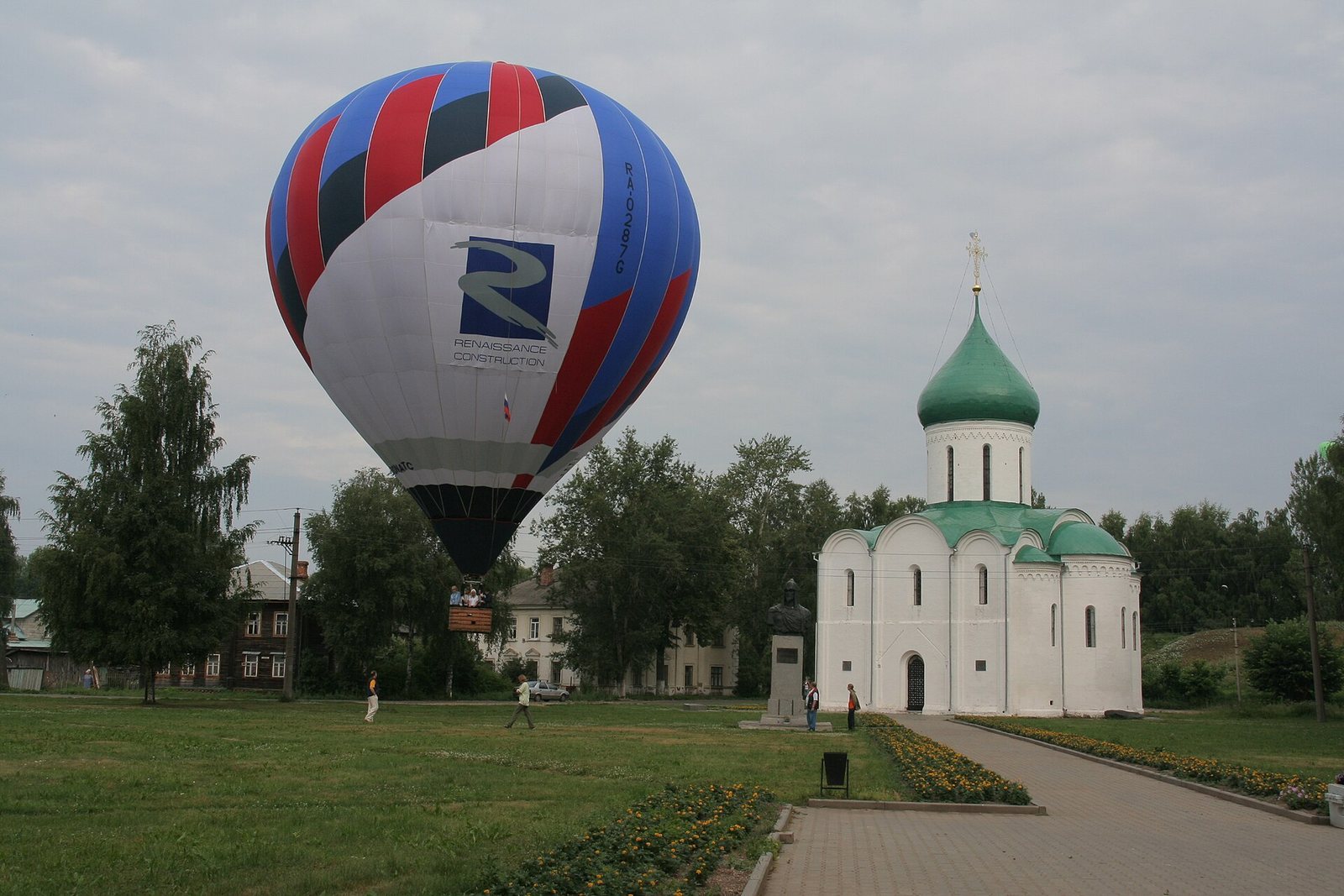
The white-stone Transfiguration Cathedral, built from 1152 to 1157, survives within the Kremlin. It was the site’s only stone building for a long period. Before the Mongol conquest, wooden princely chambers stood beside it. Stair towers and passages connected the chambers to the cathedral galleries and the city walls. A bust of Alexander Nevsky stands in front of the cathedral.
Monastery buildings
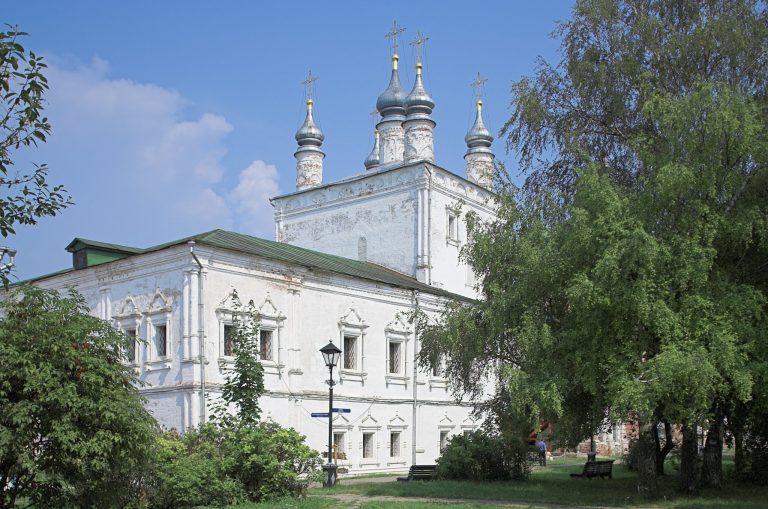
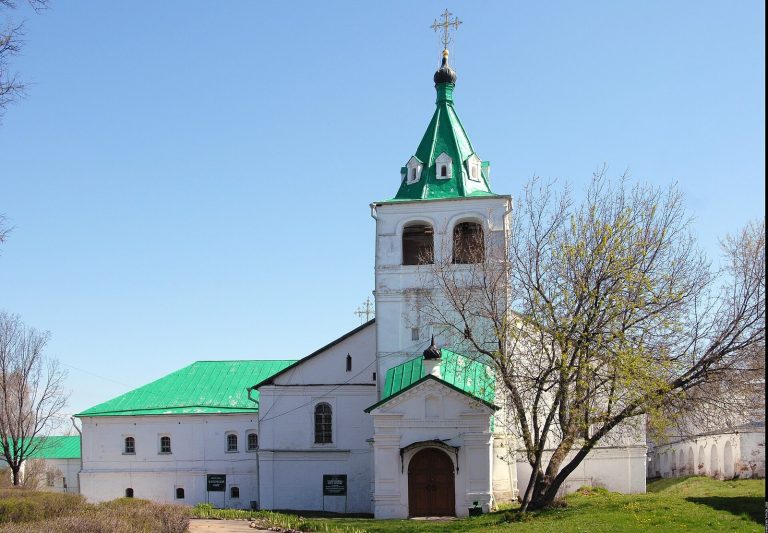
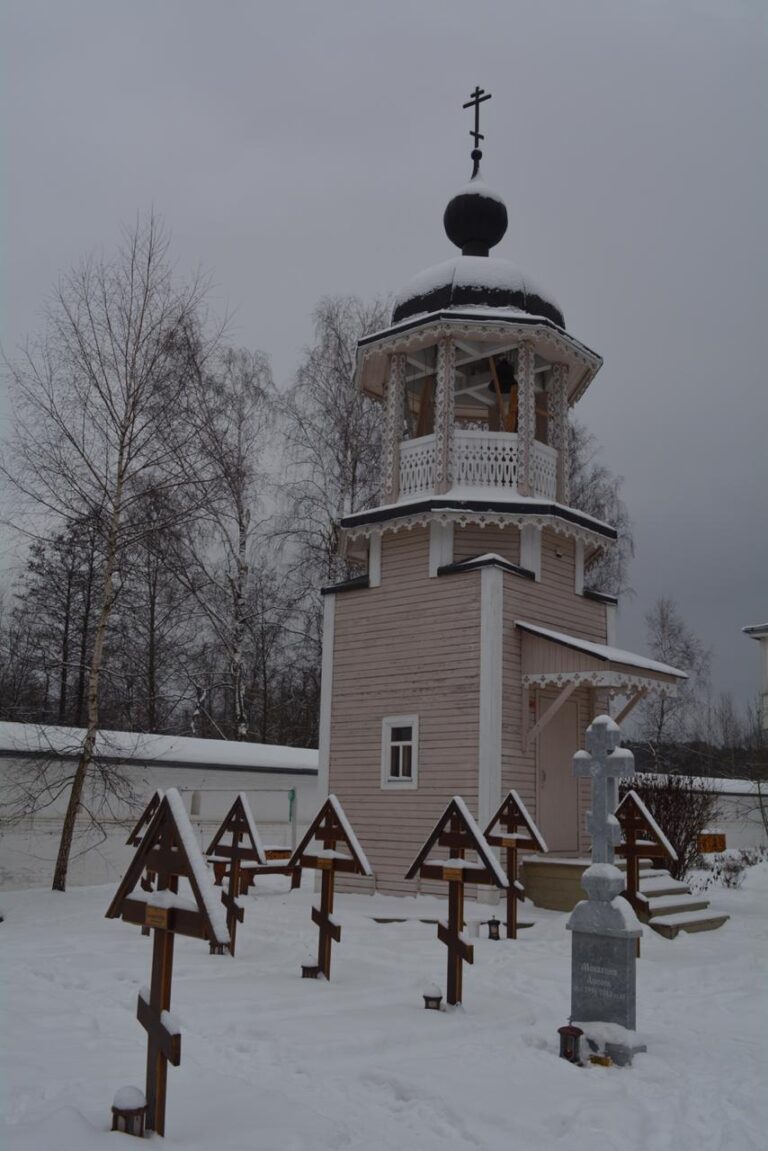
Surviving eighteenth-century buildings of the Sretensky Novodevichy Monastery include the Cathedral of the Vladimir Icon of the Mother of God and the Church of Alexander Nevsky, both built in the 1740s. A small part of the monastery enclosure remains. The rest of the enclosure and its bell tower were destroyed in 1930. A 1691 description also lists the Sretensky Bogoroditsky Monastery within the Kremlin.
Market square and Church of Peter the Metropolitan
The 1691 description places the Red Square, the site of the city market, within the fortress. It also records the brick Church of Peter the Metropolitan, built in the sixteenth century. The church is thought to occupy the site of the princely court that stood there between the twelfth and fourteenth centuries.
Administrative and residential buildings
The Kremlin’s interior also contained a government chancellery, an office for local criminal justice, a prison, a powder magazine, and state and grain warehouses. The 1691 description names compounds belonging to nearby monasteries, refuge courtyards for local nobles and boyar sons, and residences for service households and boyar families. Beyond the fortress core, populous settlements had parish churches and several monasteries.