Saint Nicholas Church: A Dominican Minor Basilica in Gdańsk


Site at a Glance
- Rating
- 4.9
- Popularity
- Low
- Country
- Poland
- Primary era
- Medieval
- External website
- Open
- Eras represented
- Medieval, Early Modern
- Civilizations
- Kingdom of Poland, Teutonic Order
- Site type
- Religious
- Remains
- Church
On this page18 sections
History
Saint Nicholas Church is a Roman Catholic Dominican church in Gdańsk, Poland. A small Romanesque church was probably built around 1185–1190 at the meeting point of the via mercatorum, a major trade route, and a road linking Gdańsk’s fortified settlement with princely estates in Pomerania. Dedicated to Saint Nicholas, the traditional protector of sailors and merchants, it served local residents as well as traders and seafarers arriving from abroad.
Dominican foundation and medieval development
On 22 January 1227, Świętopełk II, the medieval duke of Pomerania, entrusted the church to the Dominican friars. The Dominican Order was a Catholic religious order founded around preaching, theological learning, and missionary work. Saint Hyacinth, a Polish Dominican friar and missionary, had brought the order to the region. Papal legate William of Modena consecrated the church in 1239, and a Dominican monastery was soon established beside it.
In 1260, Pope Alexander IV granted the Gdańsk Dominicans a plenary indulgence for 4 August. In Catholic theology, this meant remission of the temporal punishment associated with sins that had already been forgiven. Pilgrims subsequently came to Gdańsk, while the city council organized an annual Dominican fair on that date. The event developed into St. Dominic’s Fair.
The thirteenth-century monastic buildings probably stopped functioning after Gdańsk was burned in 1308. Their destruction remains uncertain. Teutonic forces may have destroyed them, but the city’s defenders may also have set them alight because the complex stood outside the fortifications and could have served as a staging area for an attack.
Construction of the present church began after 1348 on a site south of its predecessors. The four-bay presbytery was built first, followed by the six-bay, three-aisled western hall. The building was completed in 1487 with its star vault, and the tower received its octagonal upper section.
Reformation, royal associations, and later Dominican history
The church was plundered in 1525 and again in 1576 during the Reformation, a period of religious division that challenged Catholic institutions across Europe. The friars were forcibly expelled, and several Dominicans were killed. In 1564, Gdańsk’s authorities transferred the monastery to Protestants and moved its treasury to the Town Hall. King Sigismund II Augustus intervened, and the monastery was returned to the Dominicans in 1567.
In 1587, the church hosted the presentation of the official document confirming the election of Sigismund III Vasa as king of Poland. A renewed period of prosperity followed. The monastery accommodated increasing numbers of friars, intellectual and preaching activity expanded, and the church received a principal altar, choir stalls, a pulpit, and organs. The Gothic Chapel of Saint Hyacinth on the north side of the presbytery was rebuilt toward the end of the seventeenth century.
During the Napoleonic Wars, Russian and Prussian artillery and the fire that followed destroyed the Dominican monastery in 1813. Napoleon’s French forces had been using the monastery as a military hospital. The ruined buildings were dismantled during the 1820s, and the Dominicans were expelled from Gdańsk in 1834. The surviving church then became a Catholic parish church, one of four Catholic parishes operating in the city at that time.
Twentieth-century survival and restoration
Pope Pius XI granted Saint Nicholas Church the title of Minor Basilica in 1929. This is a papal honorific recognizing particular historical, religious, or pastoral importance and is distinct from the architectural meaning of the word basilica. The associated ceremonial umbraculum, a canopy connected with that title, was later thought to have been lost. Emergency work uncovered it in December 2019, and it was restored in 2021.
Saint Nicholas Church escaped the destruction that affected historic central Gdańsk during World War II, including shelling by the Red Army. Two traditions explain its survival. One attributes it to Russian soldiers’ veneration of Saint Nicholas, while the other says that the parish priest bribed them with alcohol from the church cellar. These remain traditions rather than established causes.
In April 1945, after 111 years away, the Dominicans returned to Gdańsk and settled beside their former church. Many had come from Lviv after the city’s reoccupation by the Soviet Union and the forced expulsion of Polish clergy and residents. In the late 1960s, the church became a meeting place for opposition and independence-minded circles. Father Ludwik Wiśniewski organized discussions attended by students who later became opposition activists and politicians.
The church closed on 31 October 2018 after cracks appeared in the vaults, supporting pillars became unstable, the south-aisle floor deformed, and the arches shifted. Cracks and losses in the south wall of the presbytery, together with leaning pinnacles, also led to the closure of the pavement on Lawendowa Street in spring 2019. Emergency repairs to the foundations and vaults were completed by 2022, followed by continuous structural monitoring. The western facade received emergency restoration in 2020, the first work on the church’s masonry since 1945. The building reopened on 8 August 2020.
A bell cast in 1697 returned to Saint Nicholas Church in 2025. It had been removed during World War II, taken to the bell cemetery in Hamburg, and later transferred to the Church of Our Lady in Kassel.
Remains
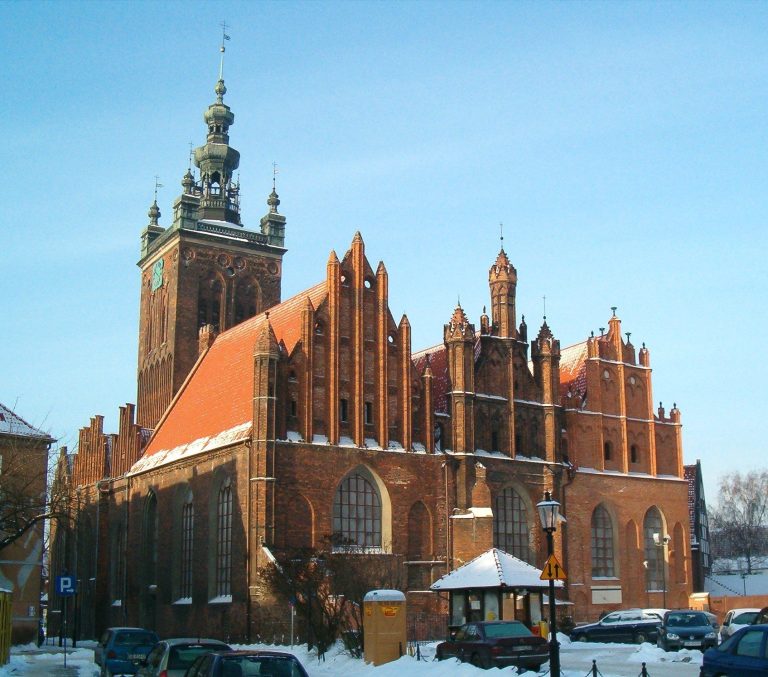
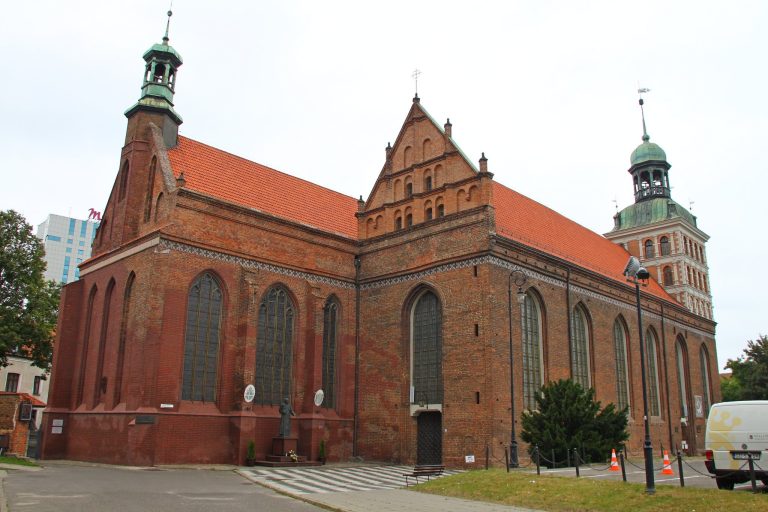
Saint Nicholas Church is a red-brick Gothic hall church with three aisles. Its interior is organized around a presbytery and a broad nave, while the surviving fabric includes concealed buttresses, ten octagonal pillars, and a star-patterned lierne vault. A lierne vault uses secondary ribs to create ornamental patterns between the principal supports. The building is approximately 63 metres long and 22.24 metres wide. The nave section measures 37 metres, the main aisle rises 16 metres, and the presbytery is 25 metres long and 9.30 metres wide.
Earlier churches and monastic remains
Romanesque church
Archaeological remains of the first Romanesque church lie beneath the present urban market area on Dominikański Square. It was a single-aisled basilica with a semicircular apse, two entrance towers, and a round Romanesque portal. Masonry from its vault is displayed beside the foundations, and a large cemetery developed nearby.
Thirteenth-century refectory
The thirteenth-century monastic refectory stood south of the earlier church. Its remains include a kitchen and a large brick oven. The refectory covered 54 square metres and occupied a ground floor set one metre below ground level. Its 3.5-metre-high vault consisted of four elliptical fields resting on sail-like vault sections and a central column placed on a granite base. After its probable abandonment following the burning of Gdańsk in 1308, the room was adapted as a cellar beneath a Gothic cloister gallery toward the end of the fourteenth century.
Gothic structure and chapels
Church body and tower
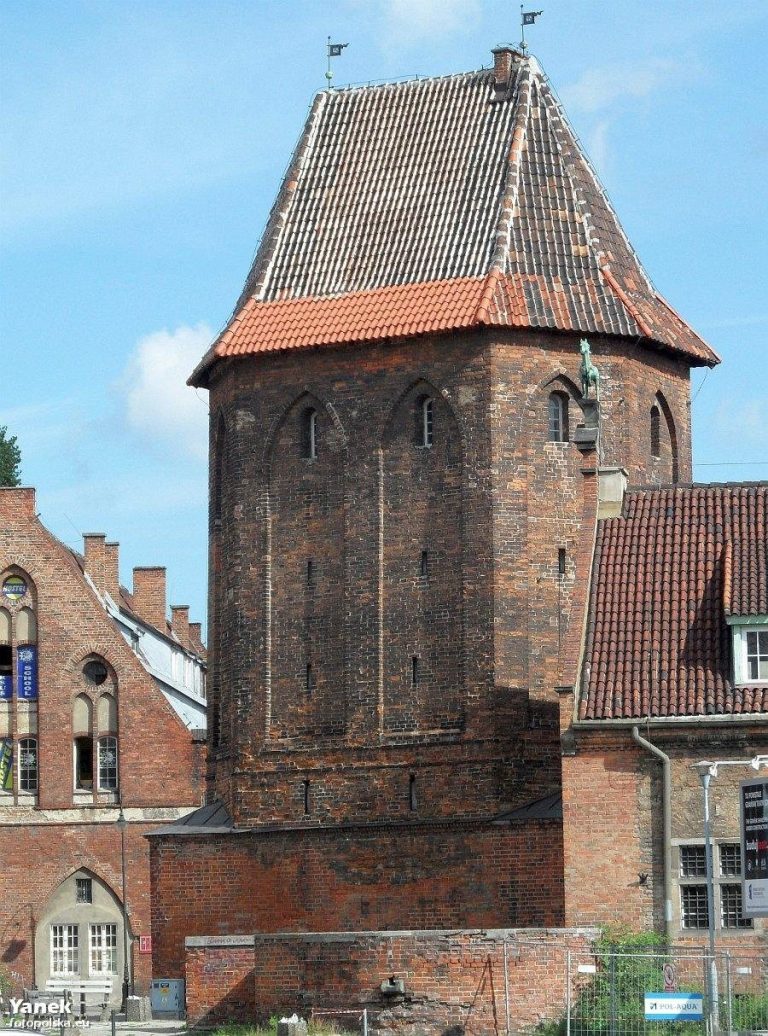
The west facade ends in a gabled top decorated with recessed panels and pinnacles. Three separate roofs cover the aisles, one over each aisle. The tower has an octagonal upper section added during completion of the Gothic church. Inside, the pillars support the star-patterned lierne vault, while the concealed buttresses reinforce the walls without dominating the interior space.
Saint Hyacinth and Saint Joseph chapels
The north aisle extends eastward into the Chapel of Saint Hyacinth, which was rebuilt toward the end of the seventeenth century. The south aisle leads to the Chapel of Saint Joseph beneath the tower and then to the sacristy. Crypts occupy the basement and are associated with the church.
Historic floor
The historic floor is formed from abrasion-resistant but brittle limestone brought from the Swedish island of Öland. Fossil remains of prehistoric nautiloids appear in the slabs, alongside marks left by the stone makers.
Paintings, sculpture, and liturgical furnishings
Medieval works and choir stalls
The church preserves furnishings from the Gothic, Renaissance, Baroque, and Rococo periods. Near the Chapel of Saint Hyacinth stands a Pietà from the beginning of the fifteenth century, showing the Virgin Mary mourning over the dead Christ. Presbytery wall paintings from around 1430 depict the Passion of Christ and were originally embellished with gold. Other Gothic furnishings include a panel painting of the Virgin and Child from around 1466 and a rood-beam crucifix from around 1520.
The choir stalls stand on both sides of the presbytery. Their seats date from around the middle of the sixteenth century, while their Rococo backs were added in the middle of the eighteenth century. Garlands, rocaille ornament, and 22 convex reliefs decorate the backs, showing scenes from the life of Jesus against architectural and landscape backgrounds.
Principal altar
The late-Renaissance principal altar was made in 1643. Five storeys high, it fills the east wall of the presbytery and combines paintings and figural sculpture with polychrome relief decoration featuring cartilage and shell motifs. Its central canvas, painted in 1647 by the Gdańsk artist August Ranisch, shows Saint Nicholas kneeling before Christ. Christ gives him a book while the Virgin Mary places a mitre on his head.
The central painting occupies the second and third storeys. Two oval paintings of Saint Dominic and Saint Francis appear on the fourth storey. Other levels contain Saint Stanislaus with Piotrowin at his feet, Saint Adalbert with an oar, Saint Hyacinth holding a Madonna figure, Saint Casimir, and Blessed Czesław Odrowąż. A Madonna within a radiant mandorla crowns the composition.
Side altars and devotional objects
Twelve side altars survive. They include the 1671 altar of Saint Rose of Lima by K. Gockeller, with a painting of the saint by Andrzej Stech; a Rococo altar of Saint Dominic from the second half of the eighteenth century, formerly dedicated to Saint John of Nepomuk; and an altar of Saint Vincent Ferrer. The 1662 altar of Our Lady of Sorrows contains a wooden Lamentation of Christ and a Resurrection painting funded by Marcin Kulmiński. The altar of the Transfiguration was restored between 2012 and 2020. A renovation in 1896 removed 15 of the 25 altars that had previously stood in the church.
Near the first pillar of the south aisle is an eighteenth-century stoup shaped like a chalice and made of black marble. Opposite it stands a richly ornamented Baroque baptismal font from 1732, funded by F. Brunatti. Its basin is a tin bowl from 1781, supported by figures of the four Evangelists, each 50 centimetres high.
Organ, lectern, and commemorative works
The late-Baroque organ case dates from 1755. The instrument’s present appearance results from a rebuilding in 1977, when the small organ placed in the south aisle in 1932 was returned to the upper section.
A hymnal lectern takes the form of a crowned Stanislaus Eagle holding the coat of arms of Gdańsk. It commemorates the election of Stanisław August Poniatowski as king of Poland in 1764. The Gdańsk bell-founder Ernest Frederick Koch made it at his own expense. Originally placed in the presbytery, it was moved beneath the principal altar before World War II and became a symbol of the Polish Commonwealth in pre-war Gdańsk.
A tomb slab commemorates a Teutonic knight buried in the church. Renaissance and Baroque epitaphs honor members of the Catholic Pomeranian nobility, including Jan Konopacki, Johann Joachim Posselius, Johann Ernest Scheffler, Piotr Wyhowski, and Józef Hercyk.
Transferred icons and recovered objects
A medieval icon of the Victorious Mother of God, also called an Hodegetria, remains in Saint Nicholas Church. An Hodegetria is an image in which the Virgin indicates or presents the Christ Child. Dominican friars brought the icon from their church in Lviv in 1945. Tradition attributes its gift to Princess Constance, the wife of Leo, the Galician-Volhynian prince, in 1260. More recent art-historical interpretation connects it with the Byzantine artistic heritage of Venice, dates it to the fourteenth century, and considers it possibly an early work by Paolo Veneziano from around the 1340s.
Fragments of a Baroque painting of the Virgin and Child, believed to have been lost since World War II, were found in the church belfry in 2018. The 1697 bell returned in 2025 after its wartime removal and later transfers through Hamburg and Kassel. The papal umbraculum recovered in 2019 measures almost 390 centimetres in height, including its shaft, and 235 centimetres across. Fungal damage had affected its condition before its restoration in 2021.