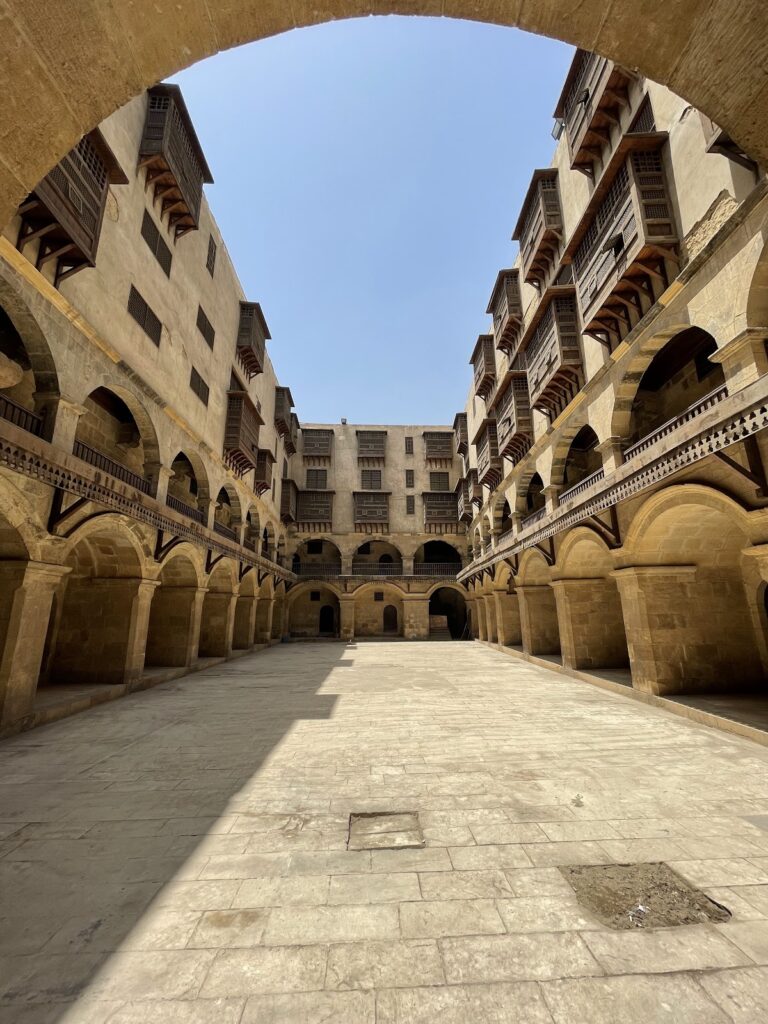
Al-Azhar Mosque: Fatimid Congregational Mosque and Center of Islamic Learning in Cairo


Site at a Glance
- Rating
- 4.8
- Popularity
- High
- Country
- Egypt
- Primary era
- Medieval
- Eras represented
- Medieval, Early Modern, Modern
- Civilizations
- Fatimid, Mamluk, Ottoman
- Site type
- Religious
- Remains
- Mosque
On this page19 sections
History
Al-Azhar Mosque is a historic mosque in Cairo, Egypt, founded by the Fatimid dynasty between 970 and 972 as the city’s congregational mosque and a center for Isma’ili Shi’i teaching. Its first Friday prayer took place on June 22, 972, during Ramadan. The mosque stood near the Sunni city of Fustat, while the new Cairo became the capital of the Fatimid state and the center of its Isma’ili religious tradition.
Fatimid foundation and religious role
Fatimid general Jawhar al-Siqilli conquered Egypt in 969 on behalf of the caliph al-Mu’izz and supervised the foundation of Cairo. Construction of Al-Azhar began the following year and ended in 972. The mosque was initially associated with the names of the new city. It may first have been called the Mosque of al-Mansuriyya, and later the Mosque of Cairo after al-Mu’izz renamed the city al-Qahira. The name Al-Azhar was adopted by the end of the reign of al-Aziz Billah, sometime between the reigns of al-Mu’izz and al-Aziz.
The origin of the name remains uncertain. One widely repeated explanation connects it with al-Zahra, an epithet of Fatimah, the daughter of Muhammad and wife of Ali. Another relates it to the Brilliant Palaces and royal gardens established near the mosque by the Fatimid caliphs. Neither explanation is confirmed by an Arabic historical source.
Al-Azhar soon became more than a place of prayer. Official pronouncements were issued there, court sessions were held there, and Isma’ili teachings that had previously been restricted were presented publicly. The caliph’s palace also hosted lessons, including separate classes for women. Al-Mu’izz appointed al-Nu’man ibn Muhammad as qadi, an Islamic judge, and placed him in charge of teaching Isma’ili doctrine. In 973, Al-Azhar was rededicated as Cairo’s official congregational mosque, and al-Mu’izz and his son delivered Friday sermons there during Ramadan.
Its teaching role became more formal under the Fatimids. In 988, Yaqub ibn Killis, the first official Fatimid vizier and a jurist, made Al-Azhar a principal center for Islamic law. Forty-five scholars were appointed to teach there in the following year. Regular stipends were provided for scholars, and accommodation was established for 35 jurists. An early formal lesson in Shi’i jurisprudence dates to 975, helping establish the educational tradition that later defined the institution.
Fatimid expansion and the end of Shi’i rule
The caliph al-Aziz expanded and repaired the mosque, while al-Hakim bi-Amr Allah continued the work and installed a new wooden door in 1010. Al-Azhar temporarily lost its place as Cairo’s principal congregational mosque in May 1009, when al-Hakim’s Mosque became the sole venue for the caliph’s sermons. Its former status was restored under al-Mustansir, and later Fatimid caliphs continued to enlarge and repair it.
A library was established in 1005, receiving thousands of manuscripts donated by al-Hakim. Much of the collection was dispersed or lost during the disorder that followed the fall of the Fatimid state. Manuscripts containing Fatimid teachings were later destroyed, and Al-Azhar eventually became a Sunni institution.
Ayyubid neglect and Mamluk restoration
Saladin overthrew the Fatimids in 1171 and founded Ayyubid rule in Egypt in alliance with the Sunni Abbasid caliphate. Because of Al-Azhar’s Shi’i institutional history, Saladin and his successors withdrew support from the mosque, ending funding for students and teachers and suspending congregational prayer. The suspension lasted for about a century.
Saladin’s qadi, Sadr al-Din ibn Dirbass, prohibited congregational prayer at Al-Azhar. The decision may have reflected Shafi’i legal principles that allowed only one congregational mosque in a community, as well as distrust of the former Fatimid institution. Saladin also ordered the removal from the mihrab of a silver band bearing the names of the Fatimid caliphs. Organized teaching declined, although the mosque remained a place for Arabic philology and private instruction. A scholar probably identified as al-Baghdadi is reported to have taught law and medicine there, receiving payment from Saladin and later from his successors.
The Ayyubids established 26 Sunni colleges in Egypt, including the Salihiyya Madrasa. Their standardized programs included rhetoric, mathematics, and science alongside religious subjects, and Al-Azhar eventually adopted aspects of this educational system. Sultan Baibars restored congregational prayer in 1266 and renewed stipends for teachers and students. After repairs following the long period of neglect, the first khutbah, the sermon delivered during Friday prayer, since the time of al-Hakim was given from a newly completed pulpit on January 16, 1266.
An earthquake in 1302 caused major damage, and Sayf al-Din Salar was assigned responsibility for the repairs. Under the Mamluk sultans, Al-Azhar was repeatedly expanded, repaired, and combined with new madrasas, or Islamic colleges. It regained importance as a center of Sunni learning, law, theology, and Arabic. Students came from Egypt, the Middle East, and other parts of the Islamic world and were organized in riwaqs, arcaded residential and teaching units associated with particular regions. Study of Islamic law generally lasted about six years.
By the fourteenth century, Al-Azhar was one of the leading centers of Islamic learning. Mamluk patronage strengthened its congregational and educational roles, although it did not entirely displace the Ayyubid madrasas as the preferred institution of Cairo’s elite. At the end of Mamluk rule, the Salihiyya Madrasa was still regarded by some as the principal citadel of scholars.
Ottoman rule and eighteenth-century rebuilding
After the Ottoman annexation of Egypt in 1517, Ottoman rulers and amirs continued to respect Al-Azhar, attended Friday prayers there, and occasionally provided stipends. Direct royal patronage and major construction declined, but Mamluk elites regained influence in the eighteenth century and sponsored substantial renovations.
In 1735, al-Qazdughli sponsored a riwaq for blind students and rebuilt the Turkish and Syrian riwaqs. Abd al-Rahman Katkhuda, appointed head of the Janissaries in 1749, later undertook the largest Ottoman-period building campaign. He added three gates, several riwaqs, and a new prayer hall south of the original Fatimid hall, approximately doubling the available prayer space. He was buried at Al-Azhar in 1776 and became the first and last person interred there since the mystic Nafissa al-Bakriyya, who died around 1588.
By the late eighteenth century, Al-Azhar had regained its position as Egypt’s favored institution of learning and was closely associated with the Egyptian ulama, the community of religious scholars. Its scholars served on advisory councils to the Ottoman governor, and the curriculum had expanded to include philosophy, logic, and science. Abdallah al-Shubrawi, a follower of the Shafi’i legal school, became the first non-Maliki head of Al-Azhar during this period. No Maliki scholar held the office again until Salim al-Bishri was appointed in 1899.
The mosque also became a center of opposition to Ottoman officials. Student protests were sometimes supported by closing nearby shops, and the gates were shut during disturbances in 1730–1731 and again during unrest in 1791. Officials involved in these conflicts were later ordered away from the mosque or dismissed.
French occupation and the nineteenth-century state
French forces under Napoleon occupied Cairo in July 1798. On July 25, Napoleon created a diwan, or administrative council, of nine Al-Azhar sheikhs, senior religious scholars, to help govern the city. He also unsuccessfully sought a fatwa, a formal Islamic legal opinion, permitting allegiance to him.
A revolt against the French began at Al-Azhar on October 21, 1798. Napoleon ordered Cairo shelled from the citadel, directing fire at the mosque. French troops entered with shoes and weapons displayed, tied horses to the mihrab, looted student quarters and libraries, and threw copies of the Quran onto the floor. Six Al-Azhar scholars were executed. After French General Jean-Baptiste Kléber was assassinated in March 1800 by Suleiman al-Halabi, an Al-Azhar student, Napoleon ordered the mosque closed. Its gates remained shut until Ottoman and British forces regained control in August 1801.
Printing, introduced during the French occupation, helped shift teaching from oral lectures and memorization toward the use of printed texts. Al-Azhar acquired its own printing press in 1930. In the early nineteenth century, Muhammad Ali Pasha sought to reduce the political and financial influence of its scholars. In 1809, he ordered the confiscation of rizqa lands, religious endowments associated with mosques and madrasas, provoking a revolt led by Umar Makram. The revolt failed, and Makram was exiled to Damietta.
Muhammad Ali and his successors developed a Western-style educational system alongside Al-Azhar and appointed officials educated outside the mosque. During this period, history, mathematics, modern science, and European philosophy entered the curriculum. Royal patronage returned under Isma’il Pasha, who restored Bab al-Sa’ayida and the Madrasa al-Aqbughawiyya. Tewfik Pasha continued the restoration, while Abbas Hilmi II rebuilt the main facade and added the neo-Mamluk Riwaq al-Abbasi, completed in 1901. The Committee for the Conservation of Monuments of Arab Art also restored the original Fatimid courtyard.
Educational reform and modern institutional change
Late nineteenth- and early twentieth-century reforms standardized examinations, centralized manuscripts in a library, improved student facilities, and placed other Egyptian colleges under Al-Azhar’s administration in 1885. Under King Fuad I, a law passed in 1930 divided the school into departments of Arabic language, sharia, and theology and introduced formal examinations for diplomas. A second law, passed six years later, transferred the school’s principal offices to a new building across from the mosque.
Reformers including Muhammad Abduh influenced Al-Azhar from the early twentieth century. Mustafa al-Maraghi became its head in 1928, was replaced by Muhammad al-Ahmadi al-Zawahiri after one year, and returned in 1935, remaining in office until his death in 1945. Under al-Maraghi, the curriculum expanded to include non-Arabic languages and modern sciences.
The Egyptian Revolution of 1952 brought Al-Azhar under closer state control. Buildings around the mosque were acquired and demolished by 1955 to make room for a modern campus, and the mosque ceased to function as the university’s school. The 1961 law formally established Al-Azhar as an independent university while separating its educational and religious functions. It created secular faculties, including medicine, engineering, and economics, and gave the president of Egypt authority to appoint the head of Al-Azhar.
The same period brought the nationalization of religious endowments, the abolition of sharia courts, and the incorporation of religious courts into the state judicial system. These measures reduced the institutional independence of Al-Azhar’s scholars while bringing the institution into the state apparatus and providing access to state resources. Successive governments used Al-Azhar to provide religious justification for political measures, including Nasser’s Islamic socialism, opposition to the Muslim Brotherhood, the 1967 war with Israel, and Sadat’s peace initiative with Israel. Under Mubarak, the institution received greater autonomy in some areas and gained a wider role in censoring printed and electronic media.
The office of Shaykh al-Azhar, the institution’s highest religious and administrative authority, was created during Ottoman rule. It was traditionally filled from among senior scholars, but the 1961 law transferred appointment authority to the Egyptian president. In 2012, a Council of Senior Scholars was re-established with powers that included electing the shaykh and deciding religious matters. After the Egyptian Revolution of 2011, student elections, protests, and internal debates addressed Al-Azhar’s independence from the state, control of its finances, and authority over leadership and religious affairs.
A major restoration completed in 2018 reinforced the building foundations, restored architectural elements, and modernized infrastructure. Al-Azhar Mosque and the surrounding historic area form part of Historic Cairo, which UNESCO inscribed as a World Heritage Site in 1979. The mosque remains active and continues to be associated with Sunni religious learning in Egypt and the wider Islamic world.
Remains
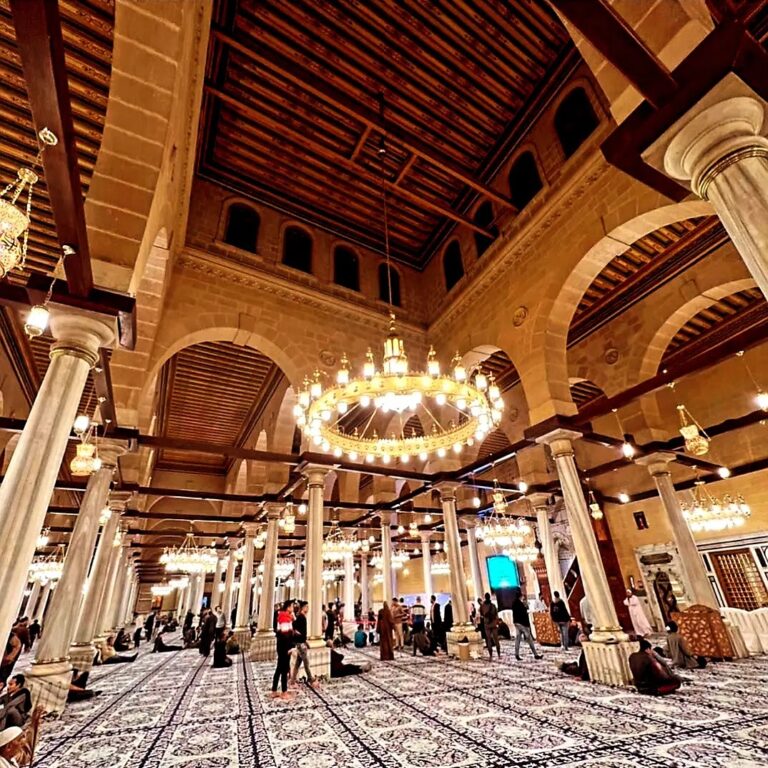
Al-Azhar’s surviving fabric combines Fatimid, Mamluk, Ottoman, and later elements. The original mosque was approximately 85 meters long and 69 meters wide, with three arcades around a courtyard and a five-aisled prayer hall on the southeast side. Ancient marble columns from Pharaonic, Roman, and Coptic buildings were reused in the arcades. Their different heights were accommodated with bases of varying thickness. The original qibla wall, the wall oriented toward Mecca, was slightly misaligned with the correct direction.
The Fatimid mosque and courtyard
Original prayer hall
The original exterior stucco combines Abbasid, Coptic, and Byzantine influences. Three early domes were built, but later renovations removed them. The original mihrab, a recessed niche indicating the direction of Mecca, was uncovered in 1933. It has a semi-dome and a marble column on each side. Its stucco decoration contains two sets of Quranic verses, the opening verses of al-Mu’minun and verses 162–163 of al-An’am. These inscriptions are the surviving decoration definitively attributed to the Fatimid period.
Central courtyard
The marble-paved central courtyard was added between 1009 and 1010. Its surrounding arcades have keel-shaped arches, carved stucco, Kufic inscriptions, and a star-patterned band with tiered triangular crenellations. Sunken roundels with 24 lobes form part of the ornament. Vegetal decoration was added around them in 1893, while the stucco ornament was restored in 1891. Alternating shallow niches beneath fluted conches also decorate the arcades. The Quranic inscriptions were added during the Fatimid period after the reign of al-Hafiz.
The southeastern arcade contains the principal entrance to the prayer hall and a Persian-framed gate formed by a recessed central arch within a taller rectangular surround. A western porch and a fourth arcade were added under al-Hafiz. Al-Hakim installed a new wooden door in 1010, and a wooden mihrab was added in 1125. Al-Hafiz also commissioned an additional dome.
Mamluk madrasas and minarets
Madrasa al-Taybarsiyya
The fourteenth-century Madrasa al-Taybarsiyya began as a complementary mosque and was later incorporated into Al-Azhar. Its original building was completely rebuilt under Abd al-Rahman Katkhuda, leaving only the southeastern wall and mihrab. The niche is 1.13 meters wide and 76 centimeters deep, with a 2.78-meter-high porphyry column on each side. Colored geometric decoration covers the impost blocks, and the semi-dome is set within an outer arch and rectangular frame. Glass mosaics depict pomegranate trees.
Madrasa al-Aqbughawiyya
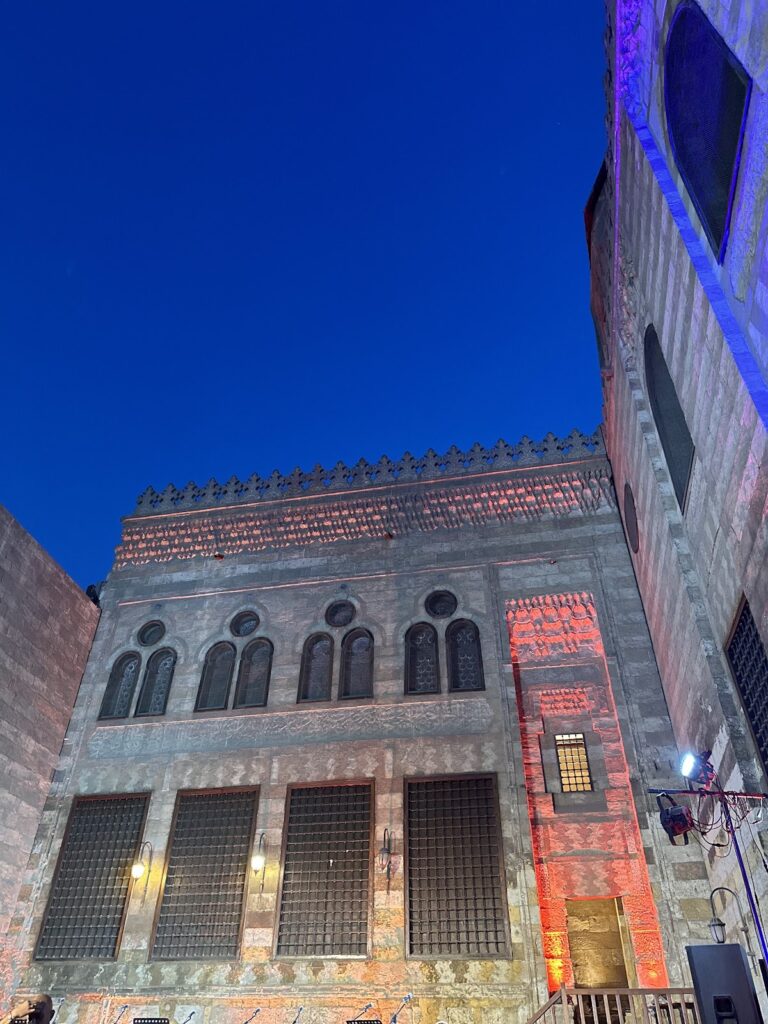
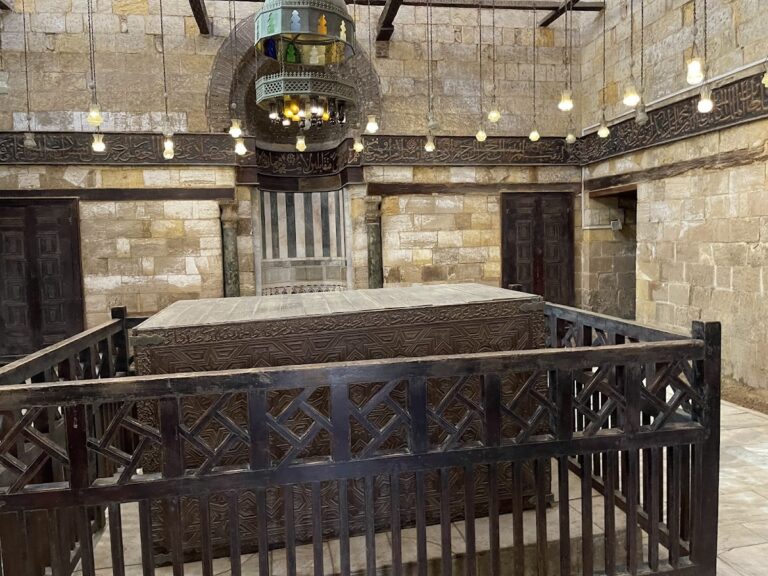
The Madrasa al-Aqbughawiyya was built along the mosque’s northwest wall in the early fourteenth century and later integrated into the complex. It contains a small burial chamber and a larger hall, each with its own mihrab, as well as the tomb of Amir Aqbugha. Its entrance, qibla wall, and mihrabs are original. The dome was rebuilt during the Ottoman period, parts of the facade were remodeled by Tewfik Pasha in 1888, and the upper part of its minaret changed from an Ottoman pointed form to a Mamluk-style finial. The madrasa is now used to hold manuscripts.
Madrasa al-Gawhariyya
Madrasa al-Gawhariyya was built in 1440. Its marble floor and wall cupboards contain decorative inlay in ebony, ivory, and mother-of-pearl. A small stone dome covers its tomb chamber and carries an externally carved arabesque pattern. The structure was restored in 1980–1982.
Minarets and Mamluk gates
The Minaret of Qaytbay was erected in the late fifteenth century on or near the site of an earlier Fatimid brick minaret. It has a square base, octagonal shafts, a cylindrical upper shaft, and three balconies supported by muqarnas, a tiered honeycomb-like architectural form. Keel-arched panels, braided decoration, and a crowned finial complete its design.
The earlier Fatimid minaret had been rebuilt repeatedly because of structural defects. It was reconstructed under Baibars, rebuilt under Barquq in 1397 after it began to lean dangerously, and repaired again in 1414 and 1432. The existing Qaytbay minaret formed part of the reconstruction of the mosque entrance. Bab al-Gindi, also called the Gate of Qaytbay, was built in 1495. It stands beneath the minaret and leads toward the main prayer-hall court.
The double-finial minaret of Qansuh al-Ghuri was built in 1509. Its square base supports octagonal and polygonal shafts, balconies carried on muqarnas, blue faience decoration, horseshoe arches, and two bulbous finials topped with crescents.
Ottoman additions and later restoration
Katkhuda’s prayer hall and gates
Abd al-Rahman Katkhuda’s Ottoman-period campaign nearly doubled the mosque’s size. He added a prayer hall south of the original Fatimid hall, an additional mihrab, and several riwaqs. His three gates were Bab al-Muzayinīn, Bab al-Sa’ayida, and Bab al-Shurba. Bab al-Muzayinīn, or the Gate of the Barbers, was built in 1753 and became the principal entrance. Its two doors are framed by recessed arches, molded semicircular arches, trefoil-decorated tympana, and a frieze of cypress-tree motifs.
Bab al-Sa’ayida was intended for people from Upper Egypt, while Bab al-Shurba was associated with distributing food, often rice soup, to students. Katkhuda also renovated or rebuilt several surrounding riwaqs, including one for blind students. A free-standing Ottoman-style minaret once stood outside Bab al-Muzayinīn, but it was demolished before the opening of Al-Azhar Street during modernization under Tewfik Pasha.
Present entrance and prayer areas
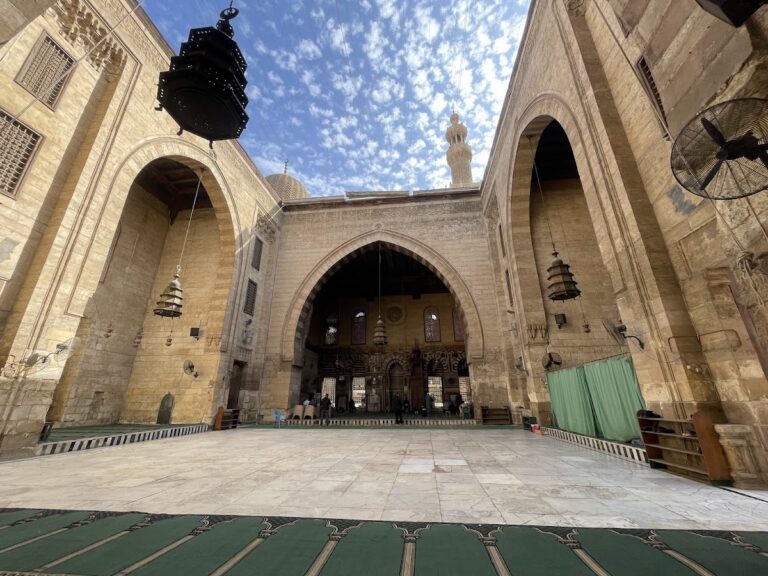
The present main entrance remains Bab al-Muzayinīn, which opens onto a smaller courtyard paved with white marble. The Aqbughawiyya facade lies to the northeast, the Taybarsiyya at the southwestern end, and Bab al-Gindi directly opposite the entrance across the courtyard. Beyond Bab al-Gindi is the principal prayer-hall court. The prayer area incorporates the original Fatimid hall and Katkhuda’s southern addition.
Isma’il Pasha restored Bab al-Sa’ayida and the Aqbughawiyya. Tewfik Pasha renovated Katkhuda’s prayer hall, aligned its southeastern facade with the street behind it, and remodeled the Aqbughawiyya facade. Abbas Hilmi II rebuilt the main facade and added the three-story Riwaq al-Abbasi in neo-Mamluk style, completed in 1901. The main mihrab now has a plain marble and gold-patterned facing that replaced part of the Mamluk marble surface, while stucco carvings in its semi-dome are probably Fatimid.
The mosque’s present appearance therefore brings together reused ancient columns, Fatimid stucco and inscriptions, Mamluk minarets and madrasas, Ottoman gates and prayer halls, and modern restoration work. A major restoration completed in 2018 reinforced the foundations, repaired architectural elements, and modernized infrastructure.
Nearby sites