Kloster Zeven: A Medieval Benedictine Monastery in Germany


Site at a Glance
- Rating
- 4.6
- Popularity
- Very Low
- Country
- Germany
- Primary era
- Medieval
- Eras represented
- Medieval, Early Modern
- Civilizations
- Holy Roman Empire
- Site type
- Religious
- Remains
- Monastery
On this page10 sections
History
Kloster Zeven is a former medieval Benedictine monastery in Zeven, Germany, developed from a tenth-century religious foundation at nearby Heeslingen. Heeslingen was probably founded around 961 during the reign of Otto I, the German king and later Holy Roman Emperor, by Count Hed with the participation of Adaldag, Archbishop of Bremen. Its early history is not fully certain, since no foundation charter survives and the surviving evidence presents a partly contradictory account.
From Heeslingen to Zeven
King Otto III confirmed Heeslingen’s connection with the Bremen Church in a diploma issued on 17 March 986. The document regulated the election of the abbess and advocate, confirmed an endowment of five farms, tithes, and other revenues, and granted the foundation immunity. Count Hed was named as founder, while his daughter Winnilgerd was the first documented abbess.
In 1141, Archbishop Adalbero of Bremen ordered the foundation’s transfer to Zeven at the request of Provost Liudmund. Abbess Hathewich and the more judicious members of the convent consented to the move. Indiscipline at Heeslingen was given as the main reason, while Zeven was regarded as a more secluded place suited to religious observance. The new location already had a settlement and was subject to tithes claimed by Heeslingen, so the community was relocated to an inhabited site rather than founded in empty land.
The transfer probably also changed the institution from a community of canonesses, women organized around communal worship and ecclesiastical duties, into a Benedictine nunnery. The Rule of Saint Benedict, the monastic code associated with Benedict of Nursia, is explicitly identified as authoritative at Zeven in 1226. The former foundation’s patronage, property, and rights passed to Zeven, the relocation was probably complete by about 1150, and Heeslingen ceased to exist as an independent institution.
Liudmund helped prepare the reform and relocation. He had previously belonged to the Augustinian canons of Segeberg and worked with Vizelin in the Christian mission to the Slavs in Wagria. At Zeven, the community was governed by a provost and a prioress rather than an abbess. The provost was the senior cleric who represented the monastery externally, managed and protected its property and dependants, and exercised pastoral responsibilities with the help of monastery clergy. Major decisions were taken jointly by the provost and the convent.
Property, community, and reform
A document from between 1185 and 1189 records the provost, convent, and monastery household taking part in a land exchange confirmed by Hartwig II, Archbishop of Bremen. It illustrates the provost’s leading institutional position. The monastery’s documents were sealed both by the provost and by the convent. The oldest surviving provost seal dates from 1288, and a round convent seal from the same year is also preserved.
The convent drew mainly on the Bremen ecclesiastical nobility, the patriciate, and the lower urban bourgeoisie of Stade. Its members formally identified themselves with the Order of Saint Benedict. In the fifteenth century, the number of full convent members remained below about 30. There were 18 in 1445, 23 in 1482, and 24 in 1499, rising to 28 shortly after 1500. With religious children and lay sisters included, approximately 40 to 50 women may have lived at Zeven. Among them were 12 to 16 children who were taught at the monastery and paid board.
Through donations and especially purchases, Zeven accumulated farms, parcels of land, houses, rents, mills, forests, hunting and fishing rights, judicial rights, ecclesiastical patronages, and churches. It became one of the wealthiest monasteries in the Archbishopric of Bremen, although feuds and attacks caused major damage during the fourteenth and fifteenth centuries.
The monastery also developed links with the Diocese of Lübeck and Holstein and acquired connections and possessions in Mecklenburg. Count Adolf III of Holstein served as its advocate, a lay protector and legal representative, from 1199. Between 1231 and 1234, nuns from Zeven entered the former Dobbertin Benedictine monastery after it had changed from a male to a female community. Zeven also possessed the village of Döbbersen, north of Wittenburg in the Diocese of Ratzeburg, together with its church. Archbishop Gerhard II of Bremen confirmed this possession in 1226, although the circumstances of its acquisition and its apparently brief later ownership remain unclear.
A monastery school is mentioned in 1402, when its neglected educational office was re-established. In 1482, Zeven entered a formal prayer fellowship with the Benedictine abbeys of Harsefeld and Unser Lieben Frauen in Stade. In 1520, the general chapter of the Bursfeld Congregation, a Benedictine reform movement promoting stricter observance and visitation, commissioned the abbots of Clus and Oldenstadt to visit and reform Zeven at the request of the Archbishop of Bremen.
Reformation and secularization
The Archbishopric of Bremen became Protestant during the sixteenth century, but the Zeven convent retained its traditional Catholic faith for a long period. The new confession reached the monastery only after 1609. Its succession of provosts included Liudmund, Dietrich I, Dietrich II, Johannes Monik, Luder Bramstede, Ludolf von Varendorf, Jodocus von Galen, and Clement von der Kuhla. Clement later served as an evangelical abbot of the Marienkloster in Stade until Zeven was suppressed. The female community was directed by leaders including the Heeslingen abbesses Winnilgerd and Hathewich and the later Zeven prioresses and other female heads who guided the convent under its changing constitution.
Swedish occupation of the Archbishopric of Bremen in spring 1645 began the monastery’s dissolution. On 10 July 1647, Queen Christina of Sweden granted Kloster Zeven and its possessions as a male fief to Lieutenant General Count Robert Douglas, a Scottish-born Swedish commander and nobleman. The Stader administration transferred possession in 1650, while the nine remaining nuns were contractually allowed to live in the monastery for the rest of their lives. A royal donation charter for Douglas followed on 30 May 1651. The monastery was then secularized without serious opposition from the emperor or the Imperial Aulic Council.
Ilse Mittdorf, the last nun of Zeven, died on 25 March 1694 at the age of 84. She remained Catholic until her death. The former monastery buildings were later adapted for administrative purposes. In 1757, the Convention of Kloster Zeven was concluded there during the Seven Years’ War, a conflict involving major European powers. After French forces commanded by Marshal Richelieu defeated William Augustus, Duke of Cumberland, French and Hanoverian forces accepted the neutrality agreement on 8 September. The arrangement was soon broken.
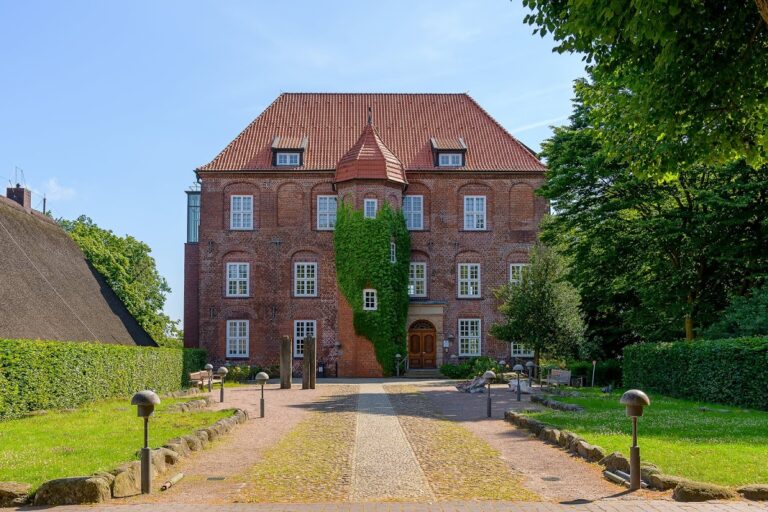
The former monastery church became the Lutheran parish church of Saint Vitus and now belongs to the Protestant Lutheran Church of Hanover. The surviving complex, including the church and former conventual building, is protected as a historic monument of Lower Saxony. The former conventual building houses the Kloster Zeven Museum.
Remains
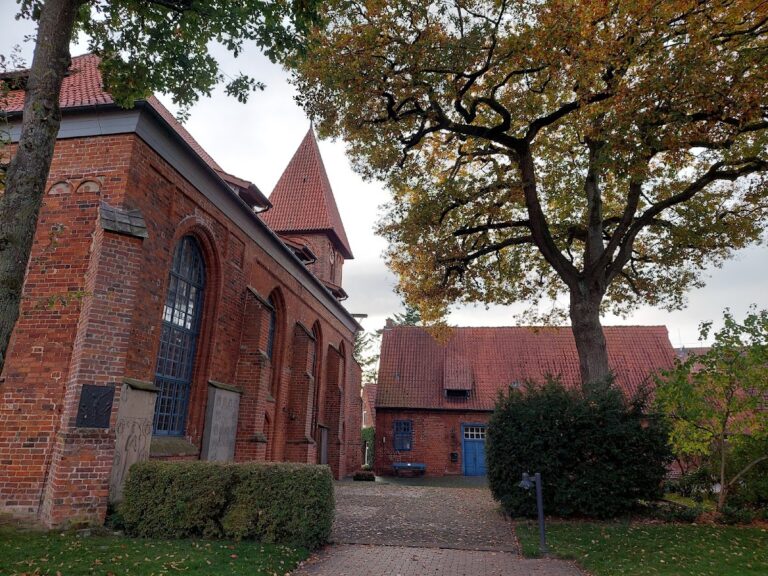
Kloster Zeven stood on the elevated right bank of the Mehde, about four kilometres from Heeslingen, near the present Zeven town park. The church and conventual buildings formed part of a larger monastery complex. The former monastery church survives as Saint Vitus Church, while only the west wing of the conventual buildings remains. A wooden bridge connects the surviving wing to the church across the north-south Klostergang passage.
The Heeslingen church
The earlier foundation at Heeslingen stood on a rise beside the Oste. Its surviving church was erected by Abbess Hathewich after 973. Built of fieldstone, it has a single nave, a broad apse, and a hall-like form that was vaulted during the Late Romanesque period. Its original round tower was demolished as unsafe at the end of the eighteenth century and replaced by a new tower in 1897.
The Romanesque monastery church
The church at Zeven was built around the middle of the twelfth century, probably between 1141 and 1158. Its fieldstone masonry and cruciform ground plan express the Romanesque architecture of medieval western Europe, a style characterized by substantial masonry, rounded arches, and clearly defined geometric forms.
The tower is square up to the eaves and changes to an octagonal shape above that level. A Baroque cupola, a domed crowning element associated with the Baroque period, completes its upper form. The ground floor originally contained the provost’s chapel. Above it was the nuns’ choir, connected by a passage to the upper floor of the surviving conventual building, known as the Old Chamber. The dormitory and the nuns’ cells were located in this part of the complex.
The church was threatened with demolition in 1867, but the Hanoverian consistorial architect Conrad Wilhelm Hase saved it. The Oldenburg architect L. Wege restored the building in 1872, when the entrance was moved from the south aisle into the tower.
Church furnishings and artistic remains
Inside the church is a monumental crucifix from the first half of the thirteenth century. Two funerary slabs date from around 1400, including one commemorating Provost Johannes Monik, who died in 1397. Remains of fifteenth-century wall paintings in the nuns’ choir show Christ with the wise and foolish virgins.
A baptismal font was cast in 1469 by Ghert Klinghe, a bronze founder from Bremen, on the commission of Provost Luder Bramstede. The church also retains a carved pulpit donated by Provost Ludolf von Varendorf in 1565, a somewhat later lectern with flat carving, a brass chandelier dated 1660, and an organ prospect made by Christian Vater in 1750. A sixteenth-century stone image of Saint Vitus, formerly mounted outdoors on a wall, is now kept inside the church.
The surviving conventual building
The conventual buildings adjoined the north side of the church in the twelfth century. The surviving west wing is built largely of rubble stone. Gaps and damaged areas in its masonry had been repaired with brick by about 1500. The building now contains the Kloster Zeven Museum, while its wooden bridge preserves a physical connection with the church across the Klostergang.
A separate building commissioned in 1585 by Provost Jodocus von Galen and Domina Anna von Wersabe contained the residences of the provost and prioress. It later served as Zeven’s administrative office before being demolished in 1840.
The monastery seal
The surviving convent seal from 1288 shows Mary seated with the infant Jesus on her lap. Saint Vitus stands beside her in a long robe, holding her left arm and carrying a palm branch in his right hand. The surrounding inscription reads “SIGILVM SCANTI VITI IN SZEVENA.” The image links the monastery’s institutional identity with its dedication to Saint Vitus.
Nearby sites