Ettal Abbey: A Benedictine Monastery and Pilgrimage Church in Germany


Site at a Glance
- Rating
- 4.7
- Popularity
- Low
- Country
- Germany
- Primary era
- Early Modern
- External website
- Open
- Eras represented
- Medieval, Early Modern, Modern
- Civilizations
- Holy Roman Empire
- Site type
- Religious
- Remains
- Monastery
On this page11 sections
History
Ettal Abbey is a Benedictine abbey in Ettal, Germany, founded by Emperor Ludwig the Bavarian on 28 April 1330. Built in the Gothic period, it stood in the strategically important Graswang Valley on routes linking Italy with Augsburg and Tyrol with Wittelsbach territories. The foundation served religious purposes, while improving the southern road and strengthening communications and trade may also have influenced its location.
Foundation and medieval development
Ludwig established Ettal after returning from Rome, fulfilling a vow made on the feast of Saint Vitalis of Milan. The foundation originally contained a double monastery, with separate male and female communities, and a commandery, an establishment of a military-religious order, for twelve Teutonic Knights and their wives under a commander. The emperor endowed the institution with villages, markets, and lands. The commandery disappeared in 1348, after which the monks continued to occupy the site.
A marble statue of the Madonna and Child brought by Ludwig from Pisa became the abbey’s main devotional object. Known as the Ettal Madonna or Frau Stifterin, and attributed to Giovanni Pisano, it helped make the monastery a pilgrimage destination. The church was dedicated to the Assumption of the Virgin Mary. After Ludwig’s death in 1347, his son Ludwig V withdrew many of the abbey’s donations, slowing construction. Abbot Konrad I Kummersprugger stabilized the monastery, and the church was consecrated in 1370.
Reform, conflict, and religious renewal
In 1442, Duke Albert III of Bavaria attempted to reform the monastery. The Melk monk Jean Schlitpacher abandoned the effort after ten months because of opposition from the abbot. In 1451, two visiting external abbots judged that the community had relaxed its strict observance of discipline and penance. The abbot then resigned.
Ideas associated with the Protestant Reformation reached Ettal through the busy routes nearby but did not permanently alter the monastery. Abbot Placidus I Gall later led a major renewal and came to be regarded as a second founder. Military conflicts nevertheless damaged the foundation. Troops under Maurice of Saxony inflicted serious damage in 1552, and Swedish detachments damaged the abbey in 1632 during the Thirty Years’ War, the prolonged European conflict that combined religious and dynastic struggles. The War of the Spanish Succession also affected Ettal, while the Catholic Reformation encouraged renewed pilgrimage.
During the War of the Spanish Succession, Elector Max II Emanuel transferred the Marian image to the court chapel on 12 April 1704. It was venerated there for ten days, then kept in several Munich churches before reaching Freising Cathedral on 30 June. The statue returned to Ettal in spring 1705.
Education and the eighteenth-century rebuilding
Ettal entered a period of prosperity under Abbot Placidus II Seitz, who took office in 1709. In 1710 he founded the Knights’ Academy, an aristocratic school for young noblemen. It educated students from several countries and combined theology, philosophy, singing, and scientific subjects with military and civil engineering, ballistics, fortification exercises, and live-fire training. The academy operated from 1711 until 1744.
The abbey also supported scholarly exchange by sending monks abroad for study, preparing them to teach at Ettal or at other universities. Ludwig Babenstuber, Romuald Dreyer, Karl Bader, Marzellin Reisch, and Magnus Knipfelsberger were associated with this teaching tradition. A fire in 1744 largely destroyed the church, monastery, and academy. The buildings were rebuilt in Baroque and Rococo forms, and the renewed complex became one of the most important Benedictine monasteries and pilgrimage centers in the Alpine region.
In 1790, the abbot and convent recovered full jurisdiction over the monastery district, including high criminal jurisdiction and the power to impose the death penalty. This authority ended with the secularization of Bavarian church property. On 21 March 1803, the Bavarian state dissolved Ettal Abbey despite strong opposition from Abbot Alphons Hafner. Its judicial district first passed to a provisional court at Murnau and was later divided between the courts of Weilheim and Schongau. Most of the former district became part of the Werdenfels court in 1827.
Suppression, restoration, and twentieth-century life
The buildings and estates passed to the Electorate of Palatinate-Bavaria. Josef von Elbling acquired the buildings in 1809, and Count Albert von Pappenheim bought them from Elbling’s grandson, August Baur Edler von Breitenfeld, in 1856. Baron Theodor von Cramer-Klett acquired the complex in 1898 and sold it at a loss to Scheyern Abbey in 1899 so that monastic life could be restored.
Benedictines returned on 6 August 1900. Ettal first operated as a priory of Scheyern and became an independent abbey again by 1907. Partially demolished buildings were reconstructed or renewed, with financial assistance from Cramer-Klett, although restoration of the entire ensemble continued until after the Second World War.
Abbot Willibald Wolfsteiner reorganized worship, revived Gregorian chant, built a college and boarding school, and helped renew the educational tradition associated with the Knights’ Academy. A secondary school opened in 1905, and the present Benedictine school developed a curriculum focused on the humanities and modern languages. Pope Benedict XV granted the abbey church the status of a minor basilica on 24 February 1920 through the apostolic letter Inter potiora. A minor basilica is a church given a special papal designation recognizing its religious and historical importance without making it a bishop’s seat.
War, political repression, and recent institutional history
From 1933 to 1945, authorities occupied the school and used it for National Socialist ideological instruction. During the winter of 1940–1941, the theologian Dietrich Bonhoeffer stayed at Ettal as a guest of the abbot and worked on his book Ethics. The priest Rupert Mayer was held under house arrest at the abbey from 1939 to 1945 to prevent further anti-Nazi preaching. Members of the Ettal community also took part in resistance activity against Hitler.
In 1993, Ettal re-founded the former Augustinian Canons’ monastery at Wechselburg in Saxony as a Benedictine priory. The abbey also maintains a Byzantine Institute. Abbot Johannes Maria Hoeck contributed to discussions about the role of patriarchs in church government at the Second Vatican Council.
In 2010, allegations of sexual abuse and severe mistreatment at the school and boarding school led Abbot Barnabas Bögle and school head Maurus Kraß to resign. The allegations involved religious and lay educators and mainly concerned abuse from the 1950s through the early 1980s. An independent study published in 2013 examined the extent of the abuse. Bögle was re-elected abbot in July 2010, and Kraß was later reinstated. In 2011, the abbey agreed to compensate 70 former pupils. Criminal proceedings continued through 2016, including a seven-year prison sentence for a former priest.
Girls were admitted to the boarding school from the 2016–17 school year. The boarding school closed at the end of the 2023–24 school year, while classroom teaching continued. In 2025, the Ettal Benedictines announced their withdrawal from Wechselburg. The abbey continues to operate religious, educational, agricultural, hospitality, brewing, distilling, publishing, and commercial activities, including a brewery, distillery, hotel, inns, bookstore, and art publisher.
Remains
The abbey church
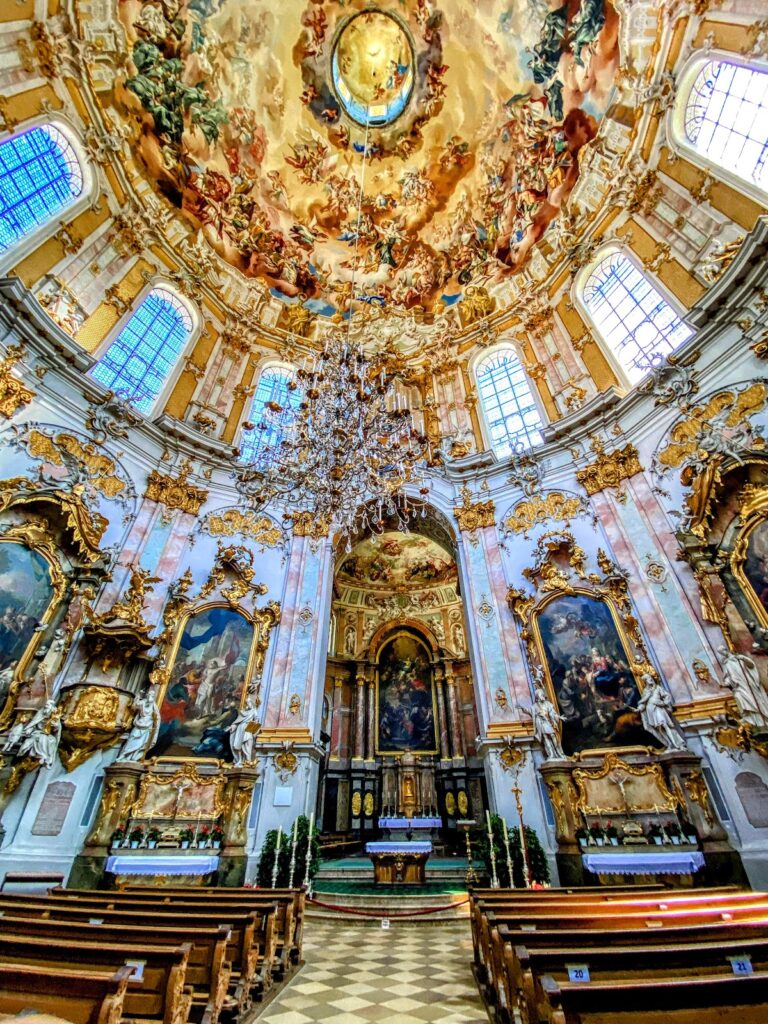
The church occupies the center of Ettal’s architectural ensemble and combines a medieval Gothic structure with Baroque and Rococo rebuilding. The original church, constructed between 1330 and 1370, followed a central dodecagonal plan. A steep pyramidal roof covered the building, while a double ambulatory surrounded its central space and a monks’ choir extended to the east. A column with an altar at its base supported the Marian statue, and a ribbed vault rose above it.
Enrico Zuccalli designed the eighteenth-century renewal, and the new main altar was consecrated in 1726. After the fire of 1744, the master mason Joseph Schmuzer of the Wessobrunn school rebuilt the church and monastery according to Zuccalli’s plans. The Wessobrunn school was a Bavarian tradition of Baroque stucco and architectural decoration. The reconstruction created a double-shelled dome, formed from two nested structural shells, while retaining important Gothic elements, including the bell tower and surviving portions of the medieval walls.
The rebuilt façade has one entrance, replacing the three entrances of the earlier arrangement. Its flanking towers were completed in stages in 1853 and 1906–1907, and niches contain statues of the apostles. Above the Gothic portal, the tympanum shows the founder and his second wife kneeling before the Crucifixion. Within the central dome, Jakob Zeiller painted the triumph of Saint Benedict.
Interior decoration and devotional features
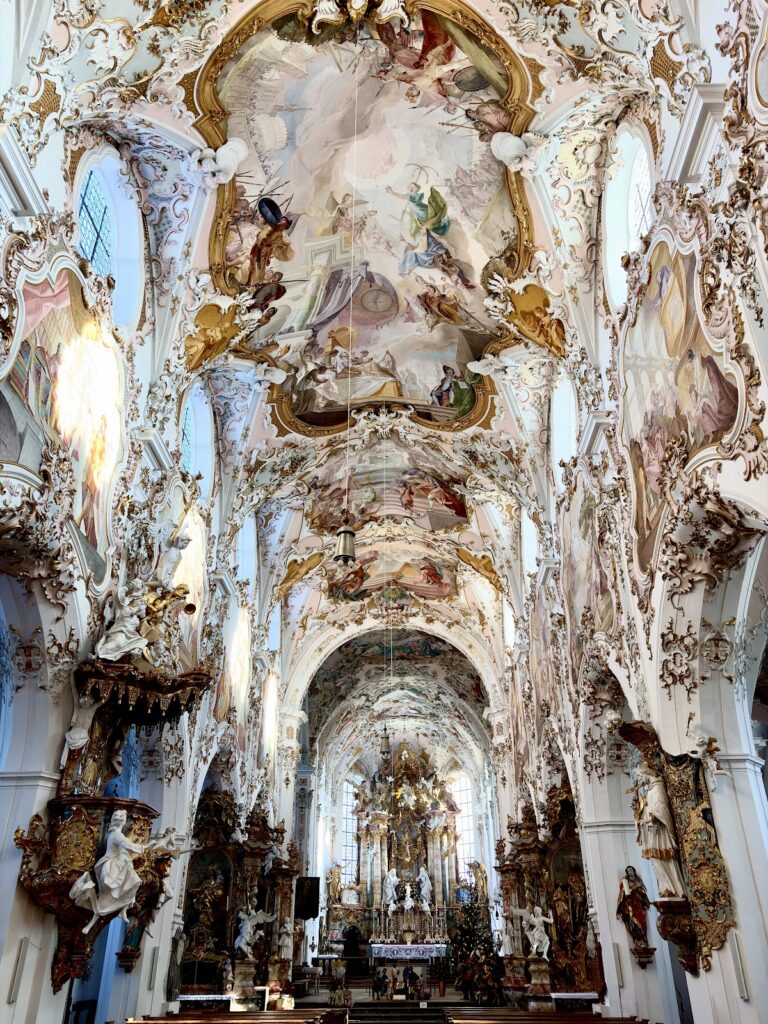
Inside, pilasters soften the angles of the twelve-sided structure and make the space appear more circular. Altars placed between groups of three pilasters create a strong vertical rhythm. Extensive stucco, putti, paintings above the altars, and a large shell motif incorporated into the organ case form the principal decorative elements. Joseph Schmuzer and his son-in-law Johann Georg Üblhör executed the stucco, while Üblhör also created the painted putti. Johann Baptist Straub made the side altars, pulpit, and other sculpture; Roman Anton Boos worked on the main altar. Paintings were supplied by Martin Knoller, Johann Jakob Zeiller, Franz Georg Hermann, and Thomas Schäffer. The decoration reflects the eighteenth-century movement from Rococo toward Classicism.
The sacristy is Baroque in style. Wolfgang of Munich painted the Gothic ambulatory in 1411, and it serves as the burial place of the monks. The marble Madonna and Child from Pisa remains associated with the foundation and the pilgrimage tradition that developed around the abbey church.
Convent and Western Monastery Courtyard
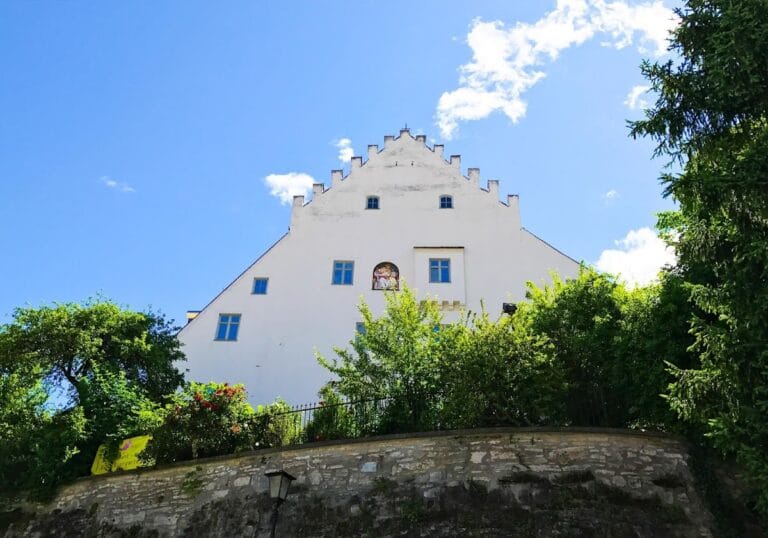
The convent buildings adjoin the church on the southeast. They form a three- to four-storey complex of four wings in Baroque forms, originally built in 1714 to designs by Enrico Zuccalli. Max Ostenrieder rebuilt and altered the buildings in 1904. They house the monastic community and form part of an ensemble that also accommodates agricultural, hospitality, brewing, distilling, publishing, and educational activities.
West of the church lies the Western Monastery Courtyard, enclosed by a two- to three-storey, four-wing Baroque complex originally built in 1753. Its north and west wings contain the boarding school, while the south wing contains the Benedictine secondary school. The courtyard buildings were rebuilt in 1912. The last section demolished after secularization was reconstructed between 1972 and 1976.
Gedächtniskapelle
The Gedächtniskapelle, also called the Winter Church, is a separate chapel built in 1998 by the architects Claus and Forster with the participation of the glass artist Florian Lechner. Its position beyond the main visitor flows reflects the large number of people drawn to the abbey church. The chapel forms a later architectural addition to the medieval and eighteenth-century complex.