Royal Monastery of Santa María de Sigena: A Royal Hospitaller Monastery in Spain


Site at a Glance
- Rating
- 4.1
- Popularity
- Low
- Country
- Spain
- Primary era
- Medieval
- External website
- Open
- Eras represented
- Medieval, Early Modern
- Civilizations
- Crown of Aragon, Knights Hospitaller
- Site type
- Religious
- Remains
- Monastery
On this page10 sections
History
The Royal Monastery of Santa María de Sigena is a Roman Catholic monastery in Villanueva de Sigena, Spain, founded in the medieval Christian period for the Hospitaller nuns of the Order of Saint John of Jerusalem. Construction began around 1183, and Sancha of Castile, queen consort of Alfonso II of Aragon, founded and consecrated the monastery in 1188. Bishop Richard of Huesca formulated its rule, and a second consecration took place in 1258. The monastery became a royal religious foundation and later a burial place for members of the Aragonese royal family.
Foundation and early community
Before Sigena was founded, the churches of Sigena and Sena were associated with the Templars of the Monzón commandery and with the Hospitallers, a medieval religious and military order that operated monasteries and commanderies. The Hospitallers had received the two settlements from Raymond Berengar IV of Barcelona in 1157. In 1184, Sancha exchanged Santalecina Castle and town, together with rights at Pueyo de Monzón, for the Hospitaller rights over the two churches.
Sigena was established as a double monastery, meaning that communities of women and men belonged to the same institutional foundation. Authority rested from the beginning with a female prioress. The women’s community included cloistered nuns, known as sorores or domne, girls housed and educated by the nuns, and media cruz, obedient nuns and community servants. Many early members came from the Aragonese royal family and the highest aristocratic lineages. The prioresses recorded before 1292 were Ozenda of Lizana, Urraca of Entenza, Toda Ortiz, Elisenda of Querol, and Inés of Benavente.
Sancha probably entered Sigena after Alfonso II’s death in 1196, accompanied by their daughter Dulce. She died in 1208 and was buried at the monastery rather than at Poblet, where Alfonso II was buried. Her presence strengthened Sigena’s connection with the Aragonese court and established the foundation as a dynastic institution.
Royal pantheon and fourteenth-century prosperity
After Peter II of Aragon, Sancha’s son, died at the Battle of Muret on 12 September 1213, his sisters among the Sigena nuns petitioned the pope for the return of his remains. His reburial at Sigena in 1217 made the monastery a royal pantheon. Sancha of Castile, Peter II, the infanta Dulce, and the countess Leonor of Aragon were all buried there.
After Sancha’s death, the monastery passed through a period of crisis and decline. Its situation improved when James I of Aragon placed it under royal protection. James II renewed that protection in 1298, beginning a new period of prosperity. Teresa Jiménez of Urrea served as prioress from 1292 to 1321, followed by Blanca of Aragon, daughter of James II, who remained prioress until her death in 1348. Blanca’s widowed sister María later took religious vows and withdrew to Sigena.
During Blanca’s prioressship, the monastery became a stopping place for the Aragonese court. It acquired tapestries, altarpieces, paintings, furniture, and other works of art, while the Painted Room, also called the Throne Room, was arranged. The monastery’s religious, dynastic, and artistic functions were closely connected during this period.
Political change and early-modern decline
During the Aragonese interregnum before the Compromise of Caspe in 1412, the prioress and nuns supported James II of Urgell. After his defeat and the accession of Ferdinand I of Aragon from the Trastámara dynasty, the new ruling house neglected Sigena. The monastery later served as a prison for James of Urgell’s wife and daughters.
Monastic life continued through the sixteenth and seventeenth centuries. In 1588, the Libro Consueta, or Third Rule, was approved as a new adaptation of Richard of Huesca’s rule. It retained the requirement of limpieza de sangre, or “purity of blood,” an admission rule intended to exclude candidates considered to have disqualifying Jewish or Muslim ancestry. Communal life declined and disappeared during the seventeenth and eighteenth centuries, and Sigena ceased to function as a royal archive or court.
Confiscation, destruction, and restoration
The ecclesiastical confiscation of the mid-1830s deprived the monastery of most of its property and revenues. The community was forced to leave the buildings temporarily, although the nuns returned several years later when reconstruction work began.
In August 1936, during the Spanish Civil War, anti-clerical anarchist militiamen burned and partly destroyed the monastery. The Romanesque church and royal pantheon survived, but many works of art were destroyed or looted, and the royal tombs were desecrated. The chapter-house paintings were removed for protection that year and transferred to the National Art Museum of Catalonia in Barcelona.
Restoration and reconstruction of the church, refectory, chapter house, and cloister began in 1950. The cloister was reconstructed in 1974 under the direction of Chueca Goitia. The Hospitaller nuns left at the beginning of the 1980s. In 1985, a community from the Monastic Family of Bethlehem, the Assumption of the Virgin, and Saint Bruno took over the monastery; it left on 21 July 2020.
Archives and contested artworks
The surviving archival documents entered the Provincial Historical Archive of Huesca in 1941. The collection contains parchments, books, and files dating from 1173 to 1923, including privileges, wills, notarial deeds, sales, donations, and records of the nuns’ daily life. It also includes seventeenth- and eighteenth-century investigations into blood purity required of prospective nuns, together with books describing documents that no longer survive. Documents belonging to the kings of Aragon were held at Sigena from the reign of James I until 1308, when they were transferred to the Hospitaller monastery of Saint John of Jerusalem in Barcelona.
Sigena was declared an Asset of Cultural Interest in Spain on 28 March 1923, and its protection by the autonomous community of Aragon was confirmed by an order in 2002. The sale of monastery artworks by the Order of Malta to the Government of Catalonia later produced a long-running dispute with the Government of Aragon. The transactions included 44 pieces sold in 1982 and 52 pieces sold in 1992 and 1995. The contested works included items regarded as legally acquired, items acquired without allowing Aragon to exercise a right of first refusal, and objects held on deposit that remained the property of the order.
In a constitutional case arising from measures proposed by Aragon in 1998, the Constitutional Court ruled in favor of Catalonia and declared those measures unconstitutional and void, while leaving the legality of the sales and the classification of the objects unresolved. In April 2015, the Huesca Court of First Instance No. 1 declared the sales void and ordered the artistic treasury to be returned. Later court orders required the return of 97 works. Fifty-three pieces were transferred on 26 July 2016, while 44 remained in Lleida. After a government order issued following the application of Article 155 in Catalonia, the remaining works were transferred from Lleida to Sigena under judicial authority on 11 December 2017. The chapter-house murals remained in the National Art Museum of Catalonia, while other works were returned or transferred from Catalan museums to Aragon.
Remains
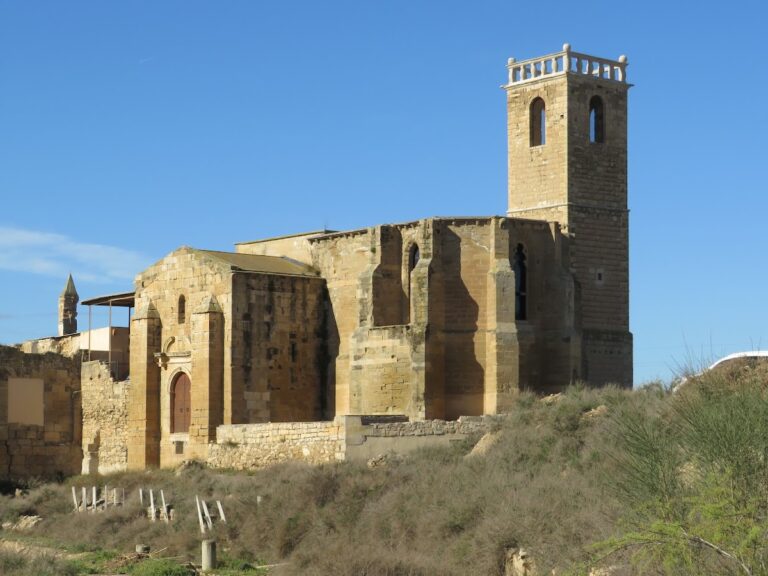
The surviving medieval complex is organized around the church and ancillary monastic buildings. The monastery square contains the guesthouse, the ruins of the prioress’s palace, and the church. The complex also preserves a twelfth-century signal tower, a solid rectangular stone tower from the former fortifications, the cloister, the former refectory, parts of the nuns’ dormitories, and the chapter house.
Church and royal tombs
The Romanesque church has a Latin-cross plan, with a single nave, a broad transept, and three apsidal chapels at the east end. Pointed barrel vaults carried on transverse arches cover the roofs, while the crossing has a ribbed vault. Cistercian and Mudéjar influences appear particularly in the roofing and windows. The Romanesque entrance portal has fourteen archivolts, bands of moulding that follow the curve of an arch, and an empty arcosolium, an arched recess often associated with a tomb, stands beside it.
The exterior of the apse includes the central apse, the apse on the Epistle side, and the outside of the nuns’ eighteenth-century pantheon. The interior is now largely empty, although fragments of the wall paintings that once decorated it survive. The choir occupies the final three bays of the church body. A monumental Baroque partition once separated it from the rest of the church, and its present arrangement is reversed.
The Romanesque royal pantheon occupies the left side of the transept. Its sandstone tombs belong to Sancha of Castile, Peter II of Aragon, the infanta Dulce, and the countess Leonor of Aragon. The tombs of Sancha and Peter remain among the principal artworks associated with the church.
Monastic buildings
The cloister is the most ruined part of the complex. Its present form derives from the 1974 reconstruction. The wing parallel to the church survives, together with half of the wing leading to the chapter house. The former refectory now serves as the community chapel, while remains of the nuns’ dormitories and the prioress’s palace survive elsewhere in the complex.
The chapter house formerly held a major cycle of Romanesque wall paintings dating approximately from 1196 to 1208. The paintings were made by an international group of artists, many associated with England. Some may have been connected with artists of the Winchester Bible, and their style also shows possible influence from the mosaics of Palermo. Their damaged surviving sections have lost much of their color and are preserved in the National Art Museum of Catalonia in Barcelona. The paintings were fully photographed in black and white shortly before their removal in 1936.
Painted and movable heritage
The Altarpiece of the Virgin is a tempera-on-panel work made between 1367 and 1381 by an anonymous master sometimes identified as Pere Serra or Jaume Serra. It shows the crowned Virgin and Child with Saint Catherine of Alexandria and Mary Magdalene. Scenes around them represent the Virgin’s seven joys and episodes from the Gospels and Acts of the Apostles, while the predella, the lower section of an altarpiece, depicts the Last Supper and miracles. The work is preserved in the National Art Museum of Catalonia and was probably commissioned by Fontaner of Glera, commander of the monastery after 1363, from the Serra brothers.
The early sixteenth-century Master of Sigena produced a large altarpiece for the church between 1510 and 1521. Associated panels include the Presentation of the Virgin in the Temple, the Nativity and Adoration of the Angels, Jesus among the Doctors of the Law, Jesus before Herod, Saint Augustine, Saint Ambrose, Saint Paul, and Saint Peter. These panels are now dispersed among museums in Toledo, Madrid, Barcelona, Zaragoza, and Lleida. The former throne of the prioress is held by the Diocesan and Comarcal Museum of Lleida.
The monastery once contained extensive mural paintings, furniture, and other works of art. Much of this material was lost through abandonment, neglect, destruction, looting, and the wartime dispersal of the collection. The surviving church, royal tombs, monastic buildings, archival records, and dispersed artworks together preserve the institution’s development from a royal Hospitaller foundation into a monument shaped by repeated political and material upheaval.
Nearby sites