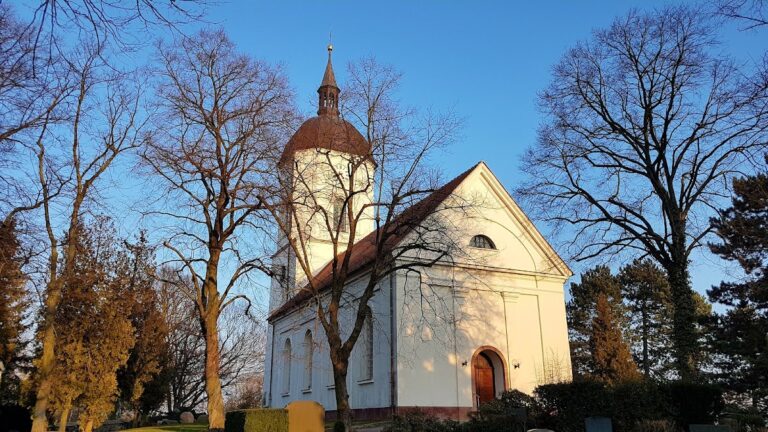
Russian Orthodox Memorial Church: Leipzig’s Memorial to the Battle of the Nations


Site at a Glance
- Rating
- 4.5
- Popularity
- Low
- Country
- Germany
- Primary era
- Modern
- External website
- Open
- Eras represented
- Modern
- Civilizations
- Russian
- Site type
- Religious
- Remains
- Church
On this page13 sections
History
The Russian Orthodox Memorial Church in Leipzig, Germany, commemorates the Russian forces who fought and died in the 1813 Battle of Leipzig, also known as the Battle of the Nations. Built by the Russian Empire in 1912–1913 in the Neo-Russian manner, the church recalls approximately 127,000 Russian troops who served in the battle, including about 22,000 who died. The engagement was a major confrontation in the War of the Sixth Coalition, in which Russia, Austria, Prussia, and Sweden fought Napoleon’s forces and ended French dominance east of the Rhine.
Orthodox worship in Leipzig
Leipzig had Russian and Greek Orthodox places of worship before the memorial church was built. A Greek household Trinity Church was recorded in 1744, and a separate household church for Russian students operated from 1751 until its closure in 1775 or 1776. Orthodox worship then continued in a Greek church under Russian protection. In 1847, the Greek consul established another household Trinity Church.
The later memorial church was initially intended to share clergy with the Russian church in Dresden. In 1914, it was placed under the Russian military department and the chief priest of the Russian military and naval clergy, while remaining canonically subordinate to the Metropolitan of Saint Petersburg. Its legal ownership belonged to the Russian Ministry of War. A law passed in 1914 provided for annual state funding, although implementation was postponed until 1917.
Foundation and consecration
The church stands on a 2.5-hectare plot provided by Leipzig at the southeastern edge of the former battlefield. Donations for its construction were collected in Russia and Germany from 1907. A building committee was formed on April 21, 1910, under Grand Duke Michael Alexandrovich, and preparatory work began in 1911.
The foundation stone was ceremonially laid on December 28, 1912. The church was consecrated on October 17, 1913, the centenary of the battle. Protopresbyter Georgy Shavelsky of the Russian military and naval clergy conducted the ceremony, which was attended by Russian, German, Saxon, and other allied military and political representatives. Those present included Grand Duke Kirill Vladimirovich, King Frederick Augustus III of Saxony, and Kaiser Wilhelm II.
On October 16, 1913, the remains of Russian soldiers killed in the Battle of Leipzig were ceremonially transferred to the church crypt. The memorial was intended to preserve the battlefield as a place of remembrance, linking the new building to the military dead buried within and around it.
War, jurisdiction, and restoration
With the outbreak of the First World War, the church was closed as an institution associated with an enemy state. Its entrance was walled up, the building was looted twice, and the gilding was removed from its domes. It was later transferred to a private owner, who rented it out. A crack in the structure prompted urgent repairs, and the lower part was adapted for worship as the Chapel of Saint Panteleimon. The lower church was consecrated in 1927, and the upper church followed on February 6, 1928. Although demolition was considered in 1927, the church remained in use.
From 1927 to 1930, the church was administered by the authority responsible for Russian parishes in Western Europe. After Metropolitan Eulogius transferred his allegiance to the Ecumenical Patriarchate of Constantinople, the parish followed him into the Western European Exarchate of Russian Parishes. An exarchate is an ecclesiastical district governed on behalf of a higher-ranking patriarch or church authority. In 1939, pressure from the Nazi authorities led to the transfer of the parish and its property to the Berlin and German Diocese of the Russian Orthodox Church Outside Russia, an ecclesiastical jurisdiction formed by Russian émigré communities outside Soviet control. The parish returned to the jurisdiction of the Russian Orthodox Church in 1945.
During the bombing of Leipzig in the Second World War, local residents sheltered in the church’s lower rooms. After the Soviet occupation of Leipzig in 1945, Soviet authorities financed urgent repairs following Marshal Georgy Zhukov’s visit. A plaque installed at that time broadened the memorial’s purpose to include Russian soldiers who died in struggles for freedom and independence between 1813 and 1945.
Repairs and restoration took place in 1923, 1963, 1978, 1981, and 1989. The 1963 work included new gilding for the domes, while the 1981 intervention left the building fully restored. Soviet military personnel stationed in East Germany were permitted to worship there because of the church’s historical status. Structural work began in 2012 ahead of the centenary, followed by restoration of the dome covering and other parts of the building. The icon wall was restored in 2018.
The church remains an active Russian Orthodox place of worship under the Berlin and German Diocese and its Eastern Deanery. Its congregation includes people of Russian, Ukrainian, Belarusian, Bulgarian, and German backgrounds. Membership is approximately 300, with about 100 worshippers attending weekly. The church was vandalized in May 2000, when anti-Russian inscriptions and fascist symbols were placed on its exterior walls. Its liturgical feast is commemorated on the Sunday after October 18.
Remains
The Russian Orthodox Memorial Church occupies the edge of the former battlefield and rises 55 metres above its 2.5-hectare site. Designed by Vladimir Pokrovsky, with construction supervised by him and assisted by the Saxon architects Georg Weidenbach and Richard Tschammer, it was built chiefly of brick in 1912–1913. Its Neo-Russian design imitates Russian stone tent-roof churches of the sixteenth and seventeenth centuries, using the Ascension Church at Kolomenskoye as its principal model.
Form and exterior
The plan develops from a square base into an octagonal level and then a sixteen-sided upper form. Unlike many Russian churches with one central tower and four subsidiary towers, this building has one principal tower. White plastered walls, corner pilasters, and narrow, tall windows define the exterior.
The upper structure ends in a reinforced-concrete tent clad in Venetian glass mosaic. A gilded onion dome and cross crown the building, with the cross suspended by chains. The church is encircled by an ambulatory gallery with eight tall, faceted lanterns that symbolize funeral candles. Eight bells, cast at the Olovyanishnikov factory in Yaroslavl, were made from cannon metal associated with the battles of 1813.
Entrance and upper church
Entrance features
A two-flight staircase leads to the upper church. The entrance is framed by a perspective portal of light sandstone and surmounted by a belfry with a small cupola. Above the forged entrance doors, a mosaic represents the Mandylion, or Image Not Made by Hands, and is framed by gilded figures of flying angels.
Worship space
The upper church is dedicated to Saint Alexius, Metropolitan of Moscow, a fourteenth-century church leader who served from 1354 to 1378 and was venerated as a saint from the fifteenth century. The interior rises 39 metres and accommodates approximately 200 people. It is finished in light tones, while the apse mosaic depicts Christ Pantocrator. The mosaic was made from designs by N. P. Pashkov in Vladimir Frolov’s private workshop. A bronze plaque describing the church’s history is placed below it.
Iconostasis and furnishings
The seven-tier iconostasis, the icon-bearing screen separating the sanctuary from the main worship space, is made of dark oak and rises 18 metres. The I. P. Khlebnikov partnership produced it, and the Don Cossacks donated it. N. S. Yemelyanov painted its 78 icons in a seventeenth-century style with assistance from A. I. Antonov and D. V. Golikov. Semiprecious stone, silver, and other metals decorate the icons.
The Artistic Carpentry Workshop of the Moscow Provincial Zemstvo in Sergiev Posad made the wooden parts of the iconostasis, the choir stalls, and other furniture under V. I. Sokolov and I. P. Zaitsev. A large carved case contains an image of Saint George the Victorious, donated by the Orenburg Cossacks. The altar image, The Prayer in the Garden, was painted by D. F. Bogoslovsky as a copy of a work by Fyodor Bruni. Cossack battle standards shape the processional banners, and the floor is formed from pieces of white and black marble.
A five-tier bronze panikadilo, a large suspended Orthodox church chandelier, weighs approximately 800 kilograms and carries 72 lamps. Its mother-of-pearl lamp bowls were made from smalt in V. A. Frolov’s workshop. State Duma deputies and Moscow merchants donated the chandelier. Eight bronze tablets on the walls list the regiments and military units that took part in the Battle of Leipzig.
Lower church and memorial spaces
Chapel and parish rooms
The lower church occupies space originally intended for a museum and is dedicated to Saint Panteleimon. It contains historic Russian banners and is also used for services. The lower floor includes a small museum, a parish hall, and a parish library holding more than 700 books in Russian and German.
Crypt and commemorative records
A crypt beside the lower church contains the burials of Lieutenant General I. E. Shevich, Major General N. D. Kudashev, Lieutenant Colonel A. Yurgenew, and unidentified soldiers placed in wall niches. Above the graves, a small icon case holds an icon of the Resurrection of Christ. Banners and portraits of battle heroes, Emperor Alexander I, and Mikhail Kutuzov flank it.
Twenty stone tablets in the lower gallery list the regiments that participated in the battle, the names of officers who died, and the number of soldiers killed. Two marble tablets at the entrance, written in Russian and German, give the number of fallen. On the eastern side of the church, the grave of two unidentified grenadiers of the Chernigov Regiment commemorates men whose remains were transferred from the battlefield in 1988. A memorial stone for Bashkir soldiers was installed in front of the church in 2003.