St. George’s Convent: A Medieval Benedictine Foundation at Prague Castle


Site at a Glance
- Rating
- 4.2
- Popularity
- Very Low
- Country
- Czechia
- Primary era
- Medieval
- External website
- Open
- Eras represented
- Medieval, Early Modern
- Civilizations
- Duchy of Bohemia, Holy Roman Empire, Kingdom of Bohemia
- Site type
- Religious
- Remains
- Monastery
On this page20 sections
History
St. George’s Convent in Czechia is a former Benedictine convent for women at Prague Castle in Prague, founded in the late tenth century during the medieval formation of Bohemia. Usually dated to 976, although dates of 973 or 974 are also proposed, it was the first female Benedictine convent in Bohemia and remained active until its suppression on 7 March 1782.
Foundation beside St. George’s Basilica
The foundation followed Mlada’s diplomatic journey to Rome, where she is said to have obtained papal permission to establish the convent and to have returned with consecrated women. Mlada, a daughter of Duke Boleslav I and sister of Duke Boleslav II, became the community’s first abbess after taking the religious name Maria. Boleslav II was regarded as the convent’s founder. The precise composition of the first community, and the reasons why Bohemia’s oldest monastery was established for women, remain uncertain.
The convent was created beside St. George’s Basilica, a princely church founded shortly beforehand. Its first basilica had been begun by Duke Vratislav I before his death in 921 and completed by his son Wenceslaus. In 925, Wenceslaus arranged the burial of his grandmother Ludmila there, after which the church was consecrated. Ludmila was an early Christian Bohemian noblewoman who became a major dynastic saint. Her burial made the basilica and convent a center of her cult and pilgrimage.
A college of priests attached to the basilica formed an important ecclesiastical center before the establishment of the Prague bishopric. It continued to provide pastoral and sacramental services for the nuns and other worshippers, with particular attention to masses for the dead. In its early period, the convent also served as a burial place for members of the Přemyslid dynasty, the ruling house of medieval Bohemia. These burials were later transferred to St. Vitus Cathedral.
As a princely foundation, St. George’s Convent had an unusually close connection with the ruling dynasty. The ruler retained supervisory rights over the convent and its property, which strengthened the institution’s position while limiting its complete independence. Women of the Přemyslid family frequently became abbesses, although the abbesses themselves administered the church, community, convent property, and associated estates. In 1302, for example, Abbess Sophie resigned in favor of Kunigunda.
Growth, rebuilding, and religious culture
The convent suffered a major crisis during the siege of Prague Castle in 1142, when fire badly damaged the church and convent buildings. The nuns fled, probably to the Church of St. John the Baptist below Petřín. Reconstruction under Abbess Berta between 1145 and 1151 was so extensive that she was remembered as the convent’s second founder, or secunda fundatrix. The rebuilding created a durable Romanesque form for the complex and included new convent buildings.
The community was active in both worship and artistic production. In 1151, its nuns embroidered liturgical vestments at the request of Bishop Jindřich Zdík, who intended them as a gift for Pope Eugene III. By the end of the twelfth century, the convent also staged Easter dramatic plays. The abbess and nuns performed the female roles, while priests, deacons, and subdeacons performed the male roles. During the same century, St. George’s sent a founding community to Teplice, extending its institutional influence.
Abbess Agnes, a daughter of King Vladislaus II, led the convent from 1200 to 1228. She directed restoration and construction work and was associated with the establishment of the St. Ludmila Chapel. Her period also encouraged the convent’s intellectual and architectural development. Around 1294, a scriptorium, a workshop or institutional center for copying and producing manuscripts, was probably established. Manuscript production and smaller literary works, however, had already been connected with the convent from the second half of the twelfth century.
Under Abbess Sophie, probably a Czech native, Czech scribes may have been brought to the convent. Common prayer texts were translated into Czech, including the Psalms, and the writing or recording of the work known as Kunigunda’s Song is associated with this period. The convent therefore served not only as a place of religious observance but also as a center for literary activity and the transmission of religious texts.
Kunigunda and the convent’s political power
The convent reached its most important cultural period under Abbess Kunigunda, who succeeded Sophie after her resignation in 1302 and remained in office until her death on 26 November 1321. Born around 1265 to King Přemysl Otakar II and Kunigunda of Hungary, Kunigunda had entered a Poor Clare convent in Prague in 1277. She married Duke Boleslav II of Masovia in 1291, returned to the Prague court late in the thirteenth century, took permanent vows on 22 July 1302, and became abbess later that year.
Kunigunda created favorable conditions for manuscript production, and most of the convent’s surviving literary output was produced during her tenure. The scriptorium made breviaries, antiphonaries, and religious writings concerned with the Passion of Christ and devotion to the Virgin Mary. Its influence continued into the fourteenth century, before the Hussite Wars, the religious and political conflicts in fifteenth-century Bohemia associated with the followers of Jan Hus.
Kunigunda also secured privileges and charters that reinforced the convent’s property and legal position. Income from pilgrimage helped pay for richly decorated works of art. Before the Hussite Wars, St. George’s was one of Bohemia’s wealthiest institutions, with extensive landed property and the character of an autonomous political and economic center. Around 1400, approximately fifty nuns, including women who had not yet taken final vows, lived there.
Emperor Charles IV strengthened the convent’s exceptional position in order to continue the Přemyslid tradition. Through the Golden Bull, a formal imperial charter, he confirmed the abbess’s rights, granted her the title of princess-abbess, and gave her the right to accompany the future queen at her coronation. The abbess also exercised judicial authority in districts subject to the convent, including Újezd and the area around the Church of the Holy Spirit. She received income from house rents, court fees, and other payments. Charles IV further promoted Ludmila’s cult through gifts and supported the convent’s patronage of goldsmiths’ work and illuminated manuscripts.
Hussite disruption and later rebuilding
The Hussite Wars brought a decisive break. The convent was plundered, the nuns were forced to flee, and its property was sold after Abbess Kunigunda of Kolowrat, who held office from 1386 to 1401, refused to sign the Basel Compactata. These agreements were intended to settle religious disputes between the Hussite movement and the Catholic Church.
A second Prague Benedictine foundation, the Convent of the Holy Spirit and Divine Mercy, had been established around the middle of the fourteenth century. Its direct influence on St. George’s cannot be established from contemporary evidence, but after the Hussite Wars it was transferred to the reform party and gradually declined. During the second half of the sixteenth century, its administration, archive, and library passed to St. George’s, probably at the request of Abbess Judith Eibenstoler of Eibenstol, who led the convent from 1567 to 1600.
The royal court supported attempts to restore St. George’s during the sixteenth century, but a fire in 1541 destroyed most of the buildings. Prolonged repairs gave the surviving complex its Renaissance appearance, and part of it was arranged as an armory. Abbess Sophie von Helfenburg established a large nuns’ choir between 1608 and 1612. During her tenure, the library was revised and many older books received new Baroque bindings, a process that sometimes damaged their texts and painted decoration.
After 1650, the armory was returned to the convent. A major early Baroque rebuilding began in 1657 and continued, with interruptions, until 1680. Abbess Anna Mechtildis Schönweissová of Eckstein, who led the community from 1671 to 1691, promoted the enlargement of the complex and the repair of its towers and western facade. At the request of Abbess Helena Pieroni da Gagliano, the scholar Johann Florian Hammerschmidt wrote the only relatively complete early history of the convent in 1715.
Suppression and modern use
Emperor Joseph II suppressed the convent by imperial decree on 7 March 1782 as part of his reform program. Public opposition and petitions from Prague residents did not prevent the buildings from being transferred to military ownership. Barracks were installed in the complex, and the abbess’s right to crown the Queen of Bohemia passed to the head of the nearby Theresian Institution of Noble Ladies, a Habsburg foundation for aristocratic women.
Interest in the convent and its history increased during the second half of the nineteenth century, followed by gradual reconstruction. From 1969 to 1975, the interiors were adapted for National Gallery exhibitions according to designs by architect František Cubr. The medieval-art exhibition later moved to the Convent of St. Agnes, while the nineteenth-century-art exhibition closed in 2012 because of the building’s poor condition.
Under a property-settlement agreement signed on 4 March 2016, the former convent passed from the administration of Prague Castle to church ownership and is administered by the Prague archbishopric. As of 2025, the building is described as empty and hazardous, with extensive reconstruction planned. Its spaces have also been used for occasional church exhibitions.
Remains
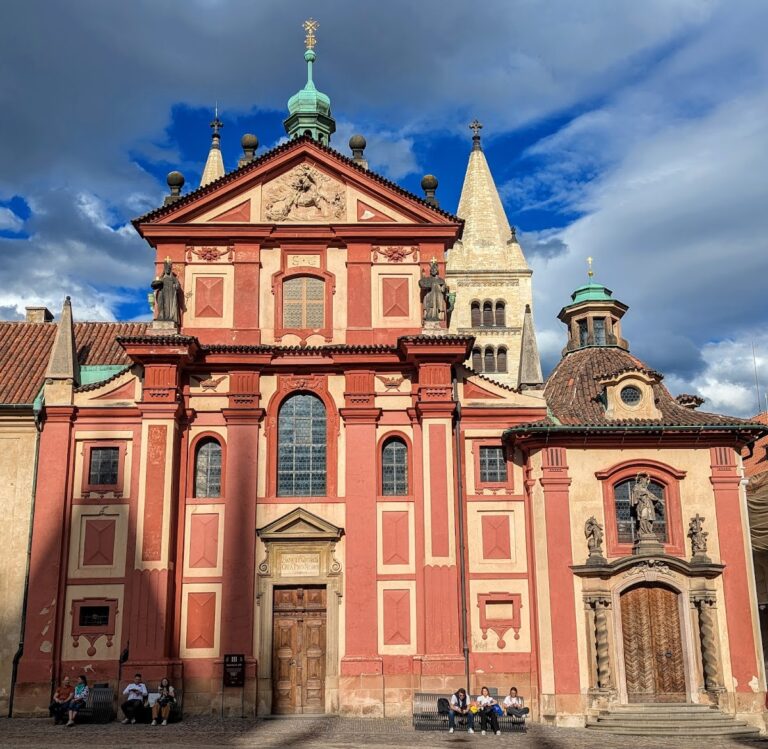
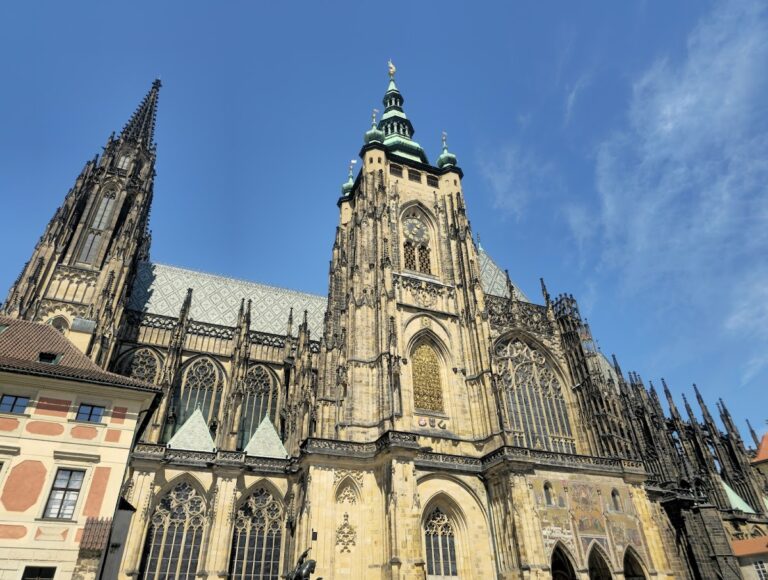
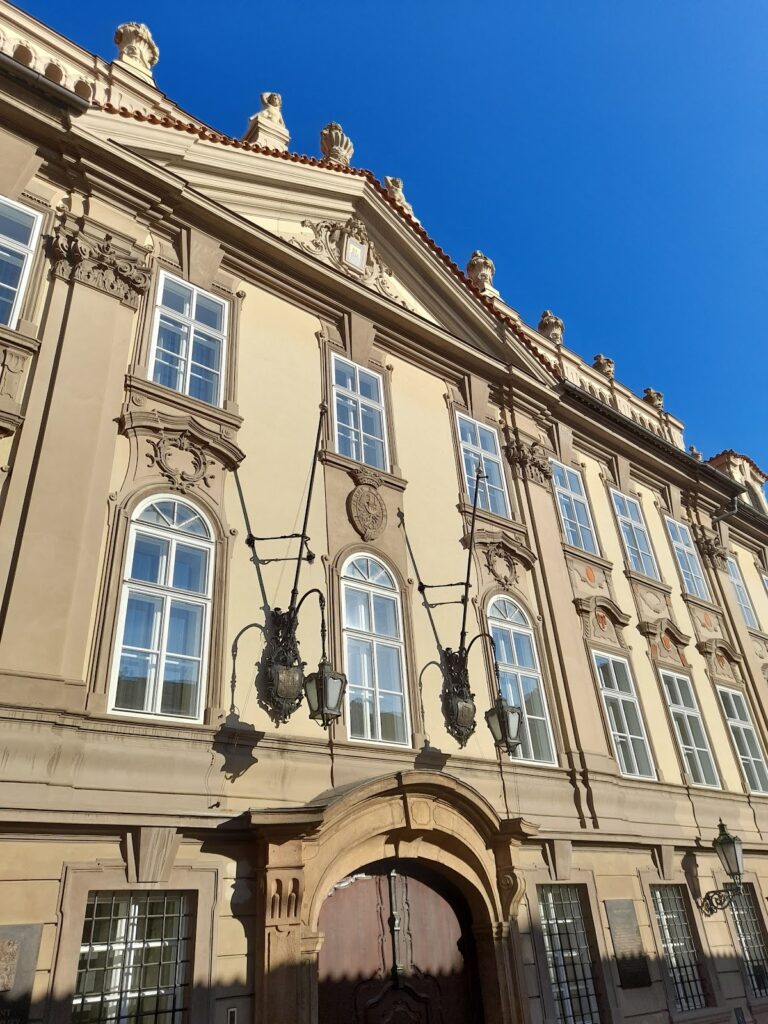
St. George’s Convent occupies the central part of Prague Castle beside St. George’s Basilica and behind St. Vitus Cathedral. The complex includes a front courtyard and a second, larger courtyard. Its surviving form combines the Romanesque rebuilding that followed the fire of 1142, Renaissance repairs after the fire of 1541, and the early Baroque reconstruction of 1657 to 1680.
Basilica and medieval architectural features
St. George’s Basilica
The basilica became the convent church after the foundation of the nunnery. Its original three-aisled structure was altered with apses, a western choir, galleries for the nuns, and an underground crypt used for relics. The rebuilding of 1145 to 1151 added two tall white towers, which remain the defining feature of the complex’s silhouette. Large wall paintings probably belong to this period, although only fragments of the decoration survive.
Agnes’s passage and sculpted tympanum
During Abbess Agnes’s tenure, an arcade addition or passage formed part of a communication system linking St. Vitus Basilica, St. George’s Basilica, and a one-aisled Romanesque church whose remains lie beneath the paving of Prague Castle’s third courtyard. Its purpose is uncertain. It may have enabled the nuns to attend services at St. Vitus or provided members of the ruling dynasty with private access to worship at St. George’s.
A tympanum, the decorated field above a doorway, is associated with Agnes’s building campaign. It depicts the enthroned Virgin Mary with the infant Jesus on her lap. Four figures kneel at her feet, including one identified as the abbess herself.
St. Ludmila Chapel
The St. Ludmila Chapel was established under Abbess Agnes and rebuilt in its present Gothic form between 1364 and 1378 under Abbess Elizabeth. Archbishop Jan Očko of Vlašim consecrated its altar in 1371. The chapel reflects the continuing place of Ludmila’s memory within the convent’s religious and dynastic traditions.
Southern portal
A Renaissance portal dating from around 1515 stands above the southern entrance of the basilica. Its sculpture shows St. George killing a dragon. The subject refers to the Christian saint traditionally represented as a mounted warrior defeating a dragon and gives the entrance a direct visual association with the basilica’s dedication.
Convent buildings and later chapels
Romanesque convent complex
The first convent building was erected on the north side of the basilica. After the fire of 1142, additional structures, including a long dormitory, were built or rebuilt during the extensive campaign of 1145 to 1151. Later repairs by Abbess Sophie of Pětichvost between 1328 and 1345 altered the complex, although the precise nature of that work is unknown.
Renaissance and Baroque rebuilding
The fire of 1541 permanently destroyed most of the convent buildings. The repairs that followed produced the complex’s distinctive Renaissance appearance, while part of the rebuilt area served as an armory. After the armory was returned to the convent, the reconstruction of 1657 to 1680 enlarged the buildings and included work on the church towers and western facade.
St. John Nepomuk Chapel
The Chapel of St. John Nepomuk was built between 1717 and 1722 in a project attributed to Franz Maximilian Kaňka. The chapel is dedicated to the fourteenth-century Bohemian saint traditionally associated with the secrecy of confession and with the Vltava.
Manuscripts, relics, and movable works
Manuscript production
The convent’s scriptorium produced illuminated manuscripts, including breviaries, antiphonaries, and religious texts. The richly illuminated Kunigunda Passional is regarded as its most important work. Three illuminated manuscripts associated with the convent are now held in a Prague art museum, while other works from its circle were made by urban scribes and illuminators.
Many surviving manuscripts acquired their present physical appearance through the Baroque rebinding undertaken during Sophie von Helfenburg’s tenure. The new bindings sometimes damaged the books’ texts and painted decoration. The physical history of these manuscripts therefore preserves both the convent’s later efforts to revise its library and the harm caused by that process.
Reliquaries
Two reliquary panels made of gilded silver and decorated with gemstones, pearls, and crystal lenses were transferred to the Basilica of the Assumption of the Virgin Mary at Strahov after the convent was suppressed. A silver bust reliquary of Ludmila associated with St. George’s is displayed by the National Gallery at the Convent of St. Agnes. A reliquary is an object made to preserve or display a saint’s relics, while a reliquary panel incorporates or protects such a relic within a decorated panel.
Exhibition interiors
The former exhibition interiors occupy three floors. The National Gallery’s medieval-art collection was later transferred to the Convent of St. Agnes, and the nineteenth-century collection was moved to storage in 2012 because of the building’s inadequate condition. The spaces now require major reconstruction and are used only for occasional church exhibitions.
Nearby sites