Church of St. George: A Pre-Romanesque Relic Church on Reichenau Island


Site at a Glance
- Rating
- 4.6
- Popularity
- Low
- Country
- Germany
- Primary era
- Medieval
- External website
- Open
- Eras represented
- Medieval
- Civilizations
- Carolingian, Holy Roman Empire
- Site type
- Religious
- Remains
- Church
On this page12 sections
History
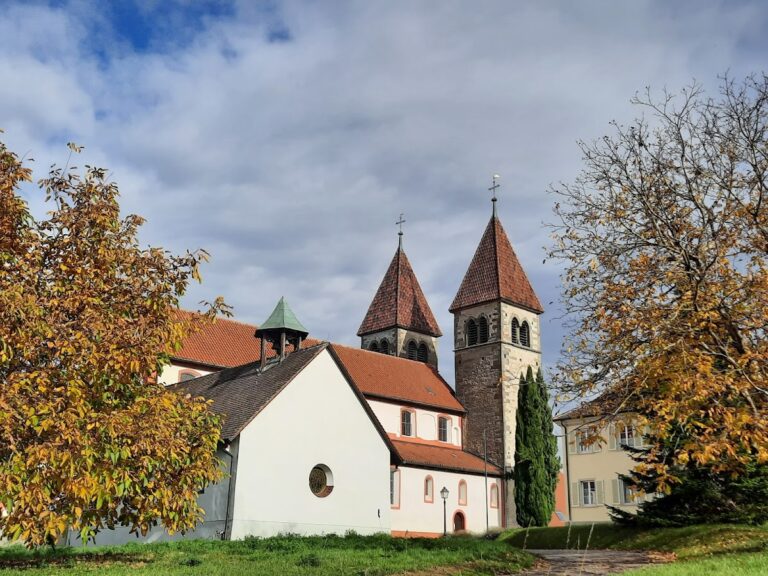
Church of St. George is a Roman Catholic church in Oberzell on Reichenau Island in Lake Constance, Germany. Built around AD 900 during the late Carolingian period, it belongs to the historic sphere of Reichenau Abbey, founded in 724, and is dedicated to Saint George, the Christian martyr whose cult spread widely during late antiquity and the Middle Ages. The church is regarded as one of Europe’s oldest churches dedicated to him.
Foundation and the cult of Saint George
The church’s origins are closely connected with Hatto III, abbot of Reichenau from 888 and later Archbishop of Mainz and a senior official of East Francia. In 896, Hatto received relics of Saint George from Pope Formosus in Rome. After crossing the Alps, he distributed relics among religious institutions, and Reichenau received several, including part of the saint’s skull. This arrival probably encouraged the medieval veneration of Saint George in Swabia.
The first church was constructed around AD 900 under Hatto III and was enlarged several times. A Reichenau version of the martyrology of Wandalbert of Prüm records a consecration on 18 November, although it does not give a year. A later tradition attributed the church’s foundation to Haito, abbot from 806 to 823, and said that the building already existed under Abbot Ruadhelm, who held office from 838 to 842. Modern research generally assigns the foundation to Hatto III.
Medieval expansion and artistic development
The first building probably consisted of the present nave and crypt. Its unusually spacious interior may have been planned for the anticipated cult of Saint George. Between AD 925 and 945, a rounded western apse was added to the nave. This alteration may have accompanied the transfer of the saint’s relics from the crypt to the western building, allowing them to be venerated above ground.
In the early eleventh century, builders added a low, elongated porch with a Michael chapel above it. During the same period, the earlier rounded transept recesses were converted into rectangular transept arms. These changes gave the church the form of a three-aisled basilica, a longitudinal plan with a central nave and lower side aisles, together with a crossing tower and raised rectangular east choir.
The date of the wall paintings remains debated. Proposals range from the late Carolingian period, around AD 900 and possibly under Hatto III, to the late tenth century or approximately AD 1000 in the Ottonian period, the tenth and early eleventh centuries associated with the Ottonian dynasty. Other descriptions place parts of the paintings in the tenth or eleventh century, while some have proposed the late ninth century. Their connection with Reichenau Abbey makes them major evidence for the artistic production of the monastery.
Discovery, restoration, and conservation
The wall paintings were found beneath a later plaster layer in 1880 during restoration work directed by building inspector Franz Bär, with building inspector Ludwig Maier participating. Maier later proposed a copy of the church for a new Catholic church at Rittersbach. That building was erected from 1886 to 1888, and its interior paintings were made by the Freiburg copyist Fritz Kohlund.
From 1889 to 1891, painter Carl Schilling installed removable picture wallpapers designed to show a clean version of the mural cycle without repainting the original paintings. The system was removed in 1909 after part of its mechanism broke. Victor Mezger carried out another restoration in 1921 and 1922, including partial repainting and artificial patination.
Later increases in visitation changed humidity and pollution levels inside the church, contributing to mould and bacterial growth that damaged the paintings. Their condition is monitored through measurements of indoor climate, microclimate, air movement, radiation, and visitation by the Baden-Württemberg State Office for Monument Preservation and the University of Stuttgart’s Institute for Materials of Architecture. Reichenau Island, including Church of St. George, has been a UNESCO World Heritage Site since 2000. The designation recognizes the island’s evidence for medieval Benedictine monasticism, its importance as an example of Central European monastic architecture from the ninth to the eleventh century, and its artistic value. A virtual reconstruction of the church has existed in the computer environment Second Life since November 2008.
Remains
Church plan and medieval building phases
Nave and crypt
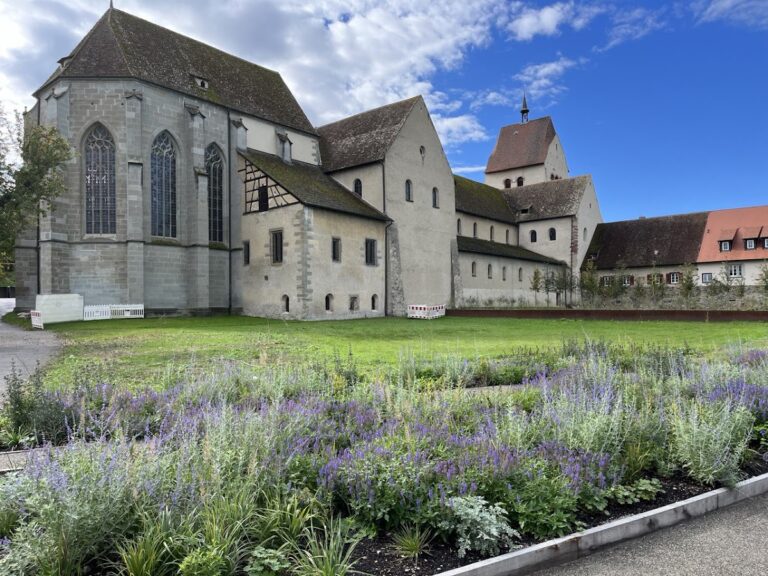
The pre-Romanesque church stands on a small hill near the eastern tip of Reichenau Island. It is a three-aisled basilica with low side aisles, a crossing tower, and a rectangular east choir raised toward the tower. The central nave is entered through a portal preceded by a passage. The first church’s nave retains its rows of columns, while the square crypt beneath the choir contains four columns surrounding an altar. The crypt may have been intended for Saint George’s relics and was probably built during the initial construction phase.
Western apse and eastern areas
The rounded western apse, added between AD 925 and 945, is painted. The raised former crossing now functions as the presbytery, which has a cross vault, while the east choir has a flat wooden ceiling. The former transept area contains two rooms separated from the liturgical area. The early eleventh-century porch is low and elongated, with a Michael chapel above it, and the earlier rounded transept recesses were transformed into rectangular arms.
Wall paintings and inscriptions
Gospel miracle cycle
The paintings cover the longitudinal sides of the nave and its north and south walls. They were made with the fresco-secco technique, in which pigment is applied to dry plaster, and survived beneath later plaster in unusually good condition. The central cycle contains eight Gospel scenes showing miracles of Christ. On the north wall, the sequence from west to east shows the healing of the demon-possessed man of Gerasa, the healing of a man with dropsy, the calming of the storm on the Sea of Galilee, and the healing of the man born blind.
On the south wall, the scenes run from east to west and show the healing of a leper, the raising of the young man of Nain, the raising of Jairus’s daughter, and the raising of Lazarus. Each scene has a Latin titulus, an explanatory inscription identifying its subject. Perspective meanders and richly designed ornamental friezes frame the paintings. The cycle begins at the entrance, moves toward the altar, and returns along the opposite side. Christ is generally shown oversized on the left of each scene, facing right and making a blessing gesture. He appears twice in the storm and Jairus scenes, and the sequence culminates in the raising of Lazarus.
The north-wall scenes have been interpreted in connection with the water side of the church because several involve water. The south-wall scenes have been associated with the presumed cemetery side and with resurrection. The first scene has also been compared with imagery from Reichenau Abbey’s foundation legend, in which the itinerant bishop Pirmin arrives by boat and drives snakes or demons from the island.
Figures, portraits, and later imagery
The clerestory, the upper wall zone above the main arcades, contains standing figures of the Twelve Apostles. Circular framed images called tondi contain busts of abbots. Around the chancel arch, a Latin inscription states: “Christ conquers, Christ reigns, Christ commands; may Christ defend his people from every evil.”
A satirical fourteenth-century image survives on the north wall beside the altar steps. It shows a poem written on a cowhide being turned in a circle by four devils and criticizes the gossip of foolish women. The image illustrates the expression that gossip cannot fit on a cowhide and may also admonish the priest not to include such gossip in sermons. It has been described as the earliest known transmission of the expression “bla bla.”
The mural cycle is closely related to the paintings in the Sylvester Chapel near Überlingen, although those paintings are less well preserved. Copies of the Reichenau paintings are also found in the Neo-Romanesque Church of St. George at Rittersbach, built in 1886.
Organ and bells
An organ built by Mönch of Überlingen in 1985 has 19 sounding stops, two pedal transmissions, two manuals, and a pedal. Its key and stop actions are mechanical. The church also has a historically and musically significant bell peal. Three smaller bells date from the thirteenth century and probably came from a single casting. They hang in a wooden bell frame on wooden yokes.
Nearby sites