Münster St. Maria und Markus: Former Abbey Church of Reichenau Abbey


Site at a Glance
- Rating
- 4.6
- Popularity
- Low
- Country
- Germany
- Primary era
- Medieval
- External website
- Open
- Eras represented
- Medieval, Early Modern
- Civilizations
- Carolingian, Holy Roman Empire
- Site type
- Religious
- Remains
- Basilica
On this page11 sections
History
Münster St. Maria und Markus is the former abbey church of Reichenau Abbey and the present Roman Catholic parish church of Mittelzell on Reichenau Island in Lake Constance, Germany. Founded as a Benedictine monastery, it developed from an early medieval church into a late Carolingian-Romanesque basilica with Gothic and Baroque additions, and is the largest of the island’s three Romanesque churches.
Foundation and Carolingian construction
The wandering monk Pirmin founded Reichenau Abbey in 724 with the support of Charles Martel, the Frankish mayor of the palace who exercised effective political leadership in the Frankish realm, and Lantfrid, an Alemannic duke. A document dated 25 April 724 states that Pirmin brought forty monks to the island. During his abbacy, the community built a first wooden monastery church.
Abbot Haito later commissioned a stone basilica on a Latin-cross plan, replacing the earlier wooden building and an intervening stone structure. Consecrated to the Virgin Mary on 16 August 816, it established the church’s principal Carolingian form. Haito’s building campaign was followed by further expansion under Abbot Erlebald, who held office from 823 to 838.
In 830, Bishop Radolt of Verona brought relics from Italy to Lake Constance, including relics of the Evangelist Mark from Venice. Erlebald enlarged the church with another nave bay, a western transept, and a twin-towered westwork, a monumental western entrance complex that could contain towers, galleries, and liturgical spaces. The monk and scholar Walahfrid Strabo names the priest-monk Einmuot as the architect of this phase.
Relics and the Romanesque rebuilding
A Byzantine abbatial cross containing a relic of the Holy Blood reached Reichenau in 925. By 946, a rotunda modeled on the Church of the Holy Sepulchre in Jerusalem had been built east of the basilica to house and honor it. Around the turn of the first millennium, the cult of Saint Mark became especially important. Its growth was linked in part to a legendary tradition concerning a secrecy promise supposedly made by Radolt.
After several tenth-century building stages, Abbot Berno enlarged the Carolingian church into essentially its present form. His reconstruction added a further western extension and replaced the earlier westwork with a new transept and a monumental, richly articulated rectangular tower in front of it. This west building became the liturgical setting for displaying and venerating the relics of Saint Mark.
A major fire damaged the church in the eleventh century. Berno supervised its rebuilding with surviving parts of the ninth-century structure, producing the present three-aisled arrangement. The reconstructed church was consecrated on 24 April 1048, on the eve of Saint Mark’s feast, by Bishop Theoderich at the order and in the presence of Emperor Henry III, the German king and Holy Roman Emperor.
Burials and later medieval development
The Münster also became a burial place for members of the Carolingian and monastic communities. Duke Gerold, brother of Charlemagne’s wife Hildegard, was buried in the church in 799. Emperor Charles III, known as Charles the Fat, died at Neudingen on the Danube on 13 January 888 and was buried in the Münster at his own request. Abbots including Berno and Mangold of Brandis were also buried there.
In the later Gothic period, renewed prosperity at the abbey led to major changes. A Gothic choir was acquired, while the earlier Holy Blood chapel and the Romanesque double apse were demolished or replaced. A Gothic upper gallery was added in the fifteenth century. The former sacristy, now the treasury, and the Gothic high choir were completed in the mid-sixteenth century under Abbot Friedrich von Wartenberg.
The relics of Saint Mark, brought to Reichenau in 830, made the Münster an important pilgrimage destination. Saint Mark became its principal patron, while the Virgin Mary remained the monastery’s original patron. The island continues to observe Saint Mark’s feast on 25 April and the Assumption of Mary on 15 August as major religious feast days.
From the end of the abbey to the present
When the monastery ended in the eighteenth century, many of its manuscripts, liturgical vessels, and vestments were dispersed to other churches and collections. The Münster nevertheless retained important Gothic and Baroque furnishings and relics. Its historical setting is now part of the UNESCO World Heritage property comprising Reichenau’s monastic island, inscribed in 2000.
Restoration during the 1960s and 1970s altered or removed some Baroque furnishings and revealed the concealed thirteenth-century wooden vault. An underground level beneath the treasury, filled in until 1938, was also reopened and connected to the building by its stair. In connection with the abbey’s 1,300th anniversary, Pope Francis granted the Münster the title of minor basilica, an honorary papal designation for a church of particular religious or historical importance.
In 2024, the former sacristy was comprehensively renovated as a treasury. The bells were rehung and their ringing system modified after asymmetric swinging had caused structural damage. The bell frame was placed on a special rubber foundation, and an electronically controlled system was installed. Since 5 December 2015, the bells in the west tower have again been permitted to ring.
That year also saw the redesign of the monastery garden north of the Münster within the former monastic walls. The work evokes the medieval cloister and commemorates Walahfrid Strabo’s Hortulus, a poem describing a monastic garden. It recreates or interprets the cloister, gardens, and cemetery-orchard as a place of contemplation, education, and biologically dynamic cultivation.
Remains
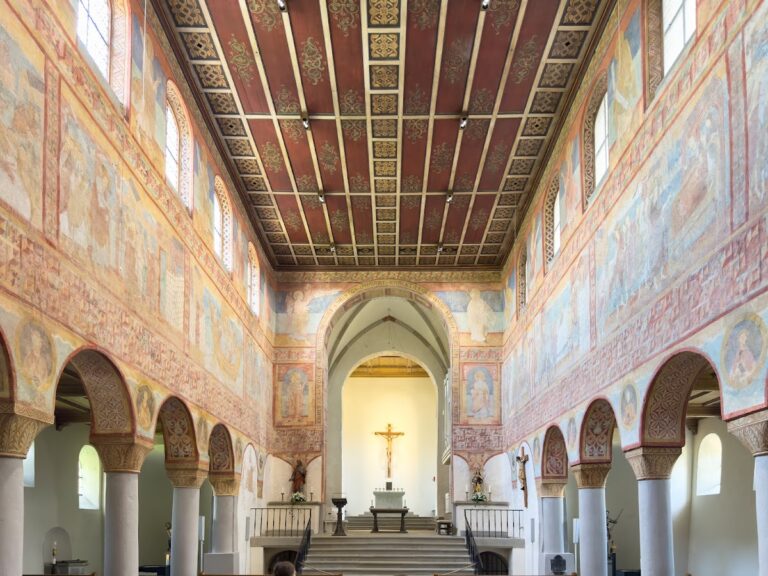
The Münster is a late Carolingian-Romanesque basilica shaped by later Gothic and Baroque construction. Its interior has three aisles of different heights, two transepts, and apses at both ends of the central nave. Two rows of five round arches divide the nave, each arch resting on a square stone pier with a finely carved floral capital. The side aisles have flat timber ceilings supported by beams, while the central nave retains an oak barrel vault dating from 1236–37.
Western entrance and tower
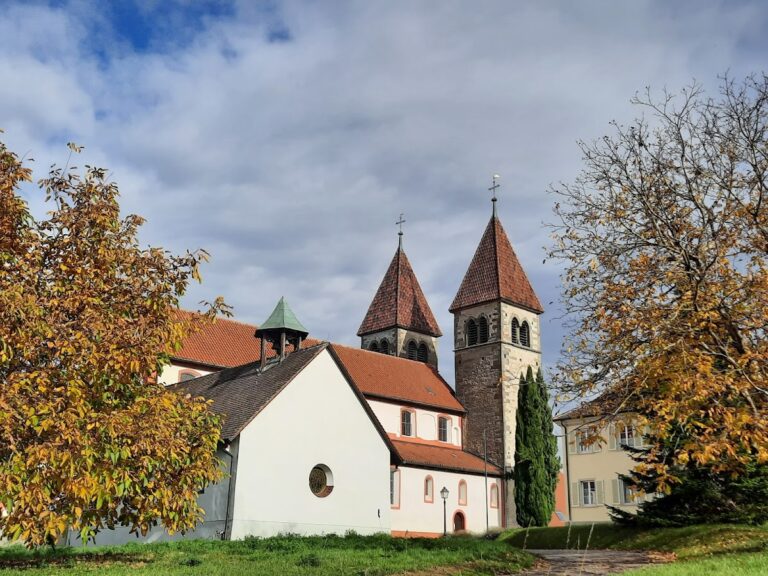
The church has no conventional facade. Instead, two portals open onto the western transept, one on each side of the bell tower, and each portal is preceded by a porch. The porches originally had an upper storey with a three-light window opening through a single round arch.
The rectangular bell tower incorporates the semicircular western apse within its base. Its lower section contains the bell chamber and a large round-arched window flanked by smaller windows. Each of the four sides has a three-light window, while the interior-facing elevation has vertical bands of red brick. A steep double-pitched roof ends in a small seven-sided pyramidal belfry topped by a Holy Spirit cross and one bell. A clock face is set above the three-light window on the southern side.
The western apse is lit by a single round-arched window. At its center stands the Gothic Saint Mark altar-reliquary of 1477, made of marble and containing relics of the saint and a ninth-century illuminated Gospel book. Its front has Flamboyant Gothic framing, and a stair at the rear leads to the altar table. The present shrine is a copy of the original.
Nave, transepts, and choir
The side elevations consist of relatively plain, light-colored plastered masonry. The fronts of the transepts have no portals and are pierced by symmetrically arranged single windows. Their crossings and the two transepts have flat timber ceilings supported by beams.
The eastern transept crossing and the terminal part of the central nave form the presbytery, raised several steps above the rest of the church. Its post-conciliar furnishings include a stone altar, ambo, and presider’s seat. An elaborate Baroque choir screen dated 1746 separates this area from the older presbytery, where the polychrome-marble Holy Blood altar of 1739 stands before the 1498 altarpiece of the Coronation of the Virgin and Saints by Rudolf Stahel.
The deep Gothic choir, built in the fifteenth century, has a polygonal apse and a star vault. Tall four-light windows with colored glass occupy its side walls, while sixteenth-century frescoes on the Eucharist cover the walls and vaults. The Gothic choir has a roof higher than those of the nave and transepts, walls of light stone blocks, and stone buttresses.
Paintings, sculpture, and altars
Late-fourteenth-century wall paintings show the Madonna and Child with donors, Saint Christopher, and Christ on the Mount of Olives. A sandstone Madonna and Child from around 1300 stands on the north wall of the Romanesque choir remnant. The side-aisle altars include a Pietà from around 1350 and a 1596 depiction of the Martyrdom of Saint Stephen.
Behind the 1746 choir screen is the Holy Blood altar from 1739. The relic associated with it is traditionally said to contain blood-soaked earth from Golgotha, a splinter of Christ’s cross kept behind a small Byzantine golden abbatial cross, and a blood-soaked silk cloth. It received a Baroque setting with gemstones in 1737 and was converted into a monstrance, a vessel for publicly displaying a sacred relic or consecrated host, in 1746.
Treasury and sacred objects
The treasury occupies the former sacristy beside the Gothic high choir. Its square room has a Gothic star vault divided into four bays by a central pier. The keystones bear the symbols of the four Evangelists. Mid-fifteenth-century painted decoration includes gold-colored accents, curling foliage between the ribs, the founder’s coat of arms, and Saint Mark with a lion.
The lower level contains wall fragments from the seventh century and four column bases indicating that the space was once vaulted. Its position is considered a possible former monastic writing room. The treasury also houses the original Saint Mark shrine, made after 1303 from wood, embossed, chased, and gilded silver, cast and gilded bronze, and enamel. Other major reliquaries include the shrine of Saints John and Paul from around 1300 and the Romanesque linden-wood Oberzell Cross from around 1120.
Among the treasury’s liturgical books and vessels is a late Gothic-bound Evangelistar, a Gospel book arranged for use during the church year. It combines ninth-century parchment leaves and eleventh-century painted leaves with a copper-gilt, silver, and wooden binding from the early fifteenth century. The collection also includes a mounted tooth relic of Saint Mark in silver, gold, and enamel with a 1723 setting, and the mid-fifteenth-century shrine of Saint Januarius.
Further objects include former choir glazing by Bartholomeus Luscher of Bern from 1556, a copy of a Romanesque bronze holy-water vessel whose twelfth-century original belongs to the House of Hohenzollern, and a twelfth-century oak reliquary casket covered with gilded silver. A late antique ivory pyxis-ciborium combines a fifth- or sixth-century container with a thirteenth- or early fourteenth-century lid, shaft, and base made from repoussé gilded copper and enamel.
The treasury preserves the medieval crozier of Eberhard von Brandis. Its staff dates from 1351 and uses gilded copper, silver, brass, and wood, while the crozier head is a nineteenth-century reproduction incorporating historical elements. The original head was acquired by the Victoria and Albert Museum in London in 1862. Other preserved objects include the vessel associated with the Wedding at Cana, the shrine of Saints Felix, Regula, and Genesius from around 1470, and the shrine of Saint Fortunata, made in stages around 1300 and at the end of the fifteenth century.
A processional cross combines a silver-gilt corpus from the mid-twelfth century with a cross made by Jakob Witzinger around 1410. The treasury also contains the Prassberg Monstrance by Georg Reischli from 1680 and the object known as Charlemagne’s “Emerald,” made of green glass paste around 780 and given a seventeenth-century frame.
Further reliquaries include the arm reliquary of Saints Marianus and Pelagius from 1458, the head reliquary of the Apostle Bartholomew from the early fourteenth century with eighteenth-century Baroque additions and a base from around 1900, the arm reliquary of Bartholomew from the late fourteenth or early fifteenth century, and the arm reliquary of Saint Emmeram from 1600.
Furniture, organ, and bells
The treasury contains a large Gothic sacristy cupboard of walnut, oak, and iron from the mid-fifteenth century, as well as a large early Baroque cupboard made from softwood, walnut, and plum wood in the early seventeenth century. In the sacristy, a wooden statue of Saint Meinrad with a club, dating from the seventeenth or eighteenth century, forms a counterpart to a statue of Saint Benedict holding a chalice. Meinrad also appears in the Münster’s bell decoration, a tiled stove of 1746–47, a wooden ceiling from 1904 now in the attic, and a seventeenth- or eighteenth-century oil painting in the Münster rectory.
The Johannes Klais Orgelbau organ, opus 1355, was built in 1967. It has two opposing cases, three manuals, a thirty-note pedalboard, 3,050 pipes, and 39 stops. The manuals and pedal use mechanical transmission, while the stops and combinations are electrically controlled; each manual has 58 notes.
The Münster has nine bells, seven of considerable age. The oldest is the Gallus Bell, which formed the focus of a 2024 installation by Christoph Brech. During the consecration of the new altar on 20 September 1970, relics of Saints Pirmin, Mark, and Meinrad, together with the bones of Haito, identified as the builder, were placed inside the altar.
Nearby sites