Eugensberg Castle: A Neoclassical Estate in Switzerland


Site at a Glance
- Rating
- 3.7
- Popularity
- Very Low
- Country
- Switzerland
- Primary era
- Modern
- Eras represented
- Iron Age, Modern
- Civilizations
- Celtic, Swiss
- Site type
- Domestic
- Remains
- Castle
On this page15 sections
History
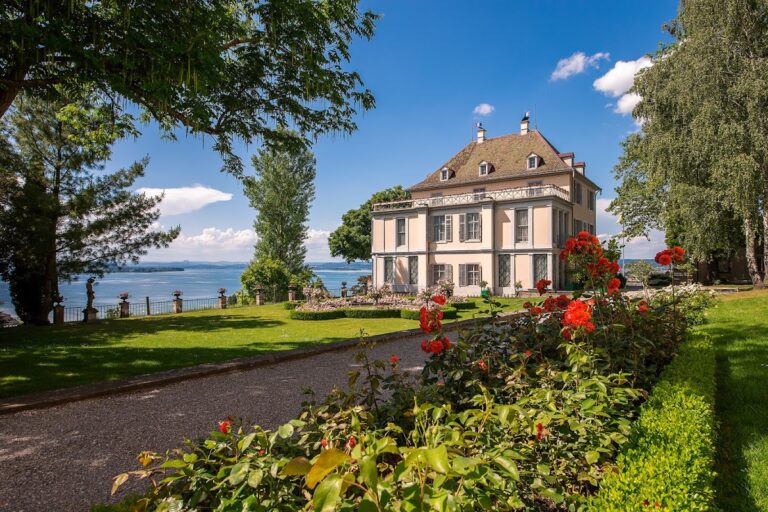
Eugensberg Castle is a Neoclassical estate in Switzerland, built for Eugène de Beauharnais between 1819 and 1821 during the Empire period. It stands in Salenstein on the southern shore of the Untersee, opposite Reichenau Island, and is named after its builder, Napoleon Bonaparte’s stepson and former Viceroy of Italy. Eugène acquired the Sandegg estate as a retreat in neutral Switzerland, creating a residence that later became a summer home for members of several prominent families.
Foundation and the Beauharnais family
In 1819, Eugène purchased the Sandegg estate from the farmer Johann Eigenmann for 15,000 gulden. The transaction did not include Sandegg Castle, which belonged to Louise Cochelet, but it gave Eugène the land on which his own residence would be built. The architect and plans for Eugensberg are unknown. Eugène visited the completed castle only a few times before his death on 21 February 1824, when he left the property to his daughter Eugénie de Beauharnais.
Eugénie continued to use Eugensberg as a summer residence. On 22 May 1826, she married Konstantin of Hohenzollern-Hechingen, who later became Prince of Hohenzollern-Hechingen. She sold the castle in 1834 to finance the remodeling of Villa Eugenia in Hechingen, and at least some of Eugensberg’s furnishings were transferred there.
Nineteenth-century ownership
Heinrich von Kiesow of Augsburg bought Eugensberg in 1834 for 32,000 gulden. After he became seriously ill, he sold the property in 1857. It then passed as a wedding gift valued at 189,000 francs to Amélie von Reichenbach-Lessonitz.
Following the death of her husband Wilhelm in 1865, Amélie lived at Eugensberg in seclusion with their only daughter, Pauline. She spent several months there each year as a summer resident and commissioned extensive alterations to the castle and park. The writer Joseph Victor von Scheffel visited Eugensberg several times. In October 1874, he entered a poem in the castle guestbook describing the Untersee, Reichenau, Thurgau, and the view from the estate.
The Saurer alterations and changing uses
After Amélie’s death, Pauline sold Eugensberg to the industrialist Hippolyt Saurer of Arbon. Between 1916 and 1918, Saurer commissioned the Zurich architects Johann Rudolf Streiff and Georg Schindler to carry out major alterations. Their work refined the original Empire-style exterior in a late-Historicist manner and expanded the estate with new buildings and agricultural facilities. The property was also consolidated into a more unified agricultural holding.
In 1938, Saurer’s widow, Sina Saurer-Hegner, offered the entire estate to the Canton of Thurgau for 600,000 Swiss francs. Architect Oskar Mörikofer criticized the alterations from the perspective of heritage conservation, and the canton abandoned the purchase. The following year, Sina transferred the property to the Hippolyt Saurer Foundation Schloss Eugensberg.
The castle operated as a museum for several years, but visitor numbers declined during the Second World War. After the foundation’s president, Waldemar Ullmann, was murdered in 1944, Sina Saurer-Hegner dissolved the foundation. In 1948, the Diakonie-Verband Ländli bought Eugensberg for 850,000 francs and established a holiday and convalescent home there. The institution ceased operating in 1987.
Late twentieth-century ownership
The entrepreneur Hugo Erb of Winterthur acquired the estate in 1990 and commissioned the architect Hermann Schmidt to undertake further construction. The project added a large swimming pool, annex buildings, a covered classical entrance, a second lakeside terrace with stairs, an underground garage, and a security tunnel to the castle. It also substantially expanded the roads and paths.
Rolf Erb lived at Eugensberg until his death in April 2017. After the financial collapse of the Erb Group and the death of his father, Hugo Erb, he had transferred the property to his ten-month-old twin children. In autumn 2015, the Swiss Federal Supreme Court upheld his conviction for harming creditors, and the estate consequently entered the bankruptcy estate. On 1 March 2019, it was auctioned to the German IT entrepreneur Christian Schmid, founder of RapidShare. Eugensberg is a Swiss heritage site of national significance.
Remains
Eugensberg occupies an elevated estate above the Untersee, with the castle set within an English landscape garden extending into meadows and woodland. The property covers 82 hectares, including approximately 12 hectares of parkland. The surviving complex combines the white Neoclassical main building from the Empire period with later wings, service buildings, landscape features, and extensive additions from the twentieth century.
Castle and landscape park
Main castle
The white castle has an Empire-style Neoclassical design, a monumental early nineteenth-century form of Neoclassicism associated with the Napoleonic era and classical architectural references. Its original exterior was altered between 1916 and 1918 in a late-Historicist manner. The interior gained a new entrance hall and was furnished with newly acquired furniture and artworks from the Beauharnais period. Both the exterior and interior were later restored and supplemented in the Empire style.
Park and grounds
The English landscape garden contains a tennis court at the forest edge, seven giant sequoias, a woodland pond, and a water-lily pond below the castle. The elevated position gives views over Lake Constance and the Untersee, as well as Reichenau Island, Constance, Mannenbach, Berlingen, Steckborn, and the Hegau.
Saurer and later additions
Estate buildings and temple
The Saurer building campaign added wings linking the main castle with the gardeners’ and kitchen buildings. It also introduced the estate manager’s house, Rosenhüsli, together with a round temple above the modern swimming pool. The temple uses forms inspired by Doric architecture, one of the principal classical Greek architectural orders, recognized for sturdy columns and simple capitals.
Modern additions
Later construction added a covered entrance in the form of a classical portico, meaning a roofed entrance supported by columns, along with a second lakeside terrace and stairway. The swimming pool and its annex buildings hold 3,300 cubic metres of water. An underground garage is connected to the castle by a security tunnel. The castle is concealed behind very tall hedges and fences and is neither accessible nor visible from outside.
Sandegg Castle and the archaeological woodland
Ruins of Sandegg Castle
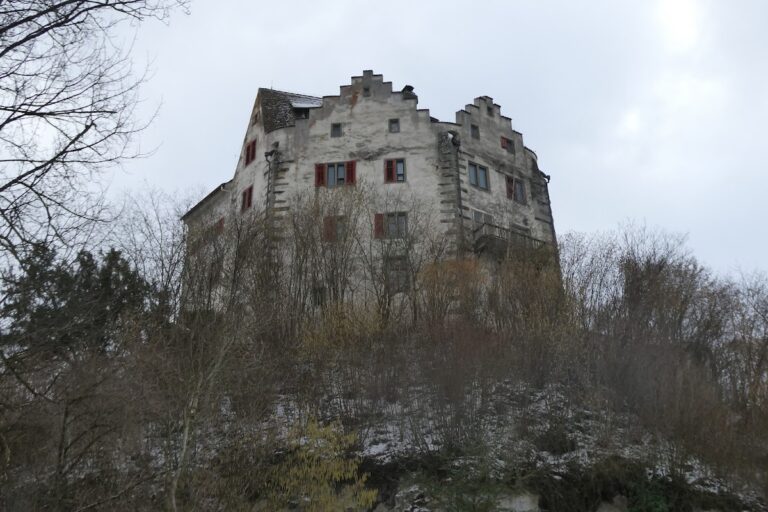
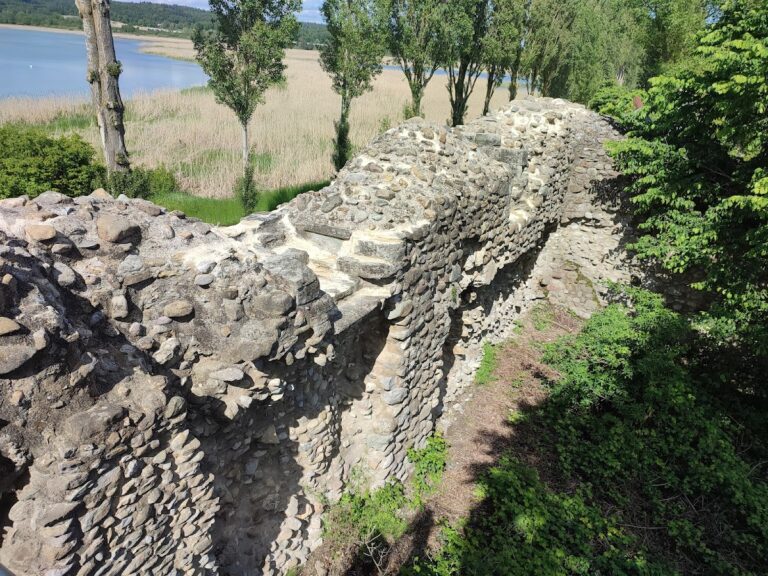
The Eugensberg estate includes the ruins of neighboring Sandegg Castle. Sandegg burned during the night of 2–3 September 1833. Heinrich von Kiesow acquired the ruin in 1843, after which it became a permanent part of the Eugensberg estate.
Celtic burial mounds
Three Celtic burial mounds lie in the Eichholz woodland behind the castle on a gently rising slope. They date from the Hallstatt period, an Iron Age period of central Europe conventionally placed between roughly the eighth and fifth centuries BC. Looting excavations took place at the mounds during the nineteenth century.
In 1933, Karl Keller-Tarnuzzer, the first cantonal archaeologist of Thurgau, investigated the mounds with P. Styger, Herbert Isler, and Leutenegger. Further assessments were prepared by the Swiss Federal Materials Testing Institute and the Botanical Garden of the University of Zurich. The finds included weapons and an urn. The Institute of Prehistory of the University of Tübingen restored them, and they are now held by the Archaeological Museum in Frauenfeld.
Nearby sites