Basilica of Sts. Peter and Paul, Reichenau: A Romanesque Collegiate Church in Germany


Site at a Glance
- Rating
- 4.6
- Popularity
- Low
- Country
- Germany
- Primary era
- Medieval
- External website
- Open
- Eras represented
- Medieval, Early Modern
- Civilizations
- Carolingian, Holy Roman Empire
- Site type
- Religious
- Remains
- Basilica
On this page8 sections
History
Egino’s Foundation
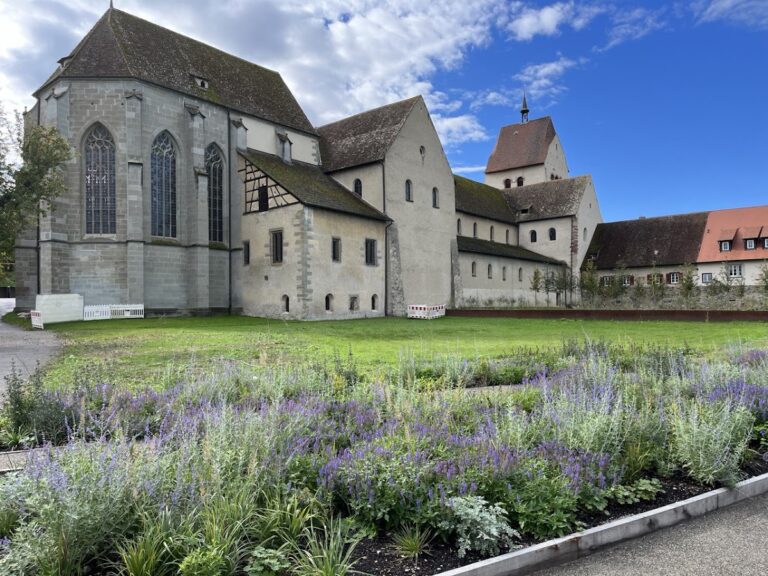
The Basilica of Sts. Peter and Paul, Reichenau, is a Romanesque Catholic collegiate church in Germany, built in the eleventh and twelfth centuries on the site of an earlier Christian foundation. Its first church was dedicated to Saint Peter and founded in 799 by Egino, Bishop of Verona. After resigning his episcopal office, Egino withdrew to a richly endowed religious cell at the western tip of Reichenau with the permission of Abbot Waldo. He died there in 802 and was buried in the church. Venerated as a blessed in Catholic tradition, Egino remains central to the history of the site.
The Romanesque Rebuilding
Two fires eventually damaged the first church, which was demolished around 1080. The present building was then raised on its foundations while retaining the earlier church’s measurements. Dendrochronology, the dating of wooden elements through tree-ring analysis, places the completion of the choir around 1104 and the nave around 1126. The final roof work is recorded in 1134. The church belongs to the Roman rite and the Archdiocese of Freiburg, and is dedicated to Saints Peter and Paul.
The predecessor was a hall church with a recessed single apse. Its ornamental reliefs and concealed Carolingian wall paintings reveal a richly decorated and originally painted interior. Lombard influences in this decoration later contributed to the artistic development of the Reichenau school of painting, a major medieval tradition associated with the monastery from the second half of the ninth century onward.
Later Changes and Religious Continuity
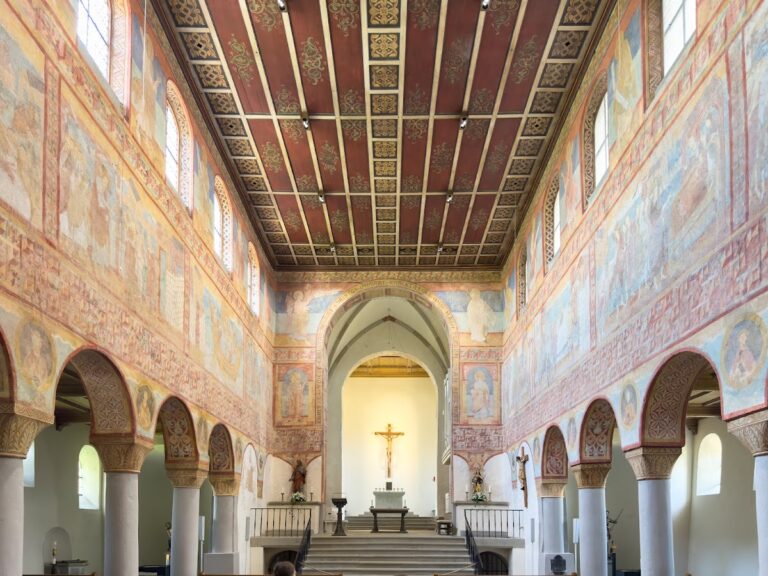
Between 1750 and 1760, the medieval interior was extensively remodeled in the Rococo style, an eighteenth-century decorative manner characterized by light and ornate embellishment. The work enlarged the windows, replaced the flat wooden ceiling with a flat stucco vault, and added an organ gallery at the west end. The monastery island of Reichenau, including the church, has been a UNESCO World Heritage site since 2000.
In 2001, Nikolaus Egender, a Benedictine who later became abbot of the Dormition Abbey in Jerusalem, founded Cella Reichenau beside the church. A small Egino Chapel serves the Benedictines of Cella St. Benedict for the canonical hours, the set times of communal prayer.
Remains
Romanesque Layout and Exterior
The church is a Romanesque column basilica, a longitudinal church in which arcades divide a central nave from side aisles. It has three aisles, no transept, and an eastern facade formed by two towers. The nearly square vestibule leads into the main worship space and retains poorly preserved remnants of its original fresco decoration. The Romanesque exterior is best preserved on the east side, although both towers were heightened in the fifteenth century.
A former chapel and a walled enclosure once adjoined the church on the south. An open wall enclosure can also be traced on the west side. In the northern aisle, surviving ornamental reliefs from the predecessor church preserve evidence of its exceptionally rich decoration. The burial place of Bishop Egino lies in the choir before the altar and dates from the twelfth century.
Apse Fresco and Interior Decoration
The apse contains a late-eleventh-century fresco arranged in three zones. In the upper zone, Christ sits enthroned within a mandorla, an almond-shaped aureole surrounding a sacred figure, accompanied by the symbols of the four Evangelists. Saints Peter and Paul and two angels stand beside him. The middle zone contains the twelve Apostles, while prophets occupy the lower zone.
An oversized Gothic window in the apse wall replaced a Romanesque central window that probably held stained glass. The eighteenth-century remodeling altered the interior’s appearance further through the enlarged windows, the flat stucco vault, and the west organ gallery. A seventeenth-century Pietà stands at the southern side altar.
Organ and Bells
The organ dates from 1783 and is associated with Johann Baptist Lang of Überlingen. Its eleven stops are divided between one manual and a pedal, with a manual-to-pedal coupler and a tremulant affecting the entire instrument. Organ builder Robert Wech of Buchloe restored it in 2018, and it was rededicated on 13 January 2019.
Five bells dating from three centuries belong to the church. Excavations have suggested that a bell-founders’ school operated in Niederzell during the fourteenth century, and three of the five bells are thought to have been cast there.