Arian Baptistry: An Ostrogothic Baptistry in Ravenna


Site at a Glance
- Rating
- 4.7
- Popularity
- Medium
- Country
- Italy
- Primary era
- Medieval
- External website
- Open
- Eras represented
- Classical, Medieval
- Civilizations
- Byzantine, Ostrogothic
- Site type
- Religious
- Remains
- Baptistery
On this page9 sections
History
The Arian Baptistry is an early Christian brick building in Ravenna, Italy, commissioned by the Ostrogothic king Theodoric the Great between the end of the fifth century and the first half of the sixth century. Its octagonal form belongs to the late antique Christian building tradition, and it served Ravenna’s Arian community near the Arian cathedral, now known as the Church of Spirito Santo. It is the only surviving Italian baptistry built specifically for Arian worship.
Theodoric and the Arian community
Theodoric established Ostrogothic rule in Italy after an agreement with the Eastern Roman emperor Zeno following the Goths’ confrontation with Constantinople in 487. He governed the western territories in the emperor’s name while combining Ostrogothic authority with Roman administrative and court traditions. Theodoric was an Arian Christian, whose faith held that Christ, the Son of God, was subordinate to God the Father and not co-eternal with him. This doctrine had been condemned at the Council of Nicaea in 325.
In Ravenna, Theodoric maintained separate places of worship for Arian Goths and Chalcedonian Christians. Chalcedonian Christianity here refers to the doctrine associated with the Council of Chalcedon and recognized by the later imperial and ecclesiastical establishment. The arrangement preserved separate districts and religious buildings rather than displacing the city’s existing Chalcedonian population. The baptistry was probably built after the Arian cathedral commissioned in 493, although surviving historical records do not provide a precise construction date.
The cathedral was originally called Hagia Anastasis and later became known as Spirito Santo. In 526, it was re-consecrated as a Chalcedonian cathedral dedicated to Saint Teodoro, although later alterations extensively changed the original church. Scientific and technical study indicates that the central section of the baptistry’s dome mosaic, including the baptism of Christ, the throne, and the figures of Peter and Paul, belongs to Theodoric’s reign. The other mosaic sections were probably completed in the middle of the sixth century.
Byzantine rule and changing religious use
Byzantine forces captured Ravenna in 540, bringing Ostrogothic Arian rule in Italy to an end. About a decade later, the baptistry passed to Ravenna’s Chalcedonian community. Between about 550 and 570, it was converted into a Chalcedonian oratory and rededicated to Saint Mary around 561. The rededication is attributed to Archbishop Agnellus in the Liber Pontificalis, a record of the bishops of Ravenna.
During the Exarchate of Ravenna, the period when the city served as the centre of Byzantine administration in Italy, Eastern-rite monks added a monastery and dedicated the complex to Saint Mary in Cosmedin. Benedictines occupied the complex from the eleventh century until 1441. It was then entrusted to secular clergy and later placed under the supervision of successive prelates and abbots.
Alteration, excavation, and protection
Important conservation work was carried out by Baldassar and Corrado Grassi in the sixteenth century. In the second half of the seventeenth century, the Oratory of the Cross was built against the baptistry’s west side. The new structure incorporated the baptistry as its apse and obscured much of its original exterior appearance.
The complex entered private ownership in the nineteenth century and was acquired by the Italian state in 1914. Allied bombing during the Second World War destroyed surrounding buildings that had encroached on the baptistry, making its exterior more fully examinable. The complex was subsequently restored under the supervision of Ravenna’s monuments commission. Excavations by Gerola from 1916 to 1919 revealed the former ambulatory around most of the building, while archaeological work recovered about 170 kilograms of mosaic tesserae from the floor. These pieces indicate that the walls once carried additional decoration.
The Arian Baptistry forms part of the serial UNESCO World Heritage property Early Christian Monuments of Ravenna, inscribed in 1996 for its artistic achievement, cultural interchange, historical testimony, and architectural significance.
Remains
Building and surrounding walkway
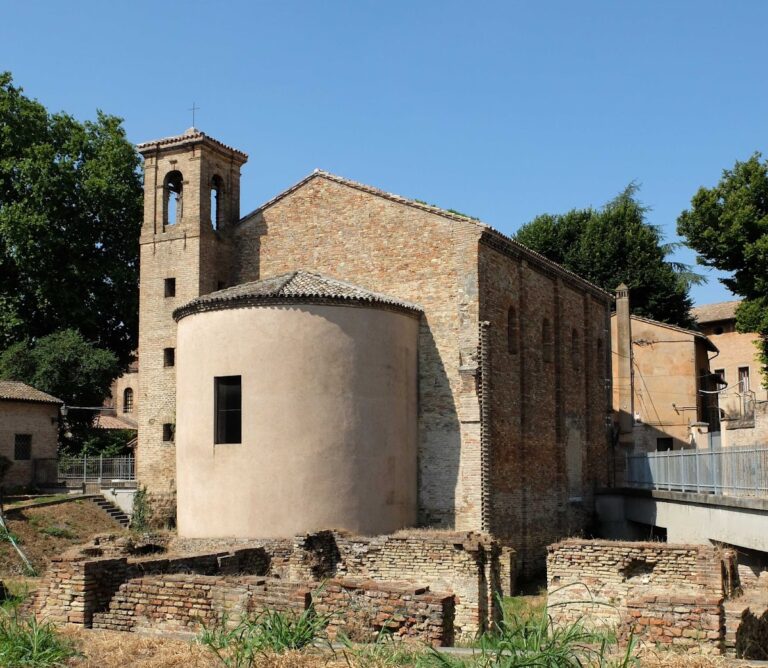
The baptistry is a small octagonal brick structure with four flat sides and four projecting apses. The eastern apse is the largest. Smaller apses occupy the lower level, while the upper level has arched windows or openings, and each apse was covered by a shallow roof. Some of the bricks were recycled from older structures, reflecting the reuse of building material in late antique Ravenna.
A walkway, or ambulatory, formerly surrounded seven of the building’s eight sides, leaving the eastern apse unobstructed. It was approximately 1.9 metres wide. The baptistry stands southwest of the former Arian cathedral and was physically integrated with the later Church of Spirito Santo. Its original floor now lies about 2.3 metres below ground level, a change that helps explain the building’s altered relationship with the surrounding complex.
Interior and baptismal area
The interior is largely bare, with exposed masonry and no furnishings. The former baptismal basin is represented by a circular marble slab at the centre, while the eastern altar has disappeared. Six graves were found within the octagonal building. Their presence is unusual for a baptistry because Late Antique church laws forbade burials in such buildings, although the burials were nevertheless placed there.
Dome mosaic
The dome preserves the baptistry’s only surviving major mosaic decoration. Made from small pieces of stone and glass, it remains mostly intact. Earlier wall decoration in marble and richly detailed mosaics has disappeared. The dome composition is arranged in two circular registers and is smaller and less elaborate than the mosaic in Ravenna’s nearby Neonian Baptistry, an earlier baptistry associated with the Chalcedonian community.
The central medallion shows the baptism of Jesus in the River Jordan. Jesus is represented as a youthful, beardless, nude figure submerged to the waist and surrounded by a halo. John the Baptist, wearing an animal-skin garment, reaches a hand above Jesus’ head. The river appears as a bearded old man with crab claws on his head, holding a vessel from which the water emerges. Above Christ, a white dove representing the Holy Spirit pours water from its beak.
The scene is set against a luminous gold background. Its arrangement was oriented toward the person being baptized, who stood in the basin facing the eastern altar. The eastward movement of Christ has been interpreted as a possible Arian symbolic choice, although its theological meaning remains uncertain. The youthful image of Christ has also been considered compatible with the Arian belief in Christ’s subordinate status, but the surviving imagery does not differ radically from Chalcedonian Christian iconography.
Apostles and prepared throne
The outer register contains two processions of twelve apostles, separated by slender palm trees. The apostles wear white garments and carry crowns in covered hands as they advance toward a throne bearing a jeweled cross on a purple cushion. The crowns express martyrdom and victory over death, while the palms carry related associations with martyrdom and heavenly reward.
Saint Peter leads one procession with the keys, and Saint Paul leads the other with scrolls representing his letters. Peter’s veiled hands express reverence according to an eastern tradition. A spindle appears on the covering of Paul’s hand, possibly referring to the Christian injunction to work. Between the two processions stands an etimasia, a prepared empty throne associated with Christ’s future return or judgment. Its jeweled cross, known as a crux gemmata, represents Christ’s power. The cloth on the throne has been interpreted as a reference to Christ’s bodily or human nature in Arian theology, though this reading is not certain.
The mosaic’s simpler, more static, and more repetitive figures contrast with those of the Neonian Baptistry. Its gold ground dominates the composition, the volumes are flattened, and palms separate the apostles rather than acanthus plants. A red-and-gold band with double blue borders surrounds the central medallion. The Arian arrangement also places John the Baptist on Christ’s left and sets a throne between Peter and Paul, differing from the composition in the Neonian Baptistry.
Variations in the stone used for the apostles’ grass and differences in the materials and styles suggest that artists working at different times contributed to the mosaic. Completion therefore took several years. Whether the differences from the Neonian mosaic reflect Arian theology or the varying skills and choices of the mosaicists remains uncertain.