Santa Maria in Trastevere: A Medieval Basilica and Cardinal Titular Church in Rome


Site at a Glance
- Rating
- 4.8
- Popularity
- Very High
- Country
- Italy
- Primary era
- Medieval
- Eras represented
- Classical, Medieval, Early Modern, Modern
- Civilizations
- Papal States, Roman
- Site type
- Religious
- Remains
- Basilica
On this page17 sections
History
Santa Maria in Trastevere is a Catholic minor basilica, parish church, and cardinal titular church in Rome, Italy, dedicated to Mary, Mother of God. Standing in the Trastevere district west of the Tiber, it is traditionally regarded as one of Rome’s oldest churches dedicated to the Virgin Mary and is associated with the early Christian congregation known as the Titulus Callisti.
Early Christian origins
The church’s foundation is connected by tradition with Pope Callixtus I, who is said to have established a Christian house church here between 217 and 222. The site was identified with the Taberna meritoria, traditionally described as a refuge for retired soldiers. A more cautious interpretation places the earliest Christian gatherings in Callixtus’s own house rather than in a purpose-built church.
The early congregation was later called Titulus Iulii and Titulus Iulii et Callisti. A titulus was an early Roman Christian church or congregation associated with a patron’s name. Ancient traditions connect the establishment or confirmation of this institution with several early popes, including Alexander I and Callixtus I, although the relationship between the early congregation and later buildings is partly traditional.
Another foundation tradition tells of an oily spring that erupted at this location in 38 BC and flowed toward the Tiber for a day and a night. Known as the fons olei, or “spring of oil,” the event was interpreted by Christians as a sign announcing the Messiah. The story was associated with the Jewish community of Trastevere before becoming part of the basilica’s Christian imagery.
The first basilica and medieval rebuilding
Emperor Alexander Severus is traditionally said to have made the site available for Christian use after settling a dispute between Christians and tavern keepers. The community’s building was enlarged or rebuilt by Pope Julius I between 340 and 352. This fourth-century structure became traditionally associated with the first Roman basilica dedicated to Mary.
The basilica was restored during the fifth and eighth centuries. Alterations in the eighth and ninth centuries included the addition of side aisles, while relics associated with Saint Callixtus were transferred from the catacombs to the church. Relics of Saints Cornelius and Calepodius were also brought from the Catacomb of Saint Callixtus by Pope Gregory IV and remained at the basilica for a period.
During the twelfth century, Pope Innocent II ordered the church to be re-erected on its earlier foundations. Completion is traditionally placed around 1143, and this rebuilding established the principal medieval fabric of the present basilica. Innocent II appears in the apse offering a model of the church, identifying him as its patron. His tomb monument was installed in the basilica in the nineteenth century.
Later changes and continuing religious life
Alterations continued during the sixteenth and seventeenth centuries. The Altemps Chapel was created in the 1580s, and the coffered ceiling was completed in 1617. In 1702, Carlo Fontana rebuilt or remodelled the portico. The basilica underwent a major restoration between 1866 and 1877 under Pope Pius IX and the architect Virginio Vespignani. During this work, carved faces of ancient deities on some column capitals were removed after they were identified as Isis, Serapis, and Harpocrates.
Ancient residential ruins were found beneath the baptistery chapel floor in 1920. They may represent a house associated with Pope Callixtus I, although that identification remains uncertain. The basilica retains its status as a minor basilica and cardinal titular church, and it is also a station church for the third Thursday of Lent. It remains linked with Marian observances, including the Feast of the Assumption on 15 August.
Santa Maria in Trastevere also has a long connection with the religious traditions of its district. During the Jubilee Year of 1525, it temporarily served the congregation of Saint Paul Outside the Walls after flooding by the Tiber, and its main portal functioned as a Holy Door. The portal served the same purpose during the jubilees of 1625, 1700, 1825, and 1900. The annual Festa de’ Noantri further connects the basilica with Trastevere: the image called Madonna de’ Noantri remains in the church for a week before returning to Sant’Agata in Trastevere.
Remains
Exterior and portico
Piazza and campanile
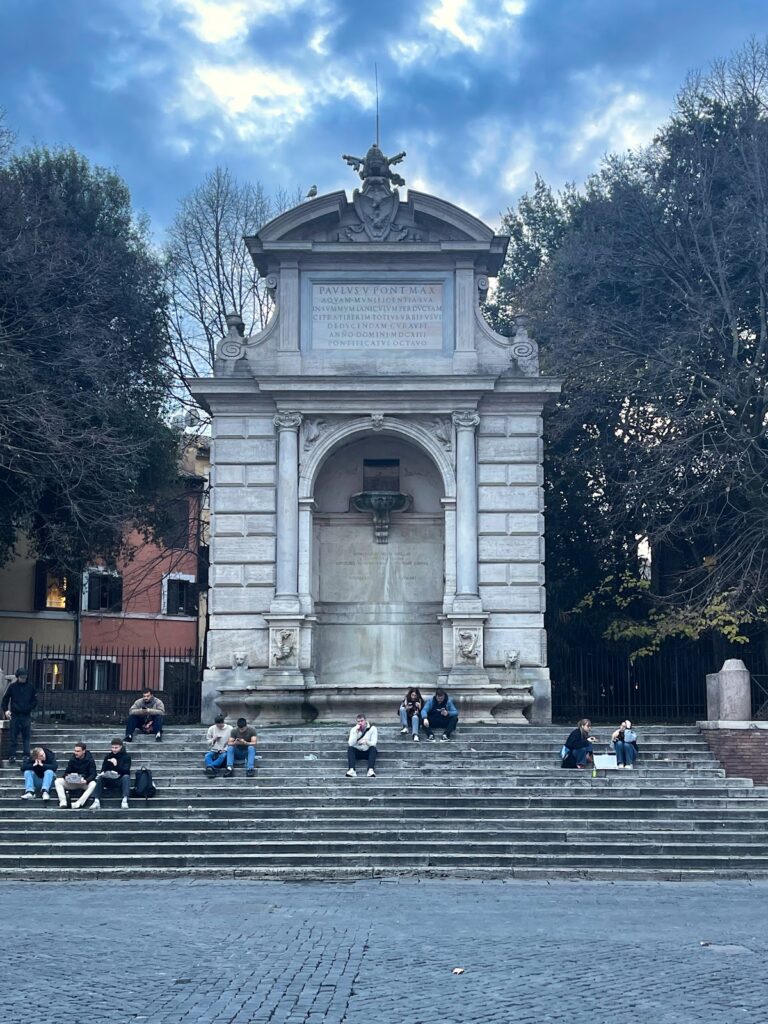
The basilica stands beside Piazza Santa Maria in Trastevere, the traditional centre of the Trastevere district. The square contains an octagonal fountain restored by Carlo Fontana, which is already shown on a map of 1472. Beside the church rises the twelfth-century Romanesque campanile. Four storeys extend above the roofline, separated by ornamental cornices, and a niche near the upper part contains a mosaic of the Madonna and Child.
Façade
The façade is crowned by a triangular pediment with a heavily weathered nineteenth-century fresco. It shows God the Father, an angel on either side, Pope Pius IX below, and the symbols of the four Evangelists toward the sides. Beneath it is a thirteenth-century mosaic of Mary enthroned and nursing the infant Christ. Ten women carrying lamps approach the throne, while the donors appear on a smaller scale. The women have been interpreted as the wise and foolish virgins, as eight virgins and two widows, or according to another meaning that remains uncertain.
Three windows alternate with four mosaic palm trees, each accompanied by two lambs. Above the entrance, nineteenth-century stained-glass windows depict Popes Julius I, Callixtus I, and Cornelius. Carlo Fontana’s portico of 1702 has five Ionic arches and a balustrade carrying statues of Callixtus I, Cornelius, Julius I, and the priest Calepodius. The statues are attributed to Jean-Baptiste Théodon, Michel Maille, Lorenzo Ottoni, and Vincenzo Felici.
Portico collections and entrances
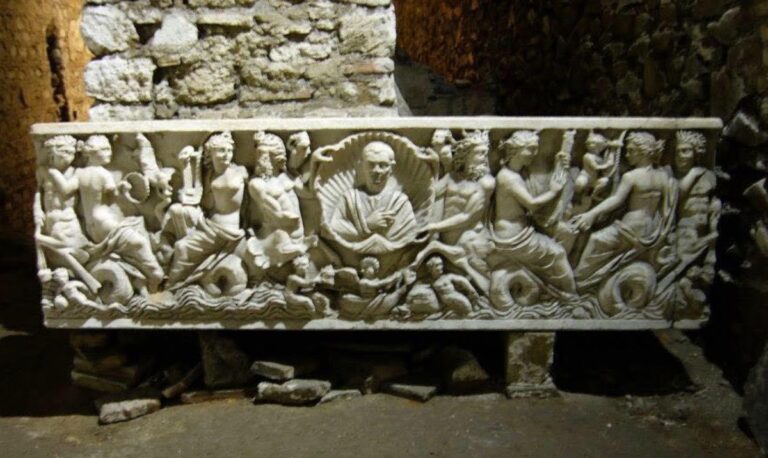
The portico contains a small lapidarium, or collection of architectural stones, with fragments from earlier buildings, including the first basilica. Greek and Latin funerary inscriptions from the catacombs, frescoes, and sarcophagi are also preserved there. Some sarcophagi are associated with the Papareschi family, to which Innocent II belonged. The three entrance doors are framed by finely carved marble friezes taken from Roman imperial buildings. Above the central door, the lunette bears the traditional abbreviation for “Mother of God.”
Basilica interior
Nave and aisles
The interior retains a medieval appearance and follows the classical basilica plan. A broad, high central nave is separated from two lower aisles by granite columns, while the raised presbytery and later side chapels occupy the eastern end. The building is approximately 56 metres long and 30 metres wide. Twenty-two granite columns, mainly bearing Ionic or Corinthian capitals, came from the Baths of Caracalla, as did the lintel above the entrance doors. Some capitals retain carved heads of ancient deities, while others were damaged during the nineteenth-century restoration.
An architrave above the columns is decorated with polychrome mosaic on a gold background. The first triumphal arch rests on two larger granite columns. The floor is covered in Cosmatesque work, an inlaid marble technique using geometric patterns and contrasting stones that was especially prominent in medieval Italian churches. It was heavily restored and partly reconstructed in the nineteenth century while generally following the earlier design.
Ceiling and presbytery
The gilded wooden coffered ceiling dates from 1617 and was designed by Domenichino, the Bolognese painter Domenico Zampieri. Its central painting represents the Assumption of the Virgin. Several steps lead to the raised presbytery. An inscription beside the central steps and another on a marble panel refer to the fons olei tradition.
Beneath the main altar is a crypt, or confessio, a space associated with the display or burial of relics. It contains relics attributed to Popes Callixtus I and Julius I, Pope Cornelius, and the priest Calepodius. The medieval ciborium, a canopy over the altar supported by columns, rests on four porphyry columns and was restored in the nineteenth century. The Paschal candlestick and the episcopal throne at the rear of the apse date from the twelfth century.
Triumphal arch and apse mosaics
The triumphal arch carries twelfth-century mosaics. At its centre is Christ’s cross between the letters Alpha and Omega. The seven lamps of the Apocalypse appear on either side, followed by the symbols and names of the four Evangelists. Isaiah and Jeremiah occupy the lower part of the arch and frame scenes from the life of Mary.
The apse contains mosaics from two principal periods. In the twelfth-century apse vault, Christ and Mary sit enthroned together against a gold background. Mary is crowned and richly dressed, while Christ places an arm around her shoulders, an unusual gesture in Marian imagery. Their inscriptions draw on the Song of Songs and a text inviting Mary to sit upon Christ’s throne. Above them, a multicoloured image of Paradise includes the hand of God the Father offering Christ a crown of victory.
Saints associated with Rome and the basilica flank the central figures. Innocent II, Lawrence, and Callixtus stand beside Mary, while Peter, Cornelius, Julius I, and Calepodius stand beside Christ. Innocent II holds a model of the church. Beneath the vault, a horizontal band shows the Lamb of God surrounded by twelve lambs representing the Apostles, who approach from Jerusalem and Bethlehem.
In 1291, Cardinal Bertoldo Stefaneschi commissioned six mosaics for the vertical wall of the apse. Designed by Pietro Cavallini, a leading Roman painter and mosaicist, they present scenes from Mary’s life in a proto-Renaissance style, with more naturalistic figures and settings than the earlier mosaics. The cycle includes Mary’s birth, the Annunciation, Christ’s birth, the Adoration of the Magi, the Presentation of Jesus in the Temple, and the Assumption of Mary.
The Nativity scene includes the words Taberna meritoria, connecting it with the oil-spring tradition. The first and last scenes lie beneath Isaiah and Jeremiah on the triumphal arch, while the other scenes occupy the apse. Below the cycle is a square mosaic of Mary and the Child with Saints Peter and Paul. Cardinal Bertoldo Stefaneschi kneels beside his coat of arms in smaller scale. Frescoes of angels bearing symbols of the Marian mysteries flank the panel and date from around 1600.
Side chapels and memorials
Altemps Chapel
The Cappella della Clemenza, also called the Altemps Chapel, stands beside the apse at the end of the left aisle. Martino Longhi the Elder created it in 1584–1585 in Baroque style for Cardinal Marco Sittico Altemps. Pasquale Cati painted the wall frescoes in 1588, presenting episodes connected with the Council of Trent, including its deliberations and Pope Pius IV’s confirmation of its decrees. The vault combines stucco and fresco.
The chapel contains the Madonna della Clemenza, an enthroned Virgin and Child painted in encaustic, a technique using pigment mixed with heated wax. The image dates broadly between the sixth and ninth centuries and is traditionally regarded as Byzantine in origin. It is one of the oldest surviving medieval Marian icons, was badly damaged by an earlier fire, and was canonically crowned in 1659.
Avila Chapel
Halfway along the left aisle, the Avila Chapel was commissioned by Pietro Paolo Avila. Antonio Gherardi designed it in 1680 as a chapel with an entrance vestibule and a portico leading toward his painting of Saint Jerome. Its complex double-dome arrangement places four stucco putti around the oculus, or circular opening, of the outer dome. They support a ring that forms the base for slender columns carrying a smaller inner dome.
The portico creates an extended perspective through narrowing lines, unequal column sizes, and differently coloured marbles. This spatial device recalls the perspective effects associated with Borromini’s gallery in the Palazzo Spada.
Relics and funerary monuments
The basilica contains funerary monuments from several periods. They include the cenotaph of Cardinal Francesco Armellini and his father, attributed to Andrea Sansovino and Michelangelo Senese; the tomb monuments of Cardinal Pietro Stefaneschi and Philippe d’Alençon; the nineteenth-century monument to Pope Innocent II; and the tomb of Cardinal Stanislaw Hosius near the altar on the right side of the nave.
A fifteenth-century tabernacle in finely worked relief by Mino del Reame stands near the central entrance. Inscriptions referring to the fons olei and Taberna meritoria also appear in the nave, beside the presbytery steps, and above the Nativity mosaic. The vestibule preserves two fragments of a first-century mosaic from Palestrina, showing water birds and marine scenes. In the right aisle, a barred niche contains a chain and a stone traditionally said to have been tied around Saint Callixtus’s neck when he was thrown into a well. Marble and granite from ancient Roman buildings are reused throughout the basilica’s medieval and later fabric.
Nearby sites