St. Catherine’s Church, Hamburg: A Lutheran Church of Seafarers and Music


Site at a Glance
- Rating
- 4.5
- Popularity
- Medium
- Country
- Germany
- Primary era
- Medieval
- External website
- Open
- Eras represented
- Medieval, Early Modern, Modern
- Civilizations
- German, Holy Roman Empire
- Site type
- Religious
- Remains
- Church
On this page20 sections
History
St. Catherine’s Church is a Lutheran church in Germany, first documented in 1256 and rebuilt in North German Brick Gothic, the medieval northern German tradition that used brick as its principal building material. Its nave was completed around 1450. One of Hamburg’s five principal Lutheran churches, it functions as both a parish and university church within the Evangelical Lutheran Church in Northern Germany and continues a liberal Protestant tradition. Its position near the historic harbor gave it a long association with seafarers.
Medieval Parish and Gothic Rebuilding
The early church served communities on the Elbe islands of Grimm, Cremon, Brook, Wandrahm, and Kehrwieder. The present medieval building developed as a three-aisled Gothic brick church, and the nave reached completion around 1450. A thirteenth-century tower shaft remains at the western end, among Hamburg’s oldest surviving structures that still serve their original function.
Renaissance and Baroque Transformations
Between 1566 and 1568, the tower facade was redesigned in the Renaissance style with sandstone and painted in color by Daniel Freese. Freese also made The Judgment of Solomon, which was formerly used as a covering for a pillar. The church stood on unstable marshland beside the Elbe, and repeated settlement led to the installation of masonry anchors in its walls. One of these anchors bears the date 1660.
The tower was destroyed in the Fastnacht Flood of 14 February 1648, a flood that struck Hamburg during the Carnival season. A stepped Baroque spire was erected in 1657. Its crown of Saint Catherine was donated by Hermann Rentzel and is traditionally said to have been made from the treasure of Klaus Störtebeker, a late-medieval North German pirate and privateer associated with legends of hidden treasure. The alleged connection between the crown and Störtebeker’s treasure remains a local tradition. Until the seventeenth century, the side aisles had separate transverse gabled roofs, which were later replaced by one shared roof.
Parish Change and Wartime Destruction
The Customs Union Agreement of 25 May 1881 brought the construction of the Speicherstadt, Hamburg’s historic warehouse district, and the forced relocation of approximately 20,000 people. The church parish consequently became much smaller. In 1887, the working-class district of Hammerbrook was assigned to the parish, prompting debate over whether St. Catherine’s should be preserved or moved. The question was settled after St. Anne’s Church was built for Hammerbrook between 1898 and 1901 to designs by Fernando Lorenzen.
An air raid on Hamburg on 30 July 1943 largely destroyed St. Catherine’s. The external walls and tower shaft survived substantially. Bernhard Hopp and Rudolf Jäger rebuilt the church between 1950 and 1956, although limited parish funds left some aspects of the work incomplete. The rebuilt church was consecrated on 4 November 1956. The tower was reconstructed in 1957 in its seventeenth-century form, using an internal steel structure.
Restoration and Continuing Use
Comprehensive renovation took place from 2007 to 2012 in connection with HafenCity, a large modern urban-development district around former harbor areas. The work rebuilt the buttresses, replaced damaged masonry, renewed the copper roof, and restored the interiors. The organ destroyed in 1943 was reconstructed in 2013. Much of the church’s furnishings was recreated after the war, while surviving or recovered medieval and early-modern works include The Crucifixion of Christ, The Lamentation of Christ, epitaphs, and sculptures of Saint Catherine of Alexandria, the church’s patron saint and a Christian martyr traditionally associated with wisdom, courage, and beauty.
The Organ Tradition
An organ was documented at St. Catherine’s by around 1400, and a financial record for one dates from 1433. Marten de Mare altered the instrument in 1520. Gregorius Vogel, Hendrik Niehoff, and Jasper Johannson partially rebuilt it in 1543, and added a Rückpositiv, a smaller organ division positioned behind the organist in the gallery balustrade, in 1551 and 1552. Members of the Scherer family worked on it between 1559 and 1591, after which it was regarded as Hamburg’s most important organ.
Gottfried Frietzsch rebuilt and enlarged the organ in 1630 and 1631, adding a Brustwerk, an organ division placed close to the player, with seven stops. Friedrich Stellwagen made further alterations between 1644 and 1647, followed by work by Joachim Richborn from 1664 to 1675, Hans Christoph Fritzsche in 1670 and 1671, and Johann Friedrich Besser between 1671 and 1674. By the seventeenth century, the instrument had four manuals, or keyboards, and 58 stops. Its temporary split upper keys, used for meantone tuning, were later removed.
Johann Sebastian Bach played the organ before Hamburg’s civic dignitaries in 1720 and praised its reed stops. His Fantasy and Fugue in G minor, BWV 542, may derive from an improvisation associated with that occasion. Earlier and later prominent organists included Heinrich Scheidemann and Johann Adam Reinken, who held the post for more than forty years.
The historic organ was largely destroyed in 1943, although 1,016 pipes initially survived. Emanuel Kemper incorporated 520 pipes from 20 stops into a new instrument in 1962. That organ was dismantled in 2008 and sold to Jastrzębia Góra in Poland, apart from the historic pipes. The surviving pipes, photographs made before 1943, and an earlier technical record later supported a research-based reconstruction by the Flentrop firm. The project recreated the lost pipework, playing mechanism, and historic facade without directly copying the 1720 instrument. The Rückpositiv was inaugurated after its first construction phase on Easter Sunday 2009. The remaining manuals and pedal towers were installed from September 2012, and the completed organ was inaugurated on 9 June 2013.
The reconstruction was supported by the foundation An Organ for Bach, established in 2005. It follows the disposition recorded by Johann Mattheson in 1720, with an additional manual coupling and three added stops, giving the instrument 61 stops. Detlef Kleuker built the choir organ in 1984 as an accompanying instrument for worship in the choir. Its original Cornet was divided into a fifth and a third during a 2001 renovation, while its 16-foot pedal Posaune was replaced by an 8-foot trumpet. The choir organ now has 15 stops on two manuals and pedal.
Remains
Building and Tower
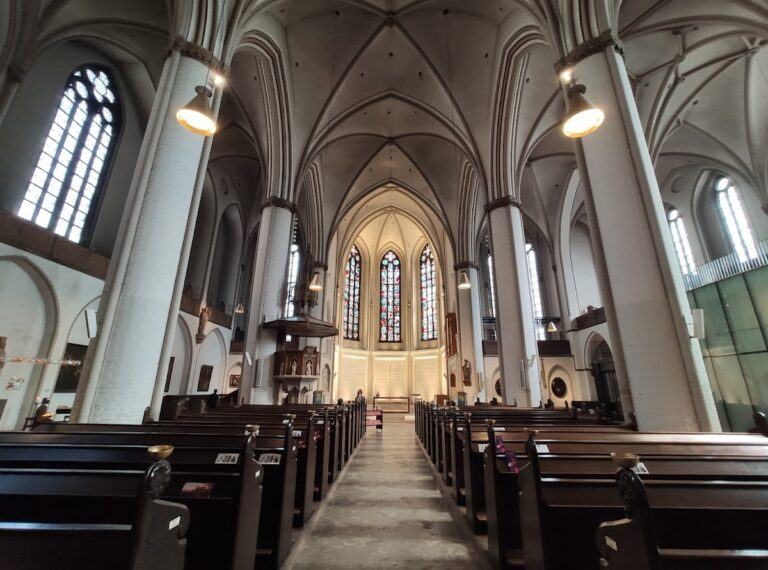
St. Catherine’s is a three-aisled, six-bay Gothic brick pseudo-basilica, meaning that its central nave rises above the side aisles without the full clerestory arrangement of a basilica. A one-bay polygonal chancel and an ambulatory, a passage around the outside of the chancel, complete the main plan. The central nave is approximately 29 metres high. The church measures about 28 metres internally in width and 75.5 metres externally in length, including the tower. Its axis is shifted northward in relation to the tower.
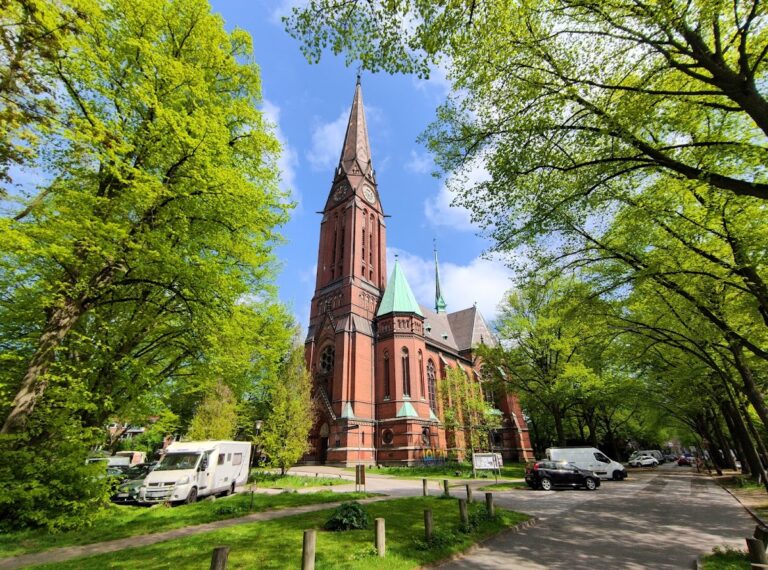
The western tower combines the surviving thirteenth-century shaft with a reconstructed upper structure. The Renaissance facade uses sandstone, while the rebuilt tower carries a stepped Baroque spire based on the seventeenth-century form and reaching 116.7 metres. Peter Marquard of Plauen created the spire. His brother Joachim Marquard built the tower superstructure of St. Mary’s Church in Zwickau, and a comparable tower from the Marquard workshop survives at St. Peter’s Church in Riga.
Brick is the principal material of the church. Tall Gothic windows open through the walls, and the interior, including its vaults, is painted white. Masonry anchors reinforce the walls against settlement on the Elbe marshland, including one marked 1660. Baroque door portals taken from old Hamburg merchants’ houses remain part of the building, while later additions preserve the character of the original annexes through modern forms. The postwar reconstruction incorporated steel reinforcement into the tower, and the later renovation renewed the copper roof, replaced damaged masonry, and rebuilt the buttresses.
Paintings, Sculpture, and Memorials
The Crucifixion of Christ
Wilm Dedeke’s The Crucifixion of Christ is an oil painting on oak measuring 197 by 130 centimetres. Dating from around 1500, it hangs beside the southern entrance. In the late nineteenth century, and probably originally, it hung on the first northern pillar. The donor figures at the lower edge are identified by their coats of arms as Tile, who died in 1491, and his wife Tibbeke Nigel, who died in 1503.
The Lamentation of Christ
A Dutch panel painting from around 1520 depicts The Lamentation of Christ. Its donor figures are Anna Brüning, also recorded as Büring, who died in 1537, and her husband Henning, who died in 1499. Their coats of arms appear in the painting. Two paintings were lent to the Hamburger Kunsthalle in 1899. Replacement copies made during the war burned, and the originals later returned to the church.
Saint Catherine Sculptures
Two late-medieval wooden sculptures of Saint Catherine came from the Upper German region. One dates from the second half of the fifteenth century and the other from the beginning of the sixteenth century. A South German school sculpture of the saint from the sixteenth century was donated to the church in 1953.
Windows and Epitaphs
Hans-Gottfried von Stockhausen created the east-choir window Awake, the Voice Calls Us in 1956 and the north window Annunciation to the Shepherds in 1957. The lower part of the north window is partly obscured by the choir organ. Ingeborg zu Schleswig-Holstein created the cycle Way into the Light between 1984 and 1986. It comprises 24 panel paintings and twelve rosettes for the clerestory and was displayed on loan until the 2007 restoration.
The church retains a marble-and-alabaster epitaph, a commemorative memorial, for city councillor Caspar Moller, who died in 1610, and a marble epitaph for city councillor Georg von der Fechte, who died in 1630.
Postwar Furnishings
Altar and Pulpit
O. Munch made the main altar in 1956. Its altar table, or mensa, and raised lower platform, or predella, are of shell limestone, while the bronze reredos, the ornamental structure behind the altar, contains a central Pentecost panel. The predella depicts the Expulsion from Paradise, and the side wings show three Easter scenes. A Cross of Nails from Coventry Cathedral stands on the altar as a symbol of reconciliation between Germany and Britain.
O. Munch’s pulpit dates from 1955 and 1956 and carries reliefs depicting scenes from the Old and New Testaments. H. Lander created the altar relief Body of Christ in 1983. It depicts the Last Supper, with Christ extending his hands over the bread and the outlines of the twelve apostles behind him, including Judas with his head turned away.
Baptismal Font and Crucifix
H. Kock made the bronze baptismal font in 1964. A crucifix installed in the southern aisle in 1954 incorporates a figure of the crucified Christ dating from around 1300 and reportedly from Aachen Cathedral.
Organs
Main Organ
The reconstructed main organ has a facade from the transition between the Late Renaissance and Early Baroque. Its Rückpositiv appears in reduced form in the gallery balustrade. Both cases feature a round central tower with outer pointed towers joined by two-storey flat fields. Two large polygonal pedal towers flank the manual divisions and are crowned by angels blowing trumpets. Carved veilwork and richly moulded cornices decorate all the pipe fields.
The instrument has four manuals and pedal, 61 stops, three tremulants, two cymbel stars, and the couplings III/II, IV/III, and I/P. It uses an unequal Bach-Kellner temperament at a1 = 465 Hz at 20 degrees Celsius. The historical meantone temperament was not restored.
Choir Organ
The choir organ has a K-shaped facade referring to the church, its builder, and its sponsor Otto Krahn. It has 15 stops distributed across two manuals and pedal and uses a well-tempered tuning.
Bell Peal
The tower contains five bronze bells tuned to f0, c1, e1, g1, and a1. The largest, Soli Deo Gloria, was cast by Hans Nuessel in 1626. Weighing 6,500 kilograms and measuring 2,165 millimetres in diameter, it is the largest surviving bell by that founder. It normally sounds alone only on Good Friday and at funerals. The four smaller bells were cast by Friedrich Wilhelm Schilling in Heidelberg in 1957 and are named Jubilate, Cantate, Rogate, and Exaudi. Rogate weighs 903 kilograms and measures 1,150 millimetres in diameter, while Exaudi weighs 879 kilograms and measures 1,079 millimetres.
The 1626 bell developed a 1.20-metre crack and was taken out of service. In September 2025 it was removed from the tower for repair at the Eijsbouts bell foundry. The same intervention replaces the heavily worn steel bell frame and steel yokes with wooden ones, renovates the belfry, and renews the bell controls.
Nearby sites