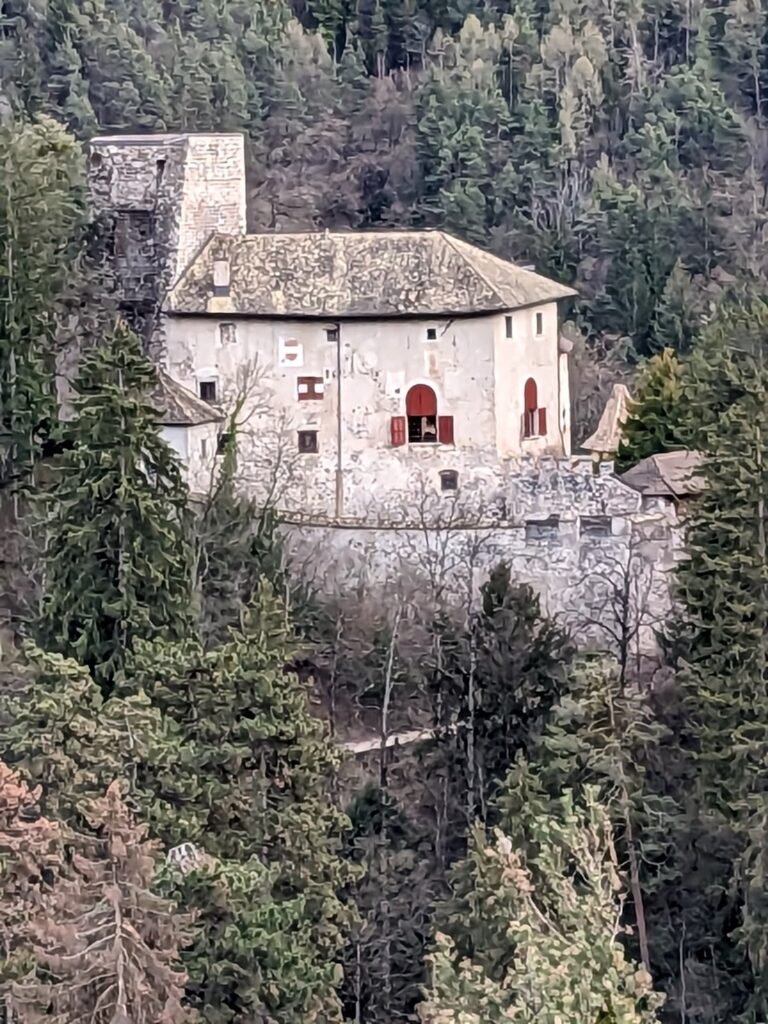
Saint Bartholomew Church: A Medieval Sanctuary and Farmstead Church in Romeno, Italy


Site at a Glance
- Rating
- 4.6
- Popularity
- Very Low
- Country
- Italy
- Primary era
- Medieval
- External website
- Open
- Eras represented
- Classical, Medieval
- Civilizations
- Holy Roman Empire, Roman
- Site type
- Religious
- Remains
- Church
On this page24 sections
History
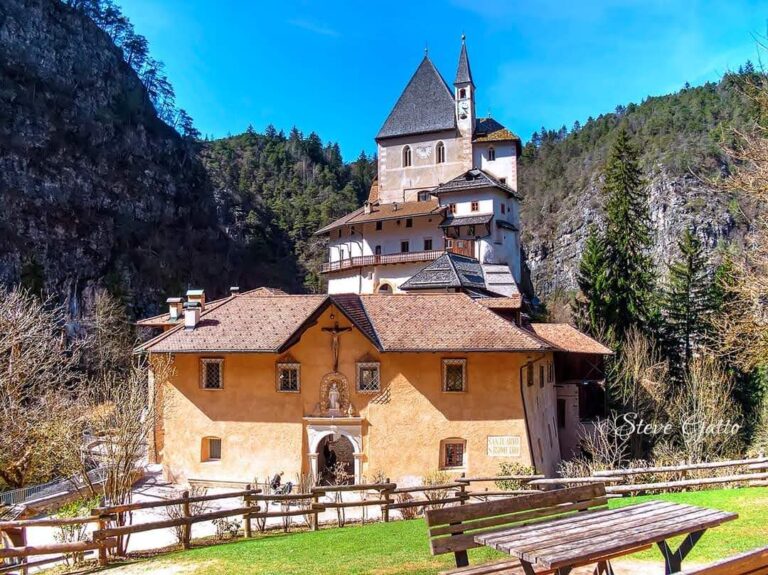
Saint Bartholomew Church is a historic church in Italy, standing beside the San Bartolomeo farmstead about one kilometre from Romeno. Built and developed through several Christian and medieval phases, it is dedicated to Saints Bartholomew and Thomas and belongs to the Archdiocese of Trento. The church is regarded as one of the principal historical and painted monuments of the Non Valley, especially for its thirteenth-century frescoes, which combine Byzantine influence with western Romanesque traditions.
Roman and Early Christian Origins
The area around the farmstead is considered one of the oldest human settlement zones in the Upper Non Valley. Roman antiquities found at Romeno include altar fragments, inscription fragments, and pieces of sarcophagi. Their presence has led to the interpretation that the church may stand over an earlier pagan place of worship, possibly a temple dedicated to Saturn, the Roman deity associated particularly with agriculture and harvests.
The earliest Christian sanctuary may have originated in the fourth century. This possibility has been connected with a church destroyed at Sanzeno and with the missionary martyrs Sisinnius, Martyrius, and Alexander, who may have built it. The church’s survival has been cautiously associated with the presence of a substantial Roman garrison at Romeno. These early phases remain partly hypothetical, but the Roman altar fragments and a reused altar stone support the idea of a Christian foundation established in a pre-Christian religious setting.
By about the eleventh century, the farmstead may have become the seat of a Lombard gastaldia, an early medieval administrative district or estate governed by a local official. A rural settlement and Christian place of worship are thought to have developed around the earlier cult site. Romeno later became an episcopal gastaldia, administered from the Court of Saint Thomas. An important route toward the Adige Valley passed between the farmstead and the church before continuing toward the Mendola Pass. An annual cattle fair was formerly held on 24 August, the feast of Saint Bartholomew, further linking the place to the agricultural life of the surrounding area.
The Medieval Hospice
During the late twelfth and early thirteenth centuries, the location also served travellers and pilgrims. At the request of Corrado of Beseno, bishop of Trento from 1189 to 1205, and Federico Vanga, bishop from 1207 to 1218, a hospice was established to offer protection and shelter. It was probably built between 1191 and 1214. The institution was later administered as a monastery and was initially entrusted to the Hospitaller Brothers of Saint Anthony of Vienne, a French religious congregation associated with care for the sick and assistance to travellers and pilgrims.
Documents attest to the residential complex and its adjoining church from at least the eleventh century. A text known through a later transcription mentions the church in 1187. The hospice was no longer active from about 1400, and in 1456 the hospice of Saint Thomas was described as effectively suppressed and no longer independently administered. It had become an ecclesiastical benefice, an endowment whose income supported its holder. A document from 1522 nevertheless indicates that confraternity members and a hospice may still have been present at the farmstead.
Ecclesiastical and Civil Ownership
In 1593 the benefice passed to the first episcopal seminary, while the agricultural holdings were leased. In spring 1612, an inquisitorial commission preparing the witch trial of Coredo came to Romeno and the Court of Saint Thomas to investigate suspected witchcraft and gather evidence in the Upper Non Valley.
In 1667 the San Tomaso priory farmstead, including the church of Saints Bartholomew and Thomas, was granted in perpetual lease to the brothers Giovanni and Nicolò Calliari of Romeno. A perpetual lease was a long-term arrangement governed by specified obligations. The Calliari family was legally required to maintain the church and farmstead, and descendants later became the owners.
Napoleon’s arrival in 1797 brought the dissolution of the Principality of Trento. The farmstead consequently passed from ecclesiastical to civil ownership, although the Calliari family continued to manage it. After the territory returned to Austria, the perpetual lease was reinstated, with an annual rent of 12 measures of rye and 6 of oats, as well as other obligations. The Calliari family later redeemed the arrangement and became absolute owners, free from the requirement to maintain the agricultural estate as a single unit.
Reduction, Restoration, and Archaeological Investigation
In 1830 the west-facing part of the church, including the facade and part of the building, was demolished by order of the bishop. The church was reduced to roughly half its former length. Its earlier length had been approximately 17.50 metres, while the surviving building is almost square in plan.
The church was restored in 1923 and again in 1925. The first intervention replaced the heavy masonry roof with a wooden one, removed limewash applied in the eighteenth century, and revealed the frescoes beneath it. The Roman altar stone now used beneath the altar was also brought to light. Three wooden sculptures were removed or relocated during the work. The crucifix remained in the central apse, while the Madonna and Child and Saint Bartholomew were moved to the adjoining farmstead. They were later transferred to the parish house for restoration and are now displayed beside the main apse in the Archpriest Church of Santa Maria Assunta in Romeno.
In 1985 the church passed from the Calliari family to the parish through a donation by the family’s numerous heirs. In 2003, electrical-resistivity testing investigated whether parts of the demolished church survived underground. Buried wall fragments were found, and archaeological excavation followed to establish whether they belonged to the earlier church or to another external structure.
Remains
Saint Bartholomew Church now has an almost square plan, measuring approximately 9.40 by 8.45 metres, although another description gives a present length of about 10 metres and a width of about 9 metres. The building originally had one central apse. Two side apses were added about three centuries later, creating a three-apsed eastern end. The eastern wall projects around the central apse and is divided by four pilasters. Three narrow single-light windows between them illuminate the apse and altar area and may carry a symbolic reference to the Trinity. The church has a relatively recent wooden ceiling, while its external plaster belongs to several periods.
Exterior and Medieval Complex
Church Facade
The principal facade has a small undecorated rose window above a single entrance door. A recess immediately inside the entrance on the right may mark the position of a former bell tower, although that interpretation is not securely established. The western part of the building was removed in 1830, leaving the present shortened form.
Former Hospice
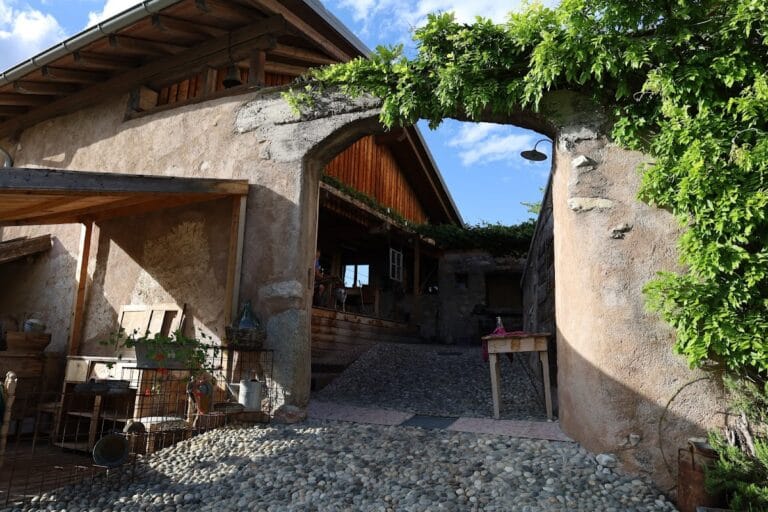
The former hospice survives through elements incorporated into the adjoining farmstead. These include foundation walls, several vaults, and a courtyard entrance with red-stone jambs. A Romanesque fresco showing the Virgin and three saints also survives within the farmstead. The hospice is no longer active as an institution, but these structural remains preserve its connection with the church and the route toward the Adige Valley and Mendola Pass.
Frescoes and Apse Decoration
Central Apse
The frescoes date mainly from the first half of the thirteenth century and cover the three apses and the interior surfaces except the west wall. Their style joins Byzantine and western Romanesque currents, particularly the Rhenish or German tradition. Yellow, red, and green dominate the painted decoration. The frescoes were made by the same workshop that worked at the church of San Giacomo at Kastelaz in Termeno.
The central apse ends in a semicircle and has a quarter-spherical vault with a horseshoe-shaped base. In the vault, Christ sits on a throne ornamented with numerous beaded circles. He appears within a flattened mandorla, an almond-shaped or vertically compressed oval surrounding a sacred figure, against a blue ground. He raises both arms, blessing with one hand and holding an open book with the other. His robe has a beaded hem, and his hair falls over his left shoulder.
The four Evangelists surround the central composition. Matthew has very long curling wings, while John and Mark are badly damaged. Mark is accompanied by a small-winged lion. Luke is among the best-preserved figures, with long outstretched wings and horns. The drum of the apse contains all twelve apostles, arranged against coloured bands, including a blue upper band and white interlacing on a brown ground. Their poses and actions vary rather than following a single repeated pattern.
Between the three windows is a scene of Christ’s entry into Jerusalem. Two men among trees hold branches, while the apostles are divided into two groups and a haloed figure appears below them.
Left Apse
The left apse has a vaulted interior filled by four very pale cherubim with multicoloured wings. They support a badly damaged Christ within a mandorla. The borders carry eye motifs, and the cherubim’s hands and feet are rendered in an awkward, strongly physical manner. The Christ figure differs from the one in the opposite apse in facial treatment, clothing, colouring, and the design of the cruciform halo. A badly damaged bishop holding a pastoral staff and accompanied by a praying figure is painted on the pier between the left and central apses.
Right Apse
The southern, or right, apse has a small domed vault. On its eastern face, Christ gives a blessing, with Saints Peter and Paul holding books at either side. Earlier interpretations identified these figures as Saints Thomas and Bartholomew, with the identification of Bartholomew partly linked to a knife, the symbol of his martyrdom.
Another bishop appears in the vault. He has been identified either as Saint Vigilius, the fourth-century bishop of Trento, or as Federico Vanga. At the centre is the Mystic Lamb, a Christian image of Christ represented as a lamb carrying a cross. Several letters in the apse remain undeciphered and may be decorative. The Christ figure here has a richer and more clearly defined robe than the one in the left apse, and its different halo suggests that the two lateral works were not painted by the same artist.
Narrative Wall Paintings
Eastern Wall and Triumphal Arch
The eastern wall above the apses shows a dark-skinned man entwined by a serpent, probably representing a person bound by sin. Traces above the left apse may show two peacocks, possibly a baptismal symbol, together with part of a foot. A red-and-yellow frieze borders the arch.
Above the central apse, the triumphal arch presents Cain and Abel’s offerings. Abel holds an absent or lost lamb, probably wrapped in a white cloth, and wears a cap. Cain has a single-coloured garment with white highlights. The hand of God, surrounded by clouds, turns toward Cain in rejection.
Above the right apse is a Nativity scene. Mary reclines on a bed and looks toward the infant in a manger. Joseph, bearded and pensive, sits on a cylindrical cushion below a canopy, while an angel leans toward the manger holding an unidentified object. Beneath this scene, the three Magi walk before their meeting with Herod, probably in the direction of Jerusalem.
North Wall
The upper north wall contains two men, a possible martyrdom of Saint John the Evangelist or Saint Margaret, and a scene that may show Herod, Salome, and Herod’s wife. In the latter composition, Herod orders the martyrdom of Saint John the Baptist, and a table bearing a bowl stands before the figures.
The lower north wall includes a damaged, indecipherable figure that may be covered with feathers or scales and has bright red eyes. Five female saints stand beneath arcades supported by columns decorated with coloured dotted motifs. Their frontal and repetitive arrangement differs from the treatment of the other painted figures. A detached fragment inside the church shows the horns of a bovine animal and may have belonged to a lost scene of Saint Proculus. On the exterior north wall, traces of a human figure may represent Saint Christopher, although the painting is illegible.
South Wall
A frieze divides the south wall. The upper section may depict the Flagellation or Crucifixion of Christ. A figure at the western end may belong to a scene showing the division of Christ’s robe.
The lower section shows the Deposition from the Cross. One figure removes the nails in an unusual manner. The sun and moon beside the cross symbolize the pope and the emperor, while Mary sorrowfully holds Christ’s hand and the apostle John appears at the foot of the cross. The women at the tomb occupy the same lower section.
A Judgment scene on the wall includes demons on both sides. One demon sits on a chalice while reading a long scroll. Two women, one wearing a braid, appear to have been painted by a later artist because their features differ from those of the other figures. Beneath the Nativity, a fragment of Saint Martin giving away his cloak survives with part of a frontal horse. The charitable subject may relate to the former hospice’s work assisting travellers and pilgrims.
Roman Stones and Baptismal Font
Roman Inscribed Stones
Ten Roman-period inscribed stone slabs and additional fragments have been found at Romeno. Some are embedded in the church’s exterior walls, and seven of the ten slabs were found near the farmstead. The finds include a red-limestone altar dedicated to Saturn, measuring 27 by 31 centimetres and dating to the third century AD. Another fragment, in white limestone and measuring 12 by 24 centimetres, comes from a Late Imperial inscription that mentions Saturn.
Two white-limestone sarcophagus fragments, one bearing an inscription, were also found, together with several smaller inscription pieces, including one that is now missing. A small polished white-limestone fragment is embedded in the southern exterior wall, while a framed inscribed fragment is set into the western wall. The present altar consists of a mensa, the horizontal slab forming the top of an altar, resting on a Roman limestone altar. Its earlier inscription was probably scraped away when the stone was adapted for Christian use. The reused altar is smooth and approximately 90 centimetres high and 65 centimetres wide.
Ancient Font
An ancient immersion baptismal font stands beside the entrance. Its circular basin was carved from a single block of white limestone. It is 77 centimetres high, has a circumference of 347 centimetres, a basin diameter of 84 centimetres, and walls 13 centimetres thick.
The relief decoration may include three rosettes, two heads, and an animal, possibly a lion. Numerous deep holes and injuries show that the basin was altered for another use. A groove once held a water pipe when it served as a fountain. Its original location is uncertain, although one restoration hypothesis places it in Romeno’s former parish church, demolished in 1773.
Wooden Sculpture and Painted Altarpiece
Madonna and Child
The wooden Madonna and Child is 77 centimetres high, carved and hollowed at the back. Mary wears a red robe decorated with blue flowers and gold borders. The outside of her mantle is covered with silver leaf, while the inside is blue. She has two gilded haloes, one wooden and one metal, and holds the naked Christ Child in her left hand. The child raises his right hand in blessing, holds a globe in the other, and has three gilded rays set into his curly hair.
Saint Bartholomew
The wooden statue of Saint Bartholomew is 95.5 centimetres high. It is carved in half-round relief with a flat back, and its coarse workmanship suggests a local popular origin. The saint stands on a green-painted pedestal and wears a blue tunic with red flowers and a red mantle decorated with varied brushstrokes, powdered pigment, and gold-leaf borders. He holds a book whose writing is now illegible and a knife, the symbol of his martyrdom by flaying.
Canvas Painting
A 140-by-90-centimetre oil painting on hemp canvas hangs on the interior wall opposite the main entrance. It is enclosed in a polychrome wooden frame and probably served as the former high altarpiece before being moved during the restoration work of the 1920s.
The painting shows the Madonna and Child in glory, surrounded by angels holding a crown above Mary and by cherubim. Saints Bartholomew and Thomas appear below in a landscape containing a distant city and a church with two domes. The work appears to have been produced by a local workshop. Inscriptions and dates on the board protecting the reverse include a partly preserved date beginning with “166,” an engraved “1783,” and nineteenth-century pencil inscriptions naming Cesare Deromedi and Romedio Deromedi in 1867 and Ermanno Deromedi in 1883. The frame bears the monogram “IHS” on its pediment and a partly preserved date ending in “81,” while its style points to the same general period.