Monastery of San Millán de Yuso: A Benedictine and Augustinian Recollect Monastic Complex in Spain



Site at a Glance
- Rating
- 4.6
- Popularity
- Medium
- Country
- Spain
- Primary era
- Early Modern
- External website
- Open
- Eras represented
- Early Modern
- Civilizations
- Crown of Castile, Spanish
- Site type
- Religious
- Remains
- Monastery
On this page22 sections
History
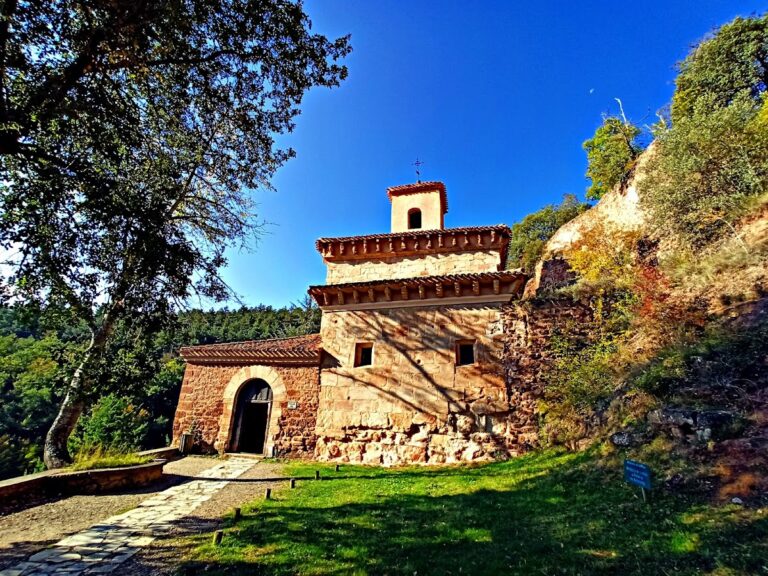
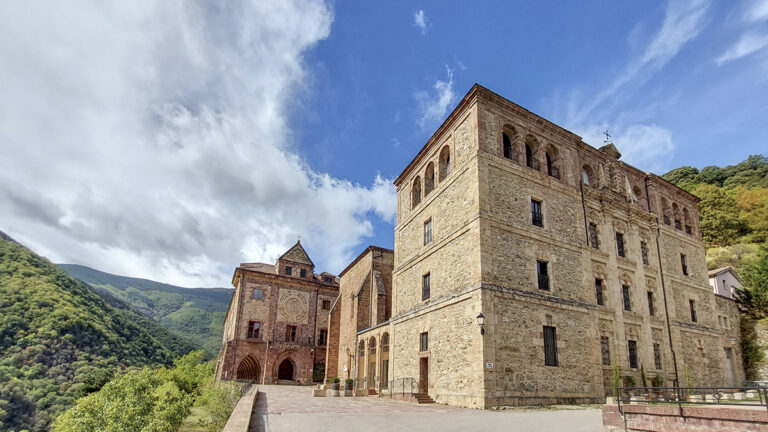
The Monastery of San Millán de Yuso is a historic monastery in San Millán de la Cogolla, Spain, built for the Christian monastic community associated with Saint Emilian. Its construction was ordered in 1053 by King García Sánchez III of Pamplona, also known as García of Nájera, after he founded Santa María la Real of Nájera. Yuso, whose name means “lower” in archaic Castilian, forms a monumental complex with the older Monastery of San Millán de Suso, or “upper” monastery, on the opposite side of the monastic tradition.
From Hermitage to Monastic Community
Saint Emilian, or Emiliano, was traditionally a shepherd who became a hermit. He died in 574 at the age of 101 and was buried by his disciples in the cave where he had lived. The first monastery, Suso, developed around that cave. About fifty years later, Saint Braulio, bishop of Zaragoza, wrote Emilian’s life, establishing an important written account of the saint and his community.
A foundation tradition connects Yuso with an attempted translation of Saint Emilian’s remains. When oxen pulling a cart from Suso toward Nájera stopped near the Cárdenas River, García Sánchez III interpreted the event as a sign that the saint wished to remain in the area. He therefore ordered a new monastery to be built lower down, giving rise to Yuso.
Suso and Yuso continued to coexist until at least 1100. Suso retained a Mozarabic rule, a medieval Christian monastic and liturgical tradition associated especially with the Iberian Peninsula under Muslim rule, and supported both male and female communities. Yuso was reorganized according to the Benedictine rule, which governed communal prayer, work, and obedience. From the twelfth century, the principal monastic community was Benedictine and based at Yuso. Together, the two monasteries represent a transition from eremitic religious life, centered on solitary devotion, to a cenobitic community of monks living under a common rule.
Manuscripts, Language, and Cultural Memory
The tenth and eleventh centuries brought a period of spiritual, religious, artistic, and cultural flourishing to San Millán. During the eleventh century, a monk wrote vernacular words and phrases in the margins of a Latin manuscript now called Codex 60. These marginal annotations, known as the Glosas Emilianenses, include early Spanish and the earliest written Basque words identified in the material. The Spanish glosses are classified by some scholars as early Castilian and by others as early Navarro-Aragonese.
The monasteries’ association with the beginnings of written Spanish and Basque led to the celebration of the Spanish-language millennium at Yuso in 1977. The monastery also acquired the metaphorical designation “Cradle of the Language.” Its literary history is linked with Gonzalo de Berceo, who was educated at Suso and later served as a clerical notary at Yuso.
Expulsions, Abandonment, and Religious Renewal
The Benedictines were expelled in 1809 under a decree of Joseph Bonaparte and returned in 1813. They were expelled again between December 1820 and July 1823 during the constitutional period of Ferdinand VII. During that interval, the royal administration sold the monastic pharmacy at public auction.
The final expulsion followed the ecclesiastical confiscation of Mendizábal. Yuso remained abandoned for thirty-one years from November 1835. A house of Franciscan missionaries from Bermeo occupied the monastery between 1866 and 1868. After another ten years of abandonment, Augustinian Recollect friars took possession in 1878 and used the monastery as a house for training missionaries assigned to the Philippines. The first rehabilitation works undertaken by the Augustinian Recollects were carried out by Friar Toribio Minguella.
The monastery remains associated with both Benedictine and Augustinian Recollect communities. The Augustinian Recollects recovered more than eighty percent of the original monastic library after the Benedictines’ departure. Saint Ezequiel Moreno, an Augustinian Recollect missionary in the Philippines and later bishop of Pasto in Colombia, lived briefly at Yuso before leaving for Colombia.
Modern Cultural Institutions
The autonomous statute of La Rioja, also called the Statute of San Millán, was signed at the monastery on 8 May 1981. Yuso was declared a Spanish Asset of Cultural Interest in 1931. On 4 December 1997, Suso and Yuso were declared a UNESCO World Heritage cultural property under criteria concerning cultural interchange, an important architectural ensemble, and associations with ideas, traditions, and literary and religious works of outstanding universal significance.
The San Millán Foundation was established at Yuso on 8 October 1998. Based at the monastery, it protects and conserves the complex’s architectural, historical, and philological heritage and promotes research into the origins of Spanish. The foundation established the Center for Research into the Castilian Language, Cilengua, in the Cura wing and the Cloister of Santa Rita. Its three institutes study the origins of Spanish, the history of the language, and Hispanic library collections.
The Association of Friends of San Millán, founded in 1974 as a public-interest nonprofit organization, supports the Augustinian Recollect community intellectually, materially, and financially. It is based at Yuso, and its members are associated with the monastery as benefactors.
People Connected with Yuso
José Sáenz de Aguirre, a Benedictine monk of Yuso, was a theologian, professor at Salamanca, and historian of church councils. Pope Innocent XI later appointed him cardinal at the recommendation of Charles II. Sáenz de Aguirre requested that his heart be brought to San Millán. It was first placed at Suso and later transferred to Yuso after the confiscation of monastic property.
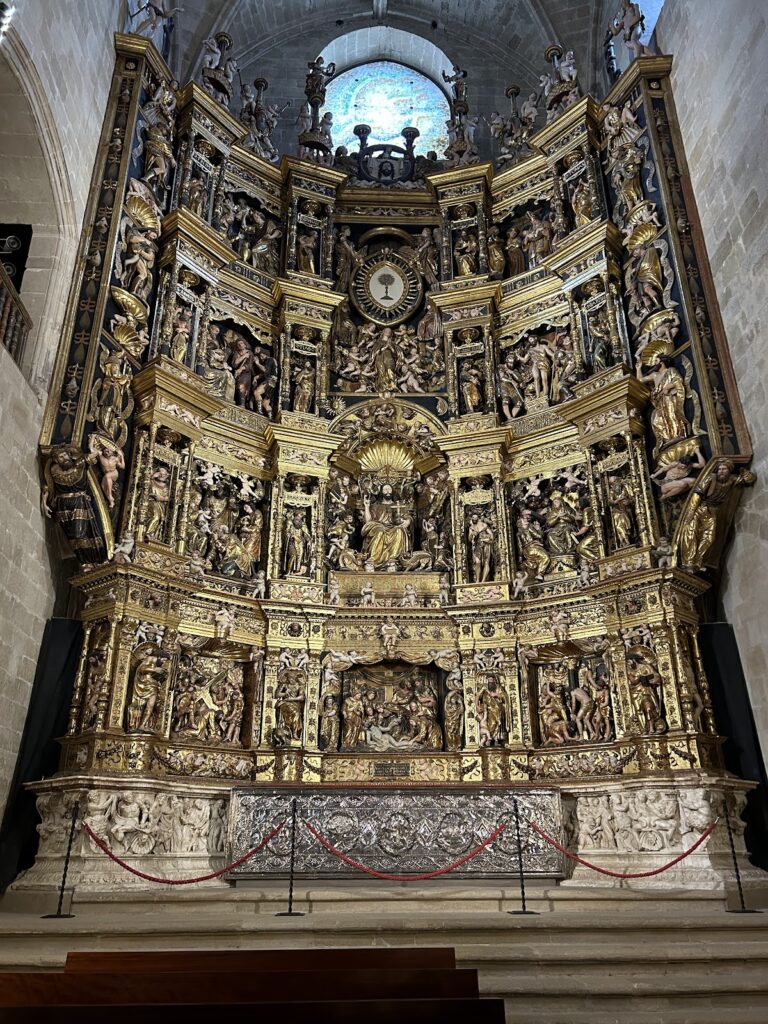
Friar Juan Ricci, a Benedictine painter, worked at the monastery from 1653 to 1656 under Abbot Ambrosio Gómez. His works at Yuso include paintings in the royal hall and the high altar retable, an ornamental structure behind an altar that incorporates painting or sculpture.
Remains
Yuso is a large monastic complex whose original Romanesque buildings were completely demolished and rebuilt during the sixteenth century. The replacement complex was created in the Herrerian style, an austere and geometrical architectural language associated with late sixteenth- and seventeenth-century Spain. Its architectural character continued to develop through the seventeenth and eighteenth centuries, combining Renaissance, Gothic, Mannerist, Baroque, Classicist, Rococo, and Plateresque elements.
Entrance and Cloisters
Baroque Entrance and Hall of the Kings
The seventeenth-century Baroque entrance has Corinthian columns and a relief of Saint Emilian on horseback. The architect Pablo de Basave designed it, and the sculptor Diego de Lizarraga executed it. The entrance opens into the Hall of the Kings, named for four paintings of royal benefactors. The Royal Staircase bears the arms of the abbey and Castile and the date 1697. The hall also contains reproductions of Codex 60 and folio 72 recto, where the Glosas Emilianenses appear, together with commemorative plaques and a facsimile of the codex.
Processional Cloister
The ground-floor cloister, also called the Processional Cloister, was begun by Juan Pérez de Solarte in 1549. It combines Renaissance planning with Gothic vaults, pointed and doubled arches, buttresses, and roughly carved Gothic pinnacles with hooks. The door linking the lower cloister with the church is a Mannerist work by the Italian Andrés de Rodi, dated 1554. Its decoration indicates the treatment intended for the rest of the lower cloister, which was never completed.
Upper Cloister
The upper cloister is Classicist. Tuscan columns are attached to pillars, while the frieze has triglyphs and metopes, and the capitals are decorated with three rosettes and egg moulding. Twenty-five paintings by José Bejes depict the miracles of Saint Emilian described in Saint Braulio’s biography.
Church and Liturgical Furnishings
Church Structure and Choir
The church has three naves, a star vault, and a lantern tower. Construction began in 1504 at the command of Abbot Friar Miguel de Alzaga and ended thirty-six years later. Its architectural character is Late Gothic. The interior was divided into two liturgical areas. The front portion, extending from the central choir through the presbytery to the relic shrine, was reserved for the monks. The rear portion, from the retrochoir to the entrance, was used by townspeople when they were admitted.
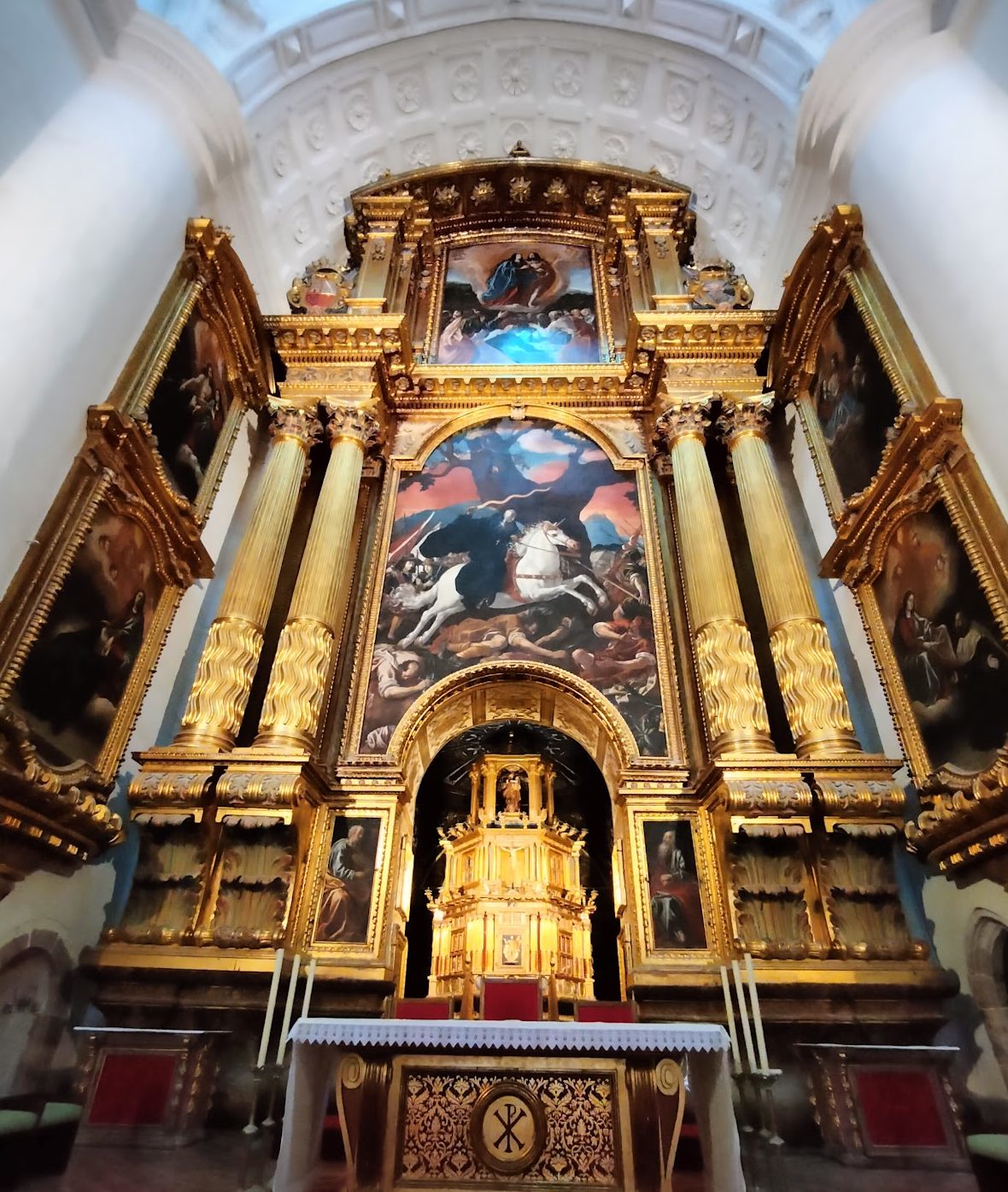
The lower choir stalls were made around 1640 by the Flemish woodcarver Matero Frabricio, following a design by a monk of San Juan de Burgos. A seventeenth-century retable contains paintings by Friar Juan Ricci, including a central image of Saint Emilian on horseback at the Battle of Hacinas in Burgos.
Retrochoir and Pulpit
The retrochoir, the space behind the choir, served the townspeople. It functions both as the parish retable and as the route through the choir toward the high altar. Francisco de Bisou made it in 1767 in the French Rococo style, with full-relief sculptures probably produced by the workshop of Pascual de Mena. The figures represent Saint Braulio, Saint Felices, Saint Aselo, Saint Gerontius, Saint Citonatus, Saint Sophronius, Saint Potamia, and Saint Oria. Braulio appears as Emilian’s biographer, while Felices is shown as Emilian’s teacher and as the patron of Haro. The other figures are disciples or associated saints.
A late-sixteenth-century Plateresque pulpit stands in the retrochoir area. Plateresque is a richly ornamented Spanish style that combines late Gothic and Renaissance features. The pulpit’s half-reliefs represent the four Evangelists.
Oratory and Reliquaries
The oratory contains reproductions of the eleventh-century reliquary chest of Saint Emilian and the twelfth-century chest of his teacher, Saint Felices. Sancho IV of Navarre commissioned the Saint Emilian reliquary in 1067. Its original contents included fine textiles, and its exterior was covered with gold, silver, precious stones, and ivory plaques. Twenty-four ivory plaques decorated the chest, with eleven on each side and one at the center of each end.
Napoleonic soldiers removed the gold and precious stones from the Saint Emilian reliquary in 1809. The surviving old component at Yuso retains its original wood and an eleventh-century Arabic textile lining. A new silver reliquary made in 1944 incorporates the surviving original Romanesque ivories, including thirteen scenes from Saint Emilian’s life, two fragments from the same series, and plaques representing Abbot Blas and the scribe Munio.
A solar phenomenon occurs in the church around the spring and autumn equinoxes, approximately 21 March and 21 September. At about 6:15 p.m., a beam enters through the rear rose window, passes through the circular opening above the retrochoir, and forms a circle of light at the church’s geometric center. The light marks the church axis and its eastward orientation.
Monastic Rooms
Sacristy
The sacristy originally served as the chapter house. Its architecture dates from the sixteenth century, and it began functioning as a sacristy in the late seventeenth century. Most of its visible paintings belong to that period, while the ceiling frescoes and central tables date from the eighteenth century. Abbot Friar José Fernández, who served from 1693 to 1697, decorated the room with twelve copper paintings above the walnut cupboards. The collection was later enlarged to twenty-four, and four large canvases were brought from Naples. A Baroque retable is headed by a statue of Our Lady Queen of the Angels holding a sceptre and wearing a crown.
Great Refectory
The great refectory, or monks’ dining room, was begun in 1580. It has a Doric entrance, seats with fluted Ionic pilasters, and a pulpit. The assembler Juan de Iriarte was contracted in 1597, and the fourteen tables were made in 1608. The furnishings remain complete.
Library, Archive, and Manuscripts
Codices and Choir Books
The Sala of Codices and Choir Books contains about thirty enormous seventeenth-century choir books. Each weighs between 40 and 60 kilograms and was made by hand over four years using parchment prepared from the skins of approximately 2,000 cattle. Together, the books contain the full annual cycle of chants used by the monastic community. The room also contains facsimiles of Codex 46, dated 964 and described as an encyclopedic dictionary of approximately 20,000 entries, and Codex 60, with the Glosas Emilianenses, early Spanish phrases, and Basque words. Works by the calligrapher Friar Martín de Palencia and Gonzalo de Berceo are also held there.
Archive and Library
The archive and library continue the work of the earlier San Millán scriptorium, a room or workshop where manuscripts were copied and produced. The archive includes the Galicano and Bulario cartularies and approximately 300 original documents, including legal suits, donations, sales, privileges, and papal bulls concerning San Millán and its monasteries or churches. Its oldest document concerns the foundation of San Miguel de Pedroso and dates from 759. The collection also includes the Reja de San Millán, written in 1025, a medieval text listing place names and tribute in Álava in Basque and Old Castilian.
The library has a Venetian-style interior dating from 1780 and retains the arrangement given to it by Abbot Anselmo Petite. Its shelves can hold no more than 10,000 volumes, but its importance lies in the quality and rarity of its holdings. The Benedictines left it almost empty in 1835, while the Augustinian Recollects later recovered more than eighty percent of the original books from surrounding towns. Digitization of the documentary holdings began in 2001 and reached more than 72,000 pages from 212 valuable volumes.
Language Hall and Later Uses
The Hall of the Language was inaugurated in 1977 during the Spanish-language millennium celebrations. It contains the coats of arms and flags of Spanish-speaking countries and the Philippines, supplied by their embassies, as well as a bust of Gonzalo de Berceo. The room is used for official events and conferences concerning Spanish. One wing of the monastery has also been converted into the Hostería San Millán hotel, with twenty-five rooms and activities connected with the monastery’s culture and wine tourism.
Nearby sites