Santa Maria del Carmine, Pavia: A Lombard Gothic Carmelite Church


Site at a Glance
- Rating
- 4.6
- Popularity
- Medium
- Country
- Italy
- Primary era
- Medieval
- External website
- Open
- Eras represented
- Medieval, Early Modern, Modern
- Civilizations
- Duchy of Milan, Holy Roman Empire, Spanish
- Site type
- Religious
- Remains
- Church
On this page26 sections
History
Santa Maria del Carmine is a major Roman Catholic church in Pavia, Italy, built for the Carmelite order in the Lombard Gothic style from the late fourteenth century. It remains the parish church of Santa Maria del Carmine, although it is administered by secular clergy. Lombard Gothic combines pointed arches and Gothic tracery with the heavier forms, brickwork, terracotta decoration, and local stone associated with northern Italy.
The Carmelite foundation and Visconti patronage
The Carmelites occupied an earlier church dedicated to Santa Maria del Carmine from 1298. In 1364, Galeazzo II Visconti demolished that building because it stood within the area being developed for Visconti Castle. The Visconti were the ruling dynasty of Milan and controlled Pavia during the church’s foundation and early construction. Galeazzo compensated the Carmelites with the church of Santi Faustino e Giovita, which had been known since at least 1105, and financed a larger replacement church.
Construction of the present church began around 1373–1374 under a project attributed to Bernardo da Venezia, who had also worked on Visconti Castle. The project required the demolition of San Colombano minore, also called San Colombano de Cellanova, an eighth-century church formerly administered by monks of Bobbio Abbey. That church had been suppressed in 1346. The new Carmelite building was conceived on a substantial scale, appropriate to an order whose communities combined contemplative religious life with preaching.
Gian Galeazzo Visconti made a substantial donation to the building work in 1390. Progress then slowed because the simultaneous construction of the Certosa di Pavia drew many craftsmen away from the project. In 1397, Francesco Barbavara, Gian Galeazzo’s treasurer, chose the high altar as the burial place of his family and provided further substantial donations. These interventions helped sustain construction during a period when work proceeded gradually.
Completion and the chapel foundations
Construction continued slowly through the fifteenth century. The church was completed in 1461, while the facade was finished in 1490. Its sixteen lateral chapels were built between 1450 and 1498. Two were financed by the wool workers’ and butchers’ guilds, while aristocratic families supported the others. Their changing dedications and ownership preserve a record of the devotional, social, and occupational groups connected with the church.
In 1509, the Chapel of Saint Sebastian was selected as a burial place for students from France, Flanders, and German-speaking lands who died while attending the University of Pavia. Other chapels also underwent successive changes. One passed from the Ricci family to the Bonati family in 1691. The wool merchants dedicated another to Saint Anne, while the shoemakers’ guild commissioned a chapel for Saint Julius of Orta in 1592. The chapel now dedicated to the Assumption received that title in 1962, after previously being dedicated to Saint Mary Magdalene de’ Pazzi.
The chapel now containing the baptistery was the last to be built, in 1490. It was first dedicated to Saint Alexander and supported by the Visconti Scaramuzza family. Earlier, it had belonged to the butchers’ guild and been dedicated to Saints Luke and Bovo; it was later dedicated to Saint Liborius. The church also received the relics of Blessed Bernardino of Feltre in 1811, after their transfer from the monastery of San Giacomo della Vernavola in Pavia.
Parish life and later changes
The Carmelite convent was suppressed in 1799, and the church became a parish. In 1807, the parish included the subsidiary churches of Santa Trinità, Santi Gervasio e Protasio, San Rocco, Santa Maria di Loreto, Sant’Ivenzio, Santa Croce, the Colombina, Santa Maria Annunciata, and San Gregorio. It had 3,847 communicants in 1807, 4,600 in 1845, and 5,040 in 1877. The clergy numbered 36 priests in 1823, but by 1845 the staff had declined to one parish priest and three assistants.
Several confraternities and devotional associations were active in the parish in 1898. They included the Confraternity of the Blessed Sacrament, the Confraternity of the Rosary, the Pious Union of the Daughters of Mary, the Company of Saint Aloysius Gonzaga, the Pious Union of the Holy Family, and the Third Order of Saint Francis of Assisi. The church’s connection with local groups also continued through memorials and artworks. The chapel of Blessed Bernardino of Feltre contains commemorative imagery, including a large painting commissioned by the guild of bakers, pasta makers, and millers and transferred from Palazzo Malaspina to the chapel in 1939.
The church and its fabric underwent restoration between 2006 and 2010. Further work restored the Saint Anne chapel in 2013 and addressed the baptistery chapel between February 2014 and June 2015, including the removal of alterations introduced during earlier restorations. A fifteenth-century stained-glass panel was restored in 1989 and placed at the center of a new frame.
Remains
Facade, plan, and construction
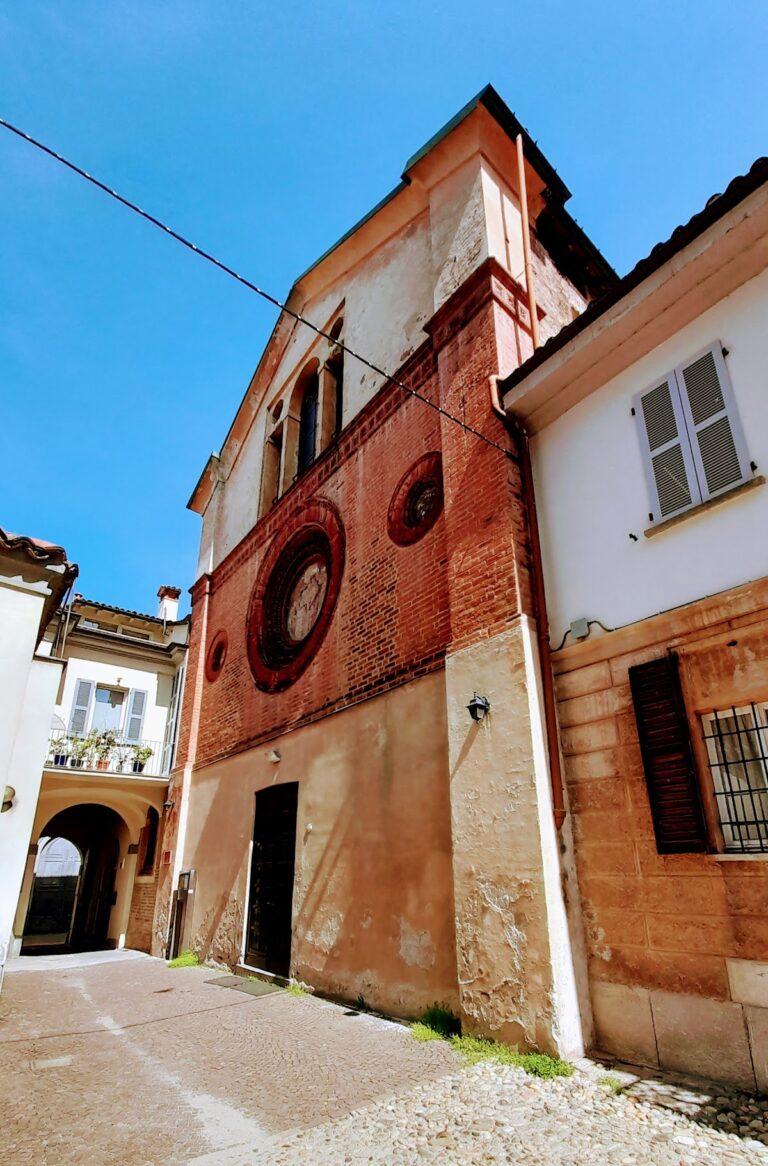
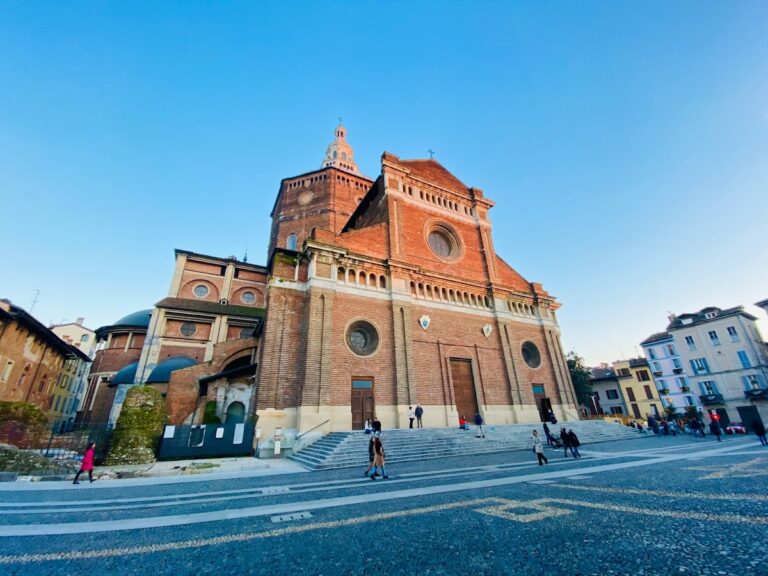
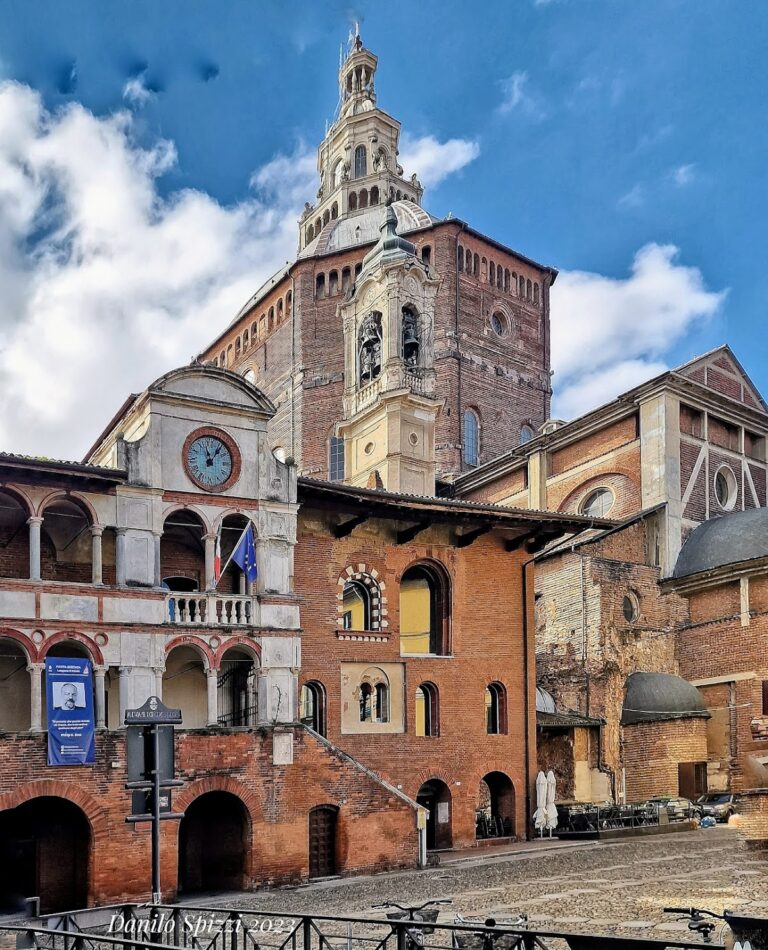
Santa Maria del Carmine stands on Piazza del Carmine. Its exterior combines a slender gabled form and residual Romanesque features with Lombard Gothic decoration. A high plinth of serizzo, a durable gray granite used widely in northern Italian construction, faces the base of the facade. Six pilasters divide the facade into five vertical fields.
The building has a rectangular outer plan containing a Latin-cross church with three naves and square side chapels. The chapels were created by remodeling the outermost aisles, while the original design had five naves. The church measures nearly 80 metres in length and 40 metres in width. Its proportions follow the ad quadratum module, a design system that repeats a square unit to establish relationships across a building’s plan and elevation. The central nave is twice as high as the side naves and is divided into four square bays. Each side-aisle bay is subdivided into two smaller square bays, each opening onto two square chapels.
The vaults are pointed cross-vaults. Their terracotta ribs contrast with the light-colored plaster, while the pillars combine terracotta with gray Angera stone. The three portals were remade in the nineteenth century by Giuseppe Marchesi. Luigi Marchesi’s sculptures, dated 1854, occupy the lunettes, with the Annunciation in the central lunette and Saints Peter and Paul in the side lunettes.
Above the portals are four large pointed-arch mullioned windows, each divided into separate openings by vertical members, together with two outer single-lancet windows. The central terracotta rose window has a broad decorated frame with angel heads, a frieze, and seven square pinnacles. Niches beside it contain the archangel Gabriel and the Virgin of the Annunciation, while a square-framed niche above holds a terracotta relief of the Eternal Father. These sculptures are associated stylistically with the circle of Giovanni Antonio Amadeo, a prominent Lombard sculptor and architect.
Bell tower and sanctuary
Bell tower
The bell tower dates from about 1450 and rises 75 metres, making it the tallest bell tower in Pavia. Friezes enrich its exterior, and the three-light bell-chamber window is adorned with marble columns. Five bells in D3 hang in the chamber. They were cast by the Barigozzi brothers in 1843, probably at Oleggio.
Presbytery and apse
The presbytery, the area around the main altar reserved for the liturgy, contains a marble high altar heavily altered in 1832 in a classicist or neoclassical manner. Above it stands a circular tempietto with the Triumphant Christ, flanked by the Announcing Angel and the Virgin. The white-marble frontal depicts the Veronica, with medallions showing Christ in the Garden of Olives and the Ecce Homo.
A neo-Gothic gallery behind the altar holds an organ made by the Lingiardi brothers in 1836 and modified in 1872. Embedded in the left presbytery wall is a Gothic stone tabernacle depicting the Annunciation. It is a surviving element of the medieval altar. Above the altar in the apse, a polychrome window depicts the Madonna enthroned with the Child. It was made between 1482 and 1489 and attributed to Vincenzo Foppa, a leading fifteenth-century Lombard painter.
The fifteenth-century panel in the apse window was incorporated into new glazing in 1827 and placed at the center of a new frame in 1989. The frame consists of an electric-blue, rounded-corner diamond within a larger circular field of modern geometric motifs. The apse window forms one of two surviving examples in Pavia from the period spanning the fifteenth and early sixteenth centuries, the other being the three apse roundels of San Lanfranco.
Triumphal arch
The triumphal arch carries a large wooden iconostasis, a screen or architectural partition bearing sacred images and emphasizing the sanctuary. Giovanni Battista Trucazzano made it between 1638 and 1645. It bears a crucified Christ flanked by the Virgin and Saint John the Evangelist.
Transept, sacristy, and cloister
Transept paintings and altar
The left wall of the transept contains numerous votive frescoes attributed to pupils or the circle of Michelino da Besozzo, a noted northern Italian Gothic painter and illuminator. They date approximately from 1410 to 1440. The same wall also contains Bernardino Lanzani’s signed and dated 1515 altarpiece of the Child Jesus between the Virgin, Saints Anne and Joachim, and Saint John the Evangelist.
In the left apse-side chapel, an altar was erected in 1905 to a design by Cesare Nava. An opening made in the vault brought light into the formerly dark chapel. Brusca painted the wall decoration, while Sassi produced its statues and reliefs.
Sacristy facade and lavabo
The right transept wall contains the 1576 facade of the sacristy, commissioned by Count Camillo della Pietra and richly decorated with Baroque stucco. Niches around the entrance contain Saint Francis with the stigmata and Saint John the Baptist, while the pediment niche holds the Virgin and Child. Abraded heraldic emblems, including the insignia of the Pietra family, remain on the facade.
The sacristy contains a Renaissance marble lavabo with three bronze dolphin-shaped taps, a relief of the Coronation of the Virgin, and two medallions depicting monks. The lavabo originally stood in the corridor leading to the choir, where the monks used it.
Monastic cloister
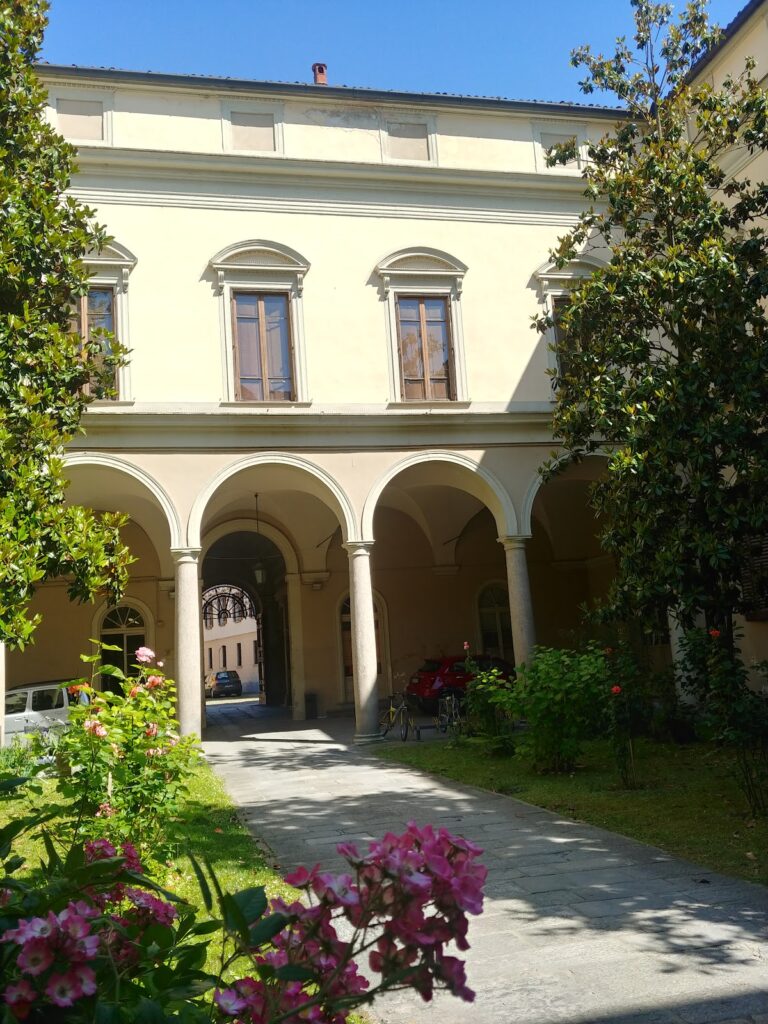
The monastery cloister lies south of the church and is arranged around two courts. The western cloister has arcaded passages on all four sides and is attached to the right nave. The former monastic building now houses the state Torquato Taramelli Scientific High School.
Right-hand chapels
Saint Roch and the former Ricci chapel
The right side of the church contains eight chapels. The first holds a wooden Crucifix formerly belonging to the Confraternity of Saint Roch and Mercy, which assisted condemned prisoners during their final hours. The confraternity was suppressed in 1808 and had previously kept the crucifix in a nearby oratory. The chapel also contains a painting of Saint Roch by Gino Testa and Tommaso Gatti’s Saint Roch Interceding for the Cessation of the Plague, dated 1642. Three carved hedgehogs in the vault keystone recall the chapel’s former ownership by the Ricci family.
The Bonati family renovated the former Ricci chapel after acquiring it in 1691. Its principal painting is Sebastiano Ricci’s Guardian Angel, dated 1694 and restored in 2011. The gilded wooden frame bears the Bonati arms and angels, while the painted wooden altar frontal depicts the archangel Raphael with the child Tobias.
Carmelite devotional imagery
A seventeenth-century oil painting represents the apparition of the Virgin to the future Pope John XXII and the Carmelite salvation promise associated with the so-called Sabbatine Bull of 3 March 1322. The Sabbatine tradition concerns the Virgin’s protection and the release of Carmelite souls from Purgatory. In the painting, the promise appears in Latin on a sheet and concerns the liberation of Carmelite monks on the first Saturday after death.
Saint Anne and Saint Julius of Orta
The Chapel of Saint Anne was commissioned by the wool merchants. Its 1618 altarpiece by Guglielmo Caccia, known as Il Moncalvo, includes scenes of wool production, showing Joachim’s flock, shearing, carding, spinning, and weaving. The lunettes depict Anne and Joachim assisting the church and the poor, together with the prophet Elijah indicating the Virgin, daughter of Saint Anne. The chapel also contains Filippo Abbiati’s Vision of Pope Honorius III and was restored in 2013.
The chapel dedicated to Saint Julius of Orta was frescoed for the shoemakers’ guild in 1592. Its scenes recount episodes from the saint’s life, including his turning a lie into truth by causing a false claimant to be found dead, crossing Lake Orta on his cloak, and freeing the island later called San Giulio from serpents. An entrance arch and a portal to the cloister adjoin the outer wall.
Bernardino Lanzani’s Madonna
Another right-hand chapel contains Bernardino Lanzani’s tempera-on-panel Madonna Enthroned between Saint Augustine and Saint Ambrose, dated approximately 1508–1510. Its upper section depicts the Pietà, the Sorrowful Virgin, and Saint John the Evangelist. A Latin inscription in the lower section explains the image’s devotional purpose.
Left-hand chapels and devotional monuments
Baptistery and Saint Liborius
The left side contains eight further chapels. The baptistery chapel has a terracotta baptismal font made in 1875 to a design by the engineer Guido del Maino and produced by the Boni firm of Milan. Its ciborium has statues and medallions on all four sides, including personifications of Charity and Faith, the Evangelists Matthew and Mark, and the Baptism of Christ. The chapel was restored between February 2014 and June 2015, when alterations from earlier restorations were removed and deterioration caused by infiltration was addressed.
The chapel dedicated to Saint Liborius contains Marco Antonio Pellini’s painting of the bishop interceding for the sick. The painting and altar were moved there from the first chapel to make room for the baptismal font. The chapel also has a statue of Saint Anthony Abbot designed by Pasquale Massacra.
Works associated with Blessed Bernardino
One chapel contains a painting by Mario Acerbi depicting the blessed teaching law at the University of Pavia. Its altar is decorated with reliefs of the blessed’s life and was made by Vittorio and Angelo Grilli.
The chapel of Blessed Bernardino of Feltre has a stone slab marking his former burial place. Federico Faruffini’s 1861 painting above it shows Bernardino distributing bread to the poor during a famine after a sermon. The painting was temporarily housed in Palazzo Malaspina before being transferred to the chapel in 1939. A large commemorative painting commissioned by the guild of bakers, pasta makers, and millers is also associated with the chapel and was moved there from Palazzo Malaspina in the same year.
Saint Emerentiana and the Assumption
Another chapel contains Bernardo Ciceri’s Saint Emerentiana Meets the Hermits of Carmel and frescoes by Luigi Morgari. The chapel dedicated to the Assumption contains an Assumption dated about 1576 and attributed to Bernardo Cane. The painting was transferred there from the sacristy in 1962. Pietro Maggi’s painting of Saint Augustine writing on the heart of Saint Mary Magdalene de’ Pazzi is also in the chapel.
Counter-facade images
Madonna of Graces
The counter-facade contains a second-half-of-the-fifteenth-century painting of the Madonna of Graces between Saint Julius of Novara and Saint Anthony Abbot. It is set within an early-sixteenth-century carved and gilded wooden architectural frame. Popular devotion attributed miraculous powers to the image.
Votive fresco
Beside the painting is a second-half-of-the-sixteenth-century votive fresco in a painted gilded frame. Five scenes depict miracles attributed to the Madonna, including the rescue of people from a shipwreck on the flooded Ticino.
Nearby sites