San Marco Church: An Augustinian Church in Milan


Site at a Glance
- Rating
- 4.5
- Popularity
- Low
- Country
- Italy
- Primary era
- Medieval
- External website
- Open
- Eras represented
- Medieval, Early Modern, Modern
- Civilizations
- Duchy of Milan, Holy Roman Empire, Italian, Spanish
- Site type
- Religious
- Remains
- Church
On this page24 sections
History
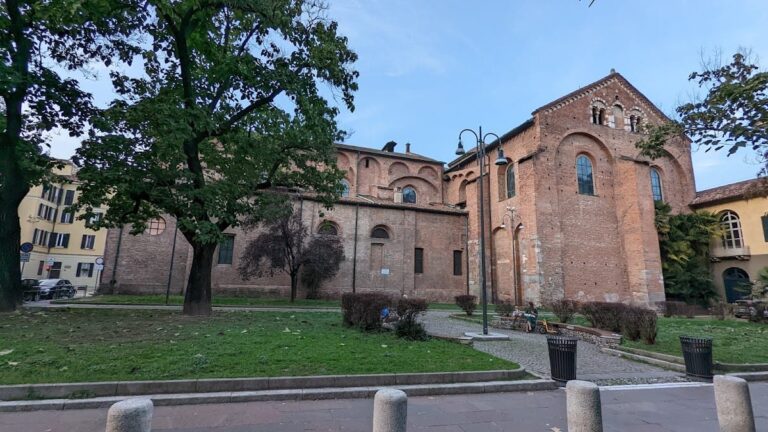
San Marco Church is a Catholic church in Milan, Italy, dedicated to Saint Mark and the Virgin Mary. It belongs to the Ambrosian rite, the distinctive liturgical tradition of the Archdiocese of Milan, and is associated with the Augustinian Hermits, a Catholic mendicant order following the Rule of Saint Augustine. Its construction is conventionally dated to 1245, while the first certain record comes from 1254, when Lanfranco Settala, prior general of the order, commissioned a Romanesque church that may have incorporated an earlier structure.
Foundation outside the medieval walls
San Marco and its convent originally stood in suburbis, immediately outside Milan’s medieval walls near a small gate between Porta Nuova and Porta Cumana. The dedication to Saint Mark is traditionally connected with Venice’s assistance to Milan during the twelfth-century war against Frederick Barbarossa, the German king and Holy Roman Emperor whose campaigns against Lombard cities included the destruction of Milan. The church probably formed part of Milan’s reorganization after that conflict. Its position beside the northern walls also suited the city’s expansion toward Como and the Alpine routes leading to central Europe.
The Augustinian Giambonini, a group of penitents who followed the Rule of Saint Augustine, were connected with the church. Settala became their prior in 1252. Once complete, the church and convent became the general house of the Augustinian Order, meaning its principal institutional residence and administrative centre. San Marco was Milan’s largest church until the completion of Milan Cathedral and the lengthening of San Francesco Grande.
Chapels, burial, and Augustinian patronage
In 1345, Erasmo, Arnolfo, and Giovannolo Aliprandi founded and endowed a chapel dedicated to Saint Ursula by donating three houses. The chapel occupied the second chapel in the southern arm of the transept. It was probably established in accordance with the testamentary wishes of Salvarino Aliprandi, who had died in 1344. A document from 1383 identifies Giovannolo as Salvarino’s son.
Salvarino was a jurist of the College of Milan and was listed among Milanese supporters of the Visconti who were tried between 1322 and 1324. He was buried at San Marco in a sarcophagus now associated with the Chapel of Saint Thomas of Villanova. An Aliprandi sarcophagus front formerly from San Marco is now held in the Civic Collections of Milan at Sforza Castle. It may represent the burial of Rebaldo Aliprandi, the father of Pinalla, Martino, and Salvarino. Made probably in the second quarter of the fourteenth century, it is regarded as a prototype of Lombard Gothic sculpture.
During the sixteenth century, the chapels along the right side of the nave were refurbished and assigned to Milanese patrician families for family burials. The families financed their decoration, but most funerary monuments were removed by the end of the century because Archbishop Carlo Borromeo opposed the burial of lay figures inside churches. Much of the sixteenth-century decoration survived. The first right-hand chapel was decorated for Pietro Foppa’s burial. Its monument, designed by Bramantino, has disappeared, while frescoes and an altarpiece by Giovanni Paolo Lomazzo remain. The second chapel took its name from the Confraternity of the Cintura, associated with the Augustinian Order. The fourth chapel was originally dedicated to Pentecost and is now dedicated to Saint Joseph. The large chapel in the left transept belonged originally to the Confraternity of the Crucifix and is now known as the Chapel of the Pietà.
Baroque transformation and musical history
The interior underwent no major alteration until the seventeenth century, when the vaults were completed in Baroque forms. This remodeling is attributed to the Roman architect Giovanni Ruggeri. After San Francesco Grande was demolished, San Marco, at 109 metres in length, became Milan’s second-longest church after the cathedral.
The church also became closely associated with Milan’s musical life. During the eighteenth century, the young Wolfgang Amadeus Mozart lived for three months in the church’s canonry. Giovanni Battista Sammartini served as organist. On 22 May 1874, Giuseppe Verdi conducted the first performance at San Marco of his Messa da requiem, written in honour of the Milanese writer Alessandro Manzoni on the first anniversary of Manzoni’s death.
The church’s first recorded organ was built in 1507 by Leonardo d’Allemania with Tyrolean labour. Costanzo Antegnati reformed it in 1604 and 1611. Eugenio Biroldi rebuilt and enlarged the instrument in stages between 1806 and 1811, and Luigi Maroni-Biroldi completed the work in 1819. Natale Balbiani extensively rebuilt it in 1874 and 1875. Padre Davide da Bergamo played concerts on the organ for three consecutive days in June 1836, drawing large crowds.
Restoration and later interpretation
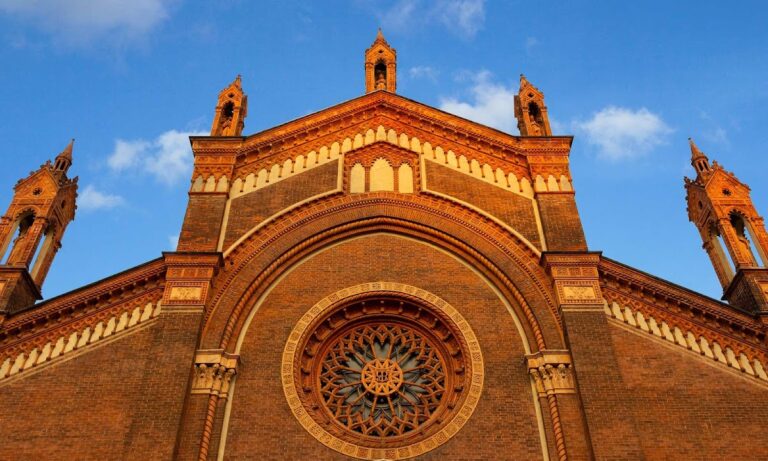
Carlo Maciachini restored the façade in 1871, using surviving fourteenth-century traces in the masonry to retain original elements and complete missing sections. The restoration raised the façade by three metres and reopened the central rose window and two large Gothic biforas within their original terracotta frames. The organ was restored by the Tamburini firm in 1973 and declared a National Monument during that work. A further restoration by Giani Casa d’Organi in 2019 returned it to the configuration associated with Balbiani’s rebuilding of 1874 and 1875.
Restoration work has also altered the understanding of the church’s medieval decoration. In 1956, the removal of part of an overlying fresco and a tomb revealed a fourteenth-century Crucifixion beneath a painting by the Fiammenghini in the right transept. The earlier work is attributed to Anovelo da Imbonate. In 1958, the architect Tirelli restored the Chapel of Saint Ursula to recover traces of its earlier Gothic structure and uncovered a votive fresco of the Madonna and Child with Saint Augustine and members of the Aliprandi family.
Remains
San Marco has a Latin-cross plan with a three-aisled nave, a projecting transept, and a deep semicircular apse. Its architectural character combines Gothic, Baroque, and Gothic Revival elements. The original church probably followed the orientation of the present building and had three aisles ending in three semicircular apses. Inside, groin vaults, or vaults formed by intersecting curved surfaces, rest on piers decorated with Corinthian pilasters. A circular dome without a drum covers the crossing.
Façade and bell tower
Gothic Revival façade
The façade originated in the mid-fourteenth century. Menclozzo completed its first order and side sections, while the upper portions were finished in Baroque form in the late seventeenth century. A three-part Serlian window, consisting of a central arch between two lower rectangular openings, was then placed within the former rose-window area. Maciachini’s restoration followed Menclozzo’s design and reconstructed the missing sections from evidence in the masonry. The resulting façade is described as Milan’s most complete and best-preserved Romanesque-Gothic façade.
The façade has a stepped outline and red-brick facing, with lower pilasters clad in marble blocks. Three portals correspond to the three internal aisles. The central portal is original, while the lateral portals were opened in the final decade of the seventeenth century. The central splayed marble portal has a pointed arch and an architrave. Its lunette contains a 1965 mosaic of the Madonna and Child between Saints Augustine and Mark, based on an original fresco by Angelo Inganni that had become illegible.
Above the portals are two three-light windows. These began as seventeenth-century Serlian openings and were remade in Gothic form by Maciachini. The upper façade contains a large central rose window, two pointed-arch biforas, or paired openings, and a gallery of small Gothic arches. Three marble statues occupy separate niches below the rose window. They represent Saint Augustine, Saint Mark, and Saint Ambrose and are attributed to Giovanni di Balduccio or the Master of Viboldone, a conventional name for an unidentified artist or workshop associated with works linked to Viboldone. Augustine wears the habit of the Augustinian Hermits and holds an open book inscribed “Hic me genuit in Christo.” Mark holds a small winged lion, while Ambrose wears episcopal vestments.
Bell tower
The square bell tower stands near the apse, and its main structure dates from the second half of the thirteenth century. Giuseppe Mongeri added the conical spire in 1885. The belfry opens through four biforas, one on each side, each divided by a marble column.
Presbytery and nave chapels
Presbytery
The presbytery is raised several steps above the rest of the church and enclosed by a marble balustrade. Its Neoclassical high altar, designed by Giocondo Albertolli, is made of polychrome marble with bas-reliefs and gilded decoration. A circular structure of Corinthian columns, known as a tempietto, forms a small temple-like canopy over the tabernacle and is inspired by the ciborium over the high altar of Milan Cathedral. The presbytery walls carry The Dispute of Saint Ambrose and Saint Augustine by Camillo Procaccini and The Baptism of Saint Augustine by Giovanni Battista Crespi, also known as Il Cerano.
Chapel of Saints Peter and Paul
The first chapel on the right is dedicated to Saints Peter and Paul. Lomazzo began its surviving frescoes in 1570. The chapel also contains an oil altarpiece showing Saints Peter and Paul paying homage to the Virgin together with Saint Augustine. The cycle has deteriorated, and the fresco of Saint Paul raising a dead person is nearly lost, although its elaborate architectural background remains visible.
The same chapel retains The Fall of Simon Magus, which shows Simon falling during his performance before astonished onlookers. Its Mannerist architecture, sharply foreshortened figures, and dramatic perspective and lighting characterize Lomazzo’s treatment. The adjoining dome is divided into eight sections containing prophets and sibyls. Its pendentives, curved triangular surfaces supporting the dome, contain illusionistic paintings of the four Evangelists. The apse basin is filled with a densely populated Glory of Angels illuminated by strong vertical light.
Chapel of the Madonna della Cintura
The second right-hand chapel is dedicated to the Madonna della Cintura. Its eighteenth-century statue of the Virgin and Child shows the Virgin holding the belt associated with the chapel’s confraternity. An early eighteenth-century Rococo ensemble includes an iron balustrade, flooring, stucco, Marian paintings, a dome, and an elaborate altar of black and polychrome marble.
Chapel of Saint Mark
The third chapel is dedicated to Saint Mark and contains a painting of the saint by the Legnanino.
Chapel of Saint Joseph
The fourth chapel, now dedicated to Saint Joseph, preserves a well-preserved dome decoration. Above its octagonal base is Mannerist stucco with winged herms alternating with lunettes topped by mascarons. Carlo Urbino painted the sixteenth-century frescoes, which depict Pentecost with the dove of the Holy Spirit at the centre and figures set against a blue sky.
Seventh chapel and Nativity paintings
The seventh chapel contains two series of paper silhouettes depicting the Nativity. Francesco Londonio painted them in the second half of the eighteenth century, and they were supplemented later. The weekday and feast-day series include a painted backdrop and architectural framing made by Piero Roccatagliata in the 1920s. At the end of the nave is the Legnanino’s large painting The Nativity with Saint Jerome.
Transepts and medieval sculpture
Right transept
The right transept contains the Fiammenghini fresco of Pope Alexander IV instituting the Augustinian Order. Alexander IV was a thirteenth-century pope. Beneath the fresco is the fragmentary fourteenth-century Crucifixion attributed to Anovelo da Imbonate, which was uncovered during the 1956 restoration.
Southern transept sarcophagi
The southern arm contains a group of sarcophagi produced from the mid-fourteenth century onward. Their presence belongs to a period when the Augustinians and other mendicant orders adopted a renewed theological and cultural orientation under the patronage of Archbishop Giovanni Visconti. The artistic style is associated with the presence in Milan of the Pisan sculptor Giovanni di Balduccio.
The group includes the marble sarcophagus of the jurist Giacomo Bossi, who died in 1339. Its three relief compartments are attributed to the Master of Viboldone. The sarcophagus of Martino Aliprandi, made around the middle of the fourteenth century by a sculptor trained in the tradition of Balduccio, has three relief compartments and two side niches. The centre shows the Trinity. On the left, the deceased is presented to the Virgin and Child by Saints Ambrose and John the Baptist; on the right, eight disciples listen to a teacher. The niches contain Saint Augustine and Saint Mark with the winged lion.
On the central wall stands the sarcophagus of Lanfranco Settala, made by Giovanni di Balduccio. It belongs to the learned Augustinian confessor of Archbishop Giovanni Visconti, not to the earlier namesake connected with the foundation of the Augustinian San Marco. An unidentified sarcophagus with a relief of the Adoration of the Magi dates from the first half of the fourteenth century.
Aliprandi sarcophagi and chapel remains
Salvarino Aliprandi’s sarcophagus shows him kneeling before the blessing Christ Judge, with two angels holding a cloth behind the throne. The Virgin, a saint possibly identified as Mark, the guardian angel, and John the Baptist accompany him. The Baptist points toward the tree of life, while six panels with prophets and scrolls flank the front.
The sarcophagus front probably associated with Rebaldo Aliprandi shows the Virgin and Child blessing the kneeling deceased, who is presented by Saint Catherine of Alexandria. Smaller panels depict Saint George and Saint Victor. Its compositional scheme is regarded as a prototype for later Campionese Gothic sculpture.
Near the former Aliprandi chapel, now at the rear entrance, is a sixteenth-century tomb slab showing the Angel of the Resurrection. To its left is a rediscovered fresco by a Lombard master from the mid-fourteenth century. The upper lunette contains the sixteenth-century Triumph of Saint Ursula, attributed, together with the Martyrdom of Saint Ursula opposite it, to the Genoese painter Ottavio Semino.
Chapel of Saint Ursula
The Chapel of Saint Ursula retains the votive fresco uncovered during the 1958 restoration. It shows the enthroned Madonna and Child with Saint Augustine and members of the Aliprandi family. Salvarino Aliprandi, shown kneeling and offering a model of the chapel, was identified by an inscription that was formerly placed to the right of the fresco and is no longer visible.
Left transept and Chapel of the Pietà
The left transept is dominated by Federico Bianchi’s late-seventeenth-century fresco The Expulsion of Heliodorus from the Temple. On its right side is the Chapel of the Pietà, which is twice as wide as the other chapels. Its altar contains an old and faithful copy of Caravaggio’s Entombment, painted for Santa Maria in Vallicella in Rome.
Ercole Procaccini the Younger, Antonio Busca, Johann Christoph Storer, Guglielmo Caccia, known as Moncalvo, and Luigi Pellegrini Scaramuccia decorated the chapel in the mid-seventeenth century. The stucco entrance arch contains five scenes from Christ’s Passion. The side walls carry Meeting with the Pious Women by Ercole Procaccini and The Raising of the Cross by Antonio Busca. Scenes of the Resurrection occupy the lunettes and vault, while putti decorate the frieze and the area around the altar.
Organ and surviving musical fabric
Instrument and historic components
The organ is mechanically actioned and has two 61-note keyboards, a Grand Organ and an Expressive division, together with a straight 20-note pedalboard extending from C1 to E2. Its controls are arranged in three columns, with two to the right of the console for the Grand Organ and pedal and one to the left for the Expressive division. The instrument includes a third-hand coupler, a rollante, and a timpanone.
Its surviving historical components include Leonardo d’Allemania’s complete Flauto in VIII register, Costanzo Antegnati’s complete Voce Umana register, numerous pipes from both instruments, and three eighteenth-century compensating wind chests by Antonio Somigliana. Six large panels with Old Testament subjects and twelve grotesque pilasters from the sixteenth-century organ galleries survive. Painted parts of the case, the sixteenth-century façade, and the doors are kept in the parish museum, together with two eighteenth-century Lenten canvases found during the latest restoration. Further historical organ fabric includes Somigliana’s three wind chests and surviving pipes distributed through the Ripieno.