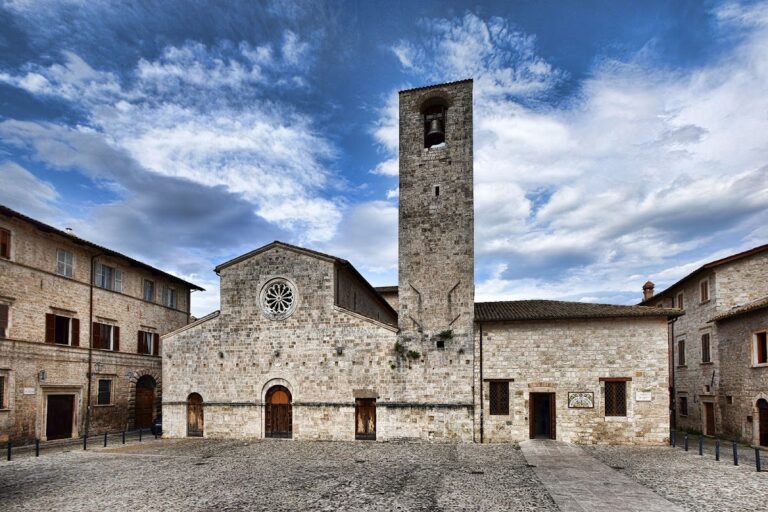
Abbazia di Santa Maria in Montesanto: A Benedictine Abbey in Italy


Site at a Glance
- Rating
- 4.6
- Popularity
- Low
- Country
- Italy
- Primary era
- Medieval
- Eras represented
- Medieval
- Civilizations
- Kingdom of Naples, Kingdom of Sicily
- Site type
- Religious
- Remains
- Fortified Monastery
On this page16 sections
History
Abbazia di Santa Maria in Montesanto is a Benedictine abbey in Italy, standing on Montesanto above Civitella del Tronto in Abruzzo. Dedicated to the Assumption of the Virgin Mary, it developed as a Romanesque monastic complex in the historic frontier zone between the Papal States and the Kingdom of Naples. Its foundation date remains uncertain, although the monastery became an important religious and territorial institution between Teramo and Ascoli Piceno.
Origins and early records
Local tradition, preserved by Sebastiano Andreantonelli and Francesco Antonio Marcucci, attributes the abbey’s creation to Benedict of Nursia, the sixth-century monastic founder associated with the Rule of Saint Benedict. According to this tradition, Benedict began the monastery personally between 540 and 542, during a visit to the Picene area when Epiphanius was bishop of Ascoli. Mario Sensi rejected this early date and placed the first monastic settlement in the final period of the feudal age. The archaeological work carried out during the restoration of 1992 to 1995 is consistent with this later interpretation, while the exact year of foundation remains unknown.
The founder is likewise uncertain. The monastery may have been established by a wealthy landowning family that created its organizational framework and used it to exercise political and territorial control. It has not been established whether this family was the comital house that included Rinaldo, count of Aprutium and count-bishop of Ascoli, who claimed patronage rights over Montesanto.
From its beginning, the community was governed by an abbot, or by a prior acting in that capacity, rather than being placed under one of the major national abbeys. The Benedictine monks followed a cloistered life, while the monastery maintained pastoral responsibility, known as cura animarum, for a broad territory between Teramo and Ascoli Piceno. When its income allowed, it employed priests to assist communities dependent on the abbey.
The first surviving mention of Montesanto appears in a document of 1064 concerning an exchange with San Salvatore alla Maiella. An imperial diploma issued by Lothair III on 18 August 1137 placed the abbey among the possessions of the Church of Ascoli and confirmed the title of presbyter of the abbey to the bishop of Ascoli. On 6 July 1193, Henry VI’s diploma Ad humanae vitae assigned jurisdiction over Montesanto to the Church of Ascoli and to Rinaldo I, count-bishop of Ascoli. The same document described the monastery as a patronage foundation of the counts of Teramo.
Power and territorial jurisdiction
During the twelfth century, Montesanto ranked among the region’s most powerful monasteries. It exercised authority over monasteries founded later, held about 2,000 moggi of land in the Val Pescara, and controlled or possessed rights over eight churches. These were Sant’Angelo de Criptis, San Savino, Sant’Egidio, Santa Maria a Luquiano, Santa Maria di Ripoli, San Pietro alla Ripa di Salino, Santo Stefano in Rivo Maris, and Santi Mariano e Giacomo alla Nocella di Campli.
The dependent institutions had varied histories and arrangements. Sant’Angelo de Criptis in the Val Vibrata consisted of a cave and hermitage. Sant’Egidio stood on the right bank of the Vibrata, belonged to Montesanto, and was granted in commendam to the bishop of Ascoli, who placed it under his protection in 1237. Santa Maria a Luquiano, near Colle San Giorgio at Castiglione Messer Raimondo, stood under the patronage of the dukes of Atri, who paid Montesanto nine ducats each year. Santa Maria di Ripoli, near Corropoli, paid the abbot 40 gold ducats annually at the Feast of the Assumption, equivalent to 70 scudi.
San Pietro alla Ripa di Salino, near Civitella del Tronto, had been united with Sant’Angelo de Criptis by 1448. Santo Stefano in Rivo Maris was founded in 842 on the coast near the Salinello River. Santi Mariano e Giacomo alla Nocella di Campli had formerly been a Benedictine priory and canonical community, meaning a clerical institution organized around a body of canons. It was mentioned in 1283 and remained a collegiate church with four canons in the sixteenth century, under a priest who held the title of abbot. It paid Montesanto an annual census of two ducats.
Montesanto also held feudal rights over the parish communities of Sant’Andrea at Castel Floriano, San Sisto of Valle Castellana, San Giovanni di Lempa, San Giovanni di Folignano, San Pietro in Collepagano, and the archpriesthood of Gabbiano. Gabbiano was under the patronage of the Sgariglia family. On 7 February 1215, the patrons of Sant’Andrea di Floriano submitted to Montesanto. Pope Alexander IV confirmed the “feud of Montesanto” to Teodino, or Teodorino, bishop of Ascoli, on 30 January 1255. The following year, Teodino appointed his chaplain Rinaldo as abbot. Rinaldo became bishop of Ascoli on 12 February 1259 and took the name Rinaldo III.
In the fourteenth century, the monastery continued to administer its possessions autonomously while paying tithes to the bishop of Ascoli. A document from 1301 refers to a judge of the lands of Santa Maria in Montesanto, indicating the extent of its administrative authority.
Decline and ecclesiastical reorganization
Montesanto entered a gradual decline at the end of the fifteenth century. Until about 1450, it still housed several monks and retained six families holding land from the abbot. Administration of its property then passed directly to the Roman Curia through a trusted administrator. In 1471, the Elders’ Government of Ascoli asked the pope to unite the monastery with the Ascoli episcopal mensa, the body managing the bishopric’s revenues, but the petition was rejected.
Giovanni Battista Parisani and Giacomo Pilotti were among the abbots associated with this period. Pilotti also served as Ascoli’s ambassador to the court of Alfonso, king of Naples. Giovanni Antonio Serbelloni, cardinal of San Giorgio, held the abbacy from 1562 to 1582 and established the perpetual vicariate of Montesanto. This arrangement required two chaplains, one at Montesanto and one at Sant’Andrea. Nicola of Aragon became abbot in 1582 after serving as bishop of Ascoli from 1579; he died on 27 July 1586.
On 14 November 1586, Pope Sixtus V issued the bull Super universas orbis ecclesias, establishing Montalto as a bishopric. The measure placed Montesanto and its vicariate under the new episcopal mensa. The arrangement included the dependent churches and communities, six parishes, and 25 population centers. The bishop of Montalto thereafter held the title of commendatory abbot, meaning that he received the title and revenues of the abbey while appointing its vicar rather than governing a resident monastic community directly.
The transfer created new boundaries between the dioceses of Teramo and Ascoli and produced jurisdictional confusion in some villages. In 1645, Bishop Girolamo Codebò established the Confraternity of the Sacrament at the abbey. For approximately the next two centuries, the monastery remained relatively tranquil under the care of a custodian-hermit devoted to religious life.
Confiscation, revival, and Marian devotion
In 1797, during the vicariate of Francesco Antonio Marcucci, the monastery’s possessions within the Kingdom of Naples were seized by the territorial sovereign. The seizure rested on the claim that Sixtus V’s act had been issued without the prior consent of the kingdom’s government. Montesanto and its possessions were removed from the vicariate of Montalto, confiscated by the Royal Crown of Naples, and attached to the Abruzzo vicariate of the chaplain of Villa Passo.
Francesco Saverio Castiglioni was consecrated commendatory abbot of Montesanto on 18 August 1800. He later became Pope Pius VIII and sought to recover the monastery’s possessions. In 1804, a decree issued ad regis beneplacitum, meaning subject to the king’s approval, assigned the possessions to him for life. Bishops Luigi Maria Canestrari, abbot from 1825 to 1846, and Eleonoro Arrone, abbot from 1846 to 1887, received Montesanto under the same arrangement.
The abbey’s modern revival is associated with the phrase Montesanto Recisa virescit, or “Montesanto, cut down, flourishes again.” Canon Monsignor Ettore Di Filippo became rector on 15 August 2001 and commissioned an ossuary, a statue of the Risen Christ, a Via Matris devotional route commemorating the sorrows of the Virgin Mary, and new paving for the forecourt. In 1999, he acquired a Bolognese-school organ dating from 1646, two Carrara-marble angels, new bells, and a statue of Pietro da Morrone, the hermit and religious leader who became Pope Celestine V.
A restoration carried out from 1992 to 1995 recovered the complex and restored its functioning. The abbey now belongs to the Diocese of San Benedetto del Tronto-Ripatransone-Montalto, which owns the buildings, while the diocesan bishop holds the title of abbot. Bishop Gervasio Gestori established the site as a rectory during the 2000 jubilee. Gestori consecrated the church on 10 August 2008, and Benedict XVI authorized its use for worship in 2011.
Montesanto also developed as a Marian shrine. For the Feast of the Assumption, believers from neighboring villages traditionally undertook an institutional pilgrimage on foot. The statue of the Virgin, covered with jewelry and securities, was carried in procession. The first participants came from Sant’Andrea, Passo, Fucignano, Valle Sant’Angelo, Pagliericcio, Cornacchiano, and Lempa, the seven centers belonging to the vicariate established by Serbelloni in 1581. The pilgrimage later drew people from other parts of Abruzzo and the nearby Picene area. The patronal feast remains associated with 15 August, a novena from 6 to 15 August, a Mass led by the diocesan bishop and abbot, a midday walking procession, and the evening “Salute of the Blessed Virgin Mary.”
Remains
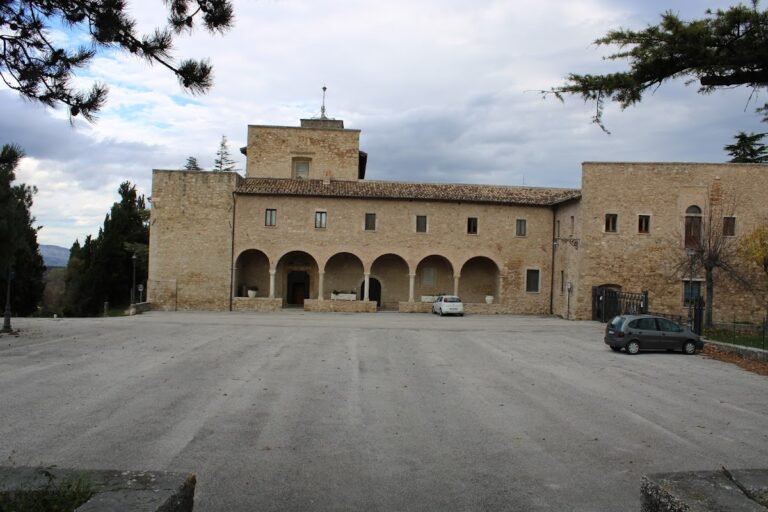
The complex occupies the summit of Montesanto at about 545 metres above sea level. Its limestone setting includes cliffs, natural cavities, and dense conifer woodland, while the hill rises above the relatively level land between the Val Vibrata and Salinello valleys. Across from it stands the rocky height and Aragonese fortress of Civitella del Tronto. The Romanesque buildings are chiefly constructed from locally quarried squared travertine blocks, with porous surfaces bonded by layers of mortar or pozzolana. The buildings face an internal courtyard paved with travertine from Acquasanta Terme.
Church and bell tower
Santa Maria Assunta
The church of Santa Maria Assunta has a rectangular plan and a single nave. Its eastern presbytery is raised two steps above the floor and covered by a cross-vault carried by four ribs resting on four columns. A blocked oculus remains high on the straight rear wall. The presbytery contains a wooden crucifix, wooden choir furnishings against the side walls, and a square modern altar with an abbatial seat. Niches beside the altar hold statues of Benedict of Nursia and the Assumption Virgin. An iron grille formerly separated the officiating clergy from the congregation.
The nave has a terracotta floor, tall splayed windows in the southern wall, and a simple barn-style wooden ceiling supported by roof trusses. Two pointed-arch entrances opened in the seventeenth century in the southern wall, replacing the traditional central portal while reproducing the arrangement of the former main façade. The date 1622 is carved into the keystone of one entrance. Four small crosses remain on the interior walls at the places anointed with chrism, consecrated perfumed oil, during the 2008 consecration.
Opposite the altar stands a seventeenth-century organ from the Bolognese school, beside a small funerary chapel. Monsignor Ettore Di Filippo is buried inside the church. The same wall preserves the two former entrances, one blocked and the other converted into the entrance of the funerary chapel.
Bell tower
The Romanesque bell tower originally stood beside the church façade. It is now separated from the church and attached to the monastery. The tower has a square base, four biforate openings divided into two lights by small columns with varied capitals, decorative leaf or projecting-boss motifs, and four single-light openings.
Four bells hang in the tower. The smallest and oldest bears the date 1615. The other three were made more recently by the Marinelli Pontifical Foundry of Agnone, with one having been recast. In 1798, the tower contained a bell weighing 500 pounds.
Earlier church and archaeological evidence
Medieval church phases
Masonry along the northern side of the present church indicates that the earlier medieval building probably had three naves. Between the thirteenth and fourteenth centuries, it was transformed into a single-nave church and shortened. The earlier interior was probably divided into bays and covered by pointed arches, whose outward thrust was carried by lateral buttresses that remain visible along the northern wall.
A seventeenth-century rebuilding dismantled the portico that had linked the church façade with the bell tower. One former façade door was blocked, while the other became the entrance to the funerary chapel. The two new southern entrances, including the one dated 1622, preserve the principal evidence of this alteration.
Burials and earlier activity
Archaeological investigations carried out during the recent restoration identified material from the Roman period, the feudal age, the Middle Ages, and later centuries. Roman ceramic fragments demonstrate activity on Montesanto during the Roman period. Inside the church, ossuary tombs belong to the seventeenth and eighteenth centuries. Inhumation graves without grave goods were uncovered deeper in the rock and are attributed to the period of the first monastic settlement.
Monastery and fortified enclosure
Medieval enclosure
Remains on the hill include the monastery’s water well, service rooms, and the ruins of a medieval double fortified enclosure with towers. The enclosing wall had a single southern entrance formed by one larger door and one smaller door. An avenue through the surrounding park leads toward the entrance and is marked by two Carrara-marble angels.
Monastic buildings
The present monastery retains a form broadly similar to its seventeenth-century arrangement and consists of two wings. The older wing runs east to west. Its entrance opens onto the abbey courtyard and passes through a barrel-vaulted room into the inner courtyard, formerly the Benedictine cloister. Ruined perimeter walls bound the cloister courtyard, which contains a stone well supplied by spring water. The complex also includes the rector’s residence and rooms used for spiritual retreats and prayer.
Recovered basement rooms serve religious or sociocultural meetings. One is the former Chapter House, where the monks met twice each day; it now contains the Chapel of the Crucifix. A niche in the circulation spaces holds an old statue of John Gualbert, the eleventh-century Italian monastic reformer who founded the Vallombrosan order.
Park and devotional features
The surrounding park contains an access avenue and smaller paths with sculptural representations connected to Old Testament episodes. These include statues of Adam and Eve, symbols of the menorah and sacred writing, and a statue of Moses holding the tablets of the law. Other works include a statue of the Virgin, a marble statue of Pietro da Morrone, and a statue of the Risen Christ made by Alessandro Caetani.
Nearby sites