St. George’s Church, Staraya Ladoga: A Medieval Russian Orthodox Church


Site at a Glance
- Rating
- 4.5
- Popularity
- Very Low
- Country
- Russia
- Primary era
- Medieval
- External website
- Open
- Eras represented
- Medieval
- Civilizations
- Novgorod Republic
- Site type
- Religious
- Remains
- Church
On this page10 sections
History
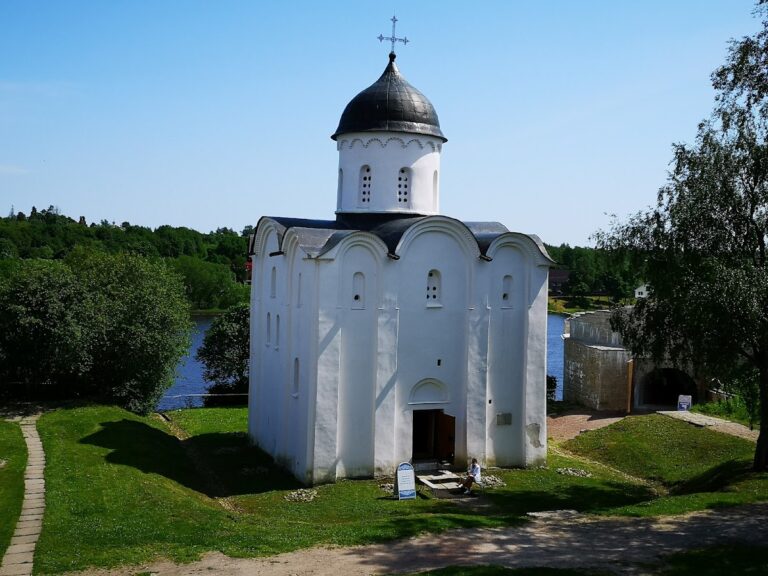
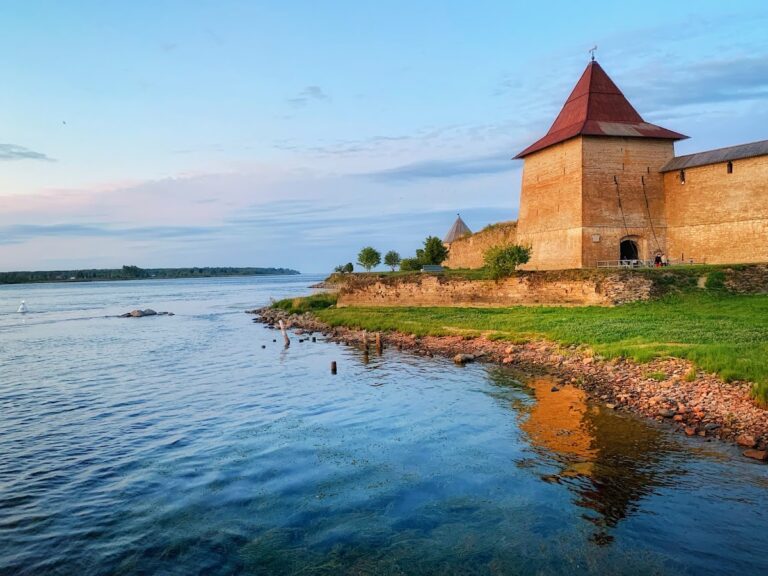
St. George’s Church is an inactive Russian Orthodox church in Staraya Ladoga, Russia, built in the medieval Russian tradition during the twelfth century. It stands within Staraya Ladoga Fortress on the left bank of the Volkhov River, at a settlement that occupied a strategic place on the trade route from the Varangians to the Greeks. Some chronicles identify Staraya Ladoga as Rurik’s first seat before he moved to Novgorod. Rurik was the ninth-century dynastic founder traditionally associated with the origins of Kievan Rus and its early ruling house.
Stone construction and uncertain beginnings
Stone building at Staraya Ladoga began in the 1110s. During the second half of the twelfth century, seven or eight stone churches were raised there, but only St. George’s Church and the Dormition Cathedral of the Staraya Ladoga Dormition Monastery have survived.
The church’s exact construction date remains unsettled. Architectural and fresco evidence generally places its final creation between 1180 and 1200. Another reconstruction proposes that Bishop Niphont, a twelfth-century bishop associated with Novgorod and major church building in the Novgorodian lands, founded it no later than the mid-1150s. On this view, work stopped after his death in 1156 and resumed following a Russian victory over the Swedes in 1164, with completion around 1165 or 1166, possibly under Prince Svyatoslav or the posadnik Zachary. A posadnik was a senior civic official who governed a major Novgorodian city or territory. Another interpretation dates the church and its frescoes to about 1167.
Victory, rebuilding, and interior change
Tradition connects the church’s foundation with the Russian victory over a Swedish force near the Voronezhka River in 1164. The Russian army was led by Prince Svyatoslav and accompanied by the Novgorodian posadnik Zachary, and the dedication to Saint George is understood in this tradition as a commemoration of the victory. The political aim associated with the conflict was to preserve trade with the defeated Swedes rather than devastate their territory.
The church was first mentioned in writing in 1445. It was rebuilt during the sixteenth century, while its interior was left unchanged. Major renovation in 1683 and 1684 introduced new windows and destroyed much of the wall painting. Some ancient paintings were uncovered beneath later wall paint in 1780.
Restoration and present status
Further restoration campaigns took place in 1902, 1925 to 1928, 1952 to 1962, and from the 1970s through the 1990s. The building was transferred to the Staraya Ladoga Historical, Architectural, and Archaeological Museum-Reserve and now functions as a museum exhibition rather than as an active church.
St. George’s Church is regarded as one of Russia’s oldest surviving churches and as one of the country’s few surviving pre-Mongol buildings. The term pre-Mongol Rus refers to the period of the medieval Rus principalities before the Mongol invasions of the thirteenth century. Together with the Dormition Cathedral at Staraya Ladoga, the church is also described as one of the northernmost surviving Russian stone churches of that period. It is a federally significant architectural monument and a protected cultural-heritage property of the Russian Federation.
Remains
St. George’s Church is a small white-stone building in the Novgorodian architectural tradition, the regional style developed in and around the medieval polity of Novgorod. Its compact plan contains four pillars, a single dome, and three apses, or curved eastern ends. The floor area is approximately 72 square metres. The plan is slightly irregular along the north-south axis, a variation attributed to the restricted building space within the existing fortress.
Church structure
The surviving building preserves the compact arrangement of its medieval stone architecture, with the dome carried by four interior pillars and three apses completing the eastern end. Its asymmetrical plan reflects the constraints under which it was built inside the fortress, rather than a regular north-south layout.
Fresco decoration
The original fresco program cannot now be reconstructed in full. The north and south walls were arranged in five horizontal registers of images, while approximately 20 percent of the original decoration survives. Some paintings were removed from the walls and placed beneath a later floor before being discovered and restored in the twentieth century. Other ancient paintings were revealed beneath wall paint in 1780. The frescoes were made in the year of the church’s consecration, and some were renewed in 1445 in an effort to reproduce the earlier designs.
Dome frescoes
The dome paintings are preserved almost intact. They show the Ascension of Christ surrounded by apostles and prophets, providing the most complete surviving part of the church’s original painted decoration.
Saint George and the dragon
The most unusual surviving composition is located in the altar area near the diakonikon, the chamber beside the altar traditionally used for liturgical vessels and related preparations. Saint George rides at the centre and subdues the dragon beneath his horse instead of killing it. A princess leads the creature by a belt, while a king watches from a wall.
The artists adapted the scene to the curved wall. Saint George and his horse occupy the flatter central portion, where distortion is reduced. A vertical building and an ascending hill line fill the more curved side, while the hill line links the central and lateral parts of the composition. A corresponding line and hill on the opposite side are inferred from the surviving arrangement.
The unusual scene has been connected with Russian religious poetry in which the freed princess helps Saint George tame the dragon with her silk belt. The dragon is therefore shown subdued rather than destroyed, and the tied tail of the horse has been interpreted as a sign of humility. The placement near the altar and the depiction of the living dragon make this composition exceptional within the church’s surviving decoration.
Painting style and artistic collaboration
The frescoes share a consistent style and were probably produced by a group of painters directed by two principal artists. Blue, red, and yellow dominate the palette, alongside white and other variations. The use of white and several stylistic features have been interpreted as possible evidence of Greek or Byzantine participation, while the Slavic inscriptions and elements of the imagery have also been associated with Novgorodian artists. The paintings may consequently reflect cooperation between Byzantine-trained and local painters.
Line is the principal expressive device. It defines faces, silhouettes, ornament, and the flat, sharply articulated folds of the garments. The horse carrying Saint George is especially notable for its economical and expressive outline. The surviving figures have severe, sometimes militarized expressions and mainly frontal, icon-like poses. Strong highlights model their faces, while the treatment of clothing and facial features gives the paintings a highly linear, calligraphic character. Other scenes emphasize princely qualities and military virtues, supporting the interpretation that the patron was probably a prince, or possibly the posadnik, rather than the Novgorodian bishop.