Church of Santa Maria Maddalena dei Pazzi: A Renaissance and Baroque Religious Complex in Florence


Site at a Glance
- Rating
- 4.5
- Popularity
- Low
- Country
- Italy
- Primary era
- Early Modern
- External website
- Open
- Eras represented
- Medieval, Early Modern, Modern
- Civilizations
- Grand Duchy of Tuscany, Italian, Republic of Florence
- Site type
- Religious
- Remains
- Monastery
On this page22 sections
History
The Church of Santa Maria Maddalena dei Pazzi is a Renaissance and Baroque religious complex in Florence, Italy, whose origins lie in a Benedictine institution founded around 1250 to 1257. Dedicated to Saint Mary Magdalene of the Converts, or Penitents, it occupied a site that already sheltered women who had abandoned prostitution and adopted the Rule of Saint Benedict. The institution later became associated with the name Spedale a Pinti and developed into a major conventual centre in the Borgo Pinti area.
The Benedictine and Cistercian Institution
The early foundation was connected with a refuge for repentant women, and the nearby name Borgo Pinti may have originated from these inhabitants. The Spedale a Pinti was mentioned by Dante Alighieri and Giovanni Villani. Villani also related the site to the Battle of Montaperti in 1260, recording that the oxen carrying the Florentine standard to the battlefield came from this location.
During the fourteenth century, the Cistercians of Badia a Settimo took control of the institution. They moved into the complex in 1442, after Pope Eugene IV transferred the Convertite to San Donato in Polverosa. The Cistercian convent was then rebuilt between 1481 and the early sixteenth century, with financial support from Bartolomeo Scala, a Florentine humanist, statesman, and patron of the arts. Giuliano da Sangallo provided the initial design in 1492.
The rebuilding coincided with an exceptional period of artistic patronage. Between about 1480 and 1530, the church received altarpieces by Sandro Botticelli, Perugino, Domenico and Ridolfo del Ghirlandaio, Lorenzo di Credi, and Raffaellino del Garbo. Later renovations, together with the seizures carried out during the Napoleonic period, dispersed many of these works to museums in Florence, Paris, Munich, and Saint Petersburg.
The Carmelite Transfer and Maria Maddalena de’ Pazzi
In 1629, Pope Urban VIII ordered a change that transformed the identity of the complex. The Cistercians moved to Cestello in San Frediano, while the Carmelite nuns of Santa Maria degli Angeli came to Borgo Pinti. They brought with them the remains of Maria Maddalena de’ Pazzi, a Florentine Carmelite nun and mystic who had died in 1607. She had been beatified in 1626 and was canonized in 1669.
Following her canonization, the church was rededicated and received an extensive decorative campaign. Jacopo Chiavistelli and Angiolo Gori painted frescoes in the vaults, while Cosimo Ulivelli and other Florentine artists created scenes from the saint’s life on the walls. The major chapel was constructed between 1677 and 1685 as a mausoleum and ceremonial setting for her relics. Promoted by Grand Duke Cosimo III de’ Medici, the chapel reflected the religious culture of his grand duchy.
The convent also became associated with a notable encounter between Catholic and Protestant belief. In 1691, while visiting Lucca, the future King Frederick IV of Denmark met Maria Maddalena Trenta, who later entered the convent as a cloistered nun. After becoming king, Frederick returned to Florence in March 1708 and sought another meeting. With permission from Archbishop Tommaso della Gherardesca and the prioress, he spoke with Trenta in the convent parlour through a grille, which preserved the enclosure of the Carmelite community. Frederick later gave the monastery 500 gold Hungarian coins.
Napoleonic Seizures and Nineteenth-Century Change
During the French occupation, Vivant Denon selected works from the church for the Musée Napoléon in Paris. Among the seized paintings were Domenico Ghirlandaio’s Visitation, Cosimo Rosselli’s Madonna and Child with Saint Bernard, and Lorenzo di Credi’s Madonna and Child between Saints Julian and Nicholas. These works were not returned after the Congress of Vienna, reportedly because their large size made transportation difficult.
The convent was finally suppressed in 1866. In the second half of the nineteenth century, the extension of Via della Colonna divided the complex and greatly reduced the cloister and old refectory. The former convent buildings passed to the municipality and were adapted for education, first for the Scuola Normale Sperimentale Maschile and, from 1898, for the Scuola Tecnica P. Toscanelli.
In 1888, the Carmelite nuns moved first to Piazza Savonarola and then to Via dei Massoni at Careggi. They took Maria Maddalena de’ Pazzi’s remains and many artworks with them, leaving the Borgo Pinti convent suppressed and divided while the church continued in religious use. Teresa of Lisieux, a French Carmelite nun and religious writer later canonized in 1925, visited the monastery in 1887 to pray at the saint’s tomb. A commemorative plaque records her prayer before the relics.
Flood, Restoration, and Continuing Use
The church and surviving conventual spaces passed to the Augustinians of the Assumption in 1926. The Florence flood of 1966 seriously affected the complex. Restoration followed through French and Italian cooperation, and the unfinished right side of the portico was completed by 1968. Part of the former convent is now occupied by the state Liceo classico Michelangiolo, while the church remains a Roman Catholic institution within the Archdiocese of Florence and is especially frequented by Florence’s South American community.
The former convent also preserves commemorative features connected with students who died in the First World War, the Italo-Ethiopian War, and the conflicts of 1943 to 1945. These later memorials form part of the complex’s continuing historical record alongside its medieval foundation, Renaissance rebuilding, and transformation into a Carmelite shrine.
Remains
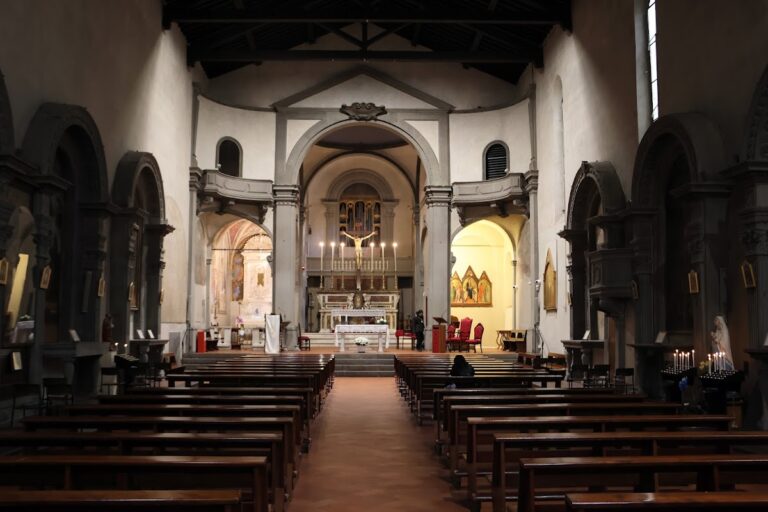
The surviving complex combines the church, an attached former convent, and a Renaissance portico or atrium opening onto Borgo Pinti. The church has a single nave with six deep chapels on each side. The fifteenth-century nave is articulated by gray pietra serena, a sandstone widely used in Florentine columns, arches, frames, and ornament, while the presbytery belongs to the seventeenth century and the ceiling and second chapel on the right were altered in the eighteenth century.
Portico and Street Front
Renaissance Portico
Giuliano da Sangallo designed the four-sided Renaissance portico for Bartolomeo Scala. Its architraves rest on Ionic columns, and its barrel vaults are supported by columns of pietra serena. The capitals imitate an ancient classical yellow-marble capital found at Fiesole and now preserved in the Casa Buonarroti Museum.
Two large round arches occupy the centres of the portico’s long sides. One opens toward the church and the other toward the street. Their arrangement recalls Brunelleschi’s solution for the Pazzi Chapel at Santa Croce. The portico is distinct from the monastery’s cloister, which lay behind the church. Part of the actual cloister, built in 1542, survives within the school and is enclosed by glazing.
Flood Repairs and Painted Decoration
The right side of the portico was completed after the 1966 flood, with the work ending in 1968. Detached frescoes with their lunettes occupy the northeast and southwest corners. They are attributed respectively to Matteo Rosselli and Atanasio Fontebuoni. A nearby marker records the height reached by the floodwaters.
Facades and External Inscriptions
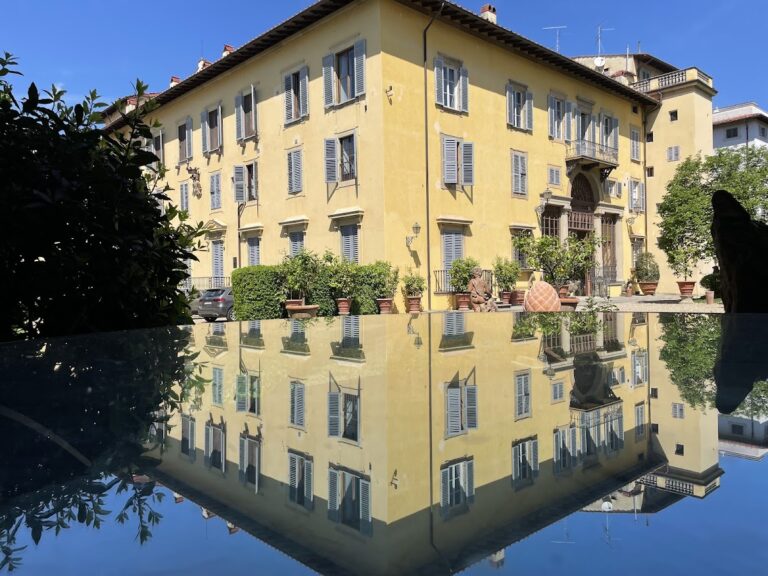
The present street facade was designed and built by Felice Francolini around 1870. The former convent facade retains nineteen broad, tall arcades that were later blocked up, together with an upper storey of windows on a plastered surface once enriched with sgraffito decoration. A project begun in 2011 and completed in early 2012 recovered and supplemented deteriorated framing and decoration; it was designed by Giorgio Castelli and directed by Brunella Sibilia.
The church portal bears the inscription “CENOBIUM CISTERCIENSE,” recalling the Cistercian phase of the complex. Near the corner of Via della Colonna, a monumental seventeenth-century surround is crowned by a shield with the Barberini bees, the emblem of Pope Urban VIII’s family. Its inscription commemorates Urban VIII and members of the Barberini family for transferring and enlarging the monastery and improving its worship. A nearby decree of the Eight of Guard and Bailiff, a Florentine magistracy concerned partly with public order, dates from 1664 and prohibited games, songs, musical performances, and other noise within one hundred historical braccia of the monastery.
Entrance Chapel and Nave
Chapel of Saint Mary of the Lily
The Chapel of Saint Mary of the Lily stands just to the right of the main entrance, between the perimeter wall and the portico. The Cistercians built it for devout women who entered the main church only twice a year during special celebrations. The Del Giglio family held its patronage, and Nereo Neri acquired the chapel in 1598 and commissioned its decoration from the workshop of Bernardino Poccetti.
Its principal painting is the Martyrdom of Saints Nereus and Achilleus by Domenico Passignano and Ottavio Vannini. This replaced Cosimo Rosselli’s Coronation of the Virgin of 1505, which is now displayed in the church’s second chapel on the left.
Nave and Chapel Structure
Six pietra serena arches on either side of the nave open into the lateral chapels. Their capitals retain the coats of arms of families that held chapel patronage. Each chapel has a sail vault and a stained-glass window. One particularly notable window, showing Saint Lawrence in the third chapel on the left, dates from 1491.
The upper walls carry monochrome frescoes alternating with ten canvases depicting episodes from the life of Maria Maddalena de’ Pazzi. Cosimo Ulivelli and other Florentine artists began this series from 1669 onward in connection with the saint’s canonization. The ceiling retains Jacopo Chiavistelli’s monumental fresco of her glorification, painted in 1699 with the assistance of Angiolo Gori.
Left-Side Chapels
The first chapel on the left contains Francesco Curradi’s Saint Lawrence, painted in 1610, and Cosimo Gamberucci’s Nativity of 1618. The second contains Cosimo Rosselli’s carved and gilded Coronation of the Virgin of 1505.
The third chapel, associated with the Tornabuoni family, contains Santi di Tito’s Agony in the Garden of 1591 and a late fourteenth-century wooden Virgin and Child. Its polychrome stained-glass image of Saint Lawrence was made in 1491 by Alessandro Agolanti. The fourth chapel contains a painted wooden statue of Saint Sebastian, dated 1500 and attributed either to Leonardo del Tasso or Cervagio del Tasso. The statue stands in an altarpiece with painted figures of Saint Roch and Saint Ignatius of Antioch by Raffaellino del Garbo.
The fifth chapel contains Cosimo Bizzelli’s Martyrdom of Saint James of 1601 and Giovan Battista Cipriani’s organ canvas, The Communion of Saint Maria Maddalena de’ Pazzi, painted in 1754. The sixth lies beyond another doorway, beneath the fifteenth-century choir loft and an eighteenth-century organ front. Giuseppe Servolini’s nineteenth-century frescoes depict the funerals of Blessed Bartolomea Bagnesi, including The Vision of Blessed Bartolomea Bagnesi to Saint Maria Maddalena de’ Pazzi in the cupola, dated 1807. Giuseppe Collignon painted the chapel’s altarpiece, The Glory of Blessed Bartolomea Bagnesi.
Right-Side Chapels
The first chapel on the right contains Carlo Portelli’s signed and dated Martyrdom of Saint Romulus, painted in 1557 and regarded as his major work. It also has a smaller Saint Albert the Carmelite of 1610, attributed to Francesco Curradi. The second chapel was decorated with eighteenth-century stucco and paintings. Its three canvases by Giuseppe Piattoli, all dated 1778, depict Saint Aloysius Gonzaga, The Archangel Raphael Appears to the Believers, and Saint Anthony of Padua; its ceiling also belongs to the eighteenth century.
The third chapel formerly belonged to the Florentine Jacopi family. It contains Matteo Rosselli’s seventeenth-century Coronation of the Virgin in a valuable fifteenth-century frame. Its altarpiece includes a late fifteenth-century predella by Lorenzo di Credi, originally part of an altarpiece taken by Napoleon and still preserved in the Louvre. The chapel also retains a stained-glass window with the Jacopi coat of arms, a marble tomb slab designed by Andrea del Sarto, and the Jacopi and Serristori arms on the entrance columns.
The fourth chapel contains an eighteenth-century framed enamelled copper work by J. M. Enzet of Limoges. Its altar holds Domenico degli Ubaldini, known as Puligo, Madonna and Child with Saints, dated 1525 to 1526. The fifth chapel has a stained-glass window bearing the Pepi coat of arms and showing the stigmata and funeral of Saint Francis. Made around 1500 to 1510, it was based on a cartoon also used for a similar work in San Salvatore al Monte.
The sixth chapel lies beyond the sacristy entrance. Its early nineteenth-century frescoes by Luigi Catani include Pious Women at the Tomb, Moses and the Jews, and Christ Deposed from the Cross, together with a cupola fresco of the Ascension. The chapel also contains a wood-and-papier-mache crucifix coated with plaster and attributed to Bernardo Buontalenti.
Major Chapel and Baroque Decoration
Chapel Architecture and Altarpieces
Built between 1677 and 1685, the major chapel is a theatrical Baroque composition of polychrome marble, bronze, gilding, sculpture, frescoes, and painted canvases. Ciro Ferri, a Roman artist and pupil of Pietro da Cortona, designed the project, which Pier Francesco Silvani completed.
The dome contains Pier Dandini’s fresco of the Ascension of Maria Maddalena de’ Pazzi accompanied by the Florentine Saints, painted in 1701. Between red and yellow marble columns stand Ferri’s central altarpiece, The Virgin and Saint Maria Maddalena de’ Pazzi of 1684, and Luca Giordano’s two lateral altarpieces, Jesus and Saint Maria Maddalena de’ Pazzi and The Virgin Presents the Child to Saint Maria Maddalena de’ Pazzi, both dated 1685.
Sculpture and Reliefs
Four allegorical sculptures in Carrara marble occupy niches near the corners. On the left are Innocence of 1723 and Religion of 1738, made by Antonio Montauti and completed by Gaetano Masoni. On the right are Faith and Penance of 1781 by Innocenzo Spinazzi. Carlo Marcellini created the marble putti in the lower zone, while Massimiliano Soldani Benzi made the bronze round and oval reliefs illustrating episodes from the saint’s life.
Former Convent and Chapter House
Surviving Conventual Rooms
The former convent retains two blocked pointed-arch windows from the original thirteenth-century construction, now inside the Aula Magna. The seventeenth-century choir, chapter house, sacristy, parlour, and mother superior’s apartment also survive. The choir and chapter house are now used as large and small gymnasiums within the school.
The former convent contains several commemorative works. Giulio Passaglia’s bronze memorial to the First World War dead dates from 1920, while Franco Borsi created Allegory of the Arts in 1943 as a student. The facade has a painted lunette of Maria Maddalena de’ Pazzi and plaques commemorating students who died in 1943 to 1945, as well as the volunteers Luigi Michelazzi and Leonardo Magnani, who died in the Italo-Ethiopian War.
Perugino’s Frescoes
The former chapter house contains Perugino’s Crucifixion and Saints, painted between 1494 and 1496 for the Pucci family while the complex was still Cistercian. The composition occupies a wall divided into three lunettes but forms a unified scene through its atmospheric Umbrian landscape. Christ on the cross is adored by the penitent Magdalene, with the Virgin and Saint Bernard on the left and Saint John the Evangelist and Saint Benedict on the right.
The chapter house also preserves Perugino’s fresco of Christ descending from the cross to embrace Saint Bernard, together with the underlying sinopia, the preparatory drawing beneath a fresco. These works remain in the former chapter-house rooms within the part of the complex occupied by the Liceo Michelangiolo.
Dispersed Renaissance Works
Several important works once belonging to the church are now held elsewhere. Botticelli’s Cestello Annunciation is in the Uffizi. Francesco Botticini’s Glory of the Virgin and Child with Saints and Lorenzo di Credi’s Madonna and Child between Saints Julian and Nicholas are in the Louvre. Perugino’s Apparition of the Virgin to Saint Bernard is in the Alte Pinakothek in Munich.
Domenico Ghirlandaio’s Visitation is in the Louvre, while his Saint Stephen between Saints James and Peter is in the Galleria dell’Accademia in Florence. The latter work was transferred to the Uffizi in 1865 and then to the Accademia in 1870. Together with the paintings removed during the Napoleonic seizures, these dispersed works preserve the wider artistic history of the church beyond its surviving interiors.