Sant’Ambrogio Church: A Historic Roman Catholic Church in Florence


Site at a Glance
- Rating
- 4.3
- Popularity
- Very Low
- Country
- Italy
- Primary era
- Medieval
- Eras represented
- Medieval, Early Modern, Modern
- Civilizations
- Grand Duchy of Tuscany, Italian, Republic of Florence
- Site type
- Religious
- Remains
- Church
On this page26 sections
History
Sant’Ambrogio Church is a Roman Catholic church in Florence, Italy, dedicated to Saint Ambrose of Milan and belonging to the Archdiocese of Florence. First recorded in 988, it was rebuilt in Gothic form at the end of the thirteenth century and later altered in Renaissance, Baroque, and Neo-Gothic periods. Its history is closely connected with Eucharistic devotion surrounding a relic known as the miraculous blood.
Origins and the Benedictine monastery
Tradition places the church on the site where Saint Ambrose was hosted during a visit to Florence in 393. Another possibility is that it began in the seventh century as the chapel of a women’s monastery founded to commemorate the saint’s passage. The church belonged to Benedictine nuns, who lived in the adjoining monastery.
Until Arnolfo di Cambio’s final circuit of Florence’s city walls was built between 1284 and 1310, the site stood beyond the built-up city in open countryside. It lay near the Cross at the Gorgo, a sacred memorial associated with the martyrdom of Saint Minias. The monastery and church therefore occupied a religious setting outside the medieval urban enclosure before the city’s expansion reached them.
The Eucharistic miracle and Gothic rebuilding
On 30 December 1230, the parish priest Uguccione discovered clotted blood in a chalice he had used to celebrate Mass the previous day and had not properly cleaned. He collected the blood in a crystal ampoule and showed it to Bishop Ardingus, who kept it for a year. During Ardingus’s episcopate, from 1231 to 1247, a first reliquary was made for the relic.
The event became a focus of Eucharistic devotion. The Eucharist is understood in Catholic theology as the body and blood of Christ, and devotion to it helped make Sant’Ambrogio a pilgrimage destination. The Company of Corpus Christi was founded during this period. The later miracle at Bolsena contributed to the establishment of the Corpus Christi feast in 1264, a Christian festival dedicated to the Eucharist.
Intense popular devotion led to the enlargement and rebuilding of the church in Gothic form at the end of the thirteenth century. Its plan at that time was already close to the present arrangement. In 1340, a procession displaying the miraculous blood was believed to have saved Florence from plague. Cosimo Rosselli later represented that event in a fresco in the Chapel of the Miracle.
Renaissance devotion and artistic patronage
In 1468, the Benedictine nuns moved the relic to a newly built chapel on the right side of the entrance. They subsequently commissioned further work for the Chapel of the Miracle, including a marble tabernacle by Mino da Fiesole made between 1481 and 1483 and frescoes by Cosimo Rosselli around 1486.
The church also became associated with Florentine artistic life. Mino da Fiesole, Andrea del Verrocchio, Simone del Pollaiolo, known as Il Cronaca, the Del Tasso brothers, and Francesco Granacci were buried there between the late fifteenth and early sixteenth centuries. Their tomb slabs remain on the floor or walls. Verrocchio also maintained a workshop in the church toward the end of the fifteenth century.
During the sixteenth century, stone arches were added to define the altars because the available space did not allow full side chapels to be built. Earlier fourteenth-century frescoes were probably covered with plaster during this stylistic renewal, possibly after damage caused by the flood of 1557.
Later relic traditions and architectural changes
On Good Friday, 24 March 1595, a fire destroyed the cabinet containing consecrated hosts. The hosts were believed to have remained intact. After firefighting water moistened them, they formed a small ring-like shape and were preserved in a gilded box in the tabernacle of the Holy Miracle. Following an examination in 1628, Archbishop Alessandro Marzi Medici recognized the event and authorized its cult and public exposition.
In 1682, donations from numerous benefactors paid for the silver reliquary that still houses the miraculous blood. Major architectural alterations followed in the early eighteenth century under Giovan Battista Foggini. Luigi Ademollo decorated the ceiling and upper nave and painted scenes in the presbytery in 1832 and 1833. The white-plastered facade was rebuilt in Neo-Gothic style in 1880, with the building record giving 1888 as the completion date.
The monastery after suppression
By the late seventeenth century, the adjoining Benedictine monastery had become impoverished. Leopoldine reforms in 1785 converted it into a conservatory, partly an educational institution for noble girls and partly a public school for local girls administered by the Paolette, or nuns of Saint Francis of Paola. Between 1785 and 1790, the engineer Giuseppe Salvetti designed and documented a wing bordering the square and the former garden. This wing was later demolished when Via Giosue Carducci was opened around 1866.
The monastery was suppressed in 1808 and was initially intended for publicly useful rental housing. In 1815, its property rights passed to the Dominican nuns of the Pieta on Via Giusti. The following year, two communities were installed there: the Augustinian Convertite from the monastery of Sant’Elisabetta and the New Convertite, also called the Pia Casa di Rifugio, a lay community established for prostitutes undergoing reform.
The Augustinian community was abolished in 1835, while the Pia Casa di Rifugio became a legally recognized charitable institution assisting young women. It sold part of the building to the Society of Infant Asylums. That section, briefly occupied by the Vittorio Emanuele II kindergarten, was demolished during nineteenth-century urban redevelopment.
Twentieth-century transformations and conservation
The remaining Pia Casa continued its charitable work. The building was requisitioned for military use during the First World War from 1915 to 1918. The flood of 1966 caused serious damage, and in 1976 the institution came under municipal administration. Part of the surplus space was leased to the National Library in 1979, and in 1991 much of the former monastery was acquired by the Ministry of Cultural Heritage for book-restoration laboratories.
After mergers with the Giovanni and Silvio Fusi Foundation and the Pia Casa di Rifugio Emilia Picone, the institution became the Sant’Ambrogio Public Service Company in 2010 and was later incorporated into the Florence Montedomini public-service organization. The surviving complex has also contained educational facilities, charitable institutions, library space, restoration laboratories, and commercial premises.
Restoration after the 1966 flood sought to recover the church’s earlier Gothic appearance. Painted fragments and sinopie were found behind the pietra serena arches. A sinopia is an underdrawing made on the preparatory plaster beneath a fresco, while pietra serena is the gray sandstone widely used in Florentine architecture. Some of the recovered material was later displayed inside the church. Preparations for the 2000 Jubilee also considered a new arrangement for the sacred relic that would allow two terracotta angels made for the Chapel of the Miracle to be exhibited.
From 1401, visitors on 7 December, the feast of Saint Ambrose, received a special indulgence. Solemn commemorations of the Eucharistic miracle took place in 1930 and 1980, marking its seven-hundredth and seven-hundred-fiftieth anniversaries. Confraternities that met in the church and its dependencies included the Company of Saint Mary of the Snow, the Company of Saint Dominic of the Night, and the Company of Saints Crispin and Crispinian of the Shoemakers.
Remains
Church plan and later architectural layers
Sant’Ambrogio has a single long rectangular nave with a raised presbytery. Two side chapels open beside the presbytery, including the larger Chapel of the Miracle on the left. The building combines the Gothic arrangement established during the late thirteenth-century rebuilding with Renaissance, Baroque, and Neo-Gothic interventions. Sixteenth-century arches made of pietra serena line the nave and define the altar areas.
Baroque presbytery
Giovan Battista Foggini’s early-eighteenth-century work includes the triumphal arch, two adjoining curved volutes, a Baroque apse, an elegant pietra dura altar, and the covering of the earlier trussed-roof ceiling. Pietra dura is a decorative technique using inlaid hard stones. These elements form the principal later architectural layer around the presbytery.
Relic chapel at the entrance
The chapel on the right of the entrance was built for the relic in 1468 and contained the tabernacle with the miraculous chalice. Its altarpiece by Alesso Baldovinetti shows the Madonna and Child with angels and Saints Ambrose, Lawrence, John, and Catherine of Alexandria in adoration. The Madonna and Child were inserted by Giovanni di Michele Scheggini of Larciano, known as Il Graffione, a pupil of Baldovinetti.
Chapel of the Miracle
Mino da Fiesole’s tabernacle
The Chapel of the Miracle contains Mino da Fiesole’s marble tabernacle, made between 1481 and 1483. Its relief predella, the lower section of an altarpiece, shows the priest Uguccione entrusting the relic to the abbess of Sant’Ambrogio. Mino da Fiesole requested burial before this work.
Cosimo Rosselli’s frescoes
Cosimo Rosselli painted the chapel around 1486 with scenes of the Eucharistic miracle and the procession of 1340. The composition includes a self-portrait of the painter and figures from his own period. It also depicts the square before the church together with its buildings and surrounding landscape. A young Fra Bartolomeo may have contributed to the work.
The sinopia of Rosselli’s fresco was detached and placed on the wall immediately before the chapel. Its upper section contains perspective construction lines used to position the buildings. Some figures are drawn without clothing details, clarifying the volumes beneath their drapery.
Medieval frescoes and recovered underdrawings
Madonna of the Milk
Near the entrance on the right is a fresco of the enthroned Madonna of the Milk with Saints Bartholomew and John. It is attributed to the school of Andrea Orcagna and was formerly also attributed to Agnolo Gaddi. Its sinopia was detached during restoration after the 1966 flood and is now placed on the front wall of the church.
Deposition and Saint Onuphrius
The Deposition attributed to Niccolò Gerini formerly stood behind the fourth altar on the right. When its sinopia was detached and placed on the interior counterfacade, an older sinopia representing Saint Onuphrius was discovered beneath it. That earlier image, attributed to the Master of Figline, was returned to its original location.
Other fourteenth-century works
A Florentine-school Annunciation stands behind the first altar on the left, while a Martyrdom of Saint Sebastian attributed to Agnolo Gaddi is located near that altar. The chapel to the right of the main altar contains a Madonna and Child with Saints attributed to Lorenzo di Bicci. A nearby enthroned Madonna and Child with Saints on the right wall is attributed to Giovanni di Bartolomeo Cristiani.
Renaissance and early modern works
Paintings formerly made for the high altar
The church formerly housed Masaccio and Masolino’s Saint Anne Metterza, made between 1424 and 1426 for the high altar, and Filippo Lippi’s Coronation of the Virgin, made in 1447 for the same altar. Both paintings are now in the Uffizi. Botticelli’s Madonna and Child with Saints, also called the Pala delle Convertite, likewise formerly stood in the church and is now in the Uffizi.
Altarpieces, sculpture, and relics
The silver reliquary made in 1682 houses the miraculous blood. Between the second and third altars on the left stands the wooden Saint Sebastian by Leonardo del Tasso. Other sixteenth-century works include Cosimo Rosselli’s altarpiece of Christ Crucified with Saints Jerome, John the Baptist, Cosmas, and Damian; Raffaellino del Garbo’s Saint Anthony Abbot, Tobias and the Angel, with an Annunciation lunette; and Andrea Boscoli’s Visitation.
Glazed-terracotta angels
Two glazed-terracotta angels bearing candles were made by Giovanni della Robbia in 1513 for the Chapel of the Miracle. Fragments of medieval frescoes and detached sinopie recovered behind the later stone arches also remain within the church.
Ademollo’s nineteenth-century decoration
Luigi Ademollo’s paintings of 1832 and 1833 cover the ceiling and upper parts of the nave. His presbytery decorations include the Massacre of the Innocents, the Last Supper, and scenes from the life of Saint Ambrose, adding a nineteenth-century pictorial layer to the medieval and Renaissance interior.
Former Benedictine monastery
Street facade and surviving court
From the street, the former monastery appears as a largely anonymous four-storey building shaped by partial expropriation and rebuilding after the opening of Via Giosue Carducci. A surviving section of a graffito with figures and inscriptions remains visible on the side facing Sant’Ambrogio Square. It dates from the period when ground-floor rooms were occupied by a branch of the Monte dei Paschi di Siena.
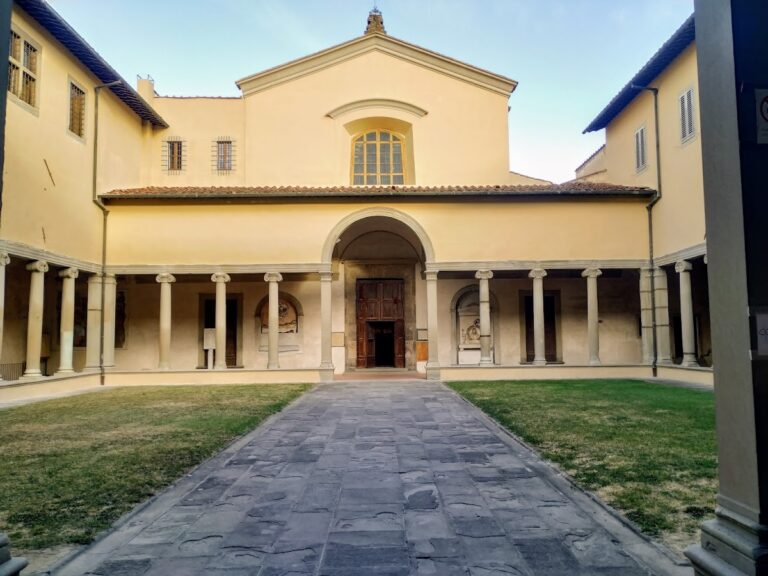
A court reached from number 8 leads to the Sant’Ambrogio nursery school and to green spaces occupying part of the former Benedictine monastery. The court contains a fifteenth-century-style terracotta relief of the Madonna and Child and a marker recording the particularly high level reached by floodwaters on 4 November 1966.
Historic regulatory plaques
Two stone plaques on the church flank, now illegible but known through earlier transcriptions, recorded Florentine regulations of 1622 and 1667. They prohibited prostitutes and women described in the regulations as being of “bad life or reputation” from living along Via dei Pilastri beside the Sant’Ambrogio and Candeli convents. The regulations imposed a fine of 200 lire and, under an earlier law of 1461, additional penalties.